Sometimes, limitations like mine may make one feel like they have nowhere to go, almost containing them within unbreakable walls of helplessness. But, if we look broader, we realize that most walls have windows too.
As a part of our “Unstoppable” series, I had the pleasure of interviewing Dr. Raman K Attri.
Dr. Raman K Attri, a powerhouse of positivity, has survived the odds and hardships of his permanent physical disability since childhood with his strong philosophy. The way he has turned around his disability into desirability, adversities into advantages, and limitations into leverages, continues to inspire many people. His immobility forced him to search for avenues to leverage the same lack. Over the four decades, he has rigorously experimented on various ways to learn faster. He transformed his inability to walk into role-model expertise as a performance scientist, with which he guides professionals and organizations to walk faster. Currently, he stands as a global authority on speed in professional learning and workforce performance. He is a training thought leader for a Fortune 500 corporation. He manages a Hall of Fame training organization, named one of the top 10 in the world.
He has earned two doctorates in the learning domain and over 100 international educational credentials. He is recognized with some of the world’s highest certifications in corporate management, business, leadership, consulting, and training. He authored 20 multi-genre books ranging from training, learning leadership to art and poetry. His writings and published work present deeper perspectives on the multidimensional aspects of human learning and excellence. A sought-after speaker, his keynotes on the speed of science are equally inspiring and actionable.
He established a research forum, XpertX, with a mission to guide people to learn the art and science of speed in learning and performance. He coaches professionals, managers, and leaders on how to accelerate the path to attain true excellence. Visit his website http://ramankattri.com to learn more about his work.
Thank you so much for doing this with us! It is really an honor. Our readers would love to get to know you a bit better. Can you share your “backstory” with us?
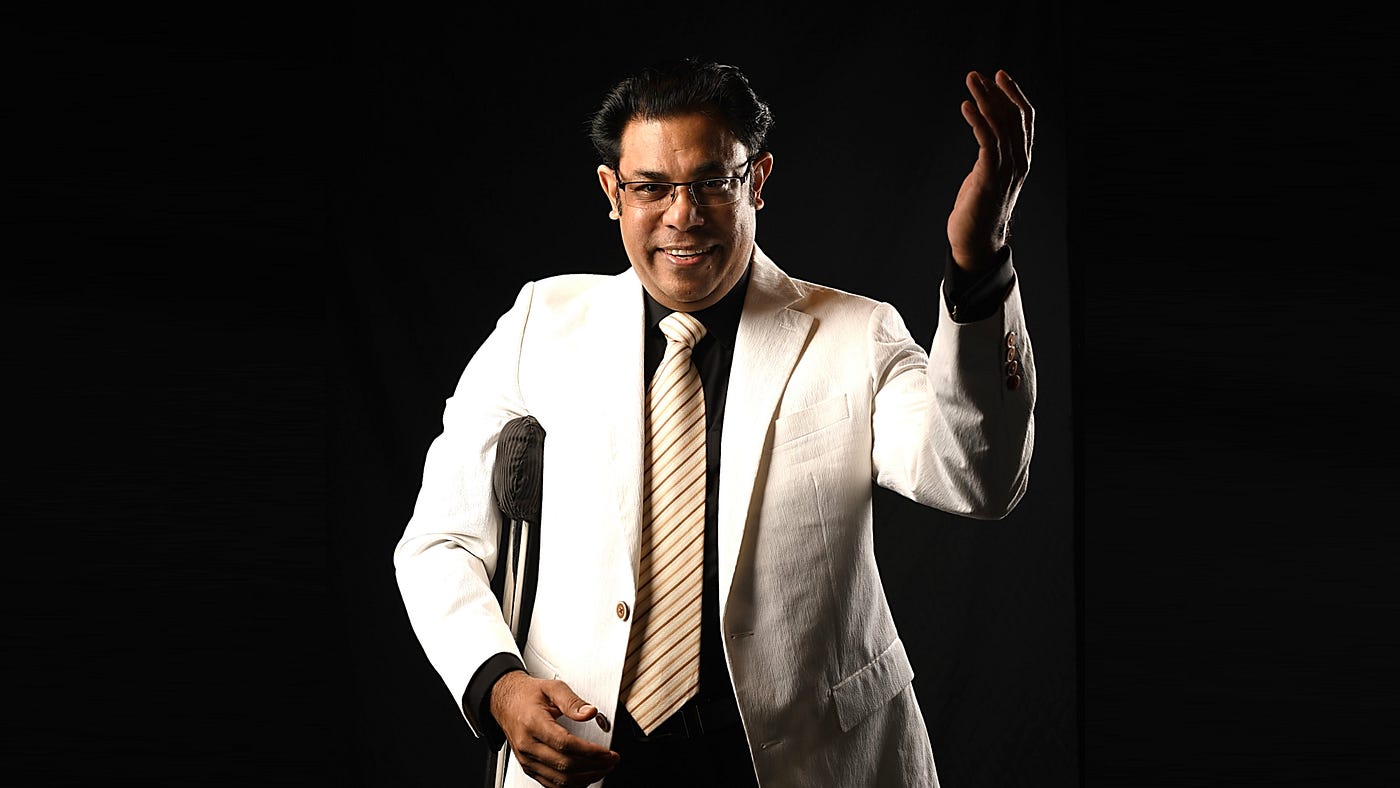
Well, my name is Raman, and I am currently living in Singapore. I was born and raised in India, in a small remote town. When I was six months old, I got infected with poliovirus, leaving my one leg paralyzed. It took away my ability to walk. At present, I’m using crutches to balance myself as I walk.
While my journey has been full of struggles, I had no choice other than coming back stronger than before. From my childhood days, I had this feeling that I have to leverage my disability somehow to move forward in life. Thus, I utilized any opportunity my limitation offered me to grow into a global authority in the learning and performance domain, earning 100 international credentials and authoring over 20 books.
You may hear disabled people say it very often, but I must say that my disability is what truly defines who I was yesterday, who I am today, and what I am meant to be tomorrow.
Do you feel comfortable sharing with us the story surrounding how you became disabled or became ill? What mental shift did you make to not let that “stop you”?
I was born in a remote part of India under unpleasant conditions, where there was a lack of medical and educational facilities. Amidst those conditions, the endemic of poliovirus was at its worst around the globe and in India. It was deemed as one of the deadliest viruses on the planet. There was no cure once one is infected with it. Even after 100 years since its inception, it is not yet entirely eradicated. Millions around the globe died instantly because of the paralysis of the lungs. Some lucky ones who survived it got to live their lives with permanent paralysis of certain body parts, deformed limbs, deformed spine, and muscular challenges. Several decades later, the survivors would face post-polio syndromes that could lead to a total collapse of the body.
I am among those survivors who got infected with this virus when I was merely 6 months old. One of my legs got paralyzed, taking away my ability to walk much before I could even start walking. So as of now, I am permanently disabled for life.
Sometimes, surviving death does not mean life will be less terrifying. What was waiting for me next was just the beginning of tough challenges. Taking you back to my childhood, my parents did not know what had happened to me. Once they found out, they knocked on each door for help. The nearest hospital was around 20 kilometers away. They went from clinic to clinic, from one hospital to another, and even from one exorcist to the next.
Frankly, I thought I was born like that. The first 15 years of childhood have been no less than a Homosapien’s evolution as I learned to crawl, drag and partially walk with the help of walking aids. Back then, in my childhood days, all I could do was crawl on the floor or hold on to something to drag myself around. After that, I tried holding my leg and dragging myself, which distorted my spine for good. When I grew up a little, I had to wear iron-clad calipers with lots of braces, hooks, and straps to keep my legs straight in place. I almost looked like and walked like a primitive robot, as this prosthetic weighed more than my own weight as a kid. In my college years only, I could learn to walk with a cane or a crutch, which is my current mode of walking. Otherwise, I was probably meant to be wheelchair-ridden for life.
Under those conditions, playing with other healthy kids and building my social network was impossible for me. Some 40 years ago, schools were not located quite far away. So, in my teenage years, my parents worried that my condition would prevent me from going to college. Sometimes our relatives had concerns about me making a livelihood for myself. It was utterly saddening that the world around me, my friends, neighbors, even my parents sometimes, let me constantly feel inferior or at a disadvantage.
Eventually, I went to a school, which started a new chapter of downfalls for me. I started feeling bad when I wasn’t able to match my classmates’ swift strides while going to school. Often they left me behind. It used to take me several hours to reach home while painfully dragging my caliper-ridden leg along the way.
Those moments repeated many times. Those were the moments when I told myself that I would walk faster in something else if I could not walk physically.
MENTAL SHIFT
I can summarize the one thing that helped me overcome this trauma in one word — “WINDOWS.”
Sometimes, limitations like mine may make one feel like they have nowhere to go, almost containing them within unbreakable walls of helplessness. But, if we look broader, we realize that most walls have windows too.
For several years, I lived inside those made-up walls. A large part of my early childhood had gone by me, hoping to break the walls I felt. My first instinct was to walk normally like other kids, be a part of that circle, and take part in everyday activities as much as possible. I wanted to play sports as the other kids did. I tried hard to break that wall, but there was hardly anything I could do about, but there was hardly anything I could do about it. While they used to play all day long, I was glued to a chair, watching them play and feeling bad about it.
Until one day, I realized that because of my immobility, I actually had plenty of distraction-free, unobstructed, disturbance-free time, which other kids could not even dream of. I saw that as my leverage, which others did not have. That leverage helped me to immerse myself enough in the world of learning and start reading books, as it demanded little mobility. I could sit and read for many hours non-stop. I read anything and everything I could put my hand on. I remember the first book I read was by Dale Carnegie, which was so uncommon for a kid to read at that age. Soon, I mastered poetry, palmistry, astronomy, physics, science, and other topics.
It was sort of my race with myself to self-assure that I was better than others. And of course, somewhere in the back of my mind was my zest to prove to the others that I was faster in learning a range of things than them.
However, that exact mental shift soon encouraged me to conduct a range of experiments on different ways to learn effectively and quickly. Eventually, I became a learning scientist, a researcher, and a global learning leader. I attained over 100 credentials, 20 books, two doctorates, and many more things like that in a short span of time without becoming insane or growing a long beard!
Well, that’s how I overcame my adversities.
Can you tell our readers about the accomplishments you have been able to make despite your disability or illness?
Despite my disability, I have been fortunate that I could make a mark in few areas.
Though I was at risk of getting any education, I ended up earning over 100 international and educational credentials, including 2 doctorates, 3 masters degrees, several PGDs, diplomas, and certifications. This includes some of the world’s highest certified designations, such as Certified Project Director and Certified Quality Director, to name a few.
Though we too poor to afford to buy the books I wanted, I have authored over 20 multi-genre books, and 20 more are in progress.
Though learning was just my interest and passion in childhood, it became my full-time profession as well. Currently, I am a senior training leader at a Fortune 500 technology corporation. In addition, I manage a Hall of Fame training organization, which is also named one of the top 10 in the world.
In high school, I had the idea to be a scientist someday. So, becoming an engineer was my best bet at that. Though people ruled out the possibility of it due to my condition, I became an engineer at 20. A year later, I was hired as a technology scientist for a premier national research laboratory.
Later, I switched to my passion, pursued research as a performance scientist, and earned two doctorates in learning and performance. Now, I stand as a global authority specializing in speeding up professional expertise. Though I still cannot walk, I teach organizations and professionals about walking faster in whatever they do.
Apart from these modest achievements, I am fortunate to have traveled worldwide solo and unassisted despite having walking difficulties.
Disability is not the end of the world. Sometimes, it might be the beginning of something.
What advice would you give to other people who have disabilities or limitations?
I would like to give five pieces of advice to people with disabilities. These are probably applicable not only to people with actual physical disabilities but also to those with perceived disabilities which they have formed in their minds.
- Strive for true acceptance, not compromises about the walls that hold you back.
No matter the crisis or its after-effects, we must accept the limitations imposed by our crisis wholeheartedly. Unless we accept, we cannot move forward. I realize that true acceptance is very difficult, as it takes a long time and it comes slow. I understood that there are three indications that you have attained true acceptance. One, when you assume your disability as part of you, that defines you. Two, when you feel the strong self-belief that it will not stop you, rather it will push you forward. Three, when you think of it as your differentiator over others.
I lived in self-denial for years. I hated myself when I looked at myself in the mirror. I tricked myself by saying “I tried my best; now this is the way it is. I accept it” but still kept sulking over it. It’s not true acceptance, it’s a compromise. One day I understood that my disability is an inseparable part of my personality. From that moment onwards, my life changed for good as I was ready to move on and make the best use of my disability. True acceptance gives us that strength when you take it as part of your personality.
When I got that self-belief, I began to leverage my immobility. Instead, I used it to learn many things without any distractions. It was not there to limit me but to push me forward. True acceptance gives you that strong self-belief that your crisis, adversity, challenge, or limitation is not there to restrict you.
I never mentioned my disability ever in any profile or resume. But the moment I recognized it as my x-factor, I got several amazing opportunities (such as an invite for a TEDx speech). True acceptance allows you to view your challenges, limitations, weaknesses, or disabilities as your unique selling point, differentiators or x-factors.
2. Not all walls are real; some are made-up in your mind.
When I watched other kids playing all day long, some voices inside me constantly told me that I was not good enough and would always be left behind. Eventually, I believed those self-talks and started labeling myself as a social reject. I went into my shell of sadness, introversion, and shyness. Result? I indeed became socially isolated because I believed it was real. On the surface, one may think my physical disability had triggered this social isolation. But the real culprit was emotionally, mentally, and psychologically telling myself victim stories of helplessness.
I figured that even if you have exceptional skills, achievements, and capabilities, these negative self-talks create much more damaging self-imposed limits, limiting self-beliefs or limited mindsets in no time. Those are things that pull you back, not your disability per se. The problem is that the real, physical limitations, like I could not walk, one can accept, sooner or later. But, more often, we don’t even know these perceived, unreal limitations are sabotaging us until it is too late.
I learned it the hard way that the walls of limitations that appear to restrict us or prevent us from doing something may not always be real. In most cases, those could be perceived or unreal. But the problem becomes worse when we take out that big hammer and invest all our energy trying to break down that wall. But we don’t spend enough time understanding the nature and composition of the wall. How do we win a war if we don’t know our opponent well? Perhaps the hammer is not right. Maybe we are breaking the wrong wall.
So, assess — What is really limiting you in any manner? Is it even real? Or just perceived in your mind? How are you reinforcing those negative self-beliefs or perceived limitations? And then think of breaking the correct wall, which is indeed is limiting you.
3. Determine what’s beyond the wall that you want so badly.
In 8th grade, I happened to read the biography of Isaac Newton — a highly regarded scientist. He was disabled, too. He suffered from stuttering, epilepsy, and autism. Despite that, he discovered the most foundational laws in physics. That day, I decided that I want to be a scientist. I saw that as a way to prove myself. At the age of 20, I went on to become an electronic engineer. And in less than a year later, I became a scientist. The real thing I wanted beyond that wall of my disability was people to know me either for “more” or for “differentiating” capabilities and not disabilities. That’s what motivated me to do “more” things, ultimately leading to a long list of credentials. If I look back and ask, did my immobility — a real limitation — come in the way of reaching that goal? The answer is no, it did not. Perhaps it helped me in a way. That’s how I learned that if you are clear about what’s on the other side of the wall you want, you would know if you need to overcome your limitation, if you really need to break that wall or if you just need to take route in which your limitation may not even matter.
Therefore, before dealing with the wall, an important question to answer is to find out what exactly is on the other side of the wall that you want so much and if it is worth seeking. If your walls are not preventing you from reaching where you want to go, then investing your energy trying to break it is a moot point. Once you are clear about it, you will find routes to reach there and may not necessarily break into the wall to go there.
4. If there are walls, there are windows too.
While watching the kids in my neighborhood playing all day long, I used to feel bad. But then I began to ask myself if there were things I could do better just because of lack of mobility, lack of social interactions, and confinement to my bedroom. Yeah, there were. I found that I could sit for hours non-stop. All that gave me plenty of time at my disposal, free of social distractions or other interruptions. Those were uncommon leverages for me as a kid. I immersed myself in reading and learning from whatever books I could find. I tried reading books on English, science, arts, psychology, philosophy, and even palmistry. There were no boundaries for me. I tried painting and arts with my healthy hands. Social isolation also gave me an unobstructed opportunity to daydream, imagine vividly, and think creatively. All of it developed me into an excellent writer while other kids were struggling to write essays.
The immobility that I was cursing so badly seemed like my thing now. A simple thought changed the course of my life — if I can’t walk or play, what else could I do? That question opened up my world of leverages that most people would ignore. I saw so many windows of opportunities, leverages, and advantages.
Our struggles become miserable only when we ignore to spot windows of opportunities that are opened up right amidst those walls in front of us. No matter how difficult the situation is, I believe there are always some leverages available to every one of us. With this simple shift, we would find that we don’t always have to break the walls. I believe windows could be right through them which could allow you to reach out to the world beyond and transform your adversities into advantages.
5. Seek clarity, not motivation or inspiration.
Momentarily charged with inspirational quotes, some of you might chase for that motivational ‘I can do it feeling,’ hoping it could get you out of the crisis or challenge you face. It is debatable as to how much motivation or inspiration can push forward. But the feeling of motivation or inspiration is short-lived. Instead, all you ever need is clarity — clarity about your limitations and your directions. Clarity is the new superpower. Once you have that clarity, you don’t need motivations, you don’t need inspirations, and you most definitely don’t need any superpowers. So, seek clarity.
I hope with the above tips, disabled people or those who have a feeling of being limited could see the world from a different perspective. You may watch this video for quick summary of these five things.
Can you share “5 things I wish people understood or knew about people with physical limitations” and why.
As I was growing up with a disability, I wish that parents, friends, teachers, peers, and people around me could understand me better. I would like to take this opportunity to debunk some misconceptions or inappropriate dealings towards persons with disabilities or physical limitations.
- Stop politicizing the word “disabled” — People call us with fancy words these days like differently-abled, specially-abled, or specials. None of those fancy words make us feel specially-abled or differently-abled. No other word can describe what “disabled” means. I come from an electronic engineering discipline in which if we turn off a function of a gadget, we call it technically disabled. It conveys the message accurately that it is no longer working. My leg does not work — that’s the hardcore reality. It is disabled. It is not specially-abled or differently-abled. My appeal to those surrounding any disabled person would be that if you don’t accept their disability realistically by calling it what it is, there is a good possibility that they would find it hard to accept it too.
- Acceptance comes hard and slow to disable people — For several years, somewhere deep inside me, I had not dealt with my disability completely, despite all the remarkable achievements. That’s perhaps why I did not post my picture ever with my walking crutch. But when I actually came to terms with it, it opened up a whole new world for me. So, if you happen to be around a disabled person, just know that acceptance will come to them eventually, just that it comes a bit slower. So, reserve your motivational talks or forward-looking encouragements to make them accept themselves sooner. While you might think of it as helping them, but it is not a help. When acceptance comes to them, you will find yourself sitting in the audience listening to them.
- Curb your idealistic expectations and be realistic — If you are in an unfortunate situation that your kid or friend is disabled, don’t force or try to teach them the ways to live and do things like normal kids. That will kill them from inside. Rather, teach them the art of slow acceptance and be realistic. Curb your tendencies to pick quotes to encourage your kids like “You are enough” “You are strong” “You can do anything”. Instead, tell them they might have some leverages over and above others which they can use. Perhaps, they have an uncanny sense of observation. Perhaps, they have superb skills at calculating something quickly. Or maybe they have developed any of their other senses by overusing that part. Point that out to them.
- The effects of most physical disabilities are not just physical — The visible physical limitations or disabilities are usually just the tip of the iceberg. There is a vast underwater iceberg of perceived limitations. Many physically disabled people have an inherent feeling of being less than others or emotion of not being good enough or feeling left behind or a feeling of not belonging or a feeling of not being valued enough. So, be sensitive to the fact that their biggest struggle could be with the invisible limitations. The positivity from disabled people comes with a lot of effort. Therefore, leverage their positivity because it is a hard-earned asset. When you go to talk about their disability, be aware of what might be behind the surface.
- Don’t make them objects of motivation or inspiration — While most disabled automatically become a source of inspiration for others, in reality, many of them don’t identify well with it. How could I be a source of inspiration or motivation when I struggle to perform some essential functions in my life? My limited choices do not make it motivating. You all have far more options. While a thought process ‘if a disabled person with limitations can do better, why can’t I do it better’ is good motivational thinking, it will take you only that far. Rather, seek clarity. See why they have such good clarity, where they get it from, and how they stay focused on it. Once you have that clarity, you don’t need any motivation or inspiration.
None of us are able to achieve success without some help along the way. Is there a particular person who you are grateful towards who helped get you to where you are?
When people support and coach you, you can progress much faster in your life. Unfortunately, I had little guidance or support from others within my proximity. That lack of support is why now I mentor and coach several people on a pro-bono basis worldwide.
However, in my journey, the most significant push has been given by my father. He worked hard to arrange for my expenses to study, afford books and go to an engineering college despite extreme poverty.
On top of that, I had been lucky to have some great friends; none of them ever made me feel any less. My best period has been with my friends, who took me places to scale small hills or even driving challenges.
How have you used your success to bring goodness to the world?
At this stage, I believe I do make some impact on the world in two ways.
First is my more profound research and experience to help corporate executives and organizations regarding how they can speed up the development of their employees. While it makes organizations more efficient and competitive, it contributes significantly to the well-being of their employees and society. Fundamentally, my work reorients executives to invest more in developing their employees. They achieve a sense of achievement and a sense of meaningful contribution faster and go back home much happier. How many families progress forward when that happens?
Secondly, I have conceptualized a movement and a forum called XpertX. I stand with a mission to teach people how to speed up the path to true excellence in all walks of life. I see many people struggling to learn faster because no one coaches them on speeding up their paths to success. My goal is to help people accelerate, not just their learning and expertise but also to help them attain excellence at an accelerated rate. My vision is to develop it as a learning portal for anyone to learn the art and science of learning. A place where they can learn the techniques to learn better and faster; where they can get some tested ways to be better performers at their workplace; where they can receive better self-clarity to speed up their path to excellence.
Can you please give us your favorite “Life Lesson Quote”?
Yeah, my favorite life lesson quote that I read in my childhood was, “Package the same idea differently and the result can be truly spectacular.” I am not sure who said it; perhaps it’s a generic anonymous quote. If you search the internet, it would probably associate this quote to my name because I often used it. But this is what my basic mantra is that I lived with throughout my journey. For instance, when I had an apparent lack of speed, I packaged that lack as my hunger to excel in the secrets of speed in personal and professional life.
We are very blessed that some of the biggest names in Business, VC funding, Sports, and Entertainment read this column. Is there a person in the world, or in the US whom you would love to have a private breakfast or lunch with, and why? He or she might just see this :-)
Yes, there are two people.
I would love to have a breakfast or lunch with and, if possible, to be on stage with the legend and the world’s number one motivational speaker, Les Brown. I have learned a few things from his powerful videos. Last year, I was fortunate enough to get some drops of his wisdom directly from him in a coaching program with him.
The second person is Jim Collins. I love the way he does his research systematically. The performance and learning scientist inside me can’t help but appreciate this legend. I would love to write a book like him someday. But if the opportunity strikes eventually to be in his proximity or have breakfast with him, I would be highly honored, indeed.
Thank you for these really excellent insights, and we greatly appreciate the time you spent with this. We wish you continued success.