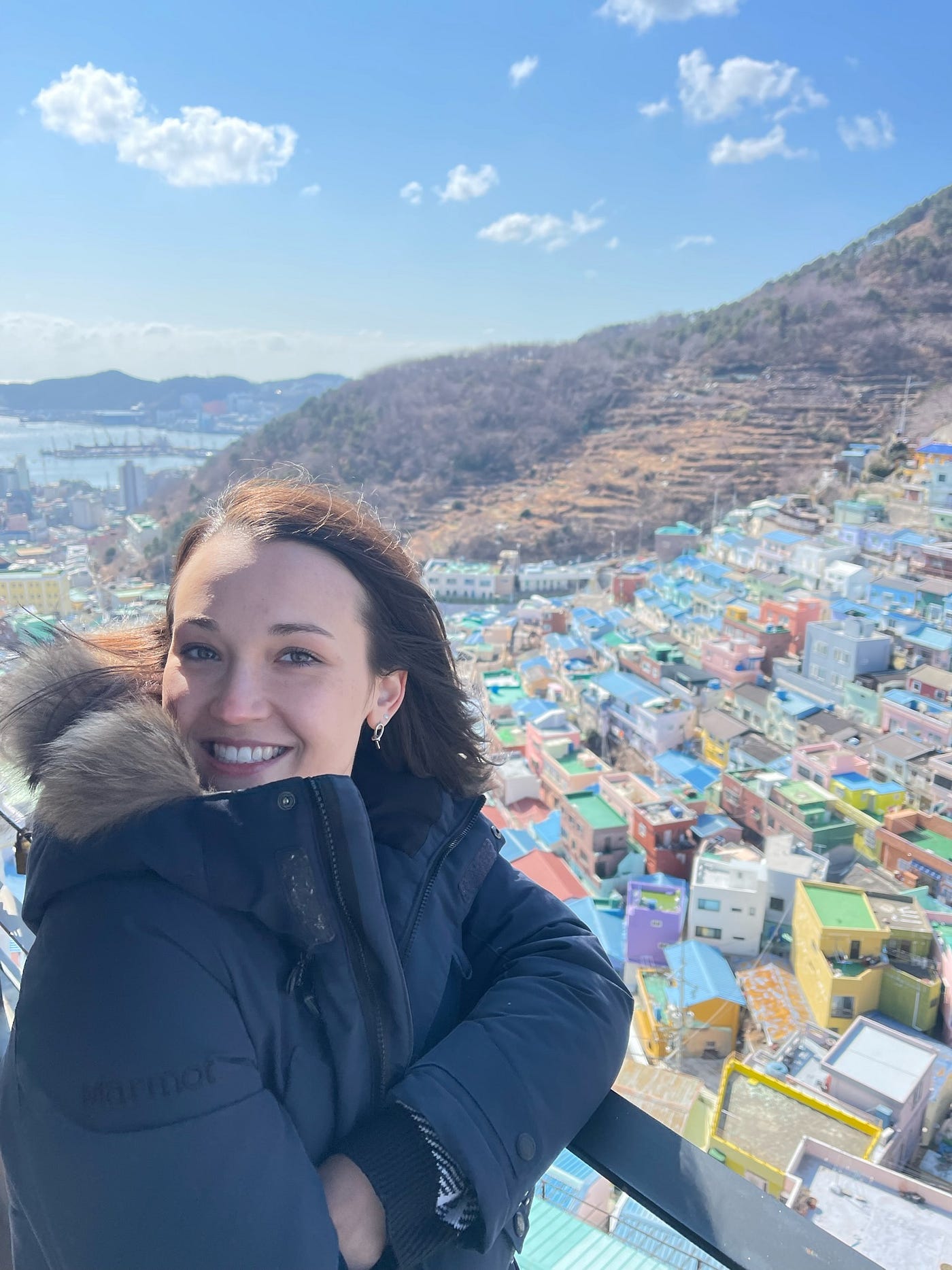
My origin story has its roots in Appalachia, where I was born and raised, and I feel so lucky to have been brought up with the Southeast Tennessee hills as my playground.
Thankfully, the world is open for travel once again. Traveling can broaden our horizons and make space for people to become more open-minded. How can travel give us the opportunity for personal growth? What are some ways that travel can help us become better human beings? As a part of our series about “How Traveling Can Help Us Become Better Human Beings”, I had the pleasure of interviewing Anna Luzader.
Anna Luzader is the founder of WhereTu, an international relocation services company dedicated to helping Americans build successful and sustainable lives abroad. She has lived and worked across three continents, completed six international relocations, and traveled to more than 30 countries, bringing a rare combination of personal experience and professional expertise to global relocation. She founded WhereTu to simplify international moves, blending strategic guidance with the understanding that relocation is never just about paperwork but a journey toward profound personal transformation.
Thank you so much for joining us in this interview series! Before we dive into the main focus of our interview, our readers would love to “get to know you” a bit better. Can you tell us a bit about your childhood backstory?
My origin story has its roots in Appalachia, where I was born and raised, and I feel so lucky to have been brought up with the Southeast Tennessee hills as my playground. I went to church every time the doors were open, and Dolly Parton was (and still is) my queen. So, by many accounts, a very typical small-town Tennessee childhood. And, yet from a young age, I felt a tug to leave it.
I loved learning about the world, different cultures, languages, foods — everything. Not too many of my third-grade classmates wanted to watch National Geographic documentaries about Amazonian tribes or begged their mom to buy them chopsticks, but I did.
I feel so fortunate that my family nurtured that curiosity. My father traveled often for work and always brought back treasures from his trips. I can remember tasting European chocolate for the first time and hearing him talk about the stunning architecture in Mexico. My mom was very intentional about exposing me to different places in the world through books, movies, and service opportunities. And the woods around my house provided the perfect space to grow my exploration skills.
As I got older, I had more opportunities to travel. My first overseas trip at 15 years old was to London with my high school’s band and choir programs. Imagine a bunch of kids and parents who have never been out of the country trying to navigate the Tube. That trip was certainly a comedy of errors, but I loved it. From there, I jumped on any opportunity I could to travel — Colombia, Ethiopia, Kenya. The travel bug didn’t just bite, it chomped down and locked its jaws, and I’ve been roaming ever since.
What or who inspired you to pursue your career? We’d love to hear the story.
Growing up, my family was deeply involved in international missions through our local church. That was incredibly formative, especially because I didn’t see many women traveling internationally, except for the missionaries that would speak to my Sunday school class. So I decided I would become one.
But, it didn’t exactly turn out that way. While I was in my second year of university, I decided to go on a semester-long trip to Kenya where I taught kindergarten, cooked in hospital kitchens, and worked with communities of internally displaced persons. It was the first time I got to really participate in life overseas, not just observe it on a week-long holiday, and I loved every bit of it. When I returned to the U.S., all I could think about was going back to Africa.
Then, after graduating from uni and co-founding my own nonprofit organization, I finally could return. But this time, I wasn’t heading to Kenya for three months, I was moving to Eswatini (formerly Swaziland) indefinitely. Though I had been there many times before, I had never packed all of my belongings into two 50-pound bags, boarded a one-way flight, and applied for a residency visa. So, like all children of the internet, I turned to Google to help me plan my journey. What I found was abysmal. There were a few missionary blogs and Peace Corps resources, but other than that, there was hardly any information about moving overseas. There certainly wasn’t a “how-to” manual or done-for-you service.
The resources simply weren’t there, and what WAS online was incredibly biased. I was looking for information on opening a bank account, getting a P.O. Box, securing housing, visa paperwork help, etc. Instead, I found heaps of content about poverty and Jesus. And coming from my very small-town-Tennessee, Southern Baptist background, I was definitely guilty of painting my own perceptions with that brush. But after building a life there, I realized just how big of a gap there was between the pictures painted by the media and what I was actually living. I figured out all the logistical pieces and daily rhythms, and my life in Eswatini became less about sexy fundraising stories for people back home, and more about calling Zodwa to ask if she was planning to make a batch of her delicious peanut butter this week. The friends I made and my experiences completely shifted my perspective, passions, and sense of purpose.
As it turns out, people all over the world share similar goals and aspirations for themselves and their children. They work hard to support their families, enjoy time with friends, and deal with mother-in-law drama, just like us. They inspired me to tell a different story of travel, and more specifically, life abroad.
Several years after moving to Eswatini, I decided to close that chapter and start a new one in Seoul, South Korea. Again, I had no other choice but to navigate the convoluted and conflicting information online about visa processes, life, and culture. At that point, I started sharing a bit more of my life online, and my inbox started to flood with DMs from people saying “I really want to move abroad but don’t know where to start.” I shared their frustrations because that was me in 2015, when I didn’t know who to ask. No one that I knew was DIY-ing their way across the world. So I created WhereTu to be the resource that I wish I had when researching and planning a move to another country — a starting point, a place to ask questions, a place to figure it out.
None of us can achieve success without some help along the way. Was there a particular person who you feel gave you the most help or encouragement to be who you are today? Can you share a story about that?
People from every chapter of my life have kept me on this path. There has been someone at every turn. First as I mentioned, my parents — who taught me about other countries from a young age.
Other people included my high school French teacher, who always encouraged me to ask questions and graciously answered all that I asked. Family, friends, and even strangers helped me fundraise for my first trips. My partner always supports my endless antics. But really, I am where I am today because of the women who made it possible.
I recently commemorated visiting my 30th country, Scotland. Fitting, since much of my family history traces back to this place. There, in Edinburgh, while looking up at the magnificent castle, all I could think about was the women I carry with me. My maternal grandmother, Nanny Ersa, a stunningly beautiful woman who had suffered more tragedy by age 30 than most do in their lifetime. My paternal grandmother, who passed away when I was young, and dedicated most of her life to taking care of her family and son with special needs. I think about my aunts, cousins, niece, friends, their daughters. And, I hold a special place for the women in KaLanga, Eswatini, and Licilo, Mozambique, raising entire villages — the hardest-working and most courageous women I’ve ever known.
I’m not sure if these women know how much they’ve shaped me. While some have cheered me on directly, others have given me courage by simply showing me how they live, especially when life has asked far too much of them. This is the place I always come back to when I’m scared to continue or try something new (which is basically every day). When I think of them, think of my life, and who I’m working to become, I hope I’m able to give them something to carry, too.
It has been said that sometimes our mistakes can be our greatest teachers. Can you share the funniest or most interesting mistake that occurred to you in the course of your career? What lesson or takeaway did you learn from that?
When I moved to Korea in 2019, I was going from cofounder (aka boss) to English teacher at a private English academy. Put very frankly, I went from a position where I called the shots to one where they wouldn’t even let me keep my name because they had too many Annas and Anna-adjacent staff. There was no training, and I didn’t know a single thing about Korean workplace hierarchy.
Within a few months of starting that job, a HUGE scandal broke when it was uncovered that the staff in charge of the foreign teachers’ documents was using our passports and visas to essentially commit fraud. Even more astonishing, I was one of the people who helped unravel the whole scheme.
After the scandal broke, the owner of the school asked to meet with me. I was so nervous, but kept telling myself that I had nothing to hide. Just tell the truth. Just be yourself. It will all be okay.
I presented her with my documentation and an outline of what I wanted to discuss, feeling pretty chuffed about what I’d uncovered. The owner started off the meeting, asked me a few questions, and then I launched into what I had prepared. She pursed her lips together, nodded, and the room immediately turned cold. I couldn’t understand what had contributed to such a sharp shift in the atmosphere.
Later, I told a Korean friend about the meeting and her face turned white. “You said WHAT to her? And she’s the owner of the business? AND you still have a job?” I was confused. From my perspective, I had done what was right and virtuous — showing up to a meeting and telling the truth even when it was hard. But as it turns out, that’s not at all what I should have done. And by doing so, I was not only making a fool out of myself, but showing the owner that I thought she was completely incapable of doing her job.
That day, I learned two things. First, I should learn how to read the room. And second, that cultural competence is REALLY important.
Can you share your favorite “Life Lesson Quote”? Why does that resonate with you so much?
Remember when I said Dolly Parton is and will forever be my queen? I really meant that. So naturally, one of my favorite “Life Lesson Quotes” comes from her.
In her commencement address at the University of Tennessee in 2009, she said, “Be careful, do not confuse dreams with wishes. There is a difference. Dreams are where you visualize yourself being successful at what’s important to you to accomplish… Wishes are hoping good things will happen to you.”
This quote reminds me that nothing happens by accident, and even “overnight success stories” aren’t really overnight. Action always produces results.
What are some of the most interesting or exciting projects you are working on now? How do you think that might help people?
WhereTu was launched at a time when Americans moving abroad and wanting to move abroad is at an all-time high, which is SO exciting! Through working with clients, I’ve learned more about what Americans moving abroad actually need and the specific challenges they’re navigating right now. Life and technology are moving faster than ever, and my clients bring unique questions I haven’t always thought of, which pushes me to keep evolving so I can better serve them.
I’ve moved enough times to know how much energy it takes to figure everything out, and my number one priority is making that process easier for others. But I’m really proud of all we’ve been able to accomplish so far because I want everyone who has the desire to move abroad to have the resources to do so confidently and not feel alone in the process.
OK, thank you for all of that. Let’s now shift to the core focus of our interview about travel and personal growth. Let’s dive deeper into these together. Based on your research or personal experience, why do you think travel can lead to personal growth? Can you share a story?
Travel has a way of showing us how much we don’t know. Sometimes, that’s really uncomfortable, especially when you realize how strong your assumptions were about a place you’ve never even been.
That’s what happened when I first went to Kenya in 2010 with a very stereotypical, Lion King idea of Africa. I imagined people living in huts with little access to the outside world, which was only half true. I found myself in Maasai Mara visiting the hut of an older woman. She had stretched earlobes and was beautifully adorned with beaded jewelry. She was serving us fresh goat milk when her cell phone rang. As she talked, our interpreter started to giggle. Apparently, it was a family member in the city asking for her to send him money. She sent it right away through M-Pesa. I had never seen anyone transfer money like that through a cell phone. It was clear that I was the one who had some catching up to do.
That moment really made me realize that we have so much common ground. I’d made assumptions about her life based on how she looked and where she lived. But then her phone rang, and the assumption I had built crumbled. What I thought to be true actually wasn’t, and since that disappeared, I could now replace it with a more accurate story.
Travel has given me a lot of those moments, enough that I now try to move through life with the understanding that I’m probably wrong about most things. It keeps me curious and gives me room to change, which are things that I think many of us value. Once you’ve changed your mind about something you were so sure of, you start wondering what else you might be able to see differently, including yourself.
A recent survey from Psychology Today showed that over 80% of participants found that travel helped them with problem-solving or decision-making. Why do you think this is true for so many people?
When you’re making 1000 rapid-fire decisions at every turn in a new environment, you can’t really put your life on autopilot, you have to be a willing participant. You have to make decisions with intentionality, even when you’d very much like someone else to figure out the train tickets and handle your luggage, for the love.
I think travel also loosens your grip on the idea that there’s one right decision or one right answer. We spend so much time worrying about making the wrong choice, but when you travel, you get to practice choosing with the information you have and making tweaks as you go. In my opinion, travel is the best exposure therapy for black-and-white thinking. It’s not so much this is THE right decision, but this is one of MANY right decisions.
That builds confidence. When you travel somewhere you’ve never been before and somehow survive, it really does make you feel like you can do anything. Those experiences stay with you, so the next time you face a problem, you have evidence that you can handle being a little lost and still find your way. This will not ruin your life. It will all be okay.
Do you think travel enhances our mindfulness, optimism, or sense of gratitude? How? Can you please explain with an example or story?
I was recently at a “Dinner Around the World” type of event in Honolulu where dignitaries from the Asia Pacific region were sharing their food and culture. And let me tell you, it was a PARTY. We ate and drank and danced for hours. As I was leaving, a friend said to me, “THIS is what the world looks like, not what we’re shown.”
She’s absolutely right. When you meet people you never thought you’d meet and experience parts of the world you never thought you’d see, that’s such a gift. I feel like it’s hard to come away from those moments without a heightened sense of gratitude.
Additionally, travel wakes us up. We live much of our lives on autopilot, but when we travel, we have the opportunity to be more present and attuned to what’s happening in the moment. We don’t rush through our meals, we plan them, analyze them, savor them. We don’t space out on the morning commute, we look out windows and compare notes. This definitely helps enhance our mindfulness.
Surely not everyone who travels automatically becomes an exemplar of human decency. What are a few reasons why some people completely miss out on the growth opportunities that travel can offer?
I think scarcity has a lot to do with it. Speaking from an American perspective, a lot of us travel with limited PTO and money we’ve spent months saving. There’s enormous pressure to make the trip worth it. You have seven days to have the time of your life, and you better come home relaxed, cultured, and with great pictures. No pressure.
Travel becomes another thing we feel like we have to achieve, so we try to squeeze every last drop out of it. When that’s our goal, it’s easy to get so focused on getting what we came for that we completely miss what’s happening around us. The people who live where we travel become part of an experience we paid for instead of fellow humans we share this Earth with. We get frustrated when things work differently or when a place doesn’t match our expectations.
For travel to change you, you have to be open to an exchange. You’re entering a place where people have full lives that have nothing to do with you or your vacation. There’s so much you can learn by paying attention, asking questions, and allowing an experience to surprise you. But you have to leave room for that. It’s hard to come away with a new perspective if you spend the whole trip fully committed to the one you arrived with. Instead, ask yourself: What can I learn? How can I grow? What do I want to always remember? And let those answers change you.
What are your “5 Habits You Should Develop In Order Make Travel Into An Opportunity For Personal Growth?” (Please share a story or example for each.)
1. Leave your hotel/resort.
Once upon a flight from San Juan, Puerto Rico to Atlanta, my neighbor and I started chatting about our trips. I shared about how much I loved the food stalls and the brightly colored buildings, and she only talked about her resort. As it turns out, she never once left the property during her whole trip.
As an anxious girlie I totally get how stressful travel can be. But in my experience, what I gain from exploration has always far outweighed any temporary discomfort I’ve felt. Do an activity you wouldn’t normally do. Find a unique group tour. Go somewhere people are just going about their day (I’m a big fan of grocery stores and markets). Watching how people move through life, what they buy, and how they interact, can show you so much about a place that you wouldn’t have seen otherwise. THIS is where the growth happens.
2. Make room for exploration.
Give yourself some time without an itinerary. The way I work this is by planning one big something per day and then filling in the rest as I go. For example, this past spring, my partner and I were in Italy for a wedding. On one of the days, we used our blank space to take a little drive with nowhere in particular in mind, and ended up at the most stunning lakeside cafe, sipping spritzes and eating panini. It was so dreamy, but we would have never stumbled upon that experience otherwise.
It’s crucial to let go of the temptation to fill every second of every hour on your itinerary and just let yourself discover. Spot an interesting street? Wander through it. Spend an hour talking to someone. Find meetups you can join. Obviously, keep safety as the first priority while doing all of this. But some of the best travel experiences I’ve had have taken place in the blank space between planned activities.
3. Micro-dose discomfort.
The trope is true: growth exists outside of our comfort zone, and we have to be intentional about meeting it there. But, this doesn’t mean that we have to go from zero to 100. Discomfort is not the same thing as recklessness. Try ordering a food you’ve never heard of before, or go on a solo adventure. Give yourself small opportunities to feel unsure and work through it. Those little experiences are what build the confidence you take home.
4. Take notes.
I never take enough pictures. Ever. And I’m always wishing that I took more. But what I *do* always have with me are notes. As I explore a new neighborhood, I write down the thoughts running through my mind, any ideas I’ve had, or any memories that stick out to me. For example, I’m in Seoul right now and decided to have a solo lunch at one of my favorite restaurants. When I sat down, I immediately recognized the song playing as one of my favorites by a small indie artist my hometown friend dated in college. It truly is a small world, and surprise joys are waiting for us everywhere.
5. Intentionally set your mental compass.
This is a big one. One thing that I used to tell the volunteer teams that would spend time with my nonprofit in Eswatini and Mozambique was that nothing was weird. I would ask them to look around. More often than not, they were the “weird” ones.
Most of us judge cultures, places, and experiences by very strict standards, and when they clash with what we deem normal/acceptable, we’re quick to criticize. We so often get in our own way. In that regard, it’s important to orient yourself toward openness. Notice where you’re looking for things to appreciate or things to admonish. If your first reaction is “that’s weird,” get curious about “why” you think that and “why” people could do it that way. You might discover that your own ways and norms deserve some questioning, too.
From your experience, does travel have a negative impact on personal growth too? Is there a downside to travel?
I do think it can have a negative impact. I think it’s hard to re-enter the rat race that is part of American life after spending time enjoying relaxed siesta culture and affordable healthcare. Joking (mostly). Seeing other ways to live can make it harder to feel content with the life you come home to.
It can also really impact relationships. When you travel, you change, your priorities shift, and the people you love may struggle to understand those changes. There’s a loneliness in coming home to somewhere familiar and realizing you don’t quite fit it the way you used to.
We are very blessed that some of the biggest names in Business, VC funding, Sports, and Entertainment read this column. Is there a person in the world, or in the US, whom you would love to have a private breakfast or lunch with, and why? He or she might just see this, especially if we both tag them :-)
Elizabeth Gilbert. All day. I recognize a lot of my own story in her writing and feel like she’s a kindred spirit. I’d love to sit down and talk with her about building a life you recognize yourself in, especially when that looks so different to those around us. And honestly, I think we’d get on like a house on fire.
How can our readers further follow your work online?
You can connect with me me on social media platforms through my personal account, @expatanna and WhereTu’s account, @wheretu.abroad . And if that little “what if I lived somewhere else” thought keeps finding you, you can visit wheretu.com. :)
Thank you for these really excellent insights, and we greatly appreciate the time you spent on this. We wish you continued success.