I use an electric wheelchair and rely on a ventilator to breathe, so disability has been a constant part of my life for as long as I can remember. I’ve never known what it’s like to live without it.
As a part of our series about women who are shaking things up in their industry, we had the pleasure of interviewing Peri R. Finkelstein.
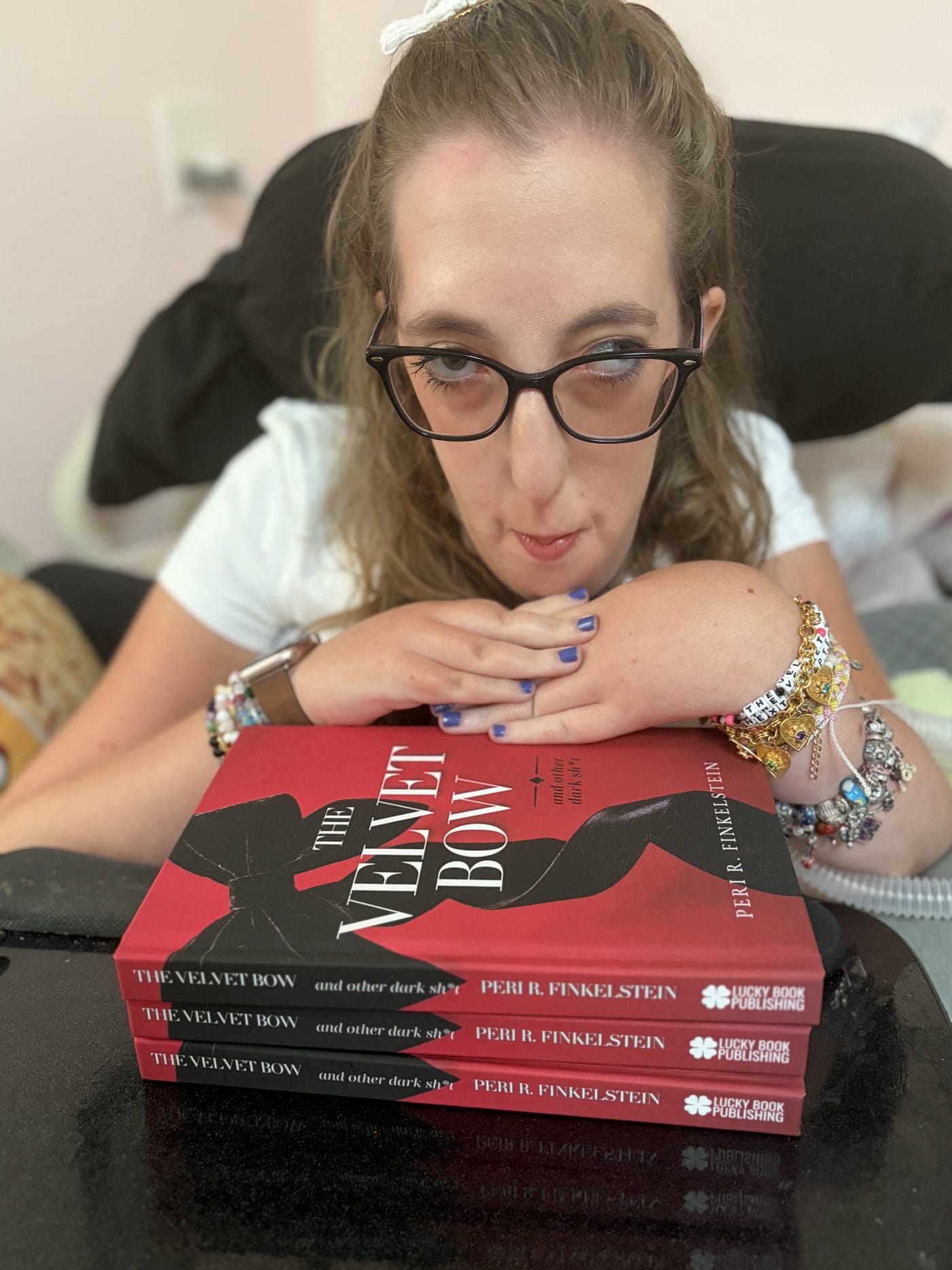
Peri R. Finkelstein is a Marketing Consultant, Digital Creator, Keynote Speaker, Founder/CEO of the Team Peri Foundation, a bestselling author, and has raised over $1M for charity. Peri was featured in Forbes in December 2022, holds a Bachelor of Science and an MBA from Adelphi University, Garden City, New York, is an Emmy Award Winner, and in 2025, she released her TEDx Talk titled “Always Wanting More & Stepping Out of Line”. In September 2026, she also debuted her memoir, The Velvet Bow (And Other Dark Sh*t), which became a bestseller.
Thank you so much for joining us in this interview series! Before we dig in, our readers would like to get to know you a bit more. Can you tell us a bit about your “backstory”? What led you to this particular career path?
I was born with a rare form of muscular dystrophy called Nemaline Rod Myopathy (NM), a condition that affects my muscles, nerves, and mobility. I use an electric wheelchair and rely on a ventilator to breathe, so disability has been a constant part of my life for as long as I can remember. I’ve never known what it’s like to live without it. Growing up, doctors’ offices, hospitals, and interactions with healthcare professionals were woven into my everyday life alongside school, home, and everything else. It was never something I thought of as unusual; it was simply my normal.
When you grow up with a diagnosis as severe as NM, questions about mortality inevitably become part of your life at a very young age. How much time do I have left? Am I afraid of death? What do I want to accomplish in my lifetime? These aren’t necessarily the kinds of questions most children are thinking about, but they were questions I found myself confronting early on.
Being born with NM put a lot of things into perspective and taught me that life is simply too short to wait around for the perfect moment. If I wanted to make a difference, create meaningful change, and leave my imprint on this world, I needed to start now. I couldn’t assume I had unlimited time to figure it all out. That sense of urgency, combined with my experiences with bullying throughout elementary, middle, and high school, eventually led me to decide, at just thirteen years old, that I would write a book of my own. I wanted to have a place to put the pain and trauma I had experienced, even though I had no idea what genre that book would eventually become.
Years later, that idea became The Velvet Bow (And Other Dark Sh*t), a bestselling memoir and, in many ways, a gift to my younger self, the girl whose self-esteem and sense of worth had been battered and bruised, and who sometimes wished the world would simply swallow her whole.
That’s ultimately why I wrote this book: for my younger self. I only wish a book like this had existed when I was going through those experiences. If I had been able to see someone put those feelings into words, maybe I would have felt a little less alone. So, more than anything, I hope The Velvet Bow helps others who have gone through similar experiences feel seen, understood, and a little less alone.
Can you tell our readers what it is about the work you’re doing that’s disruptive?
A couple of years ago, one of my very good friends gave me this gorgeous pink hat with a black velvet bow by Kate Spade. My friend and I have this annual tradition where we exchange gifts before Chanukah and Christmas, and then again around my birthday, which happens to be New Year’s Eve. The funny part is, at the time, my friend had absolutely no idea that I have a velvet phobia. So I opened this beautiful gift, and I remember thinking, “This is gorgeous…and I absolutely cannot wear it.” But I wasn’t disappointed. Instead, I was inspired. I knew almost immediately: “The title of my book is going to be The Velvet Bow.”
To me, the velvet bow became this perfect metaphor for life. Sometimes life hands you things you didn’t ask for. Sometimes people give you things you don’t necessarily want. Sometimes you find yourself dealing with circumstances that you never would have chosen for yourself. But they’re there, and you have to figure out what you’re going to do with them. That’s what the velvet bow represents to me: the unexpected thing, the uncomfortable thing, the thing you might not have chosen, but somehow becomes part of your story.
And then there was the subtitle. I was completely stumped about what to call the book after my publisher told me I needed one. I knew The Velvet Bow was right, but I couldn’t figure out what came next. Then my mom came up with And Other Dark Sh*t, and I was like, “Yes. That’s it.” Because the book isn’t just about the velvet bow metaphor. It’s about all of the dark sh*t I’ve gone through in my life, the bullying, the trauma, the challenges, the things that have hurt, shaped, and changed me, and, more importantly, what I’ve chosen to make of all of it. So the velvet bow is the unexpected thing life hands you, and the other dark sh*t is everything else that comes along with it. And honestly, I think that’s what makes the title so perfect for the book.
And I think that title is disruptive in and of itself. You don’t necessarily expect someone who has a disability, uses a wheelchair, and is small in stature to have a book called The Velvet Bow (And Other Dark Sh*t). It’s snarky, it’s funny, it’s sassy, and it challenges the assumptions people can make about what someone like me is supposed to be like. People have a certain image in their heads when they see me, and the title immediately disrupts that image.
I’ve actually seen the title have that effect. It can make bookstores uncomfortable enough to say, “No, we don’t want to feature this,” while other people see it and immediately think, “Oh, I want to read this.” And that reaction is part of what makes it disruptive. But the real disruption goes beyond the title. It’s what’s inside the book. The content itself can get a little racy. I’m not interested in presenting a sanitized or inspirational version of disability that makes other people feel comfortable. I’m telling the truth about the dark, messy, painful, funny, complicated parts of my life, and I’m doing it in my own voice. I think there’s power in that.
Can you share a story about the funniest mistake you made when you were first starting? Can you tell us what lesson you learned from that?
I had one experience during my undergraduate studies that determined my entire career path. And the worst part? I had a plan. A good one, too. I was going to be a lawyer who destroyed smug corporations that ruin the lives of people with disabilities. That was the dream. An MBA was my backup plan until a pre-law advisor at my university turned his office into a biological weapon. Thick, sweet, nauseating farts. And not a one-time offense, either. The nicest man, genuinely well-meaning, but that meeting single-handedly changed my career path.
I realized I didn’t want a future where smelly men were farting their way through my professional life. And just like that, the MBA became Plan A. I rolled out of that pre-law office with a clear sense of self and a sense of smell that was permanently damaged.
And that was that. That’s how I ended up getting my MBA. It was meant to be.
We all need a little help along the journey. Who have been some of your mentors? Can you share a story about how they made an impact?
In 2019, actor, writer, and comedian Alex Borstein delivered her now-iconic “Step Out of Line, Ladies” speech on the Emmy stage. When I heard it, I was inspired. I felt as though she was speaking directly to me, and it made me realize that while I had stepped out of line in little ways throughout my life, I really needed to commit to it. I just hadn’t figured out exactly what that would look like yet.
At the time, I never imagined that I would end up hosting a podcast in honor of Borstein’s grandmother, let alone create, produce, and edit one myself. I thought that would be a huge step outside my comfort zone. Little did I know, it was just the beginning.
After we connected through my podcast in 2022, Alex became one of my biggest cheerleaders and, over the years, a mentor to me in so many ways. She has encouraged me to trust my voice, take up space, and not be afraid to step outside the lines people have drawn for me. She has also been incredibly supportive of writing this book, and her mentorship has meant more to me than I can really put into words.
What started with me hearing her say “step out of line ladies” on an Emmy stage eventually turned into a real-life relationship with someone who has continued to remind me to do exactly that. In many ways, Borstein didn’t just inspire me to step out of line, she’s helped me become more comfortable residing always out of the lines.
In today’s parlance, being disruptive is usually a positive adjective. But is disrupting always good? When do we say the converse, that a system or structure has ‘withstood the test of time’? Can you articulate to our readers when disrupting an industry is positive, and when disrupting an industry is ‘not so positive’?
Can you share some examples of what you mean?
I think people sometimes use “disruptive” as though it automatically means difficult, rebellious, or even problematic. But when we talk about disrupting a system or social structure in a positive way, I think it means being willing to challenge something that has been accepted for too long simply because “that’s the way it’s always been done.” Positive disruption is proactive. It pushes people to question the status quo and consider whether the way things have always been done is actually the way they should continue.
That’s what I’m trying to do with my book and with my own life. I’m stepping outside the expected narrative of how a person with a disability, or significant medical challenges is supposed to be viewed. Too often, we are either treated as inspirational simply for existing or as objects of pity. There seems to be very little in between. I want to challenge that stereotype and show that disabled people are whole, complicated human beings who can be funny, angry, ambitious, messy, sarcastic, flawed, successful, and everything else that comes with being human. Stepping out of line, in that sense, is exactly what I believe disruption should be: challenging the status quo in order to make room for something better.
At the same time, I don’t think disruption is inherently positive. Disruption without purpose can simply create chaos or hurt people without actually changing anything for the better. For me, the difference comes down to intention and impact.
When I was a preteen, I traveled with a summer camp for two years while simultaneously raising thousands of dollars for a rival sleepaway camp that I was also very connected to at the time. I was good at fundraising, and they knew it. At the end of those two years, the travel camp told me that unless I started fundraising for them, I would be kicked out permanently and could never return.
I was 11 or 12 years old when I told them no. I refused to water down my integrity and moral values just to make the organization happy. I wasn’t going to stop supporting another camp simply because the board wanted my fundraising efforts for themselves. The entire board of the nonprofit ultimately voted against me, and I was no longer welcome there. So every summer after that, while my peers traveled around the United States and went on ski trips in the winter, I sat at home, alone, missing it deeply, as someone who loves to travel naturally would, but also knowing something the other campers and families didn’t: I knew exactly who that organization really was and what its values actually looked like.
There aren’t many camps that were willing to take kids like me, kids on ventilators with complex medical needs. They knew that. They knew exactly what they were doing, and they did it anyway.
Looking back, I think that was one of my earliest experiences with what it means to disrupt a system. I didn’t disrupt it just to be loud. I disrupted it by refusing to play by rules that I believed were fundamentally wrong. Sometimes positive disruption means being willing to lose your place at the table rather than compromise who you are to stay there.
Can you share 3 of the best words of advice you’ve gotten along your journey? Please give a story or example for each.
Each and every one of these pieces of advice came from podcast mentors of mine and close friends, all of whom played a role in empowering me to write my book. If it weren’t for them, I honestly don’t know if I ever would have started writing it, let alone written the vulnerable, very real version that I ultimately put out into the world.
1. Write the book, start now, be urgent about it.
This was exactly what I needed to hear because, for 26 years I had the idea of writing a book in my head, but I kept finding reasons not to start. I would tell myself I wasn’t ready, I didn’t have enough time, I wasn’t old enough, or I needed to accomplish something else first. Eve Rodsky, New York Times Best-Selling Author of Fair Play, basically gave me the push to stop overthinking it and just start. So I did. I started writing, and eventually those words became The Velvet Bow (And Other Dark Sh*t). Without that initial push, I honestly don’t know if I ever would have written it.
2. People want to hear about all of the dark sh*t.
Kimberly Elliott, Founder of The Be Like Josh Foundation & Disability Advocate, shared this advice. This one probably scared me the most because I was very much in my head about how vulnerable I wanted to be in my book. I questioned whether I should share certain stories, whether I was going too far, or if people really wanted to hear the ugly, messy, uncomfortable parts. Kimberly reminded me that people want the real stuff. They want the dark sh*t. They want the things that aren’t always pretty or wrapped up in a nice little bow. That gave me permission to stop sanitizing my story and write it as honestly as I could. And that’s what I wanted the book to be from the beginning, a real, vulnerable, and unsanitized version of my story.
3. Sometimes that last 5% of creativity makes 90% of the book happen.
Jason Halbert, Grammy and Emmy winning producer, and Best-selling co-author of The Goodpasture Chronicles, shared this. This one really stuck with me because there were definitely moments when I wanted to just be done. I had a deadline, I wanted the book published, and there were times when I thought, “Okay, this is good enough. Let’s get this thing out.” But Jason reminded me that sometimes that last little bit is where the magic happens. I didn’t want to rush the ending just to say I had finished the book. I wanted to finish the book that was actually meant to be. And if I am going to have to live with this book forever, I had to give myself the time, even when it was frustrating, even when I wanted to be done, and even when I was second-guessing myself.
Looking back, all three pieces of advice were exactly what I needed at different points in the process. Eve got me to start. Kimberly gave me permission to talk about the dark and messy sh*t. And Jason reminded me not to rush the creative process just because I was anxious to cross the finish line.
I truly don’t think The Velvet Bow (And Other Dark Sh*t) would be the book it is without them.
We are sure you aren’t done. How are you going to shake things up next?
I am far from done. In fact, I feel like I’m just getting started.
I plan on writing another three to four books, including a children’s book and a sequel to The Velvet Bow (And Other Dark Sh*t). I’ll also continue writing on my Substack, “Always Out of Line,” which is a collection of tales of wanderlust, the unvarnished truth, a sprinkle of dark humor, and a dash of sass and sarcasm. Basically, a little bit of everything, and never quite what you expect.
I also plan to continue expanding my nonprofit, the Team Peri Foundation, and its current initiative, The Peri Project, which creates self-care kits for caregivers of children in the Pediatric ICU. I believe it’s vital that we remember caregivers when talking about mental health and the overall patient-care experience. Caregivers are often so focused on caring for their loved ones that they forget to care for themselves. To date, we’ve donated more than 300 self-care kits to hospitals across Long Island and New York City, and we have plans to expand throughout the entire tri-state area. I want to keep growing this initiative and reaching the people who need that little reminder that they too matter.
And then there’s May 2027. I’m putting myself out there in a pretty big way by hosting a book signing and salon at a gallery in New York City to celebrate and promote my book, The Velvet Bow (And Other Dark Sh*t). I’m designing it as a mini soft-launch party and inviting everyone I know in the tri-state area, including my mentors. Now, here’s the funny part: I’m an introvert who absolutely hates being the center of attention. So putting myself, my book, and my work so publicly on display is a pretty big deal. But that’s also what stepping out of line is about. It’s about doing the things that scare you, putting yourself out there, and giving yourself permission to take up space.
So, what’s next? More books, bigger ideas, growing the foundation, and continuing to put myself out there. I’m not done disrupting, and I certainly don’t plan on playing it safe anytime soon. It’s time to step out of line until those lines cease to exist.
In your opinion, what are the biggest challenges faced by ‘women disruptors’ that aren’t typically faced by their male counterparts?
I think one of the biggest challenges women disruptors face is that the very qualities that can make a man a strong leader can make a woman a “bitch.”
If a woman in business demands respect, owns her power, and has earned her seat at the table, she can be labeled difficult, aggressive, intimidating, or even too emotional. Generally, those same qualities aren’t questioned in the same way when it’s a man. A man can walk into a room with confidence and authority without necessarily being asked to attest as to why he belongs there. As women, we often have to prove ourselves before we’re even given the chance to show what we are made of.
Women also have to be incredibly conscious of what they say, how they act, how they communicate, and even how they write. One wrong move, and suddenly you’re “too much,” “too aggressive,” or “too emotional.” In male-dominated industries, there can be this constant pressure to earn your place, step out of line, and prove that you deserve the seat you’re sitting in.
Now add a disability to the equation. As a disabled woman, I feel like I have two strikes against me before I even roll into the room. I have to be even more aware of how I present myself and what I say, because unfortunately, there are still people who make assumptions about what a person with a disability is capable of, including assumptions about their intelligence.
That’s one of the reasons I got my MBA. I wanted to give myself more credibility as a woman with a disability. In some ways, it became my suit of armor. It’s a credential that nobody can argue with when someone starts second-guessing whether I belong in the room or whether I’m intellectually capable following showing my business card. I shouldn’t have to prove that I have a working brain because I’m disabled. No woman should have to work three times as hard to be taken half as seriously. But until that changes, I’ll keep stepping out of line, challenging those assumptions, and proving that I belong exactly where I am.
Do you have a book/podcast/talk that’s had a deep impact on your thinking? Can you share a story with us?
I might be a little biased, but my podcast, “Team Peri Step Out of Line,” which has been six years in the making, is what changed my brain chemistry.
Before its creation in 2020, I was a pretty shy girl who was unsure of herself, her worth, and her place in the world. I was also a huge people pleaser (I still am around new people, but I’m getting better). I never imagined that starting a podcast would help me find my voice, become more confident in who I am, and ultimately change the direction of my life.
To date, we’ve interviewed more than 130 guests and counting. Along the way, this introvert has found her voice, stepped outside of her comfort zone, and gained some incredible mentors and friendships. And honestly, if it weren’t for my podcast, I never would have written my book.
One guest in particular, Mayim Bialik, is someone who had a much bigger impact on my life than I ever could have imagined. She was the 100th guest on my podcast in 2023. She later became the narrator behind my TEDx Talk, “Always Wanting More & Stepping Out of Line,” and she’s also featured on the back of my book with her advanced praise. Somehow, she became much more than a podcast guest. She became part of the story itself.
That’s what makes the podcast so meaningful to me. It started as something I created to give other people a platform to share their Step Out of Line stories, to be vulnerable without judgement, but along the way, it gave me one too. It helped me discover my voice, find my confidence, and realize that maybe I had a story worth telling.
You are a person of great influence. If you could inspire a movement that would bring the most amount of good to the most amount of people, what would that be? You never know what your idea can trigger. :-)
As I say in my book, “When life gets heavy, when hope feels distant, when you’re desperate for even the smallest lift, sometimes the answer is simple: put a bow on it.”
Sometimes you just need a pick-me-up. That little something that makes your day better, makes you smile, or gives you enough of a lift to keep going. It doesn’t have to actually be a bow. It could be a kind note, a compliment, a small surprise, a thoughtful gesture, or simply doing something that brings a little joy into someone’s day.
That’s what “Put a Bow on It” means to me. It’s about kindness. It’s about finding the little moments of joy, especially when life feels heavy. And it’s about being authentic and real, because you never know what someone else is carrying behind the scenes. We can’t always fix what’s happening around us. We can’t always change the cards we’ve been dealt. But we can choose to add a little sparkle. We can choose kindness. We can choose to make someone’s day just a little brighter.
So if I could inspire a movement, it would be simple: Put a bow on it. When life gets messy, add a little sparkle. When someone is struggling, give them a lift. When you have the chance to make someone smile, do it. You never know what that little bow might mean to someone.
Can you please give us your favorite “Life Lesson Quote”? Can you share how that was relevant to you in your life?
My great-uncle Maurice once said, “You might bend, but you won’t break.” He has since passed away, but whenever I think of this quote, I’m reminded of him.
When life feels overwhelming, when things feel like they’re falling apart and spiraling out of control, when life is extremely messy, and it feels like everything is either falling apart or crumbling at the seams, remember that you might bend, you might pivot, but you won’t break.
As someone who lives with a chronic illness and a physical disability, life is rarely going as planned. I’m constantly having to pivot, pick myself up from the broken pieces, and make do with the cards life has dealt me. That’s just how it’s always been. But my uncle’s words remind me that bending isn’t the same as breaking. Sometimes life forces you to change direction, adapt, and find a new way forward, and that’s okay. I may bend, but I won’t break.
How can our readers follow you online?
You can follow my personal journey on Instagram @peri.rhiannon, LinkedIn at Peri Finkelstein, and TikTok @team_peri_rox. I am also on Substack, and you can read it here!
This was very inspiring. Thank you so much for joining us!