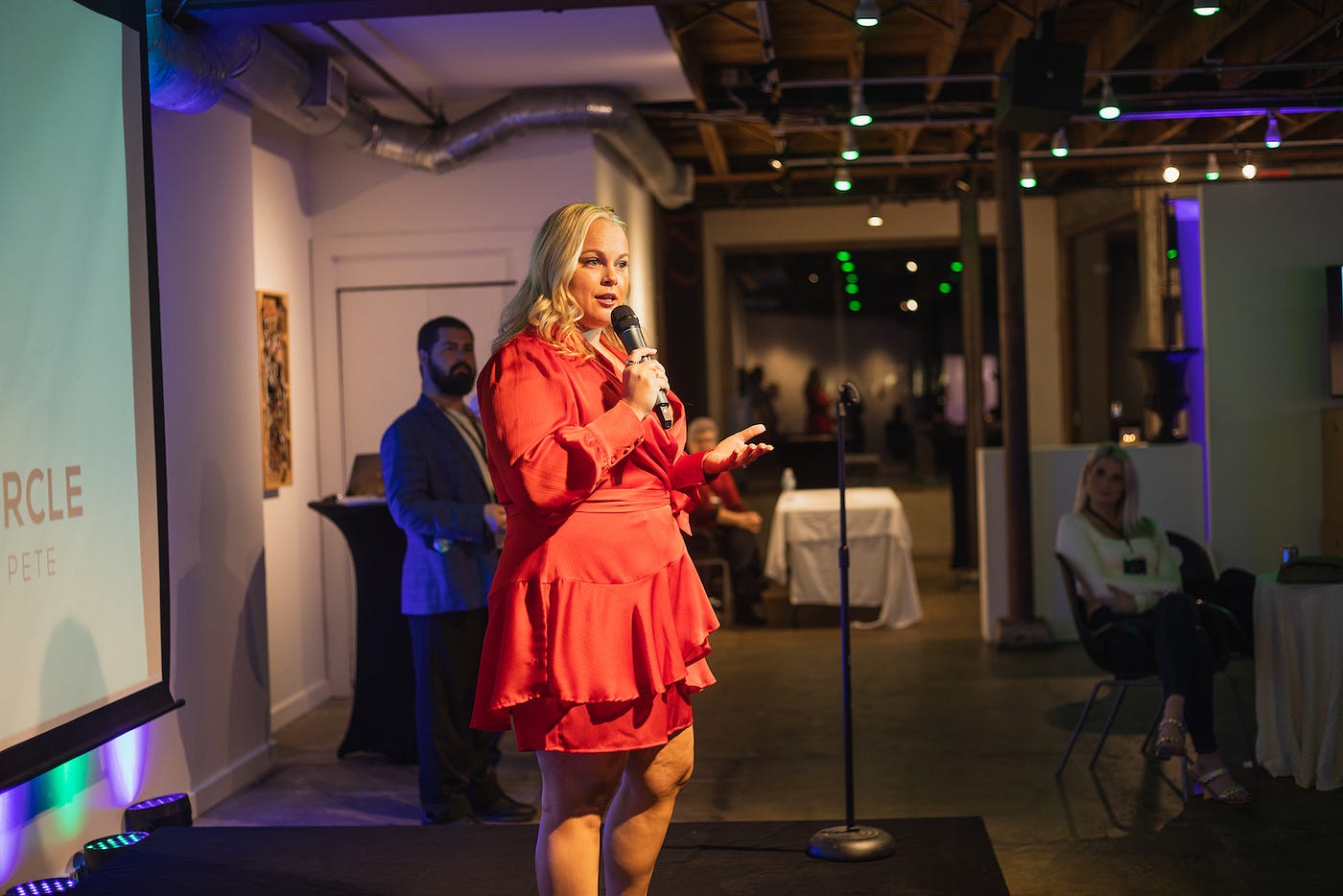
I’ve never been someone who loves working in an office. Events give me the flexibility to travel, work in the field, meet people, and bring ideas to life.
As a part of our series about the five things a business should do to create a Wow! customer experience, I had the pleasure of interviewing Danyelle Gray.
Danyelle Gray is co-founder and Chief Experience Officer of C.R.O.W.N. Experiential Group, a cultural experiences company creating spaces where women and people of color feel seen, heard, and celebrated. She spent more than a decade in experiential marketing, producing brand experiences for The Coca-Cola Company and leading experiential agencies. She also co-founded Womanish, the immersive exhibit that welcomed more than 150,000 guests in Chicago and Miami.
Thank you so much for joining us in this interview series! Our readers would love to “get to know you” a bit better. Can you tell us a bit about your ‘backstory’ and how you got started?
It’s actually a funny story. It all started in college at the University of Missouri, where I was studying management. I went to a fall fest looking for an organization to join, and I walked past a table for the Department of Student Activities. They told me they helped put on concerts and events for the school, and I thought, “That sounds fun.”
Then I joined, and they told me the best part: you get paid to work the events, and there’s a real budget to plan them. I remember thinking, wait, I get to plan events for school?
We brought artists like J. Cole, Big Sean, Jhené Aiko, and Kendrick Lamar to campus, and I got paid to work with them. I was hooked. I switched my degree to marketing, and I’ve been in events ever since.
After college, I dabbled in a lot of different corners of marketing. I did digital marketing at Viacom and worked with big brands like Coca-Cola. I tried field, direct mail, and digital, but I kept coming back to events.
There’s nothing like the payoff of standing in an experience you created and feeling the energy in the room. I’ve never been someone who loves working in an office. Events give me the flexibility to travel, work in the field, meet people, and bring ideas to life.
And now that I’m doing it for myself, it’s even better.
Can you share a story about the funniest mistake you made when you were first starting? Can you tell us what lessons or ‘take aways’ you learned from that?
My funniest early mistake? I forgot to proof something before it went to print. I sent the wrong file, and I didn’t notice until I was on site, with the event about to start and a box of very confidently printed, very incorrect materials staring back at me.
So I did what any calm, composed professional would do: I panicked, then went hunting for a print shop that could do a rush reprint. Picture me speed-walking around an unfamiliar area, phone in hand, asking strangers where the nearest printer was.
It worked out, but I aged a few years that day. The takeaway is simple: always double-check your proofs, and make sure what you’re printing is what you meant to print. Now it’s a non-negotiable on every project. Because it turns out “I’ll just glance at it” is not a proofing process.
None of us are able to achieve success without some help along the way. Is there a particular person who you are grateful towards who helped get you to where you are? Can you share a story?
The people I’m most grateful for are my parents. They’re both engineers and work in tech, so the events world was completely foreign to them. I didn’t know anyone in this industry either, and I was nervous about choosing it.
I was especially nervous to tell them. Like many parents, they had a few careers in mind for me: doctor, lawyer, engineer, IT. I knew events wasn’t on that list.
When I started telling them about the industry, they were genuinely curious. They wanted to know what a career in events even looks like, and whether it was a real career path. But they saw how much I loved it, and they were supportive from the start. They encouraged me to stick with it because they believed it was important to love what I do.
That support gave me the confidence to keep going, especially in the early days when I couldn’t point to a clear path. I’m not sure I’d have had the courage to chase it, or to start my own ventures later, without knowing they were behind me.
Thank you for that. Let’s now pivot to the main focus of our interview. This might be intuitive, but I think it’s helpful to specifically articulate it. In your words, can you share a few reasons why great customer service and a great customer experience is essential for success in business?
People will forget most of what happened at an event, but they never forget how it made them feel. Did the team greet them warmly? Was everyone helpful and fun? Did they leave feeling joyful? That feeling is what builds your reputation, and there are two big reasons it matters.
Great customer service matters because your people can make or break the experience. Imagine you paid to attend something, or even if it was free, and the staff were rude. It could be the most beautiful experience ever built, but you’d leave thinking it wasn’t a great event, no matter how much was spent creating it.
Great customer experience matters because it’s bigger than the staff. It’s the flow of the space, how long guests wait in line, and how easily they can find their way around. A lot of people think events are easy, like you just put a sign here and a table there. But every detail, from the guest journey to the wait times, adds up to whether the experience feels good or frustrating. That’s why thinking through the operations is so important.
That’s exactly what we’re focused on with Mrs. Claus’s Winter Wonderland. We want guests to leave with a feeling, and that means a friendly, bubbly, helpful team supported by thoughtful operations behind the scenes.
At the end of the day, people will always remember how you made them feel.
We have all had times either in a store, or online, when we’ve had a very poor experience as a customer or user. If the importance of a good customer experience is so intuitive, and apparent, where is the disconnect? How is it that so many companies do not make this a priority?
I think a lot of companies believe the product speaks for itself. If the product or the space is beautiful enough, they assume customers will be happy, and customer experience slides down the list.
But it doesn’t work that way. You can build a gorgeous retail store or an amazing product, and if people walk in and don’t feel welcome, or no one greets them warmly, it undermines everything you invested in.
The disconnect is that customer experience gets treated as a secondary task instead of a primary one. Companies focus on creating something beautiful, and the experience becomes a box to check later. In reality, the two go hand in hand. When you build a beautiful space, you have to build a beautiful experience to go with it.
A big part of that comes down to the people you hire. Your team is the face of your company. If you want customers to feel a certain way, you need people who represent your brand and deliver what you want guests to receive.
Do you think that more competition helps force companies to improve the customer experience they offer? Are there other external pressures that can force a company to improve the customer experience?
Absolutely, smart competition pushes companies to get better. I see it firsthand in experiential. When I see a brand do something amazing, I think, okay, we need to raise the bar.
As the industry evolves, customers expect more. They’ve seen incredible experiences and how thoughtful brands can be, so they can spot a lazy activation from a mile away. The more brands invest in great experiences, the higher everyone’s standard becomes.
Social media is another powerful external pressure. Customers talk, and the chatter online can shape how your brand is perceived. Complaints about long lines or a detail you forgot to plan for can drown out an otherwise great activation.
I don’t see competition in this industry as cutthroat, though. I see it as sharpening iron. We inspire each other, and I rarely see people copying. Instead, we build on what others are doing and push the work further. I’ve been inspired by plenty of other brands, and I hope others get inspired by ours.
That pressure is a good thing. It keeps us focused on creating a great customer experience every time.
Can you share with us a story from your experience about a customer who was “Wowed” by the experience you provided?
The experience that stands out most is when we opened Womanish. I was there every day for the first couple of weeks, standing at the exits and watching people’s reactions in real time.
Guests were wowed by the level of detail. Every artist we featured were women artists, and each installation took on an issue affecting women, like the pink tax, the gender pay gap, and the idea that self-care isn’t selfish. We wanted to take heavy topics and make them creative.
Here’s one example. In the pink tax room, we hung a really big receipt comparing products side by side: a pink razor next to a blue one, pink deodorant next to blue. People would walk out and say, “Wow, I never realized we’re charged more for being a woman.” Other pieces explored the censorship of women’s bodies, and I kept hearing, “I never thought about it like that,” and “Thank you for articulating this so creatively.”
The space itself mattered just as much. It was bright, colorful, warm, and welcoming, a complete contrast to everything going on outside at the time. Guests told us it helped them forget, even for a little while the craziness going on outside, and that they felt seen, heard, and celebrated.
That’s when I knew it had worked. I never wanted Womanish to be just another selfie experience. I wanted people to leave with something, and they did, and not just Instagrammable moments. It was amazing seeing something I dreamed up truly resonate with the intended audience.
Did that Wow! experience have any long-term ripple effects? Can you share the story?
It absolutely did. When we first opened Womanish, we were only supposed to be open for 30 days. We ended up staying open for almost two years, and we were sold out for months.
That’s the ripple effect. One guest’s wow turned into many more. People shared the experience with their friends, brought them back, and talked about it online. Partnerships and brand deals grew out of it too.
None of that happens unless people feel connected to the experience. If guests hadn’t felt we’d created something amazing, we would have closed after 30 days. Instead, the wow experiences kept compounding, and a 30-day experience became a nearly two-year run.

Ok, here is the main question of our discussion. Based on your experience and success, what are the five most important things a business leader should know in order to create a Wow! Customer Experience. Please share a story or an example for each.
- Start with a great concept. Everything begins with a great idea. Before you think about decor or logistics, ask yourself what story you’re telling and why it matters. For us, with Mrs. Claus’s Winter Wonderland, we asked: what about the women of winter? We all know Santa and Jack Frost, but we never hear about the women beside them. That one question shaped everything that came after.
2. Design it to match the concept. Your design should feel beautiful and artistic, and it should bring the idea to life so guests can feel the story before anyone explains it. For our new experience, that meant a space that feels wintry and magical, with fun pops of color so it feels like a true wonderland.
3. Map a smooth attendee journey. Walk through the experience the way a guest would, from the moment they arrive to the moment they leave. Think about check-in, how lines move, and how each part of the space connects. In any experience, we are thinking through how guests enter and exit and how each experience fits into the flow, so everything feels effortless.
4. Decide what guests walk away with. Be intentional about it. Is it a gift, a feeling, an idea? For us, we want guests to leave feeling that there’s still a little magic in the world, like they stepped into a new story and got to know the women of the North a bit better.
5. Put the right people on site. Your team is the heart of the experience. If you want it to feel magical, welcoming, or joyful, hire people who naturally carry that energy. A friendly, bubbly team can make a guest feel like they belong the second they walk in.
Are there a few things that can be done so that when a customer or client has a Wow! experience, they inspire others to reach out to you as well?
Yes, and the simplest thing is to make sharing easy and natural.
Encourage guests to capture the moment. A gentle reminder to post, share, and tag their friends goes a long way. Signage, a branded hashtag, or a note in the pre-visit email can all prompt it without feeling pushy.
Let your team help. Staff can offer, “Want me to take a picture of you?” It’s a small gesture that feels welcoming, and it gets guests photos they’ll actually love, which they’ll want to post.
Build moments worth sharing. People naturally want to share an experience that made them feel something. When guests leave with great photos and good memories, the sharing happens on its own, and that’s what inspires others to reach out.
You are a person of great influence. If you could start a movement that would bring the most amount of good to the most amount of people, what would that be? You never know what your idea can trigger. :-)
The movement I’d love to see accelerate is the creation of third spaces: places that aren’t home and aren’t work, where people can connect in real life.
They’re already happening, and I’d love to see them grow faster. We have to get off our phones and back into the community. That’s how we understand each other’s different views and have real conversations. Not everyone can live online, trolling and talking past each other, and that kind of separation is a big part of how we got to a loneliness epidemic. We keep hearing that younger generations are the loneliest ever, and so much of their time is spent on screens.
That’s what I’m working on through experiences: bringing people together in real life. It’s how conversations start and how community gets built. If I could start one movement, it would be getting more people into the same room.
How can our readers follow you on social media?
@itsdanyelleg.chi
This was very inspiring. Thank you so much for joining us!
You’re welcome, thanks so much for having me!
About The Interviewer: Tavares Beverly is the Founder and CEO of Beverly Boy Productions, a national video production company that has helped organizations tell their stories through video for more than two decades. Over the course of his career, he has worked with everyone from Fortune 500 executives and healthcare professionals to politicians, nonprofit leaders, educators, and artists, gaining a unique perspective on the role communication plays in leadership, business, and human connection. A frequent contributor on topics including communication, entrepreneurship, leadership, and personal development, Tavares believes that the ability to communicate effectively is one of the most valuable skills a person can develop. His work is driven by a passion for helping organizations connect with their audiences and helping individuals unlock their potential through mentorship, perseverance, and meaningful relationships. To learn more, connect with Tavares on LinkedIn or visit www.BeverlyBoy.com . If you’re interested in using the power of storytelling and communication to grow your organization, strengthen your brand, or inspire your audience, he welcomes the opportunity to connect.