Instead of moving forward and pretending everything is fine, I paused the conversation and asked if they were ok, and if they wanted to move forward. The power lies in the ability to be vulnerable and address the proverbial elephant in the room.
In today's fast-paced business environment, sales leaders are constantly seeking new and innovative ways to engage prospects, close deals, and exceed targets. Mastering effective sales techniques can be the key to unlocking greater success for both individual sales professionals and organizations. But with countless methods and strategies available, how can sales leaders identify the most effective techniques to drive results and enhance their team's performance? In this interview series, we are talking to business leaders. sales professionals, trainers, coaches, and thought leaders to explore "The 5 Most Effective Sales Techniques Leaders Need to Know." As a part of this series, we had the pleasure of interviewing Erica Martin.
Erica Martin has founded and led 9 successful businesses over 17 years. She gained national recognition for growing her first business, a martial arts school, to the top .01% of the industry. She went on to become one of the top consultants in the martial arts industry where she helped school owners add over $10 Million in revenue using her systems. Today, she helps small business owners of all kinds 2-10x revenue in 12 months or less. www.TheWinnersCircleStPete.com
Thank you for doing this with us! Before we begin, our readers would like to learn a bit more about you. Can you tell us the "backstory" about what brought you to this career path?
It’s a pleasure to be interviewed today, thank you for having me! I’d be happy to share a bit about my backstory. I started my entrepreneurial journey working in our family business, a martial arts school, at the age of 14.
By the age of 15 I was certain I wanted to open my own martial arts school someday, just like my dad. I started going with him to martial arts business consulting meetings by the age of 16. I remember being the youngest person in the room (by decades) and one of the only women.
For 2 years I went with my dad to these meetings and implemented what I learned in his business, which grew exponentially. Finally, when I was 18 years old I convinced my dad to let me open our first branch location. We found a retail space, and he managed the buildout while I went door-to-door in the surrounding neighborhoods promoting my school.
Within 6 months my school had 70 students. By the end of my first year the business grossed $350,000, and I won Tampa Bay Business Journal’s Top 30 Under 30. I was the youngest recipient at 20 years old.
Shortly after that, the Great Recession almost put us out of business. Families in our area were struggling. Discretionary income dried up. My students were being forced to quit, and new enrollments were at an all time low. We were months away from closing our doors for good when I had the idea to start an After School and Summer Camp program.
This changed the game for us because we were able to tap into a necessity that parents had a budget for! We offered a full service program that included transportation to our facility, martial arts classes, homework help and character building. We blew our competition out of the water!
Our revenue increased by 30% for 3 consecutive years until my school was completely full. In 2013, we decided to expand. My dad and I partnered up and purchased a 10,000 sq/ft commercial building, on a quarter acre of land, as a permanent home for my school. We had hundreds of kids in our programs, and I was managing 26 employees.
My school had earned its place in the top .01% of martial arts schools worldwide. I was featured on the cover of 3 industry magazines, and had many martial arts school owners coming to me for advice on how to grow their schools. At the age of 26, I sold the business to my dad and decided to pursue my dream of helping other martial arts school owners replicate my success.
I launched an online consulting company called Martial Arts Success Team, with a business partner. It was a pretty saturated market so we decided to niche further and focus on helping school owners start and operate successful After School and Summer Camp programs.
Within 2.5 years we had helped hundreds of school owners add an additional $10 million to their revenue through our systems and mentorship. Our systems were positively impacting thousands of families and communities across the US.
In 2017 I decided to expand my reach outside of the martial arts industry. I sold my equity to my business partner, and started helping small business owners of all kinds, which is what I still do today!
Can you share with our readers the most interesting or amusing story that has occurred to you in your career so far? Can you share the lesson or takeaway you took from that story?
I definitely have an amusing story to share! In 2019 I was working with a company that flew me to Australia to speak at their High Ticket Selling Retreat. The event was being hosted at the founders’ home. Their estate was beautiful! They had converted one of the larger rooms in the main house into an event space, and they had a cottage on the property where their team worked.
My role was to teach my Irresistible Sales Framework, and then pitch their next retreat from stage. When the day came for me to pitch, I was very nervous.
We were having a pre-event team meeting in the cottage when I suddenly realized the event was starting in 5 minutes. And, I was opening the event that day!
“I have to be on in 5 minutes!” I said, as I jumped up from the table. I rushed out of the cottage and everyone followed my lead.
I had taken 2 steps out of the cottage door when I stepped on my left pant leg, with my right high heel. The heel punctured my pant leg and locked my feet together! I started to fall face first, into a perfectly rounded bush while the entire team (including both founders) watched, in horror.
At the last second, my martial arts skills kicked in and I was able to turn and land on my back, completely flattening their bush. I remember laying on the ground, staring at the sky and laughing to keep from crying in embarrassment.
The CEO, a 6’6” Australian rugby player, came over to help me up, and accidentally stood on my hair while trying to pull me up off the ground. I was mortified, and pretty shaken up.
Rather than getting on stage and pretending nothing happened, I was honest with my audience. I told the entire embarrassing story during my pitch. I ended up closing 50% of the room.
I learned a lot of lessons that day, but the most important one was the power of being honest with my audience. I knew they would be able to sense something was off (perhaps because the team was picking greenery out of my hair when I walked in the room). And, I didn’t want the audience to feel like they were excluded from an inside joke.
I learned that it’s much more powerful to be vulnerable and speak the truth than pretend nothing is happening (especially when something is clearly amiss). I’ve applied this lesson in sales conversations where the prospect was shut down. Instead of moving forward and pretending everything is fine, I paused the conversation and asked if they were ok, and if they wanted to move forward.
The power lies in the ability to be vulnerable and address the proverbial elephant in the room.
Are you working on any exciting new projects now? How do you think that will help people?
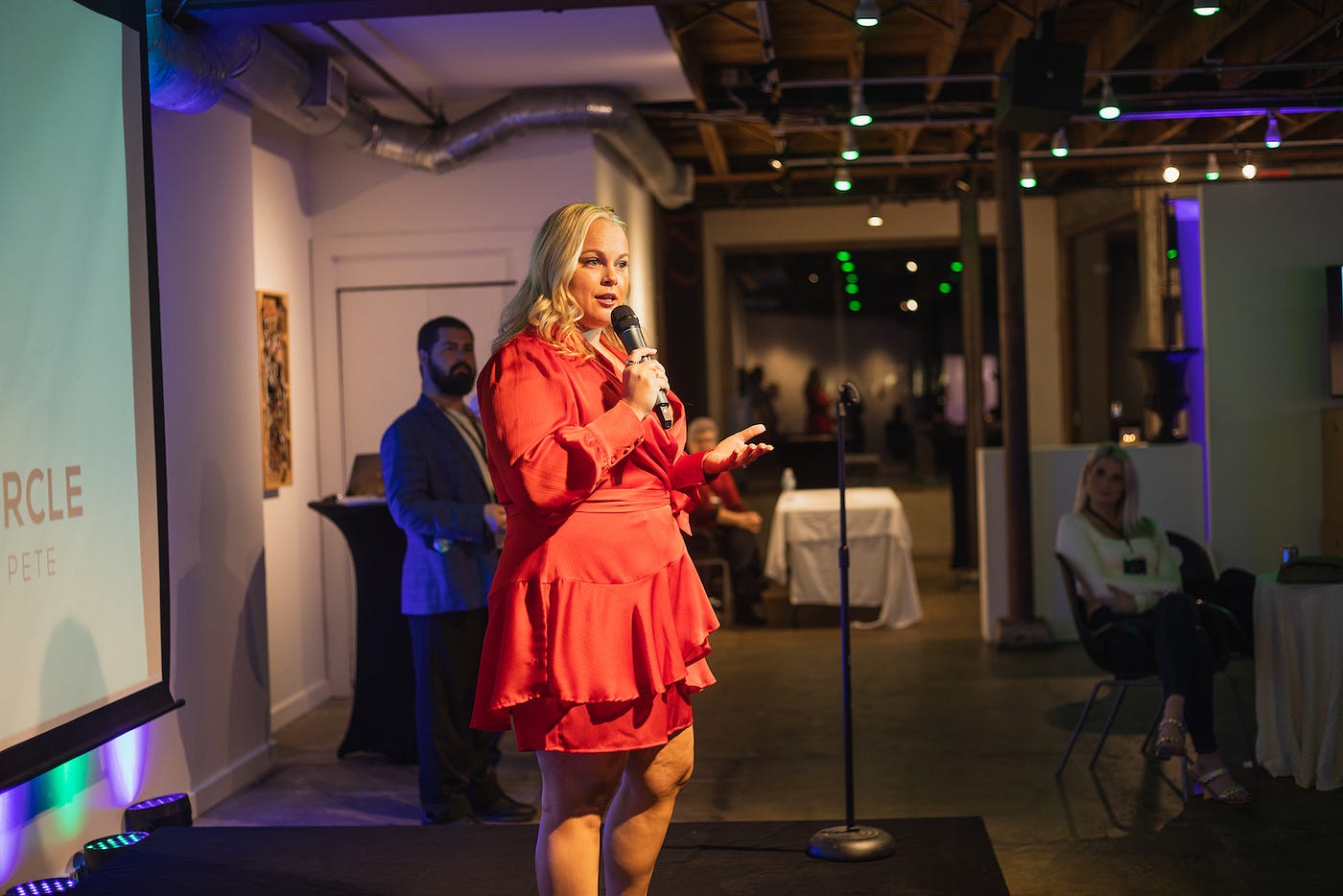
I am, thank you for asking! In January of this year my fiancé and I launched a networking mastermind group for local business owners called The Winner’s Circle.
We wanted to make high level business coaching and mentorship accessible to our local community of entrepreneurs and business owners. Each month, we host a live, in-person mastermind event so our members can connect, collaborate and build partnerships together. We have expert speakers teach growth strategies at each event, and everyone gets an opportunity to share what’s working in their businesses.
Our members also have access to group mentorship calls in the areas of sales and profit optimization, marketing, copywriting and mindset to help them overcome challenges and hit their goals.
It’s going really well! We are having a lot of fun and our members are getting great results!
For the benefit of our readers, can you tell us a bit about your experience with sales? Can you share an anecdote or two that illustrates your experience in this area?
My first time doing phone sales was when I launched my martial arts consulting business. My business partner was a big shot marketing guy, and early on we took our first few sales calls together.
I remember him telling me, “when we get on this call, I want you to start things off by hyping me up. Tell him {the prospect} that I have a 7 figure business, to establish credibility.”
I opened the call and awkwardly told our prospect how ‘awesome’ my business partner was, and then let my partner take the call over. As the call went on I realized my partner was losing the sale. He wasn’t handling objections well, and he was talking too much about himself.
I took a risk and decided to interject.
I repeated back to our prospect what I was hearing, and validated him. I asked, “If our program was free, would you want to join?”
He said, “Absolutely! I totally see the value in what you guys do, and I think you could really help me. I just don’t have the money.” Once I isolated the objection, I walked him through an exercise which uncovered he had been paying for multiple subscriptions and services that weren’t getting any results for his business.
By the end of the call our prospect agreed to cancel all of his subscriptions, and he enrolled in our program! He ended up being a client for many years after that.
I’ll never forget the look on my partner’s face after that call.
His expression was a mix of shock and awe. I thought he was going to be upset with me for butting in and taking over. Instead he said, “Erica, I’ve met a lot of business owners over the years, and you are hands down the best sales person I’ve ever met!”
From that day forward I handled all of our sales calls. I ended up closing over $3 million in sales during our 2.5 year partnership, And, successfully negotiating my exit when I sold my equity to my business partner in 2017.
How do you approach developing a sales pitch that resonates with potential customers and sets you apart from the competition?
The first thing I do is make sure I understand the customer’s pains, problems, fears and desires. I do this by asking lots of questions and actively listening. Once I understand the potential customer’s vision, I am able to position my offer as the bridge to take them from where they are now, to their goal.
When I present the offer, I make sure to deep dive on the top 2-3 benefits that most align with the things they have told me are important to them. Then, I briefly touch on the other aspects of the offer that will support them in reaching their goals. I avoid overwhelming them with all the details and focus on the areas where they will receive the most benefit.
I also like to share relevant success stories from previous clients.
I’ll say something like, “You remind me of so-and-so!” I’ll share a short story about a client who had similar challenges, and how we worked together to overcome them and hit their goals.
Ultimately, my leading edge when pitching an offer is my ability to speak to the little voice in the back of my potential customer’s head so they feel deeply understood, and they trust I can help them.
I also do not move forward with the call if I identify early on that the offer isn’t the right fit for them. This way I’m only pitching to qualified prospects.
When selling to different types of customers such as small businesses versus large enterprises, how do you differentiate your sales approach?
Whether I’m selling to a small business or a large enterprise I always follow my Irresistible Sales Framework because it gives me the flexibility to customize my approach while also making sure I’m hitting the key points necessary to close the deal.
Certain aspects of my approach shift depending on who I’m talking to such as my tone, body language and vernacular. I want to speak to my potential customer in the way they are most comfortable and receptive to. This means I might end up swearing or using slang if I’m talking to a millennial small business owner, for example.
On the other hand, if I’m pitching a seasoned board of directors I would speak slower, make eye contact with each person and use more professional language.
How do you handle objections during the sales process, and what tactics have you found to be most successful in overcoming them?
My best kept secret to overcoming objections is to handle them before they come up. I always qualify my prospect in the first 20 minutes.
If I make sure all decision makers are present early on I never get the objection of needing to “talk to their husband/ wife/ partner” in order to make a buying decision. If I’m able to qualify my prospect’s willingness and/ or ability to invest, up front, I avoid the “I don’t have the money” objection at the end.
70% of the time an objection is simply a lack of trust. 30% of the time it’s a legitimate objection.
If I have done a good job qualifying and I still get an objection after presenting the offer, I need to find out if my prospect is in the 70% or the 30%.
I am able to do this using my in 5 Steps to Overcoming Objections:
Acknowledge
Accept
Shut Up!
PinPoint the Pain Point
Close
When a potential customer presents an objection they expect you to push back. I recommend doing the opposite. Acknowledge their objection, and accept it.
For example, if someone says “I really want to do this, it’s just a big investment.” I don’t argue with them. I don’t tell them what amazing results they will get.
I acknowledge and accept their objection by saying, “I totally get it. It is a big investment.”
Then, I shut up. I sit in silence and let them process. Sometimes I’ll play a game in my head called, “Whoever Talks First Loses.” When my prospect responds, one of three things happens. Either they talk themselves into the sale. They hem and haw. Or they repeat the objection.
If they talk themselves into the sale, great! I move forward and close the sale.
If they hem and haw or repeat the objection, I’ll move onto step 4 and PinPoint the Pain Point. In other words, I bring them back to the reason they booked the call in the first place. I’ll sometimes ask, “if you decided not to move forward with me today, what’s your plan to (solve X problem or hit Y goal)?”
I’ll repeat steps 1-4 as many times as needed until I’m certain there are no other hidden objections. Once I’ve isolated the objection I’m able to determine if it’s a lack of trust or a real objection they can't overcome on their own.
If it’s a legitimate objection, my goal is to sit on the same side of the table as my potential customer and help them find out-of-the-box solutions that will enable them to say yes to the offer.
If it’s a trust objection I take the sale completely off the table. I’ll say something like, “Let’s take the pressure off. Can we pause on making a decision to work together or not, and get real with each other about what’s coming up for you right now? Are you willing to be totally honest with me?”
The last time I did this I discovered that my prospect had just found out his girlfriend was pregnant, and he was going to be a father for the first time! I was the first person he told.
Sometimes taking the sale off the table, and asking someone to be honest is the best way to understand what’s really blocking them from making a commitment.
Can you share a time when you failed to close a deal despite your best efforts, and what you learned from the experience?
A few years back I was referred to the owners of a local franchise. They wanted someone to help them build an online University, and facilitate staff training events for their 13 franchisees and 100+ employees. This fell a bit outside my normal scope of work, but I was excited to take on the challenge and I knew I had the resources and connections to produce the results they were looking for.
I jumped through all the hoops they asked me to but ultimately they chose someone who specialized in creating staff training systems for franchises.
I was disappointed at first, but when I was able to be more objective I realized the project would have taken much more of my time and energy than I thought.
It also would have prevented me from accepting new clients so I would have ended up making less money and helping less people.
I realized that it’s best for me to stick with what I’m best at, and what I enjoy the most, which is helping small business owners 2-10x their revenue.
What metrics do you use to measure the effectiveness of your sales techniques, and how do you identify areas for improvement?
I start by evaluating if I hit all 8 points in the Irresistible Sales Framework. Did I ask warm up questions and set expectations at the beginning? Did I qualify my prospect in all 4 areas within the first 20 minutes? Did I ask enough personal questions to pinpoint their pain point(s)? Did I build a vision with them?
Using a framework allows me to go back and diagnose my effectiveness on the call. If I didn’t close the sale, I can usually find an area that I missed or didn’t dig deep enough.
I also track show up rate, conversion rate and retention rate.
I once worked with a company that had a 75% show up rate for their sales calls. With a few tweaks to their appointment confirmation system I was able to increase their show up rate to 98%. Their revenue increased by 25% even though their conversion rate stayed the same.
Retention rate is another important metric.
I’ve worked with companies who had an extremely high conversion rate and a very low customer retention rate. It was because they were using manipulative tactics to make the sale instead of focusing on building a long-term relationship with the customer. This resulted in buyer's remorse, and a low customer retention rate.
One of my favorite quotes from marketing legend Bill Glazer is, “The best way to scale your business is to sell to your existing happy customers!” If you can’t retain your customers, you can’t scale your business.
Conversion rate is another important metric, although it doesn’t tell the whole story.
When I’m working with a sales team I like to find out what percentage of their leads are unqualified. I will subtract this number from their conversion rate to get a more accurate picture of their sales ability. If I find that 20% or more of their leads are marked unqualified it means there is a breakdown in 1 of 3 areas:
The marketing messaging is off
The pre-call nurture sequence is broken
The sales person isn’t qualifying effectively
Tracking and measuring each of these metrics gives me the ability to see the entire picture of what’s going on in the sales process and pinpoint the areas that need to be optimized.
What role does technology or AI play in the sales process, and how do you leverage it to enhance your or your team's sales performance?
To be honest I’ve yet to use AI in my sales process, and I’m eager to learn how it can help. The technology I have used are CRMs and project management softwares to ensure leads are being nurtured and they aren’t falling through the cracks.
Here is the main question of our interview. In your experience, what are the “5 Most Effective Sales Techniques Leaders Need to Know”? If you can, please share a story or example for each.
1 . Help the Right Person Make the Right Decision - Effective sales are measured by more than your conversion rate. My definition of effective sales is “helping the right person make the right decision.” This means really getting to know your prospect, and being honest about whether your product or service is truly what they need. If you are genuine, and keep the prospect’s best interest in mind you will undoubtedly increase your conversion rate, customer retention rate and referrals. You will also prevent buyer’s remorse and bad reviews. As Zig Ziglar once said, “You will get all you want in life if you help enough people get what they want.”
2 . Always Make “The Promise” (and keep it) - At the beginning of a sales conversation I always ask, “Is it ok if I set some expectations for the call today?” When they say yes, I respond, “I’m going to ask you a bunch of questions to get to know you, and to understand more about your business. Is that ok?” Once they say yes again I’ll move forward and make “The Promise” which sounds something like this…
“I want to let you know I’m a really straight shooter. If anything comes up and I realize I’m not the best fit to help you I promise I won’t waste your time. I’ll let you know right away and do my best to refer you to someone I trust. On the other hand, if I feel 100% confident I can help you reach your goals I’ll let you know, and we can talk about what it looks like to work together at the end of the call. Does that sound good to you?”
When you set expectations up front it allows your prospect to relax. Most people have some level of anxiety when entering into a sales conversation. Knowing what to expect alleviates their anxiety, especially if they are worried about when the pitch is coming. Just tell them up front!
In addition to building trust, making “The Promise” also protects your time because it allows you to gracefully exit the conversation, and preserve your prospect’s dignity, if you determine early on that they are not qualified.
3 . Ask All 4 Types of Questions - the top most successful sales people in the world ask, on average, 72 questions during a sales conversation. Those questions fall into 4 categories:
Warm Up Questions: these are the questions you ask at the beginning of the conversation to build rapport. Like, “how’s your day going?” or “What’s the weather like where you’re located?” Just like you would never skip the warm up before jumping into a workout, never skip the warm up questions at the beginning of a sales conversation!
Qualifying Questions: Qualifying questions fall into 4 categories:
Are all decisionmakers present?
Does the prospect have the willingness and/or ability to invest?
Does the prospect want or need my product or service?
Would I enjoy an ongoing working relationship with this person?
If you move forward without getting a resounding “yes!’ in each of these areas you will be setting yourself up for potential objections at the end of the conversation.
Personal Questions: Getting to know your customer on a personal level will help you pinpoint their pain point. In other words, it will give you insight into deeper reasons why they are seeking your help. Don’t be afraid to ask personal questions! If you feel uncomfortable you can always ask your prospect, “is it ok if I ask you a few personal questions?”
Technical Questions: These are logistical questions like payment method they would like to use, or when they can come in for their next appointment, etc.
4 . Follow The Dr.’s Formula - Can you imagine going to the doctor with a head cold? Imagine sitting there sniffling and sneezing waiting for the doctor to arrive. When he finally comes in, imagine he takes one look at you and says, “I know exactly what you need, here’s a prescription for Prozac.” and then he turns around and leaves the room. You’d probably be pretty pissed off! You’d probably think, “he didn’t even ask me what was wrong! He just prescribed me medication I don’t even need!” This is the way many people approach sales. They are so focused on making the sale they don’t take the time to really get to know their customer’s unique needs and circumstances, so they come across pushy, sales-y and disingenuous. If you really want to increase your sales conversion and customer retention I recommend applying the Dr.’s Formula. When you use the Dr.’s Formula you will spend 70% of the sales conversation in the “Consultation Phase,” where you ask questions and get to know your prospect. This is where you uncover their fears, desires and their pain points. Next, you move on to the “Evaluation Phase.” 20% of the conversation should be spent here. This is where you create a vision together of what success looks like. What is their desired outcome? How would things look and feel if you could wave a magic wand and solve all of their problems? Lastly, you will spend 10% of your time on the “Diagnosis,” where you will talk about the ways you can help your prospect get what they want. This is where you present your offer and ask for the sale.
5 . Practice Active Listening - Pay attention, provide feedback, defer judgment and respond appropriately, it’s that simple. Active listening builds trust and creates mutual understanding. As a leader in sales your goal is to get on the same side of the table as your prospect. The more understood and validated they feel by you, the more open and honest they will be about their problems or objections giving you the opportunity to provide solutions.
We’d love to know, what is the most effective sales technique you've used to close a deal, and how did you come up with it?
I think the simplest and most effective technique I’ve used to close a deal was to ask for the sale and shut up!
I remember being so nervous about sales when I first opened my karate school. Several times I talked too much and lost the sale. I’ll never forget the day I learned the power of asking for the sale, then saying nothing.
I was meeting with a mom who wanted to enroll her 2 sons in my Leadership Program at my martial arts school. I offered her an option to pay in full and save 20%.
She asked me to add up the total cost of everything her kids would need for 3 years of training so she could decide if she wanted to do it or not. I added in everything I could think of! Belt testing fees, equipment fees, uniforms, weapons, you name it.
When I tallied the total price on my calculator it came to almost $14,000! I was so shocked by the amount I couldn’t even say the number. I just turned the calculator around and sat in silence with my heart pounding in my chest.
She looked at the calculator and after a moment (which felt like an hour) she said, “Ok, sounds good!” and pulled out her checkbook.
I sat there stunned.
After that conversation I’ve never been afraid to ask for the sale and sit in silence until they respond. I can’t tell you how many people have talked themselves into the sale while I sat quietly, after presenting an offer.
We are nearly done. You are a person of enormous influence. If you could inspire a movement that would bring the most amount of good to the greatest amount of people, what would that be? You never know what your idea can trigger. :-)
If I could inspire a movement, it would be to improve access to education for everyone, regardless of their socio-economic background. Education is a critical foundation for success, and it's heartbreaking and unacceptable that so many people around the world don't have equal access to it.
I would love to see increased funding and resources for schools in underserved areas, expanding access to online education platforms, and providing greater support for adult education and job training programs.
By prioritizing education, we can open pathways to opportunities, reduce poverty, and build stronger communities. I would also emphasize the importance of continuous learning, not just for individuals but for organizations as well, to foster innovation and growth.
How can our readers further follow your work online?
The best way to connect with me is through social media or email. You can find me on Facebook, LinkedIn and Instagram.
Facebook: www.facebook.com/EricaMartinConsulting
Instagram: @EricaMartinConsulting or @TheWinnersCircleStPete
LinkedIn: www.linkedin/com/in/EricaMartinConsulting
Email: info@TheWinnersCircleStPete.com
Thank you for the interview. We wish you only continued success!