Once we make that determination, then we can explore the right technologies and solutions that best support it.
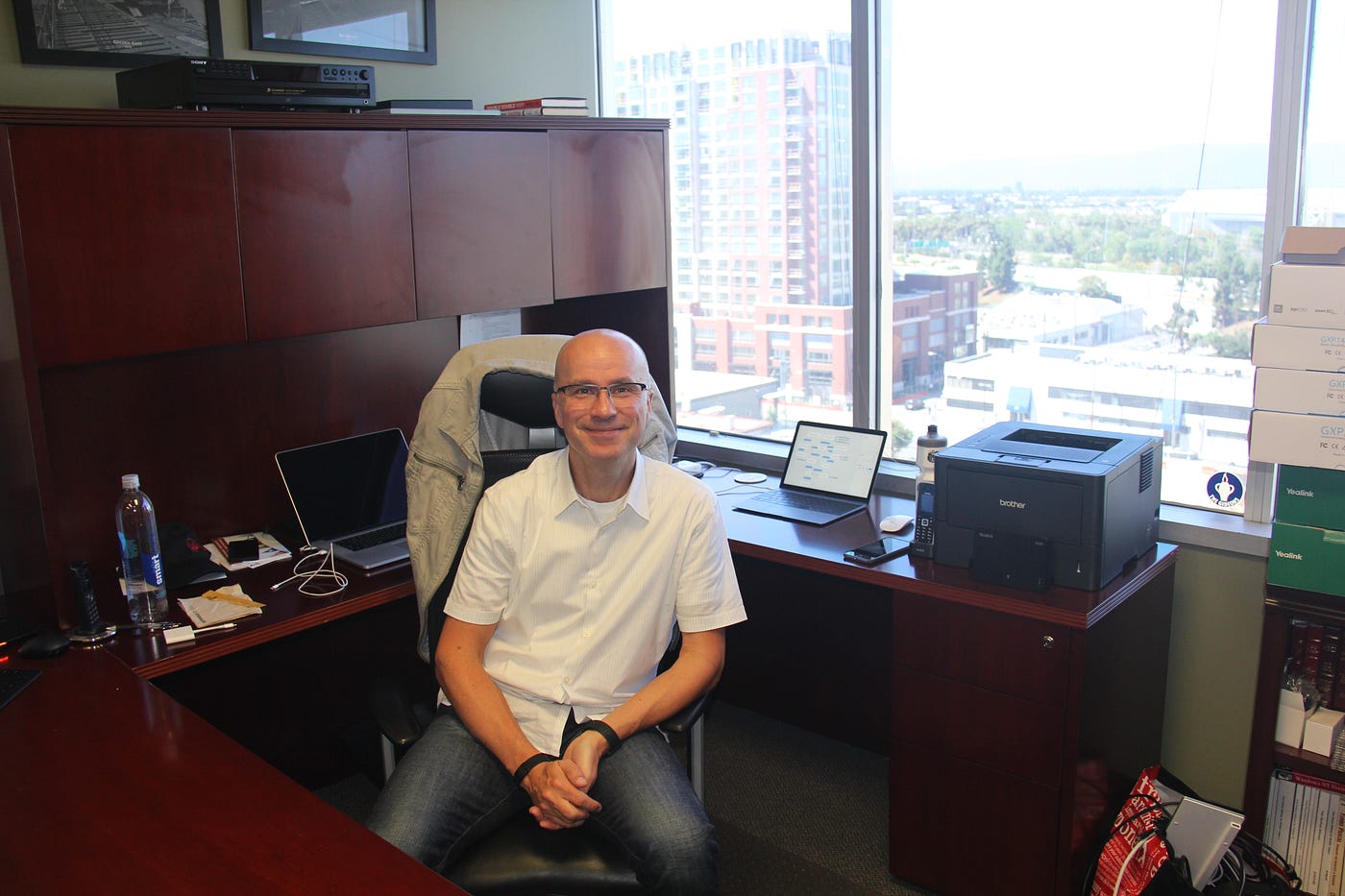
As a part of this series, we had the pleasure to interview Greg Mader.
A veteran IT-consultant whose career spans more than two decades, Greg Mader has extensive experience in the field of integrated networking, operations, database management, and manufacturing. His primary focus centers on ERP platforms and the implementation of enterprise-level technology for clients in both the public and private sector. Prior to founding Gray Matter Logic in 2011, Greg served as a lead project manager at Esri Defense and Intelligence Services, supervising a team of 60+ developers working on various global geographic information systems (GIS) technologies. He played an integral role in the creation and development of the firm’s CJMTK Geospatial Appliance — an advanced turnkey system that provides military analytics for enhanced visualization and targeting. He’s the published author of two books on Odoo software development, a prolific blogger, and accomplished team builder. A veteran of the armed forces, Greg served over 20 years in the U.S. Army, eventually rising to the rank of Field Artillery Officer, where he was responsible for the planning, training, and operational command for a battalion of 450+ troops. His educational background includes two master’s degrees: a master’s in geography from South Dakota State University, and a master’s in computer science from the University of Chicago.
Thank you so much for joining us in this interview series! Our readers would love to “get to know you” a bit better. Can you tell us a bit about your ‘backstory’ and how you got started?
Before I entered the private sector, I served in the U.S. Army for just over 20 years. I was a Field Artillery Officer in command of a battalion detachment of 450 men, responsible for planning, training and operations. Some of the lessons I learned in the military still apply to the work I’m doing today. What we do at Gray Matter Logic is always mission-specific — we set goals and hold ourselves accountable until the job gets done. My IT-related career really began at Esri Defense and Intelligence Services, specializing in GIS mapping systems and turnkey solutions that provided military analytics for enhanced visualization and targeting capabilities. I led a team of 60 developers in creating the firm’s proprietary CJMTK Geospatial Appliance. I found my entrepreneurial footing in 2011, founding an ERP implementation firm, Open Source Integrators, which we recently rebranded as Gray Matter Logic. The name reflects our working style — we blend the human element in our consultant’s expertise, with a disciplined approach to turn complicated operations into workable systems that bring clarity, confidence, and operational efficiency.
Can you share a story about the funniest mistake you made when you first started out? Can you tell us what lessons or ‘takeaways’ you learned from that?
I would say the funniest mistake I made when I was starting out happened when we were pitching a proposal presentation to one of our very first customers. It was a software company, and I believed the capabilities they advertised — that they could do first-in, first-out costing and accounting. I basically took their word for it at face value. It turned out that the customer knew more than I did, as their accounting depth went much deeper than basic first-in, first-out principles. That made it one of those cases where the road to humility was paved by being humiliated. Thankfully, we recovered and still got the deal, but the customer rightfully challenged us — they wanted to see it in action, more than just documentation. Their suspicions were borne out, and I came away from the experience knowing I needed to understand the concept better myself. From that point on, I learned to verify certain claims before taking it in front of someone as important as the customer themselves. I was determined not to make that mistake again.
None of us are able to achieve success without some help along the way. Is there a particular person who you are grateful towards who helped get you to where you are? Can you share a story?
Thinking back to early on in my career, I had a smart mentor named Clark Swinehart who taught me a lot of things. But one thing in particular stands out, as I recall him telling me, ‘Don’t get yourself caught up in ready-fire-aim projects.’ The reason that advice stands out to me after all these years is a simple fact — it’s easy to get carried away and jump straight to a coding and development solution without taking the time to properly think things over. Ask yourself, ‘Is this solution really the right fit for what this project needs?’ It’s a message that still resonates with me today.
Extensive research suggests that “purpose driven businesses” are more successful in many areas. When your company started, what was its vision, what was its purpose?
I’d say Gray Matter Logic is definitely a purpose-driven business. For client-facing work, we’ve developed an approach in which we apply a specific set of concepts to develop a working knowledge graph that maps out what ERP implementation can accomplish in layman’s terms. We then take that information and build what we refer to as our ‘Implementation Blueprint,’ a digital facsimile, so to speak. The blueprint is a repeatable approach that leverages our proprietary AI system, Peregrine, which not only mines the work we’ve done to help add efficiency to our implementation scoping model, but also highlights the expertise of our human team that routinely conducts site visits as part of the overall evaluation process. Taking the client’s business model into account, we delve into the operational side of things to demonstrate where the ERP implementation can be particularly useful, illustrated through flowcharts, drawings, and diagrams. Once complete, this gives us a clearer picture of the internal mechanics — how the work flows from one sector to the next. This approach allows us to create a specific implementation that is precise and capable of delivering much better outcomes. Not only does this demonstrate the value of the client’s business model, but it also makes it more manageable and maintainable. In doing so, the company can continue to grow and evolve by amending the knowledge graph instead of tearing things out piecemeal. The experience we’ve gained in replicating this process with hundreds of clients has strengthened this approach and made it a predictable process for us, both in terms of time and cost-savings, with some projects completed in half the time it used to take.
Can you tell our readers a bit about what your business does? How do you help people?
You’re catching us at an opportune time to discuss who we are and what exactly we do. Having recently gone through a corporate rebranding exercise, Gray Matter Logic is a new name for a set of established companies that demonstrate how we’ve evolved over the years. This name change marks a significant shift for our firm, as we’ve transitioned away from offering ERP implementations in favor of what we’re really selling, which is business transformations. Because the last thing a business really needs right now is more software. The type of business transformations we’re working on now focus on how the company should operate. Once we make that determination, then we can explore the right technologies and solutions that best support it. As for Gray Matter Logic’s approach to technology, our firm is agnostic about what we deploy, but always clear on the outcome we’re trying to achieve. When it comes to the clientele we serve, our wheelhouse includes ERP implementations that support Odoo, IFS Cloud, and Acumatica for manufacturers, aerospace and defense, electronics, life sciences, food, and beverage producers, as well as asset-intensive and field-service operations. To put it in the simplest of terms, we’re a firm that thinks for a living.
Which technological innovation has encroached or disrupted your industry? Can you explain why this has been disruptive?
I think every few years, we’re bound to get a big disruption to deal with. Looking at years past, there was the migration to cloud computing, significant advancement in data science, and even the social integration with e-commerce and communications. Most recently, and most impactful, has been the advent of AI and how its role is significantly changing the equation. From our perspective, it’s been useful in providing advice on customization, configuration, and data cleansing — but the real question is, can it ultimately replace an ERP or CRM? I personally think the jury is still out on that one. As for Gray Matter Logic’s emphasis, as well as reliance, on the human intelligence factor, we see AI as more of an augmentation, not a wholesale replacement. And I really don’t think it will be for the foreseeable future. There is no doubt that AI is going to be a powerful and useful resource — a tool we’ll probably be using with ever-increasing frequency. But to suggest it will eventually become a wholesale replacement for the human factor — that just doesn’t track with Gray Matter Logic’s approach. We’re a people-first company.
What did you do to pivot as a result of this disruption?
The most significant pivot we’ve accomplished here at Gray Matter Logic has been the development of our Peregrine platform. We read some papers three years ago that really kind of set us on this course. And that was the foundation of Peregrine. It’s our proprietary AI system, a model that’s based on open weight models that we’ve enhanced considerably on our own, as well as a harness. And the harness allows us to use other models as appropriate as well. And we’re already seeing results that have been pretty remarkable. Basically, it’s cut down our time to implement a new ERP solution by half — which is fortunate, because nobody wants to wait around on an 18-to-20-month project anymore. Now, we can do them in half the time it used to take.
Was there a specific “Aha moment” that gave you the idea to start this new path? If yes, we’d love to hear the story.
Yes, there was. If I recall correctly, it was over three years ago. There were a couple of cool little videos of OpenAI ChatGPT circulating on LinkedIn, demonstrating some of its coding ability. As for the ‘Aha moment,’ there was this one particular Saturday morning where I was sitting on the couch at home and our internal team chat just kind of blew up with one of our teammates saying something to the effect of, ‘Look what I just did — I built this module to extend a system.’ And one of my first thoughts was does this put us at risk? Here it was, a Saturday morning you know, and I’m sure we’re all thinking about other things that we want to do with our weekend. But really that moment was, it felt alarming to this teammate of ours. I think what I came to tell them was, it’s not alarming if we’re the first out of the gate. And that was one of the moments that helped us kind of gather some academic papers and some other things that kind of confirmed everything we were seeing. It was like, yeah, this is real. I addressed some of the thought leaders and colleagues within the company, and there was this consensus that, yeah, I think you’re right. And it just became one of those seminal moments.
So, how are things going in this new direction?
I’d say we’re progressing nicely; we’ve got no complaints. I think, as a team, Gray Matter Logic has done a great job pivoting and embracing our role as innovators in the ERP implementation sector and I’m quite proud of how far we’ve come, what we’ve been able to accomplish so far, and the general direction we’re headed. I’d say we’re definitely leading from the front.
Can you share the most interesting story that happened to you since you started this pivot?
Several months ago, we had a customer that worked in applied financial technology. Anyway, they’re adventurous people — they’re used to working on the cutting edge. And they wanted to migrate from an older version of a system to a newer version. And this was the case where we were able to do the migration in half the time, allowing them to get the benefits of that technology quicker. What they do is incredibly competitive in applied financial technology. So, in saving them all this time, we really created a competitive advantage for them.
What would you say is the most critical role of a leader during a disruptive period?
As fast as everything is going these days, I have to find patience for everybody else in the team. They’re coming at me with their own paces and skills and abilities, so I have to project calm and patience. That and being a good listener, being able to reassure them. Showing patience is something I have to work on every day. And what I’ve found is that if I can do that and apply some empathy too, then we all feel empowered. I think showing patience demonstrates how we have each other’s back, as we kind of think about the parts that are new or challenging to us too. Just several days ago, I was really excited to talk to the team about how, in some independent or third-party moments, our AI technology, again, Peregrine looks really good and excites people and is delivering meaningful and correct answers in a way that the competition can’t.
When the future seems so uncertain, what is the best way to boost morale? What can a leader do to inspire, motivate, and engage their team?
I believe one of the best ways companies can boost internal morale is in giving them confidence. Confidence in knowing that our organization isn’t leaving anything to chance — that we’re at the forefront of significant technological advancements like AI. As an organization, I think we’ve done a great job making sure our employees are aware that Peregrine is delivering meaningful results — it’s doing what the competition can’t.
Is there a “number one principle” that can help guide a company through the ups and downs of turbulent times?
I think the number one principle that can help guide a company through turbulent times is treating it like a profession. Treating it like a true profession and holding our staff to that same ideal of being a professional, serving other professionals. So, that means some of this we can’t take personally, we have to put the customer first. As a team, we have to hold ourselves accountable, learn, and do the work that I think professionals should be doing. In the end, just holding ourselves to a higher standard has been an effective strategy.
Can you share 3 or 4 of the most common mistakes you have seen other businesses make when faced with disruptive technology? What should one keep in mind to avoid that?
It’s funny. That’s actually an excellent question. I think it comes down to us all being a bit bipolar, right? On one hand, there’s this prevailing sense that this disruptive technology is going to solve all of our problems and we’re all in. We’re all in on how this technology is going to change us and become this magic bullet for everything we do. Or on the flipside, there’s this avoidance, where we’re just burying our head in the sand and saying, ‘ah, our industry is not going to change, and we can just ignore this thing called AI until it blows over.’ The funny thing is, and I hear it a lot more frequently from the younger generation, is that they themselves are often the ones taking the most extreme position. And maybe it’s just because I’ve been through this cycle a couple of times, but I do think there’s probably a moderate middle in there somewhere.
Based on your experience and success, what are the five most important things a business leader should do to pivot and stay relevant in the face of disruptive technologies? Please share a story or an example for each.
1. Get Hands-On Experience
First and foremost, I think the number one thing is business executives should take a personal interest and try experimenting with some of these disruptive technologies themselves. There’s umpteen gazillion tutorials on the web or on YouTube or other places, but I would say number one thing is to try it for yourself, get your hands dirty, be willing to make a mistake or two, and learn from that.
2. Formalize Your R&D
Number two is realization. You do need to have some sort of a formalized R&D moment. Maybe it’s not assigning somebody to handle research and development full-time, but maybe it’s starting the conversation or creating an R&D steering committee, a task force, something along those lines. It comes down to making a firm commitment. It’s a willingness to state that, even if we’re doing something very predictable and routine, we need to make some small investments in this technology ourselves.
3. Foster Open Communication
Number three, I think, goes back to the bipolar moment of not being afraid of disruptive technologies. Be willing to embrace the parts that are successful and be willing to make mistakes and talk openly about that, giving and receiving feedback with each other in an open and transparent way. So, facilitating good communication and being as transparent as possible, I think, is a great way to help everyone see where this is actually going.
4. Invest In Talent and Mentorship
For number four, I’d like to say a word or two about hiring the right people for your organization. As a company, we have invested heavily in hiring the best talent we can find on a global scale. Whenever we onboard a new employee, we like to pair them up with one of our senior-level experienced leaders, many of whom have established an admirable track record of speaking and industry trade events or global conferences on topics relevant to disruptive technologies. Internally, we refer to them as our “Sherpas,” reliable pathfinders who are ready to serve as guides for our newest staff members. In almost every case, they tend to form a strong bond and learn from one another. And overall, I think that helps them become a well-rounded employee ready for a tenure-track experience with our organization.
5. Adopt A Nuanced Strategy
Lastly, in the effort to stay relevant and up to speed on facing disruptive technologies, I’d like to borrow a specific approach we use with our client work — our AOAT philosophy, which stands for ‘Analyze, Optimize, Automate, and Transition.’ It’s an approach that sets us apart from our competitors and here’s why it matters — We believe that average consulting efforts will net you average projects. But our AOAT approach typically delivers an above-average outcome. And that’s because it’s a much more nuanced and thoughtful strategy. It’s also intentional from the outset and can be very effective in allowing us to pivot and be agile as needed.
Can you please give us your favorite “Life Lesson Quote”? Can you share how that was relevant to you in your life?
I don’t know if I have a specific quote in mind, but perhaps more of a philosophy I’d like to share. Ultimately, it’s about other people and having empathy with regard to the difficult work we do. Trust me, none of this stuff is as easy as people think. There needs to be empathy for what our customers and our teammates are going through, how we’re facing tough challenges together. I think it’s important that we take the time to communicate our support for one another.
How can our readers further follow your work?
Best way to follow our work is to visit our corporate website at: https://graymatterlogic.com, or our LinkedIn page at: https://www.linkedin.com/company/graymatterlogic/home.
Thank you so much for sharing these important insights. We wish you continued success and good health!
About The Interviewer: Tavares Beverly ( www.tavaresbeverly.com ) is the Founder and CEO of Beverly Boy Productions, a national video production company that has helped organizations tell their stories through video for more than two decades. Over the course of his career, he has worked with everyone from Fortune 500 executives and healthcare professionals to politicians, nonprofit leaders, educators, and artists, gaining a unique perspective on the role communication plays in leadership, business, and human connection. A frequent contributor on topics including communication, entrepreneurship, leadership, and personal development, Tavares believes that the ability to communicate effectively is one of the most valuable skills a person can develop. His work is driven by a passion for helping organizations connect with their audiences and helping individuals unlock their potential through mentorship, perseverance, and meaningful relationships. To learn more, connect with Tavares on LinkedIn or visit www.BeverlyBoy.com . If you’re interested in using the power of storytelling and communication to grow your organization, strengthen your brand, or inspire your audience, he welcomes the opportunity to connect.