What began as one reconnection at a webinar has now reached more than 200 people over two seasons. And fittingly, when we surveyed our 2025 audience, nearly nine in ten told us they came because a friend or colleague invited them.
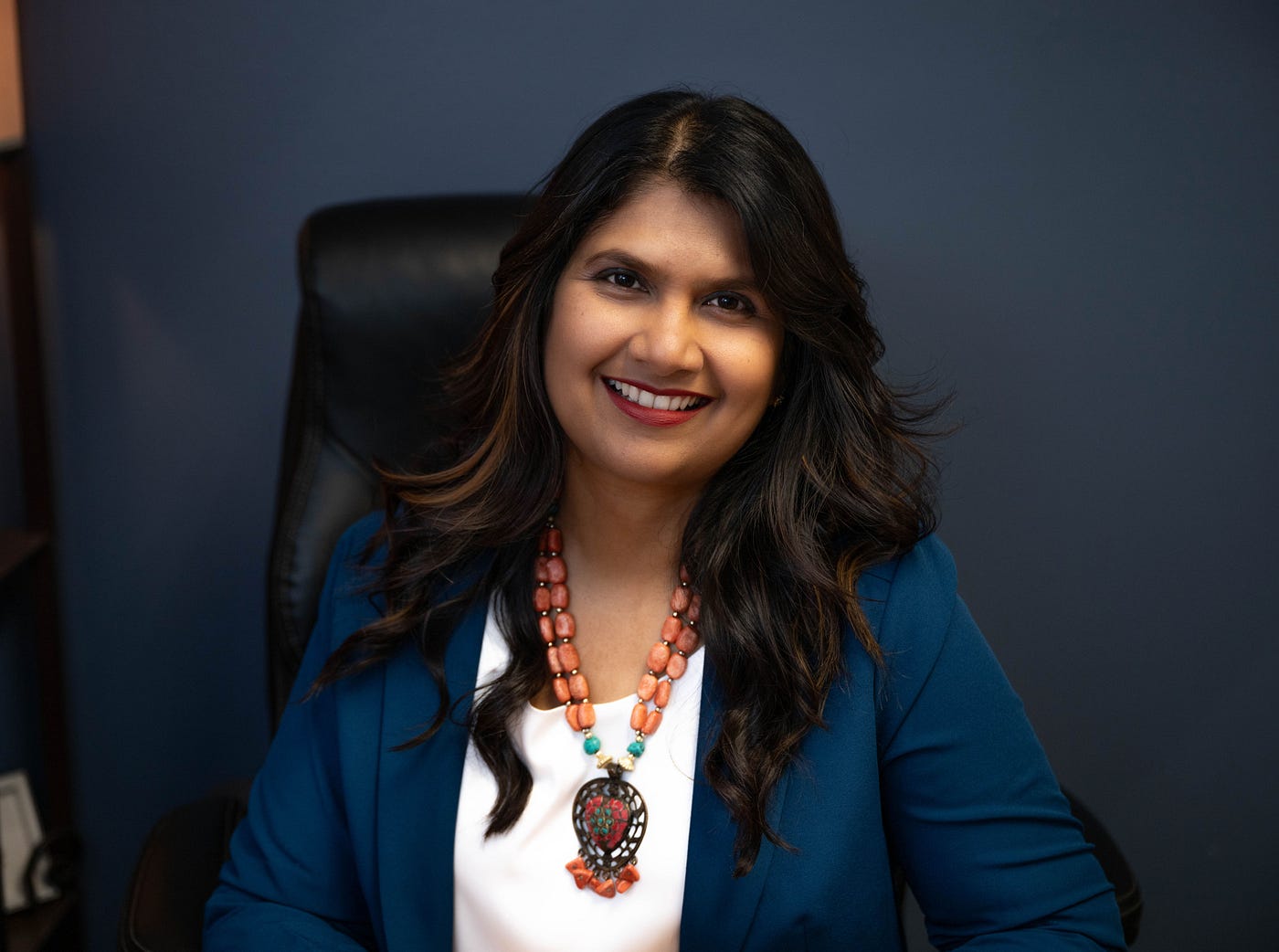
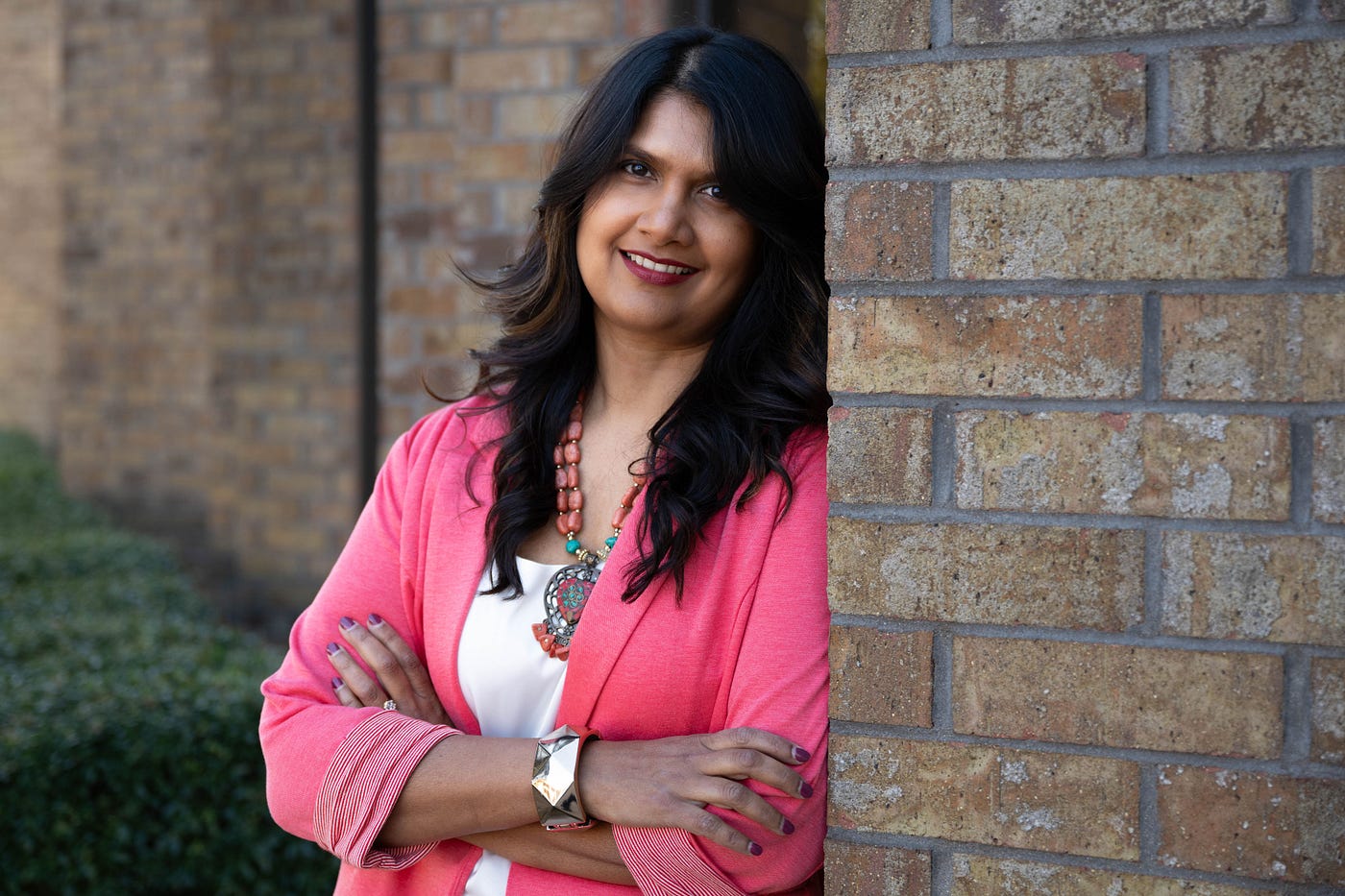
As a part of this series, we had the pleasure to interview Sharanya Rao.
Sharanya Rao is a creative force who awakens clarity and transformation through coaching and theatre, as founder of Global Coaching Works, LLC, and Artistic Director of Leela — An Indian Community Theatre (“Leela”), the Austin company she co-founded to share stories from the Indian community with the wider community. A former litigation lawyer and Third Culture Kid raised in Singapore, she brings more than thirty years of theatre experience as a playwright, director and performer. Her interactive production Anklets in the Boardroom, co-sponsored by Austin PBS, invites audiences to step into real stories of workplace discrimination and change how they end.
Thank you so much for joining us in this interview series! Can you tell us a story about what brought you to this specific career path?
Honestly, it took me years of searching to find it. I started out as a litigation lawyer in Singapore, and I burnt out completely. I knew, deep down, that this was not who I wanted to be. After completing my LLM in Dispute Resolution, I moved into the government sector. It was a stable career, but I yearned for work that felt truly fulfilling.
Becoming a mother thirteen years ago changed everything. It gave me the accountability to finally build a career aligned with my purpose, and that’s what led me to coaching.
That same year, I co-founded Leela — An Indian Community Theatre with close friends and my husband. We wanted a home for stories from the Indian community, stories we could share with the wider Austin community to help bridge cultural gaps. I was especially drawn to the stories that seldom get told: women’s perspectives and immigrant journeys. We also wanted theatre to be open to people who had never acted professionally. In our community, so much emphasis is placed on professional careers that creativity often gets set aside, and many people reach later life feeling that something is missing. So we built our own stage.
Thirteen years ago, I couldn’t see how these two parallel paths would connect. Today they meet at a confluence, where my passion meets my purpose. Coaching helps people find their voice; theatre gives them a stage to use it. It’s really beyond a career. It’s how I show up in the world.
Can you share the most interesting story that happened to you since you began leading your company or organization?
I have so many! But the one that still gives me goosebumps is about the power of community.
When I first started Leela, I connected with someone from the film industry. Then life happened. Leela went on hiatus for a few years because our entire team had children at around the same time. The pandemic became my wake-up call. I realized I was out of alignment with one of my deepest values, creativity, and that I needed to put a stake in the ground and honor it, even if that meant letting go of how it was “supposed” to look.
Around that time, an idea took hold of me: what if I used Augusto Boal’s Theatre of the Oppressed methodology to bring to life real stories from South Asian women about their experiences of workplace discrimination? I called it Anklets in the Boardroom — An Interactive Theatre Project. At that point it was only an idea. Then I signed up for a grant-writing webinar, and there was that same friend from the film world, who remembered me from ten years earlier.
As we caught up, she mentioned that she was on the Board of Austin PBS, and she invited me to a community meeting with their (then) new CEO. After the meeting, we shared the idea of Anklets in the Boardroom, and the VP of Community Engagement loved it. Austin PBS came on board as a co-sponsor and has been a community partner ever since.
What began as one reconnection at a webinar has now reached more than 200 people over two seasons. And fittingly, when we surveyed our 2025 audience, nearly nine in ten told us they came because a friend or colleague invited them. Community showing up for each other: that’s the whole story of Leela.
It has been said that our mistakes can be our greatest teachers. Can you share a story about the funniest mistake you made when you were first starting? Can you tell us what lesson you learned from that?
I’ll admit, I’ve always found it hard to laugh at my mistakes, though I’m getting better at it! The one that makes me smile now is from Leela’s early days. In the spirit of being collaborative, I welcomed everyone’s input on everything. Every idea was welcome, all at once. You can imagine the result: rehearsals and planning meetings full of chaos and confusion.
The lesson I learned is that collaboration needs a container. Over time, I’ve learned to balance openness with clear boundaries, so we create a climate of generative creativity without the storm of uncertainty. Inclusion and clarity aren’t opposites. People do their most creative work when they feel both welcomed and held.
Can you describe how you or your organization is making a significant social impact?
At its heart, Leela builds cultural bridges through the arts. Theatre is one of the most powerful mediums for change I know, because it reaches people’s hearts before their defenses go up.
We’ve seen this most clearly with Anklets in the Boardroom. The production brings to life real stories from Asian and South Asian women about discrimination at work: a name no one bothers to pronounce, an accent questioned in a meeting, a promotion that quietly goes to the “old boys’ club.” After each scene, we invite the audience to step in, take a character’s place, and change how the story unfolds. Boal called them “spect-actors,” not spectators, because no one gets to be a passive bystander. Whoever you are, whatever your gender or background, you become a possible agent of change.
And the change is measurable. More than 200 people have now experienced the show across our 2024 and 2025 seasons, and over 120 completed our post-show surveys. In 2024, 97% told us the show inspired them to act as an agent of positive change in their workplace. In 2025, 96% reported a shift in perspective, most often about speaking up in professional settings (67%), followed by workplace power dynamics and identity and cultural belonging (44% each). Half said they’re now more likely to start conversations about workplace culture, and 42% said they’re more likely to share their own stories.
That last number moves me the most. Again and again, people told us they had experienced discrimination themselves but had never spoken about it. They felt seen and heard, often for the first time. One audience member wrote simply, “This is what theatre is for!” Another said, “I wish I could require folks to attend the experience as part of personal/professional development.”
Representation matters, too. Nearly two-thirds of our 2025 audience said they only rarely or sometimes see themselves reflected on stage. And these stories didn’t only speak to one community. Our audiences have been South Asian, East and Southeast Asian, White, Hispanic, Black and Middle Eastern; engineers, lawyers, physicians, educators, coaches and retirees; from an eleven-year-old who came with a parent to theatregoers in their seventies. People of every background recognized themselves in these stories.
The other heart of Leela’s work is giving community members a voice and a platform. At every production, someone makes their stage debut, as an adult! There is tremendous fulfilment in watching someone who spent years believing the stage “wasn’t for them” discover what it feels like to be seen and heard. Theatre shouldn’t belong only to professionals. The stage belongs to all of us.
Can you tell us a story about a particular individual who was impacted or helped by your cause?
Two stories come to mind.
The first is about a fellow coach, a white man, who attended Anklets in the Boardroom. The production stayed with him, and he became far more conscious of how much a name carries and of taking the time to learn to pronounce Asian names. A year later, he told me what happened next. He was onboarding a new client of South Asian descent who went by a shortened name. When he asked for his full name, the client said, “Don’t bother, it’s probably too long for you.” In that moment, my friend made a brave choice. He said, “No, I want to learn to pronounce your name correctly. This matters to me.” He told me the look on his client’s face completely changed. His client felt seen, and that one moment built a new level of trust between them. As one of our audience members put it, “It was moving to see how small acts can change the entire dynamics.”
The second story is about one of our actors. She successfully negotiated a pay raise at work, using lines from her own scene! She told me she would never have thought to ask if it weren’t for the production. Boal described this kind of theatre as a “rehearsal for the revolution.” For her, it was a rehearsal for a raise. That’s the magic of this work: the stage becomes a safe place to practice courage, and people carry it back into their lives.
Are there three things the community/society/politicians can do to help you address the root of the problem you are trying to solve?
Yes, absolutely! The root of the problem we are trying to solve is creating belonging in the community through empathy and creativity. This is one of our primary drivers for our upcoming production, House of India by Deepak Kumar, which focuses on the heartwarming story of a struggling Indian family-run restaurant that faces a reckoning between innovation and financial collapse. The story, while focused on an Indian family, is very relatable and has universal themes of business struggles, belonging and innovation.
- Come and experience it. Attend our productions and feel the power of storytelling for yourself. Nearly nine in ten of our audience members came because someone they trust invited them, so bring a friend, a colleague or your whole team. Our next production, House of India, opens November 15 at the Mexican American Cultural Center (MACC), so join us!
- Come with curiosity and openness. You may be surprised by how many challenges we share and how much common ground we find. Our post-show conversations are where the real transformation happens. 97% of our 2025 audience rated the facilitated dialogue as impactful, and one person called it “the backbone of the evening.”
- Partner with us. Donate, sponsor a production, or become a Leela Patron. We are a theatre with a purpose, not just entertainment. A third of our 2025 audience told us they want to get more involved with Leela, and sponsors and donors help us turn that goodwill into lasting change. Come be our partner for positive change.
How do you define “Leadership”? Can you explain what you mean or give an example?
Leadership is often defined as social influence: guiding, inspiring and motivating others toward a shared goal. For me, it’s more personal than that. Leadership is about how we show up in the world.
It isn’t reserved for people with certain titles. I believe we are all innately leaders; most of us simply don’t recognize our capacity to lead until we’re given a challenge. I see it every time an audience member at Anklets in the Boardroom stands up, walks into a scene and changes how it unfolds. No title, no permission, just someone deciding to act.
We all have the ability to influence others, and it starts when we are deeply connected to our own vision, purpose and clarity. Our clarity is what inspires others. Leadership isn’t just about what you do. It’s about who you are, and how you show up for others.
What are your “5 things I wish someone told me when I first started” and why. Please share a story or example for each.
1. Be kind to yourself. You will meet enough unkindness in the world; there’s no need to add your own voice to it. Self-compassion isn’t indulgence. It’s what allows you to get back up after a hard day, a rejection, or a rehearsal that fell apart, and keep going.
2. Be willing to make mistakes, and learn from them. Mistakes are deeply uncomfortable, but working through them makes you a more skilled professional and a better human being. My early “everyone’s input on everything” approach at Leela was hard to live through, but it taught me how to build a creative process where people can truly thrive.
3. Be bold, and don’t shrink when you meet a NO. A no might be the Universe challenging you to dream bigger. Decide what you want to do with it, because sometimes a NO is really a NOT NOW or a NOT THIS. When Leela went on hiatus, it felt like a “not now.” Looking back, that pause is where the idea for Anklets in the Boardroom was born. Reconnect with your purpose and let it guide your response.
4. People are more important than results. For any work to be sustainable, people need to be at the heart of it. That’s why Leela is grant-funded and pays honorariums to our cast and production crew. Artists give us their time, talent and heart, and the arts can only thrive when that is valued. When you focus solely on results, you might gain in the short term, but you’ll lose long-term momentum.
5. Listen to your gut. It is usually right, and it can save you a lot of time, heartache and wasted effort. My gut told me I didn’t belong in litigation long before I was ready to admit it. Every step since then has been about learning to trust that inner voice sooner.
Can you please give us your favorite “Life Lesson Quote”? Can you share how that was relevant to you in your life?
My grandmother once told me, “Everyone’s dosa has holes.” A dosa is a thin, crepe-like Indian dish that is naturally full of tiny holes, and she meant it as a metaphor for contentment.
We often look at other people’s lives as perfect and at our own as full of problems. But everyone has their share of ups and downs. No one’s life is flawless, and we all do the best we can, because everyone’s dosa has holes. Her wisdom feels more relevant than ever in an age of comparison amplified by social media. It’s also why I love theatre: it’s our imperfect, human stories that connect us.
Is there a person in the world, or in the US with whom you would like to have a private breakfast or lunch with, and why? He or she might just see this, especially if we tag them. :-)
Yes, Oprah Winfrey, without hesitation. She is my hero, a pillar of courage, confidence, vulnerability and authenticity. I first watched her show as a teenager growing up in Singapore; my mom loved it and sometimes let me watch with her. Oprah tackled difficult topics and brought light to social issues in such a relatable, heartwarming way, at a time when women’s perspectives often went unheard. Her struggles and resilience shaped how I saw my own. She has grown so much as a person, in the public eye, and that takes real courage. She showed the world that personal stories, told honestly, can change minds. She is my beacon for creating social change, and it’s what we try to do at Leela, one story at a time.
You are a person of enormous influence. If you could inspire a movement that would bring the most amount of good to the most amount of people, what would that be? You never know what your idea can trigger. :-)
I would start a movement to help people reconnect with themselves, especially in nature. Imagine a day of retreat: no devices, no noise, no demands from anyone else. In the quiet solace of nature, we would finally hear ourselves with the greatest clarity.
And I believe something beautiful would follow. When we can truly hear ourselves, we become so much better at hearing one another. That’s the thread running through all my work, in coaching and on stage: helping people find their voice, and creating space for others to be heard.
How can our readers further follow your work online?
Visit https://www.leelatheatre.org to see our upcoming productions and get tickets, and follow Leela on Instagram https://www.instagram.com/austinleela/ and Facebook https://www.facebook.com/leelacommunitytheatre for behind-the-scenes stories. To learn more about my coaching work, visit https://www.globalcoachingworks.com
This was very meaningful, thank you so much. We wish you only continued success in your great work!