We want banks to be equipped with the most agile, modern technology as they deliver new and improved banking experiences for their customers.
Tech
Paul Taylor of Thought Machine: Why The Banking Industry Must Abandon 1970s Mainframes To Deliver 21st Century Customer Experiences
The founder of Thought Machine shares how his experience building core banking engines and his time at Google taught him the true meaning of enterprise productivity and relentless innovation.
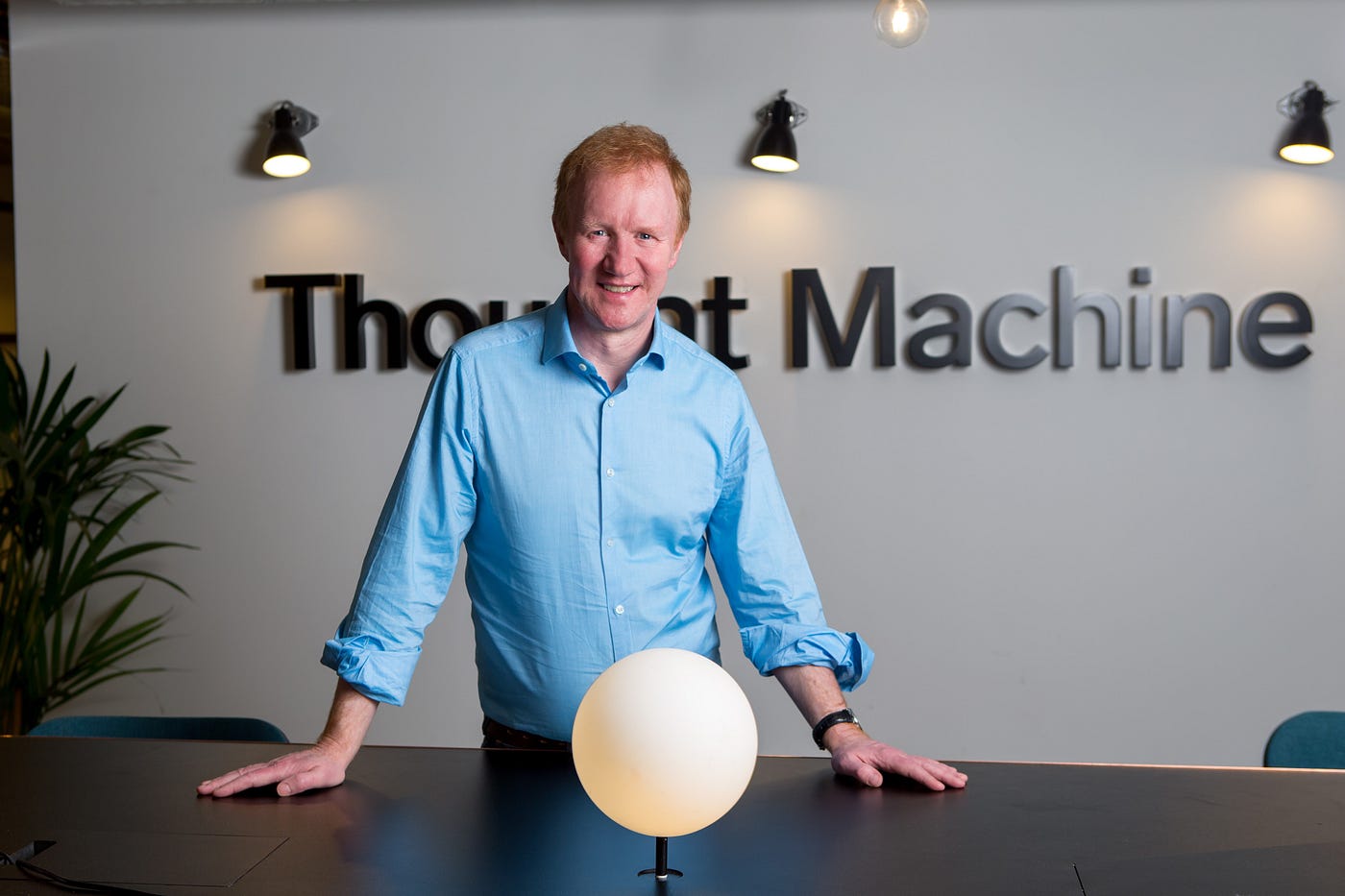
As a part of our series about business leaders who are shaking things up in their industry, I had the pleasure of interviewing Paul Taylor.
Paul Taylor founded Thought Machine in 2014 to bring modern cloud native technology to the banking and financial services industry. Prior to Thought Machine, Paul is best known for his work at Google building the text-to-speech technology now installed in more than one billion Android phones. Paul has founded two other technology companies and has held posts at University of Edinburgh and University of Cambridge.
Thank you so much for doing this with us! Before we dig in, our readers would like to get to know you a bit more. Can you tell us a bit about your “backstory”? What led you to this particular career path?
Before Thought Machine, I founded two other technology companies: Rhetoric Systems, which was acquired by Nuance, and Phonetic Arts, which was acquired by Google. After Phonetic Arts, I joined Google to lead the team of engineers responsible for writing the algorithms and launching their text-to-speech system in 2012. This provides the entire basis of all Google’s speech output, which can be found in daily usage around the world when people do voice searches or listen to driving directions.
After three years at Google as an engineer, I had an itch to build my own business again. I had become aware of the biggest problem in banking: reliance on legacy core banking technology. While most other industries have moved to cloud computing, banking still runs on ancient mainframe technology. I wanted to bring the same modern, cloud technology I was exposed to at Google to solve this problem in banking. In 2014, I founded Thought Machine. The core banking engine we have spent years building, Vault, is now deployed in top-tier banks around the world.
Can you tell our readers what it is about the work you’re doing that’s disruptive?
The majority of the banking industry is running on outdated technology built in the 1970s. Technology which does not allow banks to launch products for the 21st century customer. In an attempt to solve these problems, incumbent technology vendors have been selling off-the-shelf banking software that offers a tenure of ten years at most, with ongoing maintenance and licensing costs.
I founded Thought Machine to chart a new path for core banking services. I wanted to build a truly modern system that enables continuous innovation at a rate unthinkable to traditional banks. To do this, we built a core banking engine which was cloud native — meaning it was built entirely from scratch using cloud native design principles. The same cloud native technologies which underpin Google, Netflix, and Spotify. Our core banking technology unlocks real flexibility as banks, big and small, can customize it and launch any product imaginable at speed.
We all need a little help along the journey. Who have been some of your mentors? Can you share a story about how they made an impact?
My most influential mentor has been Peter Denyer, founder of VLSI Vision. I met Peter in the early 2000s when I was a lecturer. Peter was previously a lecturer and professor at University of Edinburgh, before he went on to found VLSI Vision. I met him by chance when he candidly asked me if I had ever thought of founding a company. I had a business idea, but no idea how I could possibly achieve it. Peter demonstrated how to subject your idea into a credible business idea and then into reality. After we met, Peter wrote me a blank cheque to invest in my company before we had given it a name. It’s hugely helpful to have a mentor who shares a similar background to you and sees your potential, especially when you are starting a business.
In today’s parlance, being disruptive is usually a positive adjective. But is disrupting always good? When do we say the converse, that a system or structure has ‘withstood the test of time’? Can you articulate to our readers when disrupting an industry is positive, and when disrupting an industry is ‘not so positive’? Can you share some examples of what you mean?
Successful disruptors break old models, to then build better ones that benefit the majority. Elite disruptors go one step further. They adopt a mindset of continuous improvement and build systems that stand the test of time. When Netflix first launched in the 1990s it exclusively shipped DVDs, and their IT architecture centered around an Oracle data centre. Embracing continuous improvement, Netflix adopted and brought modern cloud native technology to the entertainment industry. Now, Netflix is not just the disruptor of film entertainment but the de facto leader. At Thought Machine, we are bringing this same cloud native technology to banking. We want banks to be equipped with the most agile, modern technology as they deliver new and improved banking experiences for their customers.
Can you share 3 of the best words of advice you’ve gotten along your journey? Please give a story or example for each.
“There is no upper limit to productivity.” When I worked at Google, there was minimal manual work involved in testing and releasing products. The removal of nearly all unnecessary hiccups in the development pipeline means world-class engineers spend their time on high value, creative tasks. At Thought Machine we have built a similar culture to produce a highly productive workforce capable of generating software far quicker and to a higher standard than other companies in fintech.
“If everything seems under control; you’re not going fast enough.” — Mario Andretti, F1 racing driver. Often in life we want to feel in control and enjoy a high level of predictability, but that rarely leads to greatness. In a fast-paced industry such as financial technology, it pays dividends to respond quickly, especially during times of uncertainty and change.
“Give the customer what they want.” This was the answer I received from a sales guru at my first company when I asked, “What is the secret to selling”? It was a simple answer to a complex problem, but it’s true. If you listen and understand a customer’s point of pain and demonstrate how you can solve it, then you are far more likely to win over the customer. If you can do this at scale, you will have a successful business.
We are sure you aren’t done. How are you going to shake things up next?
Last month, we closed our series B round at $115m, the fourth largest fintech round in the UK this year. This funding happens in the global context of an increasing demand for truly future-proof core banking infrastructure. With an acceleration of hiring and new funding, Thought Machine is embarking on its next stage of global growth. Following our launch in Singapore last year, Thought Machine is focused on expanding internationally and we recently joined the Mastercard Start Path startup engagement program to help us build our presence in Asia Pacific, North America and Australia.
Do you have a book, podcast, or talk that’s had a deep impact on your thinking? Can you share a story with us? Can you explain why it was so resonant with you?
When I was 16 a special alumnus was visiting my school to give a talk. It was Nobel Prize winner Ernest Walton. Ernest told his remarkable story to a hall full of students: while he was doing his PhD at Cambridge University, he was assigned the task of splitting the atom alongside his teammate John Cockcroft and their boss Ernest Rutherford. At this stage, this had never been done before. Ernest explained how one day while Rutherford was away, he positioned the experimental apparatus in a position that his boss thought would never work and gave it another go. It worked! Ernest Walton was the first person in history to split an atom. Ernest went on to win a Nobel Prize for physics in 1950. I was blown away by his journey, which started at my school, Methodist College Belfast, and I thought “I’m going to work harder at science.”
Can you please give us your favorite “Life Lesson Quote”? Can you share how that was relevant to you in your life?
I’m not sure if it’s a life lesson quote, as much as it is a personal motto: don’t be afraid to jump in. It’s an important lesson to entrepreneurs who have an idea to challenge the status quo. In my case, I was in my 30s working in academia and had a business idea to build upon the text-to-speech technology that I had invented at university, but I knew very little about building a company. Despite being an academic, not a businessperson, I decided to jump in and co-founded my first tech company Rhetorical Systems. This motto still drives me today.
How can our readers follow you online?
I can be followed on Twitter at @PaulTaylorCEO and Thought Machine can be followed at @ThoughtMachine.
JH
Written by
Jason Hartman
Editor & Journalist · Authority MagazineJason Hartman is a senior columnist at Authority Magazine covering Business and Tech, conducting primary-source Q&A interviews with founders, executives, and industry leaders.

Published inAuthority MagazineTop Lessons, Top Authorities · 42K Followers
Exclusive, curated interviews with the leaders and changemakers shaping tomorrow. Leadership lessons, industry deep dives, and executive profiles.