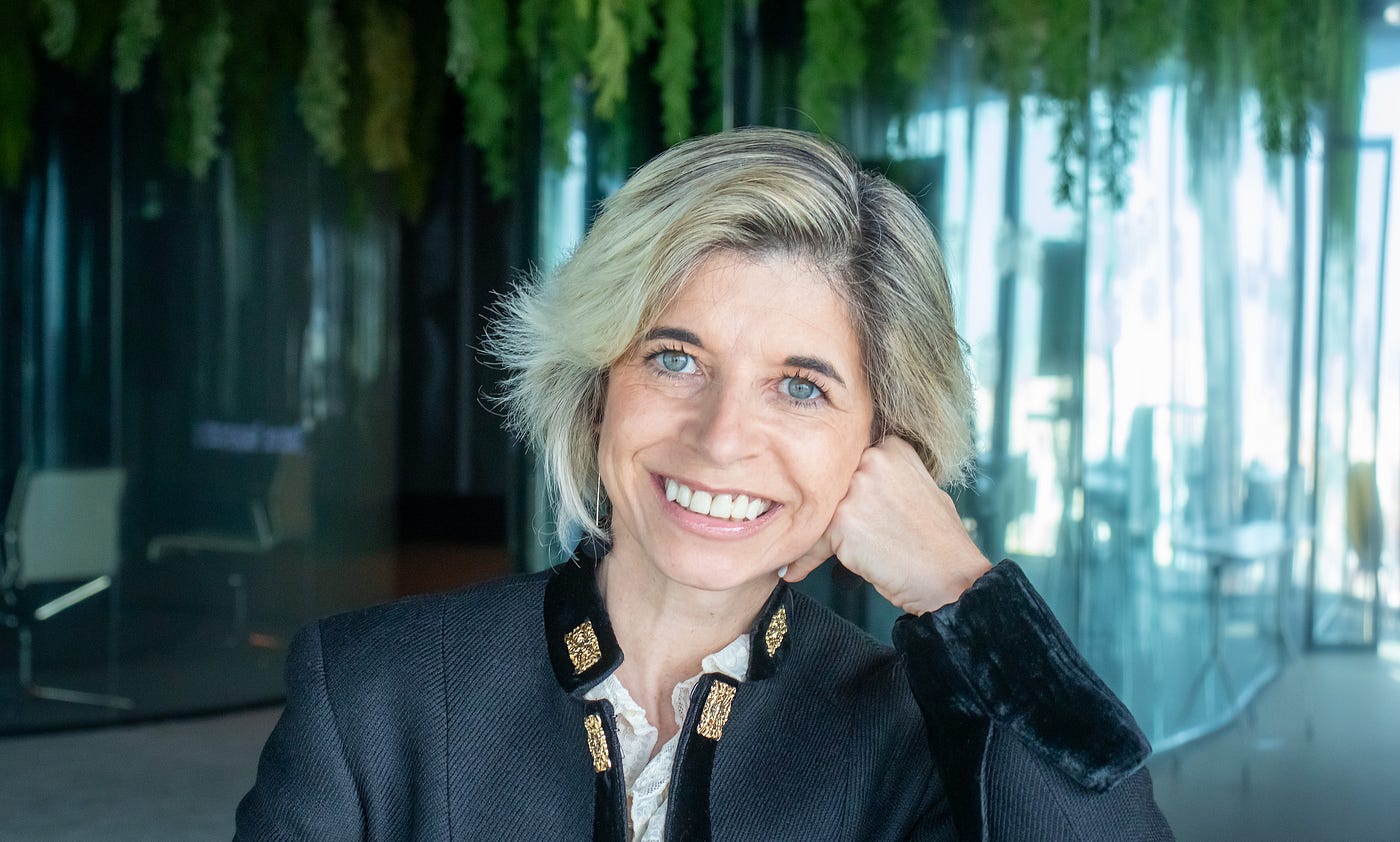
I was never a translator but studied general linguistics aspects such as morphology, phonology, syntax, and historical linguistics (relationships between language families).
Tech
Olga Beregovaya: The Extreme Curiosity And Stubbornness That Drive AI Innovation In Global Enterprise Translation
Smartling VP Olga Beregovaya shares her journey through language technology and explains how businesses can transition from AI frenzy to verified trust.

Artificial Intelligence is no longer the future; it is the present. It’s reshaping landscapes, altering industries, and transforming the way we live and work. With its rapid advancement, AI is causing disruption — for better or worse — in every field imaginable. While it promises efficiency and growth, it also brings challenges and uncertainties that professionals and businesses must navigate. What can one do to pivot if AI is disrupting their industry? As part of this series, we had the pleasure of interviewing Olga Beregovaya | VP of AI and Machine Translation at Smartling.
Olga has over 20 years of experience in Language Technology, NLP, Machine Learning, Global Content Transformation and AI Data development and is passionate about growing businesses through driving change and innovation. Olga started her career in language technology building lexicons and rules for Rule-based machine translation, gradually expanding her expertise into other broader applications of NLP and Machine Learning to enterprise translation workflows. Olga has also served as President of AMTA, currently serves as a Vice President and Technology Program Sponsor for Women in Localization and as an Advisor for Engineering Leadership at California State University, Chico. Olga received her MA, Linguistics/Germanic Studies at UC- Berkeley and MA/BA in Linguistics from St. Petersburg State University.
Thank you so much for joining us in this interview series. Before we dive into our discussion our readers would love to “get to know you” a bit better. Can you share with us the backstory about what brought you to your specific career path?
Since relatively early childhood, say, three years old, I started learning English as a second language, and I’d say by the age of four, I was pretty fluent. Around the same time, my response to “What do you want to be when you grow up?” was consistently “I want to work with languages.” So, I went to a school specializing in languages and then studied linguistics at Saint Petersburg State University back in Russia, then at UC Berkeley for my second Master’s degree. I was never a translator but studied general linguistics aspects such as morphology, phonology, syntax, and historical linguistics (relationships between language families). From there, the career path was pretty straightforward — I was always in Natural Language Processing. As the science and applications of Natural Language Processing were evolving towards Machine Learning and AI, I was developing my skill set and experience along the same trajectory. I also started engaging with several industry associations, one of them being Women In Localization, where I serve as a Vice President and Technology Program sponsor, as I find it essential for women to have a strong representation in the Technology field.
What do you think makes your company stand out? Can you share a story?
I will start with the Wild West analogy. We are witnessing the AI Wild West syndrome — companies reading about the next AI “breakthrough” (which is often to be proven when it comes to its practical value), experimenting with different ways of implementing AI in their translation processes, and soon discovering that they need a trusted partner to help them navigate the AI hype. And this is where Smartling is unique — we take our customers from “AI Frenzy” to “Trust in AI.” We are a Global Content Transformation platform featuring more connectors to 3rd party platforms than any other Translation Management system out there, which means that we drive outcomes for our customers across a variety of content types. Through myriad deployments and our R&D experimentation, we have nailed the right translation approach for virtually any content type out there. At this moment, we are investing a lot of time and effort into “nuanced prompt engineering,” making sure that our clients’ most subtle stylistic requirements can be addressed in a repeatable and scalable manner. It is easy to write a prompt “make this text sound formal”, but how easy is it to adapt the content from the same hotel chain if today they are selling to backpackers in Latin America and, tomorrow — to luxury travelers in Spain? Or, correct inherent language model biases, where a doctor is always a male, but a nurse is always a female. We deal with cases like this on a daily basis and gather data and metrics across our hundreds of customers.
You are a successful business leader. Which three character traits do you think were most instrumental to your success? Can you please share a story or example for each?
- Extreme curiosity: Ever since I was a child, I always spent time reading and studying, not because I had to, but because I was always curious about the intricacies of the world around us, about various subjects in both science and humanities, about the opinions and ideas coming from people around me. I was one of those kids hiding under a blanket at night with a flashlight so that I could read the history of the Roman wars way past my bedtime. I believe this is one of the traits that help me thrive in driving innovation and always looking for what’s coming next, which could not be more relevant at the time of the AI revolution. That, and the ability to listen to other people and always be willing to learn from them, is crucial to succeeding.
- Equally extreme stubbornness: I never allowed myself to be discouraged by failures and learned early on in life to “fail fast and start over.” Guess I can be best described as a go-getter; if I have set my mind on something, and if I see a clear goal, I will jump through any hoops to achieve it. For instance, it took me four times to get my driver’s license when I first came to America (and the guy who let me pass my exam was a very brave man, who, however, asked me to please not drive in the area where he lives), but if I needed the 5th, the 6th or more attempts — I would keep on trying until I got it. I guess this stubbornness, or maybe better called “determination” of mine, is also contagious, as I often hear that I can easily inspire others to follow my ideas and vision.
- “Pulling the rabbit out of the hat” — What also has helped me tremendously is always thinking about not just Plan A, but also “Plans B through Z”; no matter what, there should and always will be a solution. For instance, once at one of the companies I worked for, we kept a certain portion of our Natural Language Processing tools within one vendor, whose CEO called me one shiny morning and announced that the company had been sold and that they would terminate their operations with us immediately. Having tens of millions of dollars at stake, I gathered my team, and together, we came up with perhaps the fastest technology migration plan in history and executed it seamlessly.
Let’s now move to the main point of our discussion about AI. Can you explain how AI is disrupting your industry? Is this disruption hurting or helping your bottom line?
AI is what makes our industry reinvent itself completely. The old “charge per word for human translation, while carrying massive project and process management overheads” business engagement model is already giving way to new approaches — for instance, what we refer to as AIHT — AI-powered Human Translation here at Smartling. Because of the super lean automated processes and LanguageAI powering every step of the translation process, we are able to commit to quality “at half the cost.” As I mentioned, AI is disrupting all stages and facets of an Enterprise Localization Journey — from product design and development to project management decision-making, P&L modeling, actual text translation, multimedia localization, and quality estimation. There is not an area in localization that has not been or will not be touched by AI. Now, as far as the bottom line goes, being able to capture more content, making it more affordable, and shrinking the local time-to-market for corporations will drive the top line up, no doubt. Multinational companies will continue to spend on their global expansion, and the content explosion will only go up with the use of AI-generated content. What we do with the bottom line is up to us — having lean processes, the ability to do “more with the same staff”, and using AI as a human enabler — are all factors contributing to the healthy bottom line trajectory.
Which specific AI technology has had the most significant impact on your industry?
The impact of AI Technology in the Translation and Localization Industry can be described in three points:
- First, about five years ago, the huge leap from Statistical to Neural Machine Translation completely changed how our industry thinks about productivity, efficiencies, and cost savings. The years of stigma around the quality of Machine Translation gave way to confidence in the reliability of the MT output and drove enterprise-scale MT deployments across various industries. Let us not forget that Neural MT is as much of AI, as any other AI application.
- Second, most definitely, GenerativeAI and its impact on how we think about multilingual content. We see Large Language Models used for both text translation and text generation in a target language from scratch; LLMs are also producing multilingual copy, approaching human parity very closely when it comes to fluency. Accuracy, especially factual accuracy, still needs work, but when Large Language Models are used for Automated Post Editing, the industry sees results never seen before — brand voice, stylistic preferences, formality, and grammatically accurate terminology insertion.
- Third, and this impacts the multi-media segment of the industry, is the emergence of state-of-the-art Automated Speech Recognition and Text-to-speech generation. Every corporation has Marketing, eLearning, Employee Training and similar content, and the new, human-quality generation of synthetic voices will bring about tremendous cost and time savings in localizing this content. As far as ASR and transcription go, with AI, the accuracy of ASR-based transcription and subtitling has gone up exponentially, yet again driving down costs and increasing efficiency. These technologies have also driven major changes in the Interpretation space, allowing for instant automated interpretation using ASR-MT-TTS, often built within one seamless process within the same AI model.
Can you share a pivotal moment when you recognized the profound impact AI would have on your sector?
Testing GPT2 (and this was two generations of the GPT family ago!) and realizing the tremendous potential of Large Language Models when it came to solving a variety of problems and executing what seemed to be impossible tasks (write me a poem in Japanese, following the haiku verse structure). Again, the models were hallucinating, but they still were executing the task. This was the moment the light bulb came on in my head — if this is now, we can only imagine what is coming next, and so it did.
How are you preparing your workforce for the integration of AI, and what skills do you believe will be most valuable in an AI-enhanced future?
There are three aspects of preparing the translation industry workforce for the integration of AI:
- Preparing the actual tools developers and data scientists for building tools that are “fit for purpose” and finding the right approaches for the specific industry problems (say, automating the translation of different content types using MT, LLMs, and other NLP techniques). The language engineering workforce needs to be able to weed through “shiny objects” and identify the AI technologies that really help address actual business needs.
- Implementation and deployment: I will again return to the hype concept. We speak to many localization leaders under executive pressure to “Implement AI across the board”; quite often, this phrase has very little practical meaning. Localization leaders and program and project managers should know how to manage upstream or when to engage their supplier-side trusted partners and help their companies design a viable, responsible, and scalable AI strategy.
- Helping linguists make the best of AI as a “Language Co-pilot” — train linguists on working with NMT and LLM-produced translations, teach them to spot the potential errors (NMT may be disfluent, but factually accurate and actionable, while LLMs would produce what’s known as “false fluency,” and hallucinate, “dreaming things up”). Another vital area where we should be upskilling our linguists is “prompt engineering accessible to everyone.” There are only this many data scientists in the world, and those data scientists do not speak all the languages on the planet. This is where linguists proficient in the basics of prompt engineering will be playing a pivotal role — creating, testing, and iterating on prompts to produce the most optimal foreign language content.
What are the biggest challenges in upskilling your workforce for an AI-centric future?
Just like with post-editing the machine translation output, where for years we saw extreme resistance to adopting this translation approach on the part of the global workforce, I would say that now acceptance of turning from a translator to the “SME validation human-in-the-loop” role is following the similar path. Translators are expressing concerns about losing their creativity and becoming “an extension of a machine”. The skills themselves — learning how Language AI works and what to look out for when working with different AI technologies — may not be that hard to master. The willingness to learn seems to be the biggest blocker.
What ethical considerations does AI introduce into your industry, and how are you tackling these concerns?
The main ethical AI considerations for our industry are as follows:
- Potentially damaging and harmful content produced by GenerativeAI itself (various biases, a phenomenon known as “toxic AI,” and potentially harmful inaccurate statements, may bring about detrimental consequences. Imagine machine-translated or AI-generated copy that tells the end user to “pull a lever” as opposed to “do not pull the lever” — it can easily lead to a crane falling on a construction site. And this is construction; now, think about medical instructions or erroneous text narrated in AI-generated employee eLearning materials.
- As of now, the likes of deep fakes do not directly impact the localization industry, but it is always just a matter of time.
Here in the US, the president’s recent executive order, putting guardrails around the implementation of AI, marks a significant milestone in the United States’ approach to AI, striking a delicate balance between promotion and control. Rather than viewing it in isolation, it should be recognized as part of a global initiative undertaken by governing bodies to ensure AI’s safe and ethical practice. Policies and regulations are now catching up with the current state of AI research, and both regulatory measures and success metrics are pivotal in advancing AI responsibly on a global scale
From a professional standpoint, it is my belief that AI tools should be employed strictly based on their intended purpose. Natural Language Processing applications can be utilized for a purpose they were not originally designed for and, hence, can be misused for malicious purposes. The widely accepted guideline, endorsed by various Ethical AI groups, emphasizes the careful application of machine-generated text, including machine translation, limiting its use to scenarios that do not carry legal, liability, or other potential adverse consequences.
Such tools are deemed suitable for information-sharing objectives where the audience needs to understand the original language content without expecting to take actionable steps.
Far from hindering growth, these measures construct necessary guardrails around the current AI landscape, establishing a foundation for future expansion. They address a pressing societal concern regarding AI — trust and ethical deployment.
As confidence grows in the thorough testing and vetting of AI applications, particularly Large Language Models, it will not impede growth and innovation; instead, it will stimulate greater adoption. This, in turn, will fuel future research and development activities, creating a positive feedback loop for the advancement of AI technology.
Governments and regulators have largely overlooked the challenge of “watermarking” AI-generated content. This task is complicated by the increasing difficulty in differentiating AI-generated text and multimedia from human-created content. Two potential approaches are establishing reliable detection mechanisms or implementing conspicuous watermarks to identify AI-generated content easily.
The concern about publishing and indexing machine-generated content, evident in Google’s past refusal to index such content, has persisted for a decade. The current escalation of concerns arises from the growing indistinguishability between AI-generated and human-generated content, posing challenges in content identification and management.

What are your “Five Things You Need To Do, If AI Is Disrupting Your Industry”?
1 . Analyze and vet. If you see the avalanche of AI applications relevant to your industry flooding your professional news feeds or coming up in your customer conversations, take a pause and assess the actual validity of the claims being made; take time to separate noise from the actual transformative applications
2 . Look at the way you make money — your business model. Identify the areas that will be most impacted by AI and can be most damaging for your revenue and bottom line, and identify the opportunities for turning AI from your “enemy” into your revenue enabler.
3 . Assess your current workforce and identify what new skill set is needed for your company to be successful. Reskill your existing talent, hire where needed, and invest in internship and mentorship programs.
4 . Have a very strong stand on the ethical and responsible implementation of AI in your industry; task your in-house legal counsel with studying data transmission, retention, and reuse clauses in AI providers’ SLAs, ensure compliance with local regulations, and make sure that your company is not in infringement of any local labor laws.
5 . Overcommunicate — be very clear in your message to the market about the ways you adopt and embrace AI for the benefit of your customers. AI, being a borderline terra incognita, makes the market out there hungry for how-tos, deployment best practices, whitepapers, and overall clear messaging, which will help them navigate the turmoil.
What are the most common misconceptions about AI within your industry, and how do you address them?
The most common misconceptions are:
- AI is the silver bullet, which will solve all the industry cost-time to market and quality problems and render translators, terminologists, and other language experts obsolete. The reality is that GenerativeAI still requires a lot of work when it comes to handling translation and generating content in foreign languages. Here at Smartling, our tests clearly show that large language models are not yet the best fit for translation tasks and often deliver translations inferior to translations produced by the traditional neural machine translation transformer models. LLMs do still hallucinate and produce factually inaccurate copy, and even more so when it comes to foreign language content, often because the training data is English-centric and reflects the phenomena from the English-speaking world.
- I believe that the impact of AI on non-textual content forms is seriously underestimated, if not almost overlooked. AGI and Generative AI revolution mainly applies to text transformation and generation.
- While other industries are capitalizing on LLM multi-modality, using generated images and videos to augment their product and Marketing strategy, we as an industry still mainly focus on translation. Now, think of the Generative AI potential when it comes to Text-to-speech, replacing the standard Desktop publishing practices with generating images in the target language, a complete overhaul of multimedia localization, and internationalization of the UX design. Maybe it is just the product of the industry’s traditional thinking in “text first” terms, and other applications of AI will catch up later.
Can you please give us your favorite “Life Lesson Quote”? Do you have a story about how that was relevant in your life?
“If it will not matter in five years, it does not matter” — I spent a good part of my career and personal life engaging emotionally and worrying about “the matters of the day,” be it “this person did not approve of my idea” and “that person went behind my back, presenting my idea as his/hers.”
Over the years, I believe, or hope, that I learned to separate what really matters and will have an impact on my life, the success of the business, and the overall well-being of humanity from the problems of the day, which will have no positive impact.
My favorite quote of all time is text on a tombstone: “Here lies John. When he was crossing the road, he was absolutely right, but now he lies here just like he would if he was wrong.” This is also one of my biggest lessons in life: what do you want to get — prove your point and make sure that you always come out as the winner, who is right, or actually drive things forward, worrying less about always winning the argument, and more about how to make the best of a specific situation for the best positive outcome, even if it takes “leaving ego at the door.”
Off-topic, but I’m curious. As someone steering the ship, what thoughts or concerns often keep you awake at night? How do those thoughts influence your daily decision-making process?
In this time and age, starting about two years ago, any leader directly involved with AI, spearheading their company’s AI strategy and vision, and also involved in different industry associations, yet again contributing to the way the industry is influenced by the emerging technologies — one is lucky to be getting any sleep, given how rapidly things change daily.
It is not a concern, but rather something that is the underlying thought behind my decision-making: how do we as an industry make sure that we benefit from what’s practical and useful about the AI innovation “on steroids” right now, and see through the crystal ball for the near and remote future. What keeps me awake is separating the true “contributing technology” from “the hype” and being able to guide our customers to benefit most from their Language AI journey.
The hype curve is real, and my daily decisions are mainly influenced by assessing the viability and necessity of including AI in our tech stack. Short: separate the real from the unconfirmed promise, and make the best of it.
You are a person of great influence. If you could start a movement that would bring the most amount of good to the most amount of people, what would that be? You never know what your idea can trigger. :-)
This again will tie to diversity in the technology sector: I would most definitely start a movement (although it perhaps is more of an initiative) focusing on giving kids with learning disabilities or mental health issues an opportunity to learn, participate, prosper, and be equal contributors to the technology revolution. AI is not only a field of study, but it is also an enabler that should help such kids master the skills that would otherwise be out of their reach. As we now have established, when it applies to AI, the diversity in the model design, data collection, and development team is the most winning path towards mitigating model bias “at the source”.
How can our readers further follow you online?
https://www.linkedin.com/in/olga-beregovaya-04b5/
Thank you for the time you spent sharing these fantastic insights. We wish you only continued success in your great work!
About the Interviewer: Cynthia Corsetti is an esteemed executive coach with over two decades in corporate leadership and 11 years in executive coaching. Author of the upcoming book, “Dark Drivers,” she guides high-performing professionals and Fortune 500 firms to recognize and manage underlying influences affecting their leadership. Beyond individual coaching, Cynthia offers a 6-month executive transition program and partners with organizations to nurture the next wave of leadership excellence.
CC
Written by
Cynthia Corsetti
Editor & Journalist · Authority MagazineCynthia Corsetti is a contributing interviewer at Authority Magazine covering Tech and Business, conducting primary-source Q&A interviews with founders, executives, and industry leaders.

Published inAuthority MagazineTop Lessons, Top Authorities · 42K Followers
Exclusive, curated interviews with the leaders and changemakers shaping tomorrow. Leadership lessons, industry deep dives, and executive profiles.