Our society constantly renews itself and continues to exist thanks to the energy of the young. Yet we struggle with how to pass on the knowledge of what we have learned and achieved to younger generations without stifling their creativity and potential to build a better life.
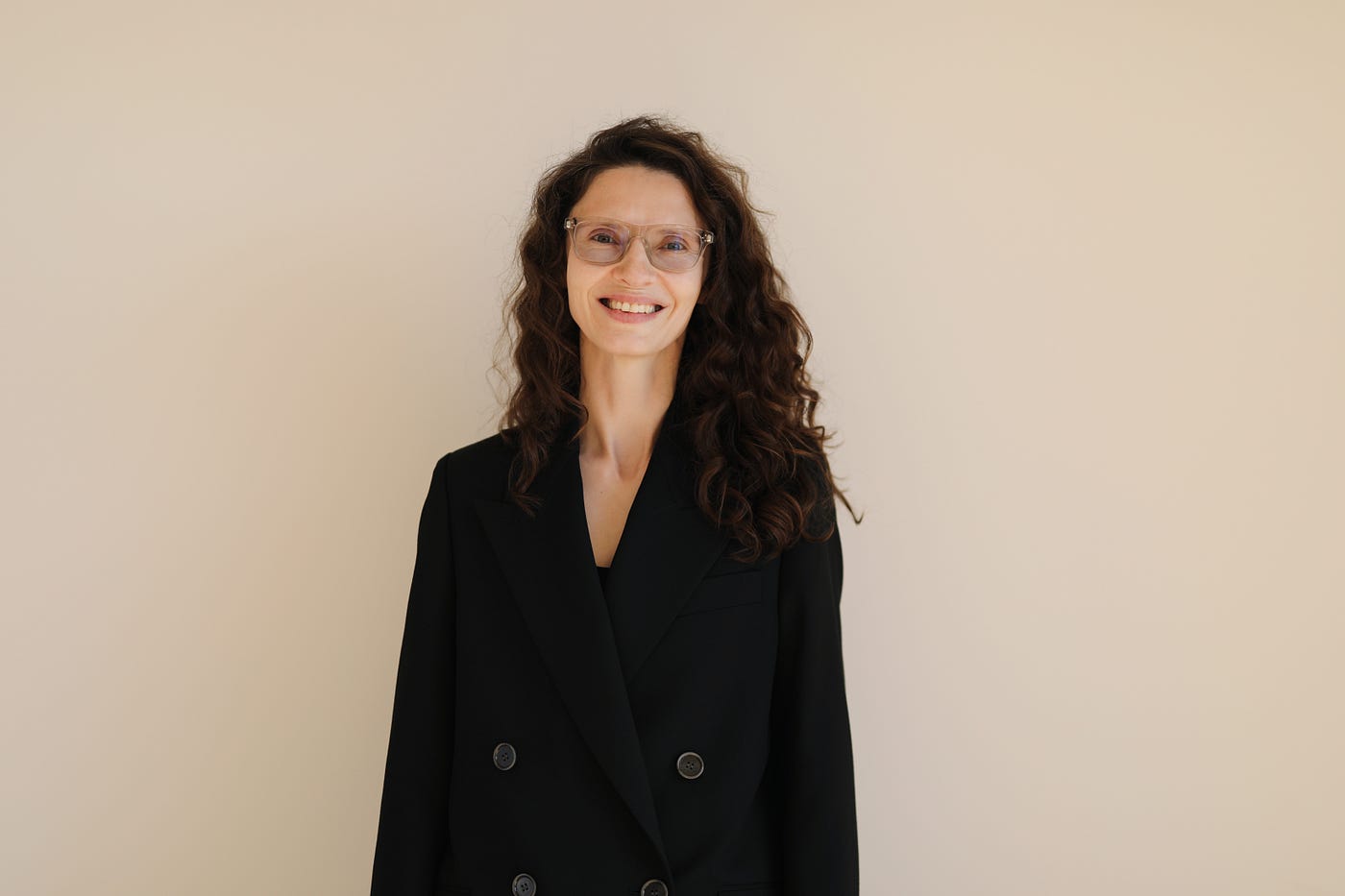
As a part of our series about women who are shaking things up in their industry, we had the pleasure of interviewing Masha Liberman.
Maria (Masha) Liberman is a Los Angeles-based technology executive, entrepreneur, and investor who was born in Moscow, where early experiences with political and economic instability shaped her lifelong interest in individual freedom and economic opportunity. After building a series of technology and media ventures with her siblings, she was acqui-hired by Snap Inc. in 2016, where she spent more than four years helping develop the technology that became the foundation for Snapchat’s 3D Bitmoji. She went on to co-found Product Science, Libermans Co., and Frank Money, served on the board of The Fuller Project, and today, as CEO of Humanism, an investment approach centered on the value and potential of people, she focuses on how a changing economy is reshaping human capital, entrepreneurship, and opportunity, topics she writes about regularly on her Substack.
Thank you so much for joining us in this interview series! Before we dig in, our readers would like to get to know you a bit more. Can you tell us a bit about your “backstory”? What led you to this particular career path?
My career path was bumpy, disrupted by a series of catastrophic events. I was born in the Soviet Union into a family of established scientists. My father was a laureate of the Stalin Prize, the country’s highest scientific award. I was the oldest daughter, an A+ student, and a valedictorian. My path into science seemed predetermined. But when I was thirteen, the country collapsed. My parents lost their livelihoods. They were too old and had six young children to care for, making it difficult to adapt to the new realities. My family survived in great part because of aid from American foundations. Every piece of clothing I owned was donated by American humanitarian organizations. This experience left me with a deep appreciation for philanthropy.
While I was still in college, the country began turning away from free elections and freedom of the press, leaving science in even deeper decline. During my graduate studies at Moscow State University, I worked as a geoengineer on the construction of Moscow’s new downtown and witnessed one of the most corrupt and irresponsible construction projects of the century. I dropped out of my PhD program and started a VC firm with my siblings, which helped me connect with the most exciting thinkers and projects emerging in Russia at the time. Nearly everything we built was aimed at disrupting the media industry.
After the global financial crisis, funding dried up, but the crisis also opened a narrow window of opportunity. We no longer had to compete with big corporations and corrupt intermediaries. With sheer talent and knowledge, we secured a direct contract with Russia’s largest TV network to build an innovative show.
Later, after being acqui-hired by Snapchat to lead a team creating Bitmoji, I moved to the US. I quickly saw how American Big Tech siphoned talent from around the world by offering outsized compensation to keep people working within these companies, often preventing them from building something better or different.
After leaving Snap, I set out on a mission to establish a new channel of financing for younger people, one that would help them build wealth, gain influence and independence, and pursue what they deem important earlier in life.
Can you tell our readers what it is about the work you’re doing that’s disruptive?
My interest has always been in disrupting elites and the status quo that creates barriers for human potential. In my current work, I focus on expanding power and economic opportunities for young people. There is a fundamental human need to transfer wealth from the present to the future to ensure support when one can no longer work. And there is also a fundamental human need to receive support when one is too young. Surprisingly, as a society, we greatly innovated with regard to pensions so that we can support our older selves, but achieved very little progress in how we tend to the needs of younger ages. To fix that imbalance, I work to change the perception of retirement savings from something that needs to be stored into something that needs a courier to carry it into the future, and to shift the perception of younger people from those who are seen as a liability to those who are these essential couriers. The Humanism Fund that I cofounded creates investment products that managers of retirement savings can use to invest in human potential.
Can you share a story about the funniest mistake you made when you were first starting? Can you tell us what lesson you learned from that?
I still remember how, as a mailroom clerk at my first job, I sent an invitation to a board meeting to someone who had just been ousted as chairman and had to leave the country due to prosecution. They apparently complained about receiving the invitation, and within minutes, the entire company knew that its youngest clerk was so ignorant that she apparently didn’t even follow the news.
In fact, I was following the news, but I considered it a matter of common courtesy to send an invitation to a sitting board member, even if they couldn’t attend.
I learned that doing what you believe is right, based on your values, doesn’t necessarily mean that others will see it the same way, let alone reward you for it. But the reactions of others don’t change who you are as a person. That lesson has stayed with me, helping me stand by my values when facing difficult decisions.
We all need a little help along the journey. Who have been some of your mentors? Can you share a story about how they made an impact?
I’ve had many wonderful mentors, older and wiser than me, but I think we underestimate the impact our peers have on us when we are young.
For example, a good friend was just one year ahead of me in her career, as I was in graduate school. While applying for countless positions in search of my first job, I received an unpaid assignment to evaluate an ed-tech project for philanthropic impact investing. I thought I had done an amazing job writing a scathing report about its many flaws and outdated technology, based solely on the project’s website.
My friend pushed me to go the extra mile and actually reach out to the project team and meet with them. I made a good impression and got the job, but my report also changed. While I maintained my negative verdict, I was now able to recognize the role the project played in its community.
Advice like that might have been difficult to accept and embrace had it come from someone in a position of authority. Coming from a peer, however, it became an honest and natural learning experience.
These days, watching the catastrophic collapse of entry-level hiring, I can’t help but wonder whether we are not only failing to make the necessary investments in developing the next generation of workers, but also eroding the environment in which young employees can learn from one another.
In today’s parlance, being disruptive is usually a positive adjective. But is disrupting always good? When do we say the converse, that a system or structure has ‘withstood the test of time’? Can you articulate to our readers when disrupting an industry is positive, and when disrupting an industry is ‘not so positive’?
Can you share some examples of what you mean?
Disruption and preservation are two natural forces in the cycle of life. Neither can exist without the other, and both are vital. I love Hannah Arendt’s description of this cycle and our struggle with it in her essay “The Crisis in Education” from the 1950s.
Our society constantly renews itself and continues to exist thanks to the energy of the young. Yet we struggle with how to pass on the knowledge of what we have learned and achieved to younger generations without stifling their creativity and potential to build a better life. It is this balance we are constantly seeking, and when we have a strong sense that either force has gone wrong, it is likely an imbalance that we are feeling.
Right now, our society is deeply tilted toward preserving its financial structure, which, unfortunately, resembles a balance sheet where older people own all the assets and younger people bear all the liabilities. Much of what is presented as disruption is, in fact, an attempt to preserve this imbalance of power. We can see it in the way a select few AI giants attract outsized financing while remaining deeply unprofitable.
My industries, technology and venture capital in particular, promised change, only to end up as a small cog in a machine of financialization that has driven consolidation and monopolization — the antitheses of innovation.
We should therefore be careful with labels and pay close attention to trends, as they can reveal the consequences of earlier disruptions that were either left incomplete or went badly wrong.
Can you share 3 of the best words of advice you’ve gotten along your journey? Please give a story or example for each.
1. Between Silicon Valley and LA — choose LA.
Not quite advice, but rather a contractual term. Snapchat made me and many other great talents from all over the world take a turn and change a destination that had seemed predetermined. We joined one of the few big tech companies headquartered not in the San Francisco Bay Area, but in one of the largest and most diverse cities in America, a city that inherited many of the country’s problems and is a living representation of how deeply rooted they are and how much work is required to upend them.
Only later did I realize what a great opportunity I had been given to live and work outside the comforting and exciting tech bubble.
2. Proactively study culture and try to understand other people’s values and traditions.
This was advice I received many times from many wonderful people, from my sons’ elementary school teacher to an investor in my startup.
A hard truth I learned during my time in tech is that successful products (those that show rapid initial growth) are always based on a deep, insider understanding of a culture. It can be the culture of a college campus, as in the case of Facebook or Snapchat, thrifters in the case of Craigslist, or travelers in the case of Airbnb. You cannot solve the problems of people you don’t understand and have never met.
At Snapchat, as the company matured, I also witnessed many instances of a bunch of grown-ups trying to create new product features for teenagers. The difficulty of remaining respectful of young people’s values as you grow older is one of the reasons why renewal is so important, whether in company or country leadership.
3. Be less useful.
It’s actually the title of a new book, How to Be Less Useful, by Priyanka Mattoo, whom I’ve known since my TV days. I admire her career shift from being a great talent agent to becoming a fantastic and hilarious writer.
It’s unusual advice. We are used to hearing the opposite. Our content should be useful to gain followers, we should make ourselves useful to people we need something from, and we should be useful to feel needed. But that makes your purpose driven by how other people will value you.
At one point, between projects, I made a long list of groups and people I could be useful to, and how. I realized that instead of asking how I could fit into other people’s missions, I could just follow my own. I keep the list to remind myself that I didn’t follow any of its points, and that only by not following them did I find what I wanted to do next.
We are sure you aren’t done. How are you going to shake things up next?
Next, I want to push for what I call, the Great Rebalancing. We’re seeing rent, tuition, and childcare keep climbing while entry-level jobs keep disappearing. Students, young workers, and parents raising children are told to save, invest, and wait. The only hope for wealth-building is retirement or inheritance, but that money often comes too late to make an impact on people’s lives during major life decisions such as buying a home, starting a family, or taking a career risk.
Retirement funds themselves aren’t as stable as people may think they are. They’re investors, putting contributions into markets and companies, and people’s retirement security depends on how those bets perform. When retirement fund investments underperform, or even break, as they have in the past, real people lose a significant share of what they spent decades paying into. And with retirement money now funding some of the biggest AI companies, the money meant to secure people’s futures is funding the very thing narrowing the next generation’s path to build one.
But institutional capital doesn’t have to choose between retirees and future workers. Instead, we need to look for investments that serve both. We need to build ways for young generations to build wealth now that aren’t risky and volatile, unlike prediction markets. That’s what we’re doing at Humanism — and we need more creative solutions.
Every generation has disruptors who build around the old rules instead of tearing them down, and some people are already identifying these solutions, which I write about in my Substack. I want to convene those disruptors so we can work together toward a world where retirees are secure without sacrificing young workers’ futures, children have what they need while they’re growing up, and a recent graduate can build wealth without waiting for an inheritance or gambling it all away. This is the Great Rebalancing.
In your opinion, what are the biggest challenges faced by ‘women disruptors’ that aren’t typically faced by their male counterparts?
First of all, it is important to remember that marginalisation of women has nothing to do with women, it’s a local phenomenon, deep in history. My experience in Russia is very different from my experience in the US, where gender gaps are extremely pronounced.
Disrupting the status quo takes three things: research to shape your thinking; leadership to inspire your team; and networking to spread the word and build alliances. As with any marginalized group, women have no problem with the first two, but face extreme barriers with the third — and often are left in a situation where they have to step back and let someone else be the face of the work.
But this is not a way out, because when we remove women’s perspectives from the front lines, we inevitably change the mission and leave existing blind spots unaddressed.
I’m proud to have served on the board of The Fuller Project, an organization dedicated to reporting that drives real change for women, and I’m grateful to Authority Magazine for providing a platform for women’s voices.
Do you have a book/podcast/talk that’s had a deep impact on your thinking? Can you share a story with us?
Oh, so many! It’s a tough question. Of the interesting conversations I’ve listened to recently, the one that probably comes to mind first is Annie Lowrey’s interview about her new book, The Time Tax, in which she meticulously collected examples of the burdens people endure to access government benefits or exercise their rights.
I have borne the burden of the time tax throughout my life and know that it is not justified or reflective of one’s contribution to society. I paid it as an entrepreneur in Russia, where society is suspicious of entrepreneurs, as a woman in tech, and as an immigrant. And I see its growing burden on parents and the next generation as their economic power declines. My goal with all the changes I’m trying to implement is to decrease, not increase, the time tax.
However, mistrust of public benefits and a means-tested, even punitive, approach are deeply rooted in liberal political culture and should be addressed with care. I consider it important to find ways to overcome this mistrust so that, as a society, we can learn to treat public expenditures as they are — investments.
You are a person of great influence. If you could inspire a movement that would bring the most amount of good to the most amount of people, what would that be? You never know what your idea can trigger. :-)
I would love for society to unite in learning how to invest in human potential. We had a great epoch of the value of human life, human dignity, and human rights. A lot more remains to be solved, but we also achieved a lot. Now it’s time to dramatically evolve in our ways of thinking about the future.
Can you please give us your favorite “Life Lesson Quote”? Can you share how that was relevant to you in your life?
“The size of your desk should reflect the size of your ambition.”
I came across this on social media, and it most likely was part of some Feng Shui-related advice.
What I love about it is that it doesn’t specify what the right size is. I think a true life lesson cannot be too specific because life is constantly changing. There are times when I look for smaller surfaces and crowded places, as my ambition is narrowly focused or yet to be discovered, often after being written on a paper napkin. And there are times when I take over the entire dining table, covering it with books and papers, and dream big.
How can our readers follow you online?
On my Substack, mashaliberman.substack.com, I write about what a changing economy means for human capital, entrepreneurship, and economic opportunity, and what it would take to build investment models that serve people now and in the future. Each issue offers deep-dive analysis, practical ideas, and questions we should be asking, and explores potential solutions to achieving the Great Rebalancing.
This was very inspiring. Thank you so much for joining us!