The scarce resource is no longer the ability to publish. It is attention and trust.
As part of our series about how to become known as a thought leader in your industry, I had the pleasure of interviewing Fernando Vítolo.
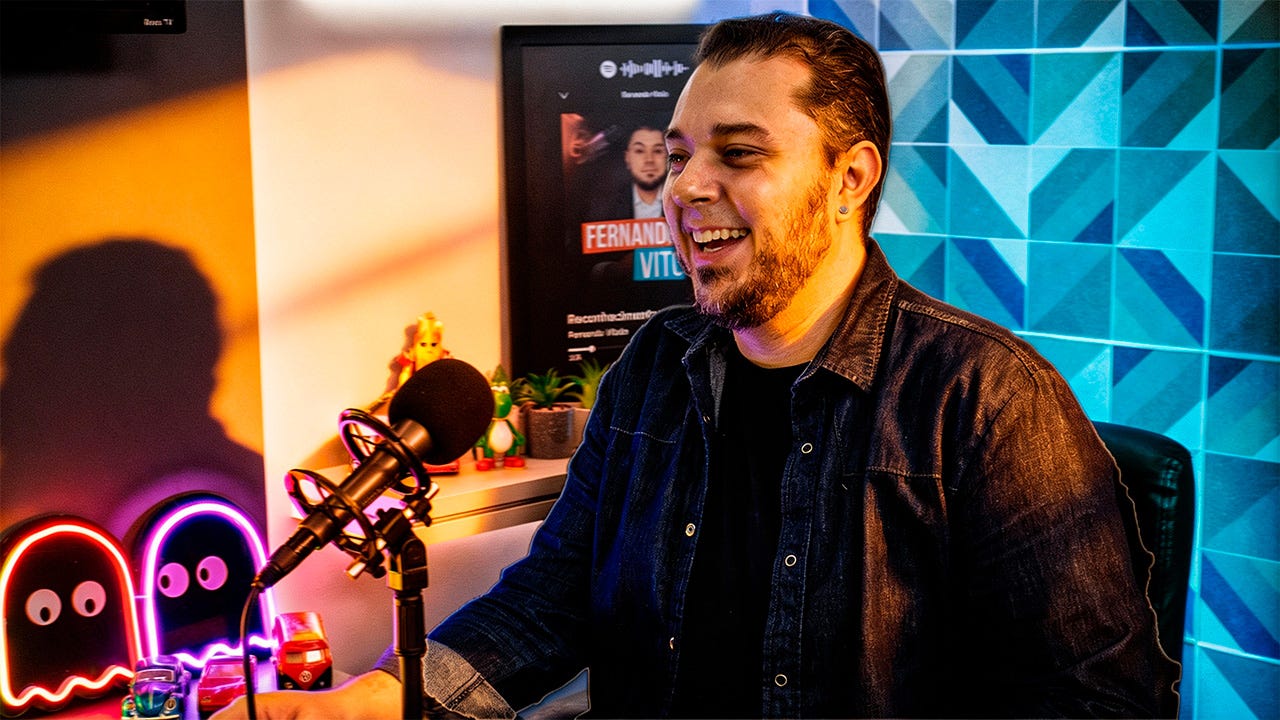
Fernando Vítolo is a Brazilian writer, journalist, broadcaster, and founder of Younik, a media production company based in São Paulo. He created and hosts New Rádio, where he has interviewed leading personalities from Brazilian television, theater, and cinema, and has written books exploring communication, professional recognition, and entrepreneurship. His work asks why capable professionals sometimes remain invisible and how they can communicate their knowledge without losing their own voice.
Thank you so much for joining us in this interview series! Our readers are eager to learn more about you. Could you provide some background information about yourself?
I’m Fernando Vítolo, a Brazilian writer, journalist, broadcaster, and founder of Younik, a media production company in São Paulo. My interest in communication started long before it became my profession. In 1998, when I was 12, I built a website called DrumsFVG with Microsoft FrontPage. It was about drums, their history, and the companies that made them. This was dial-up internet: information was scarce, connections were slow, and solving a problem meant doing the detective work yourself. Soon afterward, I developed a website for a jukebox rental company in São Paulo. Those experiences taught me to learn independently, something I still rely on today.
My career eventually led me through journalism, radio, publishing, interviews, and audiovisual production. I created and host New Rádio, where I have interviewed Brazilian cultural figures including Marcelo Tas, Antonio Fagundes, Marisa Orth, and filmmaker Fernando Meirelles. I’ve also written about communication, professional recognition, and business. Across these different projects, one question keeps coming back: why do some highly capable people remain invisible while others become the obvious choice?
What establishes you as an authority on thought leadership? Could you briefly share your expertise with our readers?
I don’t think authority comes from calling yourself an authority. It comes from doing the work, learning from the people you meet, and having something useful to say. I’ve spent years interviewing people, writing, producing media, and helping professionals explain what they know. At Younik, that work becomes podcasts, videos, articles, books, and educational content. In my writing, particularly A Arte de Ser Escolhido (The Art of Being Chosen) and my developing project O Custo da Invisibilidade (The Cost of Invisibility), I explore the gap between competence and recognition.
I have also watched communication change from traditional broadcasting to social media and AI-assisted production. The tools are different, but the problem is familiar: people cannot recognize value they never see or never understand. My expertise is practical and editorial. I know what it takes to take an idea out of someone’s head, shape it into a story, and put it in front of an audience. I also know that visibility without substance doesn’t last.
Can you recall a funny mistake you made when you were first starting out? What lesson did you learn from it?
One mistake I can laugh about now happened while we were recording a Mapex event in Brazil. Our client was Mapex, and we were filming an entire drum workshop organized by the Instituto de Bateria Vera Figueiredo. One of the sessions featured drummer Junior Vargas. We had two cameras recording it.
At one point, I went to check the footage from one of the cameras. Instead of simply reviewing the files, I accidentally formatted the memory card. Yes, formatted it. All that footage from that camera was gone. Not exactly the kind of button you want to press when you’re responsible for recording a live event!
Fortunately, the second camera had recorded the workshop, so we still had enough material to save the content. It was a huge relief, although I certainly wasn’t laughing when it happened.
That experience taught me to be much more careful with recorded media. Check what you’re doing, protect the original files, and never treat backups or a second recording source as an unnecessary luxury. Sometimes, the difference between a disaster and a story you can laugh about years later is one extra camera.
What are the most significant disruptions you foresee in your industry over the next five years, and how can businesses adapt to these changes?
Over the next five years, I expect the biggest disruption in media to be the extraordinary ease of producing content. AI already helps people research, write, edit, and publish. That is useful, but it also means audiences are surrounded by more material than they could ever consume. The scarce resource is no longer the ability to publish. It is attention and trust.
Businesses will have to answer a harder question: Why should anyone spend time with what we make? My advice is to invest in original perspectives, subject-matter expertise, verified information, and people who can ask thoughtful questions. Technology should remove repetitive work, not remove the personality from the message. The brands that listen to their audiences and are willing to say something specific will have a better chance than those publishing generic material at scale.
Can you explain the benefits of becoming a thought leader? Why is it valuable to invest time and resources into this?
Being recognized as a thoughtful voice in your field can create opportunities that competence alone doesn’t always create. People are more likely to seek you out, invite you into conversations, and consider your ideas when they understand your experience and your point of view. For a professional, that might mean an invitation to speak, a collaboration, a book, or a new client.
But I would be careful with the idea of ‘investing in thought leadership’ as if it were just another advertising campaign. Trust is built by making a contribution repeatedly. Publish ideas that help people think. Explain what you have learned, including mistakes. Listen when someone disagrees. Recognition can be a result of that work; it shouldn’t be the only reason for doing it.
Can you share an example of a significant challenge you faced in your career and how you leveraged innovative thinking to overcome it?
In 2018, an institution I provided services to ended our professional relationship. I was deeply disappointed. At first, it was difficult not to see the decision as a rejection of everything I had contributed. Then I realized I had a choice: keep spending energy on the frustration or put that energy into something I could build myself.
I chose to build. That period became a turning point for my own channel, books, and a new phase for Younik. I didn’t overcome the setback with a clever piece of technology. The innovation was in changing the question from ‘Why did this happen to me?’ to ‘What can I create now?’ I learned that other people may decide to close a door, but they don’t get to decide what I do with the next chapter.
Now that we have covered that, we’d love to hear your advice on becoming a thought leader. Can you share five strategies that someone should follow to gain recognition as a thought leader in their industry? Please include examples or stories from your own experience for each strategy.
1. Start with something you actually know. In 1998, at 12, I created DrumsFVG because I loved drums and wanted to learn more about their history and brands. I didn’t begin with an audience-growth strategy. I began with a subject I cared about. That curiosity made me willing to work through the technical problems of an early website. Expertise grows from attention and effort, not from a title in your profile.
2. Make your knowledge understandable. I have met people with remarkable experience who struggle to explain why their work matters. Through books, articles, podcasts, and other projects at Younik, I’ve learned that the job is often to translate complex knowledge into language that the audience can follow. Being right about something is not enough if nobody understands what you’re saying.
3. Listen before you try to lead. My experience interviewing people for New Rádio, including figures from Brazilian television and cinema, has reinforced this lesson. A good interview begins with preparation but improves when you listen to the answer rather than rush to your next question. The same is true for people hoping to be recognized in an industry. Listening gives you insight that posting alone never will.
4. Build relationships by offering something first. I sometimes call bad networking ‘net-ME-working’: contacting someone only when you need a favor, a sale, or an introduction. Real networking starts by contributing. Share a useful idea, make a thoughtful introduction, or help someone solve a problem without immediately asking for a return. Over time, people remember the way you treated them, not just your business card.
5. Keep showing up, but don’t lose yourself. When a professional relationship ended in 2018, I redirected my frustration into developing my channel, books, and a new phase of Younik. I learned that recognition can take different forms, and that a setback doesn’t have to define your story. Consistency matters, but so do your values and the time you spend with people you love. A career should give you a life, not consume it.
Who do you think is an outstanding example of a thought leader? What specific qualities impress you about this person?
One person whose thinking has influenced me is Brazilian author and business thinker Roberto Tranjan. His book Metanoia changed the way I looked at business. What impresses me is an ability to challenge the assumptions behind familiar professional habits rather than simply offer formulas for success.
For me, a genuine thought leader helps you see an old problem differently. You may not agree with every idea, but you come away asking better questions. That is much more valuable than collecting followers.
Nowadays, anyone can produce content with AI. How does one create high quality thought leadership content that can stand out, in a sea of AI generated slop?
My first rule is simple: don’t publish something just because a machine can produce it. Ask whether it deserves someone’s attention. AI can be extremely helpful with organizing research, identifying gaps in a draft, or speeding up technical work. I use tools such as ChatGPT and Gemini. But the personal experience, judgment, questions, and final responsibility must remain mine.
I built my first website in 1998, when information was difficult to find. Today, information is everywhere. What still matters is what you’ve lived, what you’ve noticed, and what you can explain clearly. A story about the first website I built at 12 or the disappointment that changed my career in 2018 cannot be replaced by a generic list of tips. I would rather publish one considered observation than ten polished paragraphs that could have come from anyone.
How do you stay informed about the latest trends and developments in your field, and how do you incorporate this knowledge into your strategic planning?
I learn from several sources, but conversations are probably the most important. Interviewing people for New Rádio exposes me to ways of thinking that don’t necessarily come from my own field. I also read, experiment with new production tools, and pay attention to how different platforms behave.
The point is not to chase every new app. At Younik, I look at whether a tool improves the work, saves time, or helps us communicate more clearly. Sometimes we test an approach with one piece of content before using it more widely. I like technology, but I try not to confuse novelty with usefulness.
Some people feel that the term “thought leader” is overused and has lost its impact. What are your thoughts on this?
I agree that the expression ‘thought leader’ is overused. It can sound like something people put in a biography because they want to be admired. I would rather be known as someone whose ideas are worth listening to.
The test isn’t whether you call yourself a leader. It is whether you help other people think, make decisions, or approach a problem differently. And sometimes the most credible thing you can say is ‘I don’t know.’ A person who has stopped learning has very little business telling everyone else what to think.
Can you share your favorite “Life Lesson Quote”? How has it been relevant in your life?
A sentence I often come back to is one I’ve formulated from my experience: ‘Technology changes. Curiosity shouldn’t.’
I was building a website with FrontPage and a dial-up connection at 12. Today, I work with professional studios, digital platforms, and AI. Almost every technical tool has changed. What allowed me to move between those worlds was the desire to learn and try things for myself. I hope that remains true for the rest of my career.
You are a person of great influence. If you could start a movement that would bring the most amount of good to the most amount of people, what would that be? You never know what your idea can trigger. :-)
I would encourage people to share what they know before they feel completely ready. Not everyone needs to become famous or build a personal brand. But many experienced people have stories, lessons, and practical knowledge that could help someone else. Too often, that knowledge stays private because people think they aren’t interesting enough to speak.
I would love to see more conversations between generations: older professionals sharing what they’ve learned, younger people bringing new questions and tools, and both sides listening. My work in interviews and publishing has taught me that a good conversation can preserve knowledge that might otherwise disappear. It can also remind us that recognition is less important than contribution.
How can our readers further follow your work online?
Readers can follow my work through Younik at https://younik.com.br, on Instagram at https://www.instagram.com/fernando.vitolo/, and on LinkedIn at https://www.linkedin.com/in/fernandovitolo/. My interviews and other media projects are also presented through Younik and New Rádio.
Thank you so much for your insights. This was very insightful and meaningful.