Passion is not just a trait, but a catalyst for all the positive attributes in work and life. It’s a fundamental igniter of all success and when it wavers, everything else will follow.
Business
Gemma Allen of IDA Ireland: Why Refusing To Keep Everyone Happy Is The Ultimate Key To Executive Decisiveness
The IDA Ireland vice president shares how authenticity, deliberate decisiveness, and navigating the unique stigmas of female leadership fuel global technology investments.
How does a successful, strong, and powerful woman navigate work, employee relationships, love, and life in a world that still feels uncomfortable with strong women? In this interview series, called “Power Women” we are talking to accomplished women leaders who share their stories and experiences navigating work, love and life as a powerful woman.
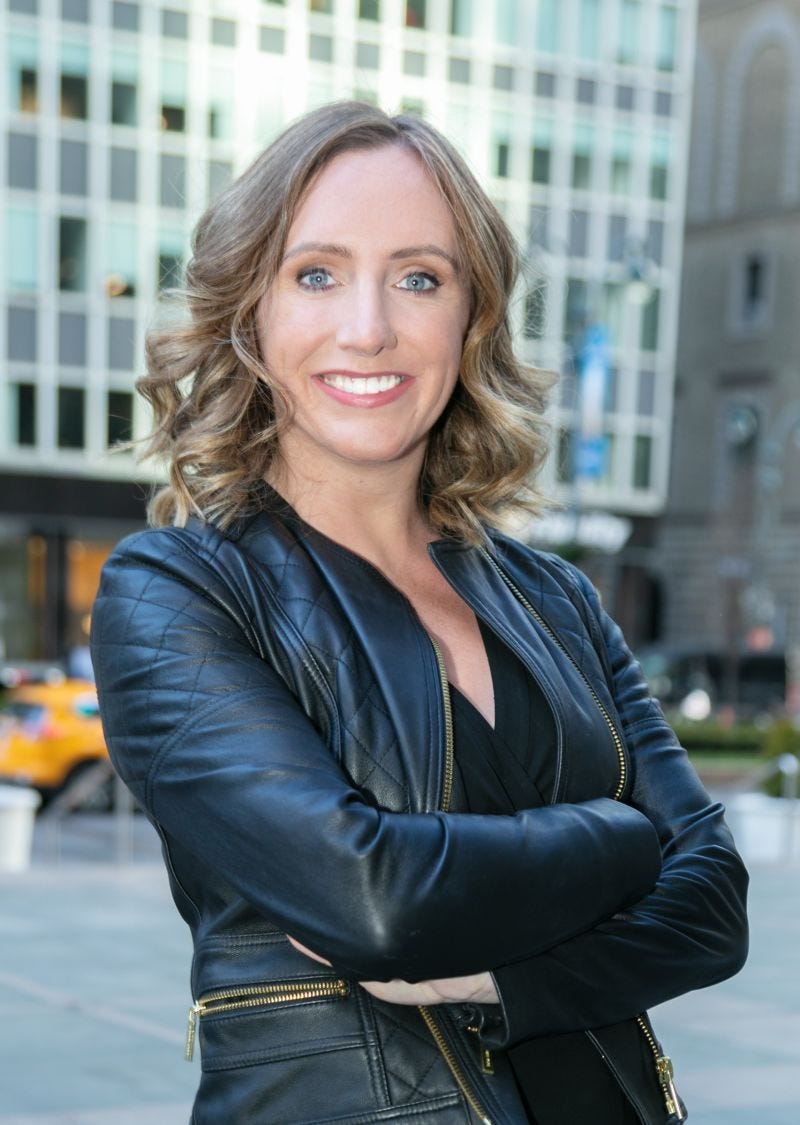
As a part of this series, I had the distinct pleasure of interviewing Gemma Allen.
Gemma Allen is the vice president of B2C technology at IDA Ireland. In her current role with IDA Ireland, she is responsible for building relations with business leaders, political stakeholders and key industry players furthering foreign direct investment into Ireland. Allen is based in New York City and has over 15 years’ experience working with the world’s largest technology companies in the U.S. and Europe.
Thank you so much for doing this with us! Before we dig in, our readers would like to get to know you a bit more. Can you tell us a bit about your childhood “backstory”?
I grew up in Cork City, in the South of Ireland as the youngest of 5 children. My father was a car mechanic and my mother stayed at home with my siblings. Neither of my parents had a high school education but instilled a huge passion for learning in me, which I carry with me today. When I lost my father to cancer as a teenager, I learned quickly how important community is. My extended family, friends and neighbors rallied around and there was a palpable sense of support. My community has always inspired me to work hard and have high hopes because I feel there is a shared sense of pride in anything any of us achieve as individuals.
Can you tell us the story about what led you to this career path?
I can tell you it was not linear or overly planned. I studied social and political science in college and originally hoped to be a social worker. I worked in community outreach and learned about the impact that businesses can have on their communities. I went back to school to get my Masters, which was a great career driver for me. I joined the Ireland-based Microsoft team and learned about global technology working with incredible people all over the world.
In the early years of my career, mentors brought me under their wing and provided sometimes harsh but necessary feedback and encouragement. That was inestimable to my development. I always was inspired by the connection between community and business. Especially the infinite social impact businesses can have on people’s lives. It was the broad organizational goal of IDA Ireland, the Irish government agency for inward investment, that attracted me to my current role. I was so excited about the potential to work with technology companies helping them to expand abroad and have tangible impact on Irish communities. I knew I had to give it a shot and the rest is history, I guess.
You are a successful business leader. Which three-character traits do you think were most instrumental to your success? Can you please share a story or example for each
Authenticity, first and foremost. I have always tried to be wholeheartedly myself and allow my own energy to show. I am a very outgoing person. I enjoy talking, laughter and banter and I’ve never tried to change in ways that societal cliches often expect. I wholeheartedly believe we are at our best and can inspire others to do the same, when we are comfortable to be ourselves.
Decisiveness. I call this out because it’s a trait that I had to actively work to improve and build. I saw quickly how much respect it garners from peers, managers, and clients. Moments of indecisiveness were fueled by my first thought: ‘how can I keep as many people as possible happy?’ That inherent calculation costs time. However, it also costs respect. Decision-making allows you to work with a far more natural form of conviction and that has been an invaluable lesson.
Passion. Passion is not just a trait, but a catalyst for all the positive attributes in work and life. It’s a fundamental igniter of all success and when it wavers, everything else will follow. If you are passionate about work and goals, use it as a prime energy source. It keeps you focused, confident, and determined. It means that when things don’t go as planned, you can measure the outcome to inspire yourself to do better That helps to build resiliency. Passion for the work, team, and task must be there, if not, exhaustion and burn out follows. The mission must line up in a way that motivates. When that dwindles or changes, it’s time to move.
Ok, thank you for that. Let’s now jump to the primary focus of our interview. The premise of this series assumes that our society still feels uncomfortable with strong women. Why do you think this is so?
The business world is witnessing a new dawn for the acclimation of female leaders. Fundamentally, it comes down to the depiction of power as a concept in long-term social conditioning. There are inherent and often subconscious expectations of leaders as strong, brash, logical, which are largely deemed male behavior traits. When powered by the age-old conundrum ‘you only know what you have always known, it becomes a real challenge for the status quo. As result, these traits are often used to comparatively judge women. This is damaging and detrimental because often women bring a vast array of equally as powerful and effective traits such as communication, empathy, and creativity. However, these are underestimated due to a lack of representation and precedent. That can cause unintended inertia for strong women.
What do we need to do as a society to change the unease around powerful women?
Above all else, we need to talk about it. There needs to be a forced consciousness around the role of female leaders, the eradication of unfair assumptions, and an open discussion on both conscious and unconscious bias. We need more representation of women in leadership and a changing depiction of what it means to be a leader. This must happen across business, media, education, and broad society.
In your opinion, what are the biggest challenges faced by women leaders that aren’t typically faced by their male counterparts?
The biggest and often most reductive challenge for women, as opposed to men, is how society measures failure for each. It’s easier to fail as a man and be admired for your attempt. For women, there is a stigma, and they are more likely judged on the outcome than their willingness to try. If society could get to a place where everyone can ‘fail up’ equally, meaning making a mistake yet still being rewarded for the attempt, the business world would see more women willing to take risks and further challenge the status quo.
Let’s now shift our discussion to a slightly different direction. This is a question that nearly everyone with a job has to contend with. Was it difficult to fit your personal and family life into your business and career?
There’s no question but that often the responsibility of family life can have intended consequences for moms who want to pursue a career. The ‘motherhood penalty’ is definitely a real challenge and needs to be addressed. At certain times and events throughout my life, yes absolutely it has been extremely difficult. I think it’s impossible to juggle work, family, friends, hobbies, and wellness. It’s a cold reality that time nor tide waits for no one, and you must make compromises to have any sort of balance. It’s all about priorities.
For the benefit of our readers, can you articulate precisely what the struggle was?
I would have to say becoming a mother was the ultimate game changer, but I do know that it’s a challenge for men too. The realization that suddenly you are a full-time caregiver, and life outside work is no longer discretionary, is a shock. However, ironically, it provides a sense of appreciation for work. I would tell friends that work felt like Sesame Street compared to days with an irrational toddler. It made me more selfish with my time and, as result, more effective. It divorced me from my long-term love of procrastination.
What was a tipping point that helped you achieve a greater balance or greater equilibrium between your work life and personal life? What did you do to reach this equilibrium?
Greater balance came with a much more forced sense of awareness. I really gained that by peer coaching and mentoring on managing stress, setting both priorities and boundaries and time management training. I started to look at the things in life that stressed me out and I’d write three reasons I should keep doing this. Taking time to write it down really helped bring clarity to what is actually important to me. I tried to look for practical support and teachings. For example, I recently did a speed reading and breathing class and was so surprised at the helpful application of what seemed like basic skills in daily life.
Ok super. Here is the main question of our interview. Based on your opinion and experience, what are the “Five Things You Need To Thrive and Succeed as a Powerful Woman?” (Please share a story or example for each.)
1. Solid trust in your own intuition. It can be so easy to get caught up in the noise and sometimes the hardest person to hear is yourself. Trusting your gut and your own intuition is sacrosanct. Being an authentic and effective leader. It is the only measure of clarity in decision-making you can truly rely on. I have always been a very social person and sometimes, even unintendedly through chit-chat, garner too many opinions on different scenarios. I would find myself in a loop sharing with others, and I realized that it was a complete waste of energy. The largest power any of us have exists within and you must harness your intuition and go with it.
2. The inspiration of other women. You need to see it, to be it and we all need role models. I’m inspired by women who are honest, humorous and break down the barrier of expectation. I follow their careers and listen intently to their advice and regularly refer to them in my own moments of doubt. Having role models can help create your own benchmark and stay true to it.
3. Collaboration. It can be both a hugely valuable skill to make work and life more rewarding and enjoyable. It allows you to see outside yourself and goals, grow from others and understand the art of negotiation and compromise. Collaboration is a big part of building a network. The best learning is on the job by collaborating with new people and situations. The times when I didn’t instantly feel at ease and had to work to build trust and break down assumptions were hugely beneficial for my professional and personal development. Feeling uncomfortable with others and working through it is one of the best experiences a professional can get.
4. Mentorship. Mentorship can take many forms and serve many purposes. For women, it can be an opportunity for advice that both builds confidence and provides practical feedback. There is an impression that mentorship is a form of strategic networking, but often it can include tactical help, advice and reassurance. I had a mentor who helped with my return to work while battling post-natal depression. What this woman gave above all else was a sense of confidence in myself and practical advice to navigate life changes. It was like a voice of reason and encouragement when I needed it.
5. A support network. No one can be successful alone. Everyone needs help, mentorship, advocacy, sponsorship, and support from others. This is especially true for women. There is often damaging rhetoric around women being catty and hard on one another. This creates an unfair depiction of women. Celebrating other women’s wins both large and small is one of the only ways to break those societal expectations of jealousy and competition and redefine the image of female leaders.
We are very blessed that some very prominent names in Business, VC funding, Sports, and Entertainment read this column. Is there a person in the world, or in the US with whom you would love to have a private breakfast or lunch with, and why? He or she might just see this if we tag them.
I would have to say Amy Poehler! I think she is a creative genius and the character she plays in Parks and Rec, Leslie Knope, is a girl crush of mine. I would love to bottle her optimism and drink it
Thank you for these fantastic insights. We greatly appreciate the time you spent on this.
AM
Written by
Authority Magazine Editorial Staff
Editorial Desk · Authority MagazineThe Authority Magazine Editorial Desk produces, verifies, and edits long-form primary-source interviews with executives, innovators, clinicians, creators, and social impact leaders across Business, Tech, Pop Culture, Wellness, and Social Impact.

Published inAuthority MagazineTop Lessons, Top Authorities · 42K Followers
Exclusive, curated interviews with the leaders and changemakers shaping tomorrow. Leadership lessons, industry deep dives, and executive profiles.