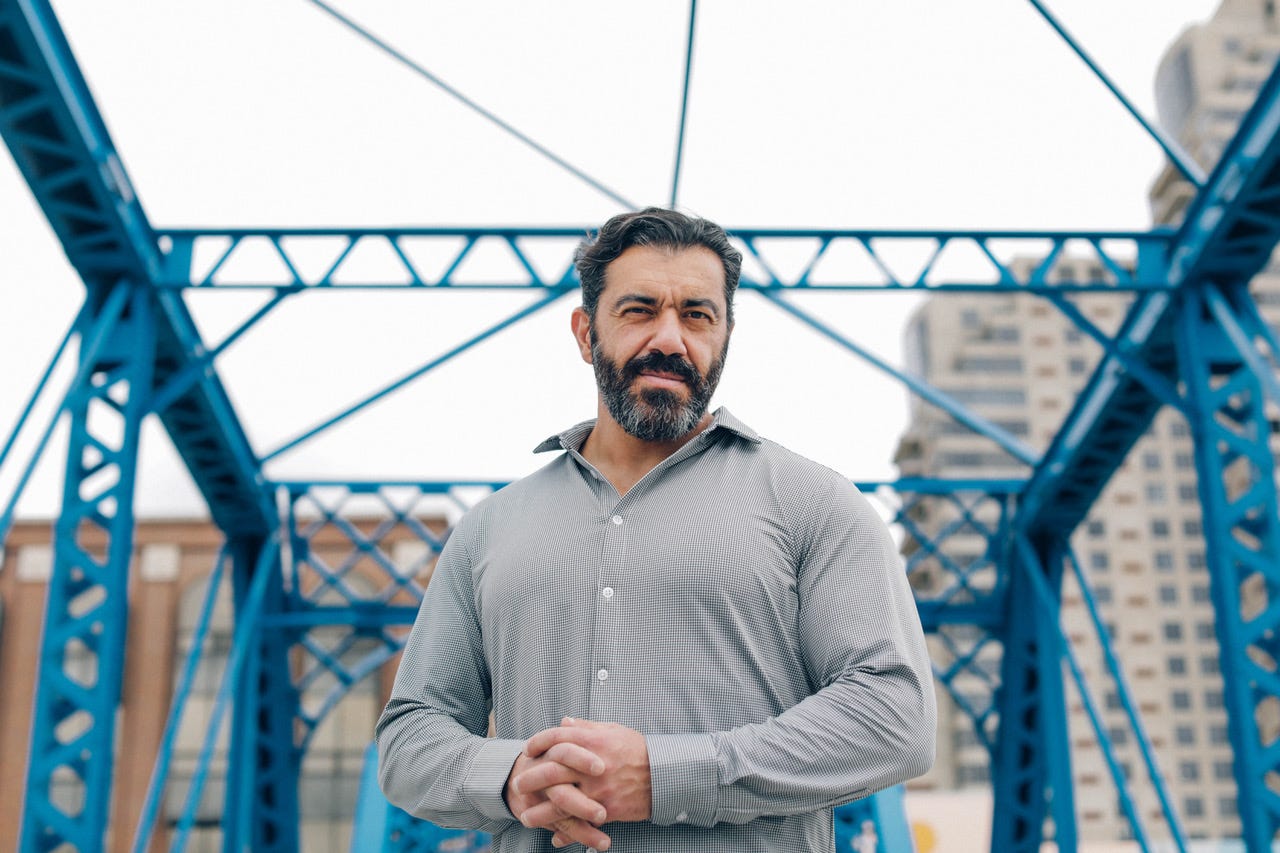

Everything was even harder because of COVID, which happened just when we started the program. Everything shifted to remote mode without having in-person meetings. Just imagine, this young female founder running a hard-tech construction startup and raising money from investors over Zoom - it was challenging to say the least!
Anna Cheniuntai, CEO, Apis Cor
By the age of 22, Anna Cheniuntai had earned a degree in Space Physics and successfully managed a massive $5m+ project deploying the ground navigation system for the 2014 Olympic Games. Anna then set out to disrupt the construction industry with novel innovations in automation and robotics. Today Anna is the co-founder and CEO of Apis Cor, the pioneer of advanced, robotic 3D printing technology for construction. Apis Cor 3D prints full-scale buildings on Earth, and soon on the Moon and Mars.
Can you tell us a bit about your “backstory”? What led you to this particular career path?
Ever since I was young, I always wanted to be an entrepreneur. While at university, I was young and exploring my options, so I decided to study something fundamental, very interesting, and inspiring, which led me toSpace Physics. I was always thinking about what type of entrepreneurial venture I could sink my teeth into.
One year before graduation, I met my future Apis Cor co-founder, Nick. At that time he had his own business building industrial machinery robots like CNC milling routers and metal cutting machines. Factories would come to Nick and ask him to build machines to do specific tasks because they could not find a solution on the market and Nick would build custom machines to meet their requirements. I joined him and started helping with the operational part of the business and learned a lot about heavy CNC machinery.
We soon secured a massive contract to manufacture and deploy the ground navigation system for visitors of the Olympic Games in 2014. The entire system includes approximately 6,000 signs of different sizes (half of them were 4-8 ft tall concrete stellas of 4,000 lbs weight) deployed around the Olympic Games infrastructure for people to find facilities like the Olympic stadium, ATMs, local architecture, etc. We had to develop the routes, design, fabricate and deploy.
Nick and I were literally responsible for millions of visitors finding their way around the Olympic Games and not getting lost. It was an extremely hard project to complete within a short period of time - making the project realization even more challenging. To make matters worse, construction sites where we were to deploy the signs were not completed on time.
Fortunately, we successfully delivered and not only got our first big paycheck (the total value of the contract was about $5m), we also learned how outdated the construction industry was.
And that was the turning point for us. We realized that the construction industry desperately needs automation and tools to increase productivity. Following this notion, Nick invented unique 3D printing robots that featured the breakthrough innovation - true mobility and portability. He designed and built the robot. I was helping in every aspect I could to build the first prototype - I worked on getting spare parts to help with soldering the wires, screwing the bolts and nuts and even mixing first concrete 3D print material.
I believe that if you want to innovate, you need to create something completely new that disrupts a specific job. Based on our Olympics experience, we decided to change the way houses are built.
Can you share the most interesting story that happened to you since you began your career?
One of my favorite stories is when we participated in Level 2 of NASA’s 3D printed Habitat Challenge, a competition to design and 3D print a habitat that could be used on the moon or Mars.
We had to autonomously 3D print the habitat element and autonomously installed pipes of different sizes during the actual printing. To achieve this, we had to sync our 3D printer with ABB industrial robots which were provided by Autodesk Build Space in Boston.
Our true challenge: we did not have time for a rehearsal. We executed the 3D printing on almost the last day. If it failed, we would not have time to reprint the structure.
We could not foresee all of the imperfections, and one of the installed pipes was immediately displaced by the robot. It almost fell down. If that had happened, it would have compromised the entire structure. Additionally, we would have had to do a long human intervention to fix the problem. We faced losing our whole score. but the pipe was magically put back in place when the robots passed back across it. It was extremely nerve wracking.
It was an intense and exhilarating drill to be a part of the potential construction on the moon and Mars – and hands down one of my best experiences!
Are you able to identify a “tipping point” in your career when you started to see success? Did you start doing anything different? Are there takeaways or lessons that others can learn from that?
The Alchemist Accelerator significantly boosted and upleveled my career. Because of the quality of the accelerated program, and the challenges I accepted during it, I grew personally which had a positive impact on our business development. I learned so much about raising funds, sales, negotiations.
Through the program we were tasked and challenged to deliver results and show how we were developing. I was challenged to do things I did not have enough experience with or did not ever do at all, such as fundraising. And we needed to raise money.
Everything was even harder because of COVID, which happened just when we started the program. Everything shifted to remote mode without having in-person meetings. Just imagine, this young female founder running a hard-tech construction startup and raising money from investors over Zoom - it was challenging to say the least!
After watching other founders accomplish some of their fundraising goals, I was inspired to start. I said to myself: “Okay, if they can do that, I can too.” I raised the first $500k within about four months. It was extremely hard and it took a lot of effort to constantly change the strategy, learn from my mistakes, adapt quickly and stay focused. I had about 150 online meetings and kept moving after many “NOs” in a row. But I am extremely thankful to investors who believed in what we are doing and were not even concerned about me being a female founder & CEO.
The 2 takeaways that I embraced from this tipping point in my journey:
1) you don’t know what you are capable of until you try, and
2) there are “your” people out there who will believe in you, you just need to keep searching for them.
Thank you Alchemist Accelerator and to Ravi Belani for contributing to Apis Cor, and me personally.
None of us are able to achieve success without some help along the way. Is there a particular person to whom you are grateful who helped get you to where you are? Can you share a story about that?
The first person that impacted me and helped me to find my way was my mom. She used to be an entrepreneur running a small business of short-term apartment rentals. I was always hanging out with her and her entrepreneur friends, it was a lot of fun. I helped my mom with her business and sometimes we worked very hard. That was the first time I learned the sense of “no pain no gain” and witnessed the freedom that came along with it. I decided that I wanted to be an entrepreneur too, but I did not know what exactly I would do. Apis Cor has given me the opportunity to build a valuable business.
I have met many people along the way who helped me or just had faith in me when I really needed it. I still remember my first investor who gave me my first check for $10K right after our first Zoom call. After receiving dozens of no’s, this first win encouraged me to keep working hard. I really needed that endorsement to believe in myself.
We will be always grateful to the people and communities that step up to help us. Autodesk Tech Center in Boston and their team facilitated our team for NASA’s Challenge and beyond. That is where I gained a lot of practical experience and knowledge in fabrication, laser cutting, water jet cutting, plastic 3D printing and many other hands-on skills. Many thanks to the outstanding hospitality and support from the Autodesk team.
Do you have a book, podcast, or talk that’s had a deep impact on your thinking? Can you share a story with us? Can you explain why it was so resonant with you?
The first book that had a deep impression on me was “Trilogy of Desire: The Financier, The Titan, The Stoic” by Theodore Dreiser. I read it when I was studying at university and was so immersed, I couldn’t put it down!. The main character Frank showed how you can achieve literally anything and make your dreams come true. If you are a smart, strategic thinker, you can withstand huge challenges, and if you are brave and fully faithful/committed to your beliefs, you will be successful.
Can you please give us your favorite "Life Lesson Quote"? Can you share how that was relevant to you in your life?
“It takes all the running you can do, to keep in the same place. If you want to get somewhere else, you must run at least twice as fast as that!” - The Red Queen from “Alice in Wonderland” by Lewis Carroll. I think it is extremely true and resonates with me. It takes a lot of effort just to stay in a good position in life. To achieve something significant and keep moving it forward is not enough to just work hard, you need to work twice as hard. It is kind of a version of Elon Musk’s quote “work like hell”. In fact, this approach is something that has been working for me since we got that massive Olympic Games project.
In my world, hard work does not mean just working hard, but working with your head. Constantly thinking about how things can be done in a more efficient way, questioning things and processes, asking “is this the best way of doing it?” even if it was done this way for decades. An entrepreneur always needs to innovate and be a bit of a rebel in order to keep running twice as fast.
Ok super. Let’s now shift to the main part of our discussion. Homebuilding in the US has grown tremendously. We'd love to hear about some of the new trends and techniques that are being used to build the homes of the future
Can you share with us how 3D printed houses are more eco-friendly than traditionally built structures?
Typically, there is a pile of construction waste and material leftovers sitting next to the newly built house. It is not the case for a 3D printed home. 3D printing technology generates way less construction waste because with additive manufacturing you add as much material as you need to print a desired shape of a building. There is no need to cut or do post finishing of the materials to fit them into the frame.
Additionally, 3D printing opens the horizons for alternative and eco-friendly materials. For example, we have been developing the geopolymer 3D print material. They are called "geopolymers" because the raw materials used for their production are mainly minerals of geological origin such as calcined clays, coal fly ashes, and industry by-products.
This material is stronger and more fire resistant than traditional concrete. But most important, is that this material can be completely cement-free. Imagine millions of homes being built without cement but still stronger than concrete homes.
There is a lot of talk about 3D printed homes. Can you tell our readers a bit about what that is, what that looks like, and how that might help people?
Although the homebuilding industry continues to grow, there are not enough homes being built to meet growing demand. Construction just cannot keep up, and as a result the housing shortage is about 5m homes which have increased by 10x times since 2012.
One of the main reasons for this problem is the shortage of skilled labor. In the US alone, there are over 400,000 unfilled construction positions and despite the rise of salaries, construction companies and homebuilders still cannot find people they need. We simply don’t have the people to build the amount of houses we need.
In the years following the 2008 housing crisis, skilled workers who were unable to find work joined new industries or dropped out of the workforce entirely. From 2008-2011 construction companies shed about 2.3 million jobs. Baby Boomers are beginning to retire in record numbers and are leaving all industries, including construction. Millennials are entering the market, but many have unrelated degrees, no training or connection to construction and little interest in performing dirty, dangerous, and difficult jobs.
With that being said, construction needs new technologies to increase productivity and build homes faster, cheaper and more sustainably. One of the promising solutions is concrete 3D printing. About 20 homes have been 3D printed so far across the world, about half of them in the USA.
The method is pretty similar to traditional plastic desktop 3D printing but instead of plastic we use durable and strong concrete material and instead of desktop box-size 3D printers we use larger machines to print larger objects like real-size houses. The technology allows to construct the shell of a house in a matter of a few days and subsequently expedite the overall construction process.
The cost of the furnished home can be up to 30% less than traditionally built concrete block or wood framed houses. Having these advantages, 3D printing technology can help to fill the growing gap for new houses worldwide and help people in need of affordable housing to actually purchase a home of their own.
Can you talk about other interesting tech innovations that are being incorporated into 3D printed homes today?
Personally, I like the idea of having a house that can defy powerful weather. 3D printed houses can be extremely strong (compressive strength of the geopolymer material can be 8,000 Psi, 4x times stronger than concrete block). The ability to design a building to be earthquake, fire, flood and hurricane resilient is amazing. A well designed 3D printed home is even resistant to hazards such as mold. You can expect to see a lot of innovation in this space. The technology to print 3D buildings is good today and it is going to be even better in the years to come.
How about actual construction materials? Are there new trends in certain materials to address changes in the climate, fires, floods, and hurricanes?
The hempcrete material is a very interesting innovation, although it is not well studied. However, there are several products available on the market, including insulation materials. As far as I know, hempcrete shows superior fire resistance properties.
3D printing also opens up new building design freedoms. It is now possible to build curved walls, which was very expensive or even impossible with traditional materials. Curved walls can be structurally stronger for flood and wind resistance, curved shapes are better at load distribution than straight elements.
For someone looking to invest in the real estate industry, are there exciting growth opportunities that you think people should look at more carefully?
We are the first construction 3D printing company qualified by the SEC to accept investment from both accredited and non-accredited investors. We truly think it is a historic moment because now everyone can be positively impacting our world and the lives of future generations. You can find more information on our website.
Let's talk a bit about housing availability and affordable housing. Can you explain to our readers how 3D printing houses can help with this crisis?
With 3D printing technology there is tremendous room for innovation to reduce construction costs. Besides the fact that 3D printing makes building houses faster and cheaper, it also provides a flexibility in value engineering to meet specific project criteria.
For example, our 3D printing technology, in comparison to other players in the industry, produces high quality walls without the “sausage” effect and the walls can be just painted right away. Insulation can be installed in the 3D printed walls so there is no need to install the drywall which also reduces the costs.
But before we start tackling the affordable housing problem with all of the advantages of 3D printing technology, the proper validation and preparation work has to be done to know what should be achieved. Is it going to be a house for 100k or for 250k? Both options still can be considered as affordable housing but the end result will look different. This is not something that can be figured out overnight.
There are a lot of variables in construction accounting for the final price: different finishing materials, insulation materials, mechanical and plumbing solutions, roof system as well as requirements for foundation due to local soil conditions and building codes.
We launched the industry’s first Affordable Housing Cooperative Program to work with nonprofits and affordable housing companies to develop 3D printed homes that meet the particular requirements and expectations. During the development Phase we are designing spec houses that fit the distinct requirements of price, sq.footage, floor plan, finishes and other factors. We already have 3 companies from Florida and North Carolina on board and welcome more groups to join us.
Is there anything that home builders can do to further help address these problems?
I would advise to help accelerate education about emerging technologies and bring awareness about innovative methods of construction. Any change starts with education. We created Apis Cor University which is an interactive and informative online courses and hands-on workshops that educate anyone who is interested in 3D printed homes - from just curious individuals to building officials and industry stakeholders.
You are a person of great influence. If you could inspire a movement that would bring the most amount of good to the most amount of people, what would that be? You never know what your idea can trigger. :-)
I would inspire people to join the movement of preserving the wildlife and oceans by reducing the amount of plastic waste we create. Start using reusable cups, bottles, food containers, reusable or plant-based straws (I hate the plastic ones) - anything that can be reusable!