
When I was a very, very small child, I was born with the gifts of being able to sense, see, and experience the energies of others in a myriad of ways.
As a part of my series about “How To Develop Mindfulness And Serenity During Stressful Or Uncertain Times”, I had the pleasure of interviewing Amelia Vogler.
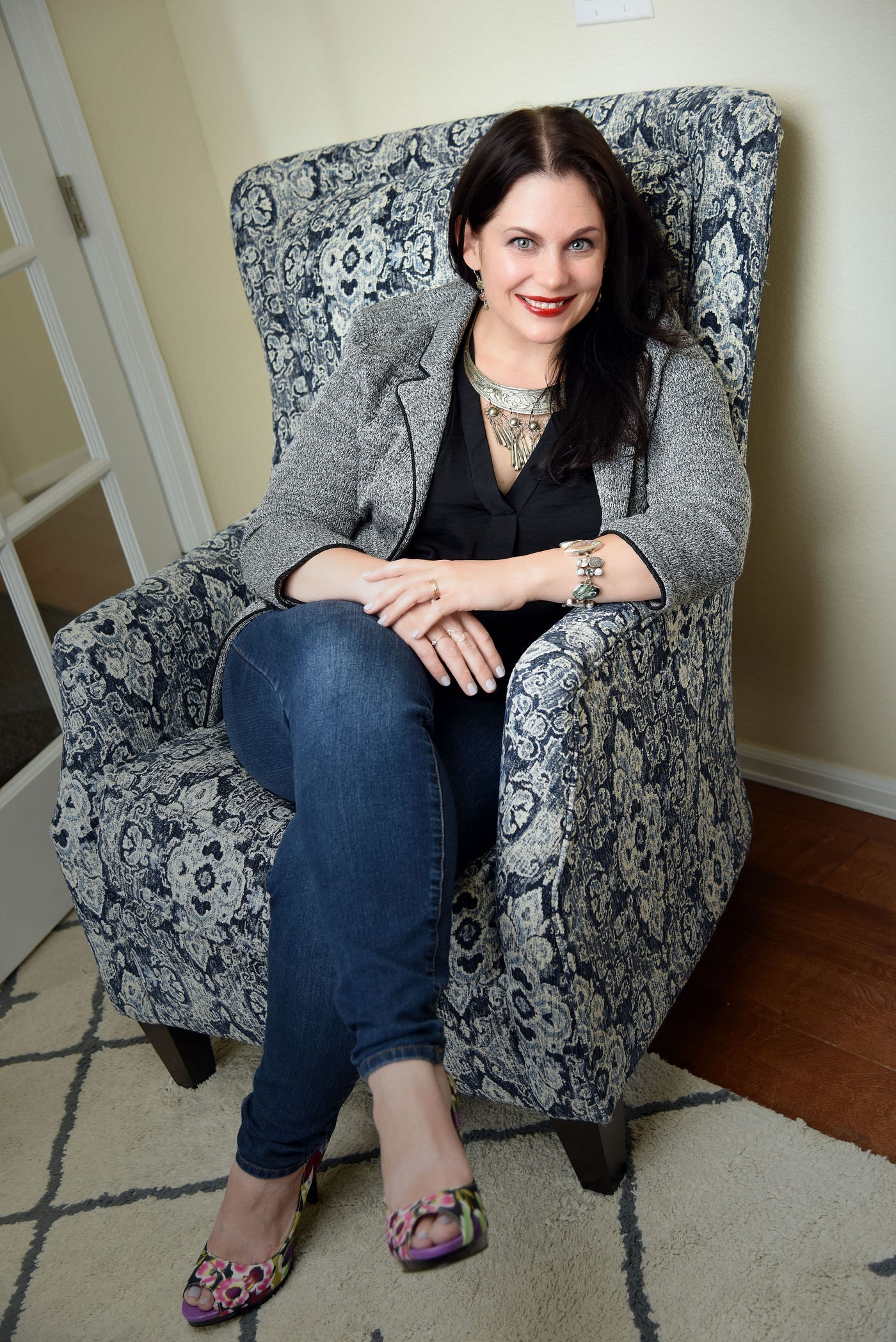
Amelia Vogler is a Grounding and Energy Medicine Specialist, an internationally respected teacher of energy medicine, and meditation guide. She embeds essential energetic practices in her meditations and teachings to support the betterment of humanity, one individual at a time, one quiet moment at a time. In addition to her teaching and meditation, she has an international private practice. In her 15 year career, she has helped over 7,000 individuals re-pattern self-limiting negative beliefs through grounding practices, intuitive insight, and advanced energy medicine.
Thank you so much for doing this with us! Our readers would love to “get to know you” a bit better. Can you share with us the backstory about what brought you to your specific career path?
When I was a very, very small child, I was born with the gifts of being able to sense, see, and experience the energies of others in a myriad of ways. Over time, as I grew, I allowed these sensitivities to take a back seat to my everyday experience of what I might call "normal life" - grad school, employment, marriage, etc.
I have many memories of being in my father's funeral home (a funeral home that has been in our family for over 250 years in Winston-Salem, NC) throughout my childhood. As a young child, I would visit the funeral home after school while Dad finished the day's paperwork. Sometimes, I would roller skate through the linoleum hallways; sometimes, I would look in the rooms that my dad told me not to look into.
The dead are an empty type of quiet. They are an empty type of still. Their eyes especially lack the glimmer of light that we have when we are alive. They are lightless and became curious about that light. What is it? What is that light in our eyes?
It was that curiosity of that light that brought me to healing.
That light is both life and that which can heal life. I might call it our Spirit. That light is what sparked in me a dedication to understanding what makes us alive and what it means to be truly alive - in body, in mind, and Spirit.
I did not realize it then, but that light that fascinated me was the same light that I was sensing, seeing, and experiencing as a little girl.
It took a lifetime of severe migraines to eventually lead me to an energy-based holistic modality called Healing Touch. After one year of consistent treatment, two things happened to me. First, I no longer have those migraines; I haven't gotten one in close to 17 years, and all of my sensitivities to energy returned, and I was back home in the light.
Because I personally saw the curative power of energy medicine, I dedicated myself to increasing the sensitivity of my intuition and natural healing gifts through the study and practice of these energy-based modalities to help others. I started my education with the Healing Touch Program, one of the premier energy-medicine educational programs in the World - teaching Healing Touch the modality that saved my health and the training that came to be the base of my energy-based health and wellness practice for many years.
Can you share the most interesting story that happened to you since you started your career?
I didn’t start my career in energy-medicine; I started my career working as a documentation engineer at IBM and then moved to SAS Institute; at that time, Fortunes #1 Best Companies to Work for in the US. What made me extraordinary in business is my intuition and my ability to see and sense the solution and reverse engineer the steps to create it. I was agile in business, not because of my traditional business education (of which I have none), but my adeptness in listening and empathizing with people, hearing between the words, seeing beyond the immediate, and knowing how and when to make career shifts within the company. I remember my final move came after I was flying home on the Corporate from a day-long listening session at a pharmaceutical laboratory, and looking out of the window, I saw one of the most inspiring skies I had ever seen. A sky filled with the soft pillows of sweeping white clouds broke open in places to allow the pink light of the setting sun to stream columns of light from below. The thought that “I am wasting my time” working for someone else. It was nature’s way of saying that there was more to me than a successful experience of traditional business life. For me, what mattered the most wasn’t the jets, the parties, the paycheck, or a fantastic stable job (one which I loved very much); what mattered more was the inner calling to help others. After that plane landed, I dedicated myself to helping others first and creating a practice around that. I suppose, in some ways, what I was doing was following the light in my eye and helping others find theirs.
I went on to create a Global practice in healing. I work with ungrounded executives to find and maintain balance in their lives. I work with individuals who feel like they don’t belong in a profound sense or have never felt like they knew how to be here in the world or connect with others. I also support surgeries in exciting ways. Once, I worked with a client through prostate surgery and felt myself suddenly working in tandem with a robotic arm. The surgery used the Da Vinci Surgical Robot system, and I could feel and sense every movement of this machine as I was working with my client’s energy. It was amazing but not miraculous. These days, almost every day that I work with clients, I get the humbling pleasure of supporting them to get more of their life and light back - body, mind, and Spirit.
What advice would you give to other leaders about how to create a fantastic work culture?
If you don’t have people who believe in your mission and values, then they aren’t the right people for your team. I have 20 consultants supporting my practice that understand and appreciate my scope of practice, the unique type of “work” that I do and respect my contribution to the World. You can’t train “caring,” so you have to find the right people. When you have a group working together who aligns with your business values, you have a group that automatically connects with your service and works towards the same goals. In my practice, these are exceptional client care, student experience, and ease of access so that my clients can entirely focus on their healing and well-being.
I do not micromanage, and I listen. I have brought on extraordinary talented people to my team. All of whom are ten million times smarter than I am in their areas, and I trust them to execute to their level of professionalism. I listen to them, and I trust them without needing to micromanage them. These are qualities that empower and elevate.
Every single person on my team knows that they matter and knows that I carry a deep respect for everyone individually and everyone as a collective. We are a fluid, creative group that honors each other, celebrates each other and works together amazingly well. I intentionally take the time to highlight everyone’s contributions.
I also incentivize generously. If we have to work extra hours to complete a project, I’ll send a gratitude payment. If a challenging time arises, there will be flowers at your doorstep and an offer of time away or some energy work from yours truly. If the people on my team need anything, I will do everything I can to support - body, mind, and Spirit.
We have FUN. If we aren’t laughing our way through mistakes, stretches, or discomforts, then it’s too serious! This element of life is something the dead taught me, if you are too busy for laughter and fun, then you are too busy!
Is there a particular book that made a significant impact on you? Can you share a story or explain why it resonated with you so much?
I love the book "First You Have to Row a Little Boat: Reflections on Life Living" by Richard Bode. It's a short book that invites us to listen deeply to our Spirit guiding us as we navigate the external currents.
"And so in time, the rowboat and I became one and the same-like the archer and his bow or the artist and his paint. What I learned wasn't mastery over the elements; it was mastery over myself, which is what conquest is ultimately all about." Bode writes.
Life is large. It will pull on you in many directions, but your compass is within, and true North sits in your values, integrity, honesty, and ability to chart your next choice based on Right Relationship with yourself. This book resonated with me so profoundly because of growing up with the dead around me. There is little more important to me than feeling alive and helping others do the same. This little book gave me permission to stay true to and navigate from here.
Ok, thank you for all that. Now let’s move to the main focus of our interview. From your experience or research, how would you define and describe the state of being mindful?
When we are mindful, we are fully present - connected to thoughts, feelings, body sensations, and softly focused through an intentional connection with the present moment. Mindfulness is not a laser focus with hard edges and intensity, nor is it being quiet but allowing your thoughts to run wildly, nor is it noticing the body with judgment. Instead, being mindful is bringing a compassionate awareness of your whole self with the present moment.
This might be intuitive to you, but it will be instructive to spell this out. Can you share with our readers a few of the physical, mental, and emotional benefits of becoming mindful?
From coaching, we know that we can't change what we can't see. Being mindful cultivates the awareness needed to create any positive change across our lives' physical, emotional, mental, and spiritual dimensions. In the physical, mindfulness practices help us to see clearly and get connected with what is out of balance in our body. For example, many people find that they are more tired than they thought, that they don't feel as vibrant and alive after eating certain foods, that they are carrying more tension in specific areas of the body. With awareness, changes become possible, and it becomes apparent that even small changes can make considerable differences in our lives. For example, did you know that if you go to bed even just 30 minutes earlier a night, you can add 3.5 hours of more rest per week (that's 14 hours per month!)
Mindfulness practices benefit resetting the speed of the mind. As we are in the constant deluge of stimulus and stress, our mind races to notice, label, and evaluate each new experience or piece of information. The mind is scanning for threats, an ancient hardwiring that once kept us safe. These days, the stimulus and information presented to us don't present an actual threat. However, the body still acts as if it "could" and acts accordingly - increasing our cortisol and keeping our adrenal system engaged. This type of stress is not healthy for the mental or physical body. Mindfulness practices help us move our attention from scanning for threats to softly focusing on one thing simultaneously, which increases a felt sense of safety and well-being and can interrupt the stress response.
What if you started each day with the sole intention of looking for beauty? Wouldn't that change your morning walk from an everyday task to a walk where inspiration is around every corner. Your neighbor's peonies are beginning to break open in full bloom. The smell of honeysuckle down a path. The natural rhythmic beauty of the city's bustle around you. Mindfulness allows us access to moments that inspire and warm our hearts and support our emotional balance, sense of contentment, and emotional balance. As the dead will teach us, life is a string of inspiring moments after inspiring moments - we just have to keep our eyes open to see them.
Ok. Here is the main question of our discussion. The past 5 years have been filled with upheaval and political uncertainty. Many people have become anxious from the dramatic jolts of the news cycle. The fears related to the pandemic have only heightened a sense of uncertainty, anxiety, fear, and loneliness. From your experience or research what are five steps that each of us can take to develop mindfulness during such uncertain times? Can you please share a story or example for each.
Using the breath is the very first place to start with any mindfulness practice. Our breath connects us to every single present moment of our life. You are most safe, secure and available for creative problem solving to flow through you in the present moment. Use your breath to lead you to the present moment. Take this moment to turn your attention from this article to your breath. Feel the air of your inhale coming into your nose, follow it as it fills the chest, notice the expansion of the chest and the natural fall with your exhale and feel the breath leaving the body. Repeat this a few times. Watch as you watch your breath and notice how suddenly your thoughts slow, and you are one with your breath. This is a simple mindfulness practice using the breath.
If you ruminate on more challenging aspects of life, remember the power of “Yes, and....” Yes, it has been a tough few years. Yes, maybe finances are tighter. Yes, there are still threats of COVID-19. Yes, there is uncertainty. Yes. Name the challenging thing that is presenting itself to you. Now, remember the power of “AND.” You have an unbelievable ability to hold many things at once. “Yes, it has been a hard few years, AND I am sitting here in my kitchen, and I am okay.” “Yes, finances are together, AND I am creative, ingenious, and can trust myself to get through this.” The power of “AND” allows you to move your mindful attention from the struggle to what else is true for you in the present moment. This practice will help to break the cycle of anxious thinking and interrupt it with more empowering thoughts.
If you are really having trouble concentrating or your mind is racing. Try the 5-4-3-2-1 technique. This grounding technique helps you move your restless or anxious mind to a stream of mindful activities centered around your senses. Mindful sensory-based activities have been scientifically proven to reduce anxiety and depression. You cycle through a mindful exercise of noticing specific numbers of things you see, feel, hear, smell, and taste.
Start with five and count backward.
Notice 5 things you SEE, such as the clouds, a tree, the carpet, a chair, etc.,
Notice 4 things you FEEL, such as your toes in your shoes, a ring on your finger, the chair you are sitting in, etc.
Notice 3 things you HEAR, such as your partner unloading the dishwasher or the rustling of leaves outside.
Notice 2 items you SMELL, such as your deodorant, coffee, or even your clothes.
Notice 1 thing you TASTE, such as the air around you.
We are social beings, and this period of isolation has been very challenging and unnatural. Many people have been very touch-deprived, and many studies show that touch elicits a felt sense of safety and wellbeing. If you were to place your right hand on your left shoulder and your left hand around the right side of your belly, you are now hugging yourself. This simple hug is already a significant step in inciting a sense of safety but adds a layer of mindfulness to this practice. Place your right hand on your left shoulder and take a moment to feel your right hand on your left shoulder. Feel the sensation of touch and the weight of your hand. Do the same with your left hand; wrap it around the right side of your belly. Again, feel the sensation of touch and the weight of your hand. Let yourself receive the experience of being held.
Finally, laughter is a great mindful practice that can lighten and unburden the heart. I know a very dumb joke that makes me smile every time. If that doesn’t do it, I think about that time that I walked right into a metal pole in NYC! Oh, my goodness, I had about ten people ask me if I was okay! Queue up a picture or a joke or a memory that elicits humor and laughter. (Or think of me running into that BIG pole!) Laughter is strong medicine for shifting worry to joy and keeping you connected to happiness as a foundation for the new you are creating.
From your experience or research what are five steps that each of us can take to effectively offer support to those around us who are feeling anxious? Can you explain?
Find ways of asking them how they are doing, without asking them “how are they doing.” You will want to offer a space that allows for connection because connection sustains, grounds, and nourishes us. When we ask, “How are you?” The typical answer we hear is, “fine.” Invite someone to connect with you more deeply by asking a question that communicates, “I care about you, and I want to connect with you.” I like this question because it will allow your friend or loved one to connect and be seen and offer them a small gratitude practice. Finding gratitude has a way of opening our hearts to compassion and goodness. “This has been a tough year; I’m wondering what you feel most grateful for?”
Ask your friend and loved one to share time with you outside of the house. Invite them to a walkout, go to a museum, see an outdoor concert, take them for an urban hike. This invitation does two things, it will help them get out of their house and out of their current thought patterns, and it will provide time for meaningful connection, which communicates, “they are not alone, and they are cared for.”
Be curious and ask them to describe one of their favorite places in great detail. Having them re-visit this place can be an excellent way to support them in remembering and returning to a felt sense of wellbeing and safety. This favorite place could be a place that you ask them about from time to time to support them in touching back into feelings of wellbeing. This strategy comes from the neuroscience of positive change. The more that we can look for and remember the good, the easier it will be to see the good every day! After all, neurons that fire together, wire together!
Take them volunteering. When we can help others, we begin to connect with our capacity for goodness. This more profound sense of goodness attends to feelings of insufficiency, depression, or loneliness. Volunteering helps regain a sense of purpose that is larger than self and returns you to a sense of connection with the world around you. Studies have shown that volunteering can reduce depression and increase self-confidence.
Help them create a self-care map. Sometimes when in the extreme overwhelm, it’s hard to remember how to prioritize basic needs. Sit with them and help them map out some of the fixtures of their self-care. You might start by clarifying when they need to start winding down to be in bed on time for a good 8 hours of sleep. You could brainstorm ideas for meal planning so that they are eating healthy. You might help them develop a list of some activities that they enjoy - parks they love, new bike routes, a list of funny movies to watch; and finally, let them know that it might be a great idea to add a therapist or social worker to their team of people who care about them. We can’t have too many people in our corner supporting us right now!
What are the best resources you would suggest for someone to learn how to be more mindful and serene in their everyday life?
I love the app called Headspace. It’s a brilliant meditation app that coaches you through starting a meditation practice that sets you up for success.
Find wonderful guided meditations on Insight Timer for almost any mental or emotional state.
An excellent place to start for education in mindfulness is the introductory classes or books by John Kabat-Zin, the Founder of Mindfulness Stress Reduction.
If you wish to have more personal support, I also highly recommend you find someone who does energy medicine to help move the anxious and heavy energies of this year and help you rediscover the light in your eye.
Can you please give us your favorite "Life Lesson Quote"? Do you have a story about how that was relevant in your life?
"Stay close to anything that makes you feel alive." When we are alive, we are living by the streams of our inner light. This quote to me says, "stay close to that which inspires you." This quote is particularly salient because I will never forget flying on that jet, watching the clouds and the pink sunlight streaming up, working a fabulous job that didn't enrich my heart and Spirit; I felt in that moment unalive. It was a call to find that which enlivened me, and for me, it was helping others through energy medicine and intuitive coaching.
You are a person of great influence. If you could start a movement that would bring the most amount of good to the most amount of people, what would that be? You never know what your idea can trigger. :-)
I want to host a Global Grounding Day every year. Individuals around the globe would come together to get grounded through a shared meditation and exercise and from a grounded place, connected with their "aliveness," give back one simple thing to others or Mother Earth. Each of us has the capacity to change the lives of another, and sometimes it is as simple as a smile. I remember this one day when there was a long line in our local coffee shop, and the individual behind me was pretty frustrated because he was late. I bought his coffee, and it warmed his heart. He purchased the following individual's coffee. And I was told this practice went on for almost an hour! Generosity can change the world, and I hope to be a catalyst for that.
What is the best way our readers can follow you online?
Website: https://ameliavogler.com/
Instagram: ameliavogler_healing
Thank you for these fantastic insights. We wish you only continued success in your great work!