I sold the wedding and event planning company after 10 years and continued to write. I was always a writer, always writing books and researching.
I had the pleasure of talking with Sara Dahmen, a woman whose extraordinary career has taken her from television production and entrepreneurship to bestselling historical fiction, Emmy-winning filmmaking, and the nearly forgotten art of traditional coppersmithing. But one of the most revealing stories about her begins with a pair of ballet flats.
Years ago, Dahmen walked into a Wisconsin metal foundry to meet the craftsmen producing parts for her cookware business. She was eager to learn how everything worked. Unfortunately, she had overlooked one small detail: appropriate footwear. Surrounded by molten metal, flying sparks, and workers in heavy protective gear, she stood there wearing what she remembers as “really cute ballet flats.” The foundry owner took one look at her and suggested she stick to the sides. The workers stared at her shoes.
Dahmen bought a pair of work boots afterward. She still wears them today.
It’s a fitting introduction to someone who has spent much of her adult life entering unfamiliar industries, learning their rules, and eventually finding her own place within them. Her willingness to look inexperienced, ask questions, and occasionally make expensive mistakes has allowed her to build a career that resists almost every conventional definition of success.
Growing up in a small Wisconsin village, Dahmen was surrounded by a large Polish-American family with deep attachments to its European heritage. Traditional music, language, and customs were part of everyday life. Her mother, a teacher, encouraged her independence and gave her the confidence to pursue interests that didn’t always fit her family’s expectations of what a woman’s career should look like. That combination of respect for tradition and willingness to challenge convention would eventually become central to her work.
After studying communications and marketing in Milwaukee, Dahmen entered commercial production, working on television, radio, and print campaigns for clients ranging from Subway and CITGO to the tourism industry in Belize. At 22, newly married and looking for something productive to occupy her time, she started a wedding planning business. What began as a side project became a full-time company that she operated for a decade before selling it.
Writing, however, was always part of her life. Her fascination with historical fiction led her into extensive research about how people in earlier centuries lived, worked, and made things. Eventually, that curiosity took her somewhere unexpected: into the world of traditional copper cookware.
Through her company, House Copper & Cookware, Dahmen began reviving American cookware designs and manufacturing techniques that had largely disappeared. She learned from old books, antique equipment, and aging craftsmen, piecing together knowledge that had once passed naturally between generations. As a woman working in a highly specialized, traditionally male trade, she also encountered people who questioned whether she belonged there.
The technical challenges were formidable, but an equally important battle was taking place in her own mind.
Dahmen recalls standing in her workshop one afternoon, worrying about whether a pot’s seam was perfect, whether the tin lining would meet expectations, and whether customers would find fault with her craftsmanship. Then she experienced a moment of clarity: “Pretty much nobody else can do this.”
It was an unusually liberating realization for someone accustomed to questioning her abilities. She had spent years mastering something extraordinarily difficult. Perhaps she could finally give herself permission to trust that expertise. That confidence began carrying over into her work as a novelist, screenwriter, and producer.
Today, her accomplishments span several creative industries. She is the author of the historical Flats Junction novels and the nonfiction book Copper, Iron, and Clay, published by HarperCollins. Her work has attracted national attention from outlets including Forbes, PBS, Food & Wine, Martha Stewart, and the TODAY Show. Yet even with those achievements, she continues to wrestle with a challenge familiar to entrepreneurs and artists: the difficulty of surrendering control.
In her copper workshop, Dahmen can shape the material, solve problems, and see tangible results. Film production is different. Projects depend on networks, financiers, collaborators, and decisions she cannot control. A promising slate of productions can meet with rejection after rejection. The contrast has made her appreciate what she calls “hand knowledge,” the skills that live in a person’s hands and cannot be taken away by someone else’s decision.
Her latest historical novel, Threads in the Tapestry, scheduled for release on November 20, 2026, reflects another dimension of her fascination with preserving overlooked history. Set in the 16th-century Ottoman world, the book explores the lives of influential women including Hurrem Sultan, also known as Roxelana, and the Jewish philanthropist Gracia Mendes. Dahmen’s research led her to examine their connections to efforts that provided refuge and assistance to vulnerable communities across religious boundaries.
For Dahmen, these historical figures offer a compelling way to explore questions that remain urgently relevant: what happens when powerful people choose cooperation over division, and how many remarkable stories disappear because later generations stop telling them?
Her attraction to forgotten history is closely connected to her commitment to endangered crafts. Both involve recovering something valuable before it disappears.
There is another constant beneath her many professional reinventions: family. Dahmen credits her husband’s support as essential to everything she has accomplished. She is also candid about opportunities she has declined because their demands would have come at too great a cost to her marriage or children. Her ambition is substantial, but she has learned that even exciting projects are not automatically worth pursuing.
Perhaps her most revealing description of herself comes from the material she knows best. She compares a person’s identity to a copper wire. It can be twisted, bent, and reshaped into different forms without losing its essential substance. Becoming a wedding planner, a novelist, a coppersmith, or a film producer does not require becoming an entirely different person.
That philosophy helps explain a career that might otherwise appear almost impossibly varied. Dahmen has discovered that reinvention does not mean abandoning everything that came before. The curiosity, stubbornness, craftsmanship, and appetite for learning remain remarkably consistent, even as the work changes.
And while her pursuits range from ancient metalworking techniques to contemporary filmmaking, she returns repeatedly to one conviction: people are capable of far more than they realize, provided they remain willing to learn and keep moving.
“You can still second-guess; just don’t stop,” she says.
It is an idea Dahmen has tested repeatedly, sometimes with spectacular results, sometimes with painful lessons, and at least once with entirely the wrong shoes.
Yitzi Weiner: Sara, it’s such a delight to meet you. Before we dive in deep and talk about your amazing work and creativity, our readers would love to learn about Sara Dahmen’s personal origin story. Can you share the story of your childhood and how you grew up, and particularly the genesis of all the amazing creativity, and some would say genius, that has come since then?
Sara Dahmen: I wouldn’t call it that! I grew up in a small village in the middle of Wisconsin, with a very proudly Polish, giant family on my father’s side, while my mother’s side is Polish and German. Weirdly, that was a really huge piece of my childhood, to the point that as an adult I went and got my own folk costumes from our regions because we grew up with the music and the language. That is very common in Wisconsin; people cling to their heritage even after a few generations, and I’m only a second-generation American.
I have two younger brothers and I’m the only daughter, and my parents have been married for 40-plus years and are still going strong. I was really lucky that my mom was a teacher. As much as we butted heads, she gave me a lot of self-confidence to chase after things, even if my family didn’t necessarily think it was what a girl should be following. There was a little bit of, “Why aren’t you staying home completely and taking care of the kids instead of creating this career for yourself?” Still, they support me, and my brothers roll their eyes a bit and support me too. I’m really lucky to have come from a very supportive background.
Yitzi Weiner: That’s your origin story. Tell us the next chapter. Tell us the story of how you became Sara Dahmen.
Sara Dahmen: Well, I got married and changed my last name! No, I went to college in Milwaukee and got a whole bunch of degrees in communication and marketing that I sort of use and don’t use. You know how we all get our degrees thinking we’re going to use them, and then we don’t really, yet we still do. I worked in production as a commercial producer, where we made TV, radio, and print ads for anything from tourism for Belize to Citgo to Subway.
Then I decided to start a wedding planning business on the side, which turned into a full-time business. I was 22 when I started that because my husband was studying so much when he wasn’t working. I was newly married and sitting there bored, so I started a business just to keep myself busy. Ever since then, it has been one entrepreneurial deep dive after another.
I sold the wedding and event planning company after 10 years and continued to write. I was always a writer, always writing books and researching. I really love historical fiction; I love learning and then entertaining people with what I’ve learned so they can learn and be entertained too. That research deep dive is what also turned me into a coppersmith, because rabbit holes are dangerous! Now I’m a writer, a coppersmith, a movie producer, and a mom. It’s busy and it’s wonderful, so I have no complaints.
Yitzi Weiner: That’s unbelievable. Maybe I’m misinterpreting, though I feel like you rolled your eyes a little bit when you said “coppersmith.”
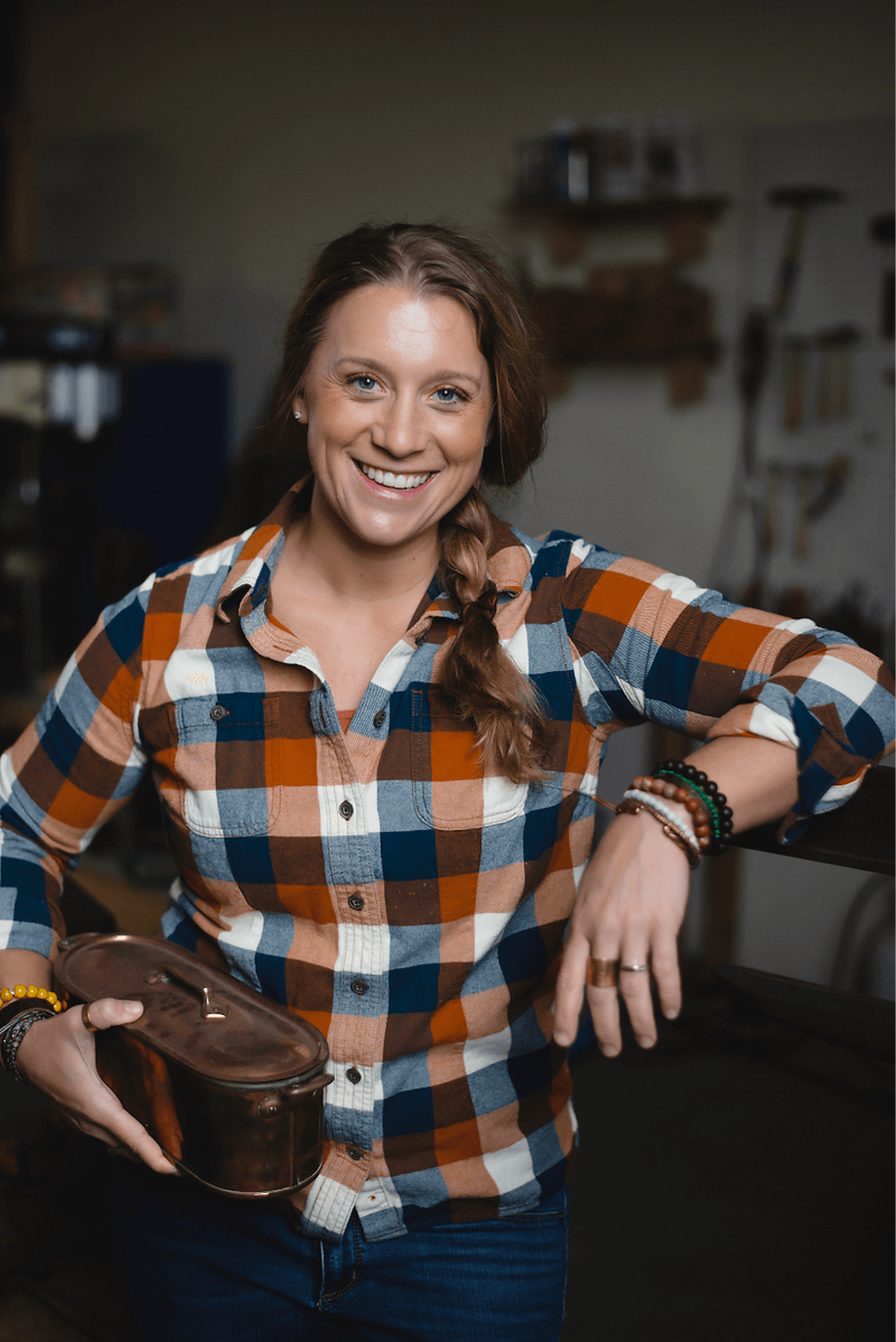
Sara Dahmen: Well, that’s because people always ask, “What is that?” It seems so out of left field, and it’s hard to explain because it doesn’t fit into anything else I’ve ever done. Yet I’m really proud of the fact that I am the only woman in America building and restoring copper cookware using tools and methods from the 1700s and 1800s. It is a really cool job.
Because I’m the only woman doing it, I do sometimes get a little bit of pushback from people who don’t think I should look the way I do and be a coppersmith. So I sometimes have to tell them, “No, no, no. I promise you, this is the periodic table of elements and the science of how it works. I’m not making it up.”
Yitzi Weiner: You’re clearly an artist. Are you an artist in other areas as well?
Sara Dahmen: I do like to paint and draw, though I haven’t had time for it in years. When I was younger, I spent a lot more time doing art, just not recently. Now, my art is building beautiful pieces of cookware that I know are usable and will outlast me for centuries. And I get to write books and movies, which is still an art form, and I love it. It’s my favorite art form.
Yitzi Weiner: You probably have some incredible stories from your amazing and prismatic career, meaning how colorful and varied it is. I’m sure this is difficult to single out, can you share with our readers two stories that stand out in your mind?
Sara Dahmen: One actually has nothing to do with my careers, though it has probably had the most profound impact on me. On the day I met my husband, within minutes of starting to talk, I remember thinking, What if this is the guy I marry? I don’t know if that’s a real love-at-first-sight situation, yet we’ve been together 24 years, and every year is better and more fun. I couldn’t be doing what I’m doing if I didn’t have the support of a partner and spouse. As weird and sappy as that sounds, it’s a big thing. A lot of people don’t know that it happened within minutes of meeting; I could still tell you what he was wearing because the memory is so distinct.
The second one is the day I figured out how not to have impostor syndrome quite as badly. I was in the copper shop building some pots, and I was panicking, thinking, What if it doesn’t turn out? What if it’s not really good enough? What if they’re unhappy with how this seam looks or how this finish turns out, and it’s not exactly perfect? What if the tin drips and people don’t like it?
Then I realized, No, hold on. Pretty much nobody else can do this. Stop overthinking it, and just build it to the best of your ability. If somebody is upset about it, tell them to build it themselves. Oh, wait, they can’t! That realization translated into feeling more confident about myself as a film producer, a screenwriter, and a novelist. I couldn’t tell you the exact date, though I remember where I was standing in the shop during the late afternoon. It’s a very visceral memory. Those two moments weave in and out of my life forever now. They’re probably different from the stories you’re used to hearing, yet to me they’re very raw, tangible, tactile stories. Touchable.
Yitzi Weiner: I love that. Going back to the first story, why do you hesitate to call it love at first sight?
Sara Dahmen: Because I’m such a pragmatic, practical person that I think, That’s not a real thing. Maybe it is. Maybe that’s what it feels like when you just think, Huh, this is my person. That seems so fantastical that part of me thinks it’s an overdramatization and maybe I just really liked him right away. Still, maybe it is real, and if that’s how it works, then we all need to know it’s quieter than they make it out to be in the movies.
Yitzi Weiner: You’ve taken on so many roles. What has been the most challenging project or role you’ve taken on so far, and why?
Sara Dahmen: I used to say coppersmithing was, because the trade was pretty much dead. Trying to rebuild a cookware line here in America when nobody knew what to do, and finding people to help me rebuild it, was very much a challenge. There were roadblocks every time I turned around. I would think I had something solved, and then it wouldn’t work, so I’d have to start all over again, sometimes going way back to the drawing board to make sure I could build the company and products I wanted. I was piecing it together with nothing more than old books and guys in their 70s who were figuring it out alongside me.
Over the past several years, though, working in the film industry has probably been the most challenging. The biggest challenge is that I don’t have full control over as many pieces as I would like, and I’ve learned that I don’t do well when I lack control over the pieces. That brings extra challenges compared to building the cookware line. Had you asked me this five years ago, I would have said starting cookware from scratch, whereas lately it has been this next aspect of my many career paths.
Yitzi Weiner: I love that. I think it’s a modern phenomenon. It used to be that people would have one solid career for the rest of their lives and feel stuck, and people don’t like being typecast in any way. What’s really appealing about your story is that you can be anything you want, even in unrelated fields.
Sara Dahmen: It’s weird to put on a new skin and stop calling yourself a wedding planner and say that now you’re a coppersmith. That’s a very dramatic shift; all of a sudden your identity is changing and you almost have to get used to saying it out loud.
I’m a coppersmith, so I think the best way to look at it is that who we are is like a copper wire. Your life is that copper wire: you can twist it, change its shape or the direction it’s pointing, and make little knots in it, yet you’re still always that copper wire. That backbone doesn’t change. If you remember, I am still me; I’m just doing this as life goes on around me, it feels less like a huge new narrative you have to invent. I’m simply taking a left turn, making a kink in my wire, and trying a different direction. If we realize there’s nothing wrong with doing that, making changes and big life decisions becomes much less scary.
Yitzi Weiner: I’m going to ask an uneducated question: why a coppersmith instead of an ironsmith? As far as I know, cast iron pots are very popular. What is the benefit of copper over iron?
Sara Dahmen: They’re used for very different cooking processes. Copper is actually older than cast iron in our kitchens. People often assume cast iron has been around forever, yet cast iron really wasn’t used the way we know it until the late 1700s, whereas copper was used hundreds of years before that. Historically, copper was easier to manipulate without needing blast furnaces.
My uncle Doug was a blacksmith who worked in wrought iron, cast iron, and steel. It’s strange, because metal lives under your fingers, and I just never got the feel for iron; I couldn’t figure out how to move the metal. My uncle Doug made it look so easy because he understood it mechanically and it just flowed for him. When I’m working with copper, I can feel how it’s moving, so it called to me.
From a cooking standpoint, copper is much more conductive. You need a fraction of the heat for a fraction of the time compared to cast iron, which makes it great for precision cooking. If you’re making a roux, for example, a lot of French cooks use copper because the minute you shut off the heat, it stops cooking and cools down quickly. With cast iron, you have to rev it up, add the food, and fry at higher temperatures. So they serve very different uses in the kitchen for different dishes.
Yitzi Weiner: Sara, please tell us about any exciting new projects or adventures you’re working on. We’d love to hear all about them, so feel free to be as elaborate as you like.
Sara Dahmen: Obviously, the biggest one is the book that comes out this Friday, Threads in the Tapestry. It represents years of research going back to original sources, some of which conflicted, to put together a huge story from the Renaissance that almost nobody knows. I hope people pick it up and say, “Wow, I had no idea that 500 years ago a Christian, a Muslim, and a Jew could work together to save thousands of people from war and the Inquisition.” They were the billionaires of their time, and they poured their own money into creating safe havens for people.
Then these two women, the Sultana, who was the greatest woman in the East, and the richest woman in the West, came together and hatched a plan to pour money into the Middle East on land the Sultan gave them. Working together, they meant for it to be a crossroads where, no matter what your faith was, there would be a safe place to get hospital care, food, and shelter for as long as you needed on your journey. To me, that’s such a timeless message. I often wonder whether it fell short because they died before they could finish it, or because people in power disliked seeing that different faiths could work together, causing the story to disappear from history. So I’m really excited about that book.
I also have another book coming out in 2027 called The God Talkers. It is based on a skeleton that the Nazis dug up in the 1930s and used for their internal propaganda. Just a few years ago, researchers were finally able to run extensive DNA tests on the remains. The great irony is that this shaman would actually have been the very first person murdered by the Nazis rather than celebrated in their propaganda. I love weaving history and religion into my books; it’s what I love talking about. Beyond that, there are always movies and TV shows in various stages of development that I have no control over, and I’d have to check my NDAs to know what I’m even allowed to mention right now!
Yitzi Weiner: I get it. Maybe this is hard to do, yet without giving away the whole story, can you share a favorite episode from Threads in the Tapestry?
Sara Dahmen: Oh gosh, I’m running through each chapter in my head! The book was challenging because so many of the characters I wrote about were real historical figures, so I couldn’t invent many people even though it’s historical fiction.
There is a scene where the woman we come to know as Roxelana, or Hurrem, who becomes the Sultana, has a conversation with Sultan Suleiman the Magnificent. She explains her Slavic culture to him and how, back in the 1500s, her people believed that husband and wife cleave together to become a fortress. Between the two of them, they run their lives together, divide and conquer, and become stronger because of it.
She is saying this to a Sultan whose dynasty’s tradition for centuries was never to marry. Sultans didn’t get married; they had concubines, had sons, and sent the sons off to govern provinces. When the Sultan died, those half-brothers fought to the death, and the last one standing became the new Sultan. Without calling it stupid outright to the Sultan’s face, she explains what she believes makes for a far more powerful partnership. You can see the first kernel of the Sultan thinking, Maybe there’s something to this, because he eventually broke with centuries of tradition to marry her. I always wondered what made him decide to change how the entire sultanate had been built, so I loved building that scene and imagining how that conversation might have transpired.
Yitzi Weiner: Is Gracia Mendes one of your characters?
Sara Dahmen: She is! Yeah, you would know who she is. A lot of people have never heard of her. If you were raised in a Jewish household, you might know her name, whereas almost nobody in Wisconsin knows who she is. Funny enough, I was talking to some producers from Ukraine and briefly mentioned the book, and they immediately said, “Oh, Roxelana!” because Hurrem was from that Polish-Ukrainian region. Depending on where you come from, you might know one of these women, yet rarely both, and people certainly don’t realize how their work in the Middle East connected. That story had never really been pieced together, and I tracked down all the documentation.
Yitzi Weiner: Actually, I’m writing a biography right now about a great 16th-century poet named Rabbi Elazar Azikri. He lived in Tzfas (Safed), right near the community that Gracia Mendes helped to fund, and I’ve been reading all about how the textile industry and scholarship flourished there during that brief window.
Sara Dahmen: Yes! She had that land in Tiberias because the Sultan gifted it to her. He basically told her, “Just raise the tax base and get more taxes out of the area, and you can build whatever you want.” Meanwhile, his wife Hurrem was pouring her own money into Jerusalem and the region as well, funding a foundation, a soup kitchen, and a hospital. It was all right there at that crossroads. Coming from their own personal traumas, I think both women saw it as the place where East meets West and where there could be a true safe haven. While Gracia Nasi’s project was primarily a Jewish enclave, the Sultana’s foundation was meant for all People of the Book, welcoming any Christian, Muslim, or Jew to come lay down their head.
Yitzi Weiner: Unbelievable. There’s a saying that sometimes our mistakes can be our greatest teachers. Do you have a story about a humorous mistake you made when you were first starting out, along with the lesson you took away from it?
Sara Dahmen: A humorous story, as opposed to depressing and expensive! Usually they’re depressing, expensive, or both at the same time. You have some very good questions; I’m really thinking to pull a good one.
One funny mistake happened before I truly understood metalsmithing. We were ordering parts from a foundry here in Wisconsin, and I thought, I’ll go up and visit. I should meet the people I’m working with, shake their hands, and see how things are made. Well, I had no idea how dirty a foundry actually is, or what counts as appropriate footwear. There is thick black dust everywhere; you couldn’t keep it clean if you tried.
I showed up in really cute ballet flats! You’re supposed to wear steel-toe boots because molten metal is pouring out, sparks are flying, and workers are wearing protective gear. The foundry owner just looked at me and said, “Oh… well, stick to the sides.” As they walked me through, the guys working on the floor did a double take because I obviously didn’t belong there, and every single one of them stared straight down at my shoes.
I got smart real quick and bought a pair of work boots that I still wear today, though I felt like an idiot at the time. It taught me to do even more research on the small details before diving into the next aspect of building copper cookware. I might as well have had a neon sign flashing above my head saying, Newbie amateur! She doesn’t know what she’s doing yet.
Yitzi Weiner: What’s amazing is that you didn’t let that impression intimidate you or stop you. A lot of people would have turned around right there.
Sara Dahmen: Oh, no. Even when I get intimidated, which I definitely do, I don’t have trouble forcing myself to do crazy things. The entire time in my head, I might be thinking, Who does this? You’re insane. Why are you doing this? Turn around now. Too late, you’re already walking forward!
The key is keeping yourself from stopping when you second-guess yourself. You can still second-guess; just don’t stop. Whether you’re writing a book, making a movie, or making a copper pot, if you get inside your own head and stop, your life becomes a stalemate. No matter how rich you are, time is the one thing you can never buy back, so you might as well fill it with things that excite you. Even when it’s scary, force yourself to keep moving, because there is always value in what you learn, even when the lesson is expensive and depressing!
Yitzi Weiner: This is our signature question. Sara, you’ve been blessed with so much success, and you must have learned a lot from your experiences. Looking back all the way to the beginning of your career, can you share five things you’ve learned over the years, maybe sometimes the hard way, that someone starting out today can really benefit from?
Sara Dahmen: 1. Never be afraid to say, “I don’t know.” I learned that the hard way because there is no faking it when you’re building copper cookware. I had to swallow my ego and be a vessel that craftsmen could pour their knowledge into, without being afraid to come back and ask, “Tell me that again, I don’t remember. Can you write it down?”
2. Surround yourself with supportive, trustworthy people. I’ve kissed a lot of toads in business. In the beginning, you want to believe the best in everybody and assume they’re entering a business arrangement with an open heart just like you. Chances are they aren’t, and the hardest skill is spotting that early. Even now, I sometimes wish I had listened to my gut and had a tough conversation early on instead of having to backtrack late in the game. Some people go to the opposite extreme automatically, saying, “Prove it. I trust nobody,” assuming everyone will burn them from day one and feeling pleasantly surprised when they don’t.
3. Always keep a tactile hobby on the side. When I’m spending heavy stretches of time in the film industry, we might pitch a slate of great projects and get a string of rejections from every network. That is crushing because you have zero control over all those “noes.” Being able to walk out to the shop and build a piece of cookware, or for someone else, knitting a sweater or gardening, gives you something physical that nobody can take away. I call it “hand knowledge” because it lives in your hands and no one can steal it. Working with your hands will save you mentally on the days when things outside your control are beating up your confidence. Honestly, I sometimes think if Putin had been a blacksmith, he might never have invaded Ukraine; he just didn’t have a hobby!
4. Keep your priorities straight. It is very easy to get lost in your career. Plenty of times I’ve stood on the precipice of pouring massive energy into a new project or business, only to realize I wasn’t willing to make the sacrifice it would demand from my marriage and my children. Yes, certain opportunities will pass you by when you make that choice, yet if you’re doing it for the reasons that matter most, you’ll never regret those lost opportunities. My family comes first, and I won’t take on something that hurts them.
5. Learn when to shut up and listen. I’m probably talking too long on all of these, which proves my point: “You talk too much, Sara!” Because I struggle with slowing down and listening, I sometimes barrel through decisions way too fast. Once, I walked into my cousin’s father’s car dealership and asked, “What do you have?” He pointed to a blue car in the corner and said, “I got that model for my daughter.” I asked, “Cool, does it come in orange?” He said, “Yep.” I said, “Cool, I’ll take that one,” bought the car, and left. When I got home, my husband asked, “What kind of car is it?” I said, “I don’t know, it’s orange.” He asked, “Did you test-drive it?” “No.” “How do you know if you like it?” I told him, “If it’s good enough for my cousin whose dad owns the dealership, it’s good enough for me. Does it work? Yes!” My husband couldn’t believe it because he’s the total opposite, Mr. Blue Book, researching every detail. I tend to make snap decisions for better or worse, so learning to slow down and listen, even when it goes against your nature, makes a huge difference.
Yitzi Weiner: Sara, this is our final aspirational question. Because of your amazing work and the platform that you’ve built, you are a person of enormous influence. If you could spread an idea or inspire a movement that would bring the most amount of good to the most amount of people, what would that be? You never know what your idea might inspire.
Sara Dahmen: It would be the mission I’ve been working on since I started building cookware 12 years ago: preserving lost trades and folk arts, and making them mainstream and accessible again. Over the past 10 years, whether it’s a real cultural shift or just my algorithm, I’ve noticed growing interest in those lost trades.
Preserving traditional crafts creates a low-simmering confidence across an entire community. Everybody knows how to contribute and build something real that lives in their hands and in their heads. That shared group confidence builds stronger communities and happier people, and the ripples keep spreading. In a digital world, we’ve drifted far away from that, and it’s too valuable to lose. I’ll always be the first to try making something new with my hands and encourage others to try too; someone might discover they’re a natural savant at a craft they never considered. Keeping lost knowledge alive makes everybody better off.
Yitzi Weiner: Sara, how can our readers continue to follow your work? How can they purchase your book, watch your films and shows, purchase your cookware, and support your work in any possible way?
Sara Dahmen: My personal website is saradahmen.com, and my cookware company is at housecopper.com. Beyond that, I’m very easy to Google, and you can find me on Threads, Facebook, YouTube, or Instagram. I don’t really do TikTok; I tried it twice and couldn’t figure it out! I actually just recruited my daughter to help. Well, I didn’t pay her; I basically told her, “You can have TikTok on your phone if you make TikTok videos for me.” My books are traditionally published and available anywhere books are sold, and all of the cookware is online.
Yitzi Weiner: Sara, it’s been an honor to meet you and truly a delight. I wish you continued success, good health, and blessings, and I’d love to do this again in the near future.
Sara Dahmen: Oh, thanks, Yitzi! Thanks for all these hard questions; they were awesome. I appreciate you featuring me in Authority Magazine and asking thoughtful questions that really made me think, rather than just the usual ones. Thank you again for the opportunity.
Yitzi Weiner: It’s my pleasure! It’s really an honor to have you, and I’m very excited to share the article with our readers.