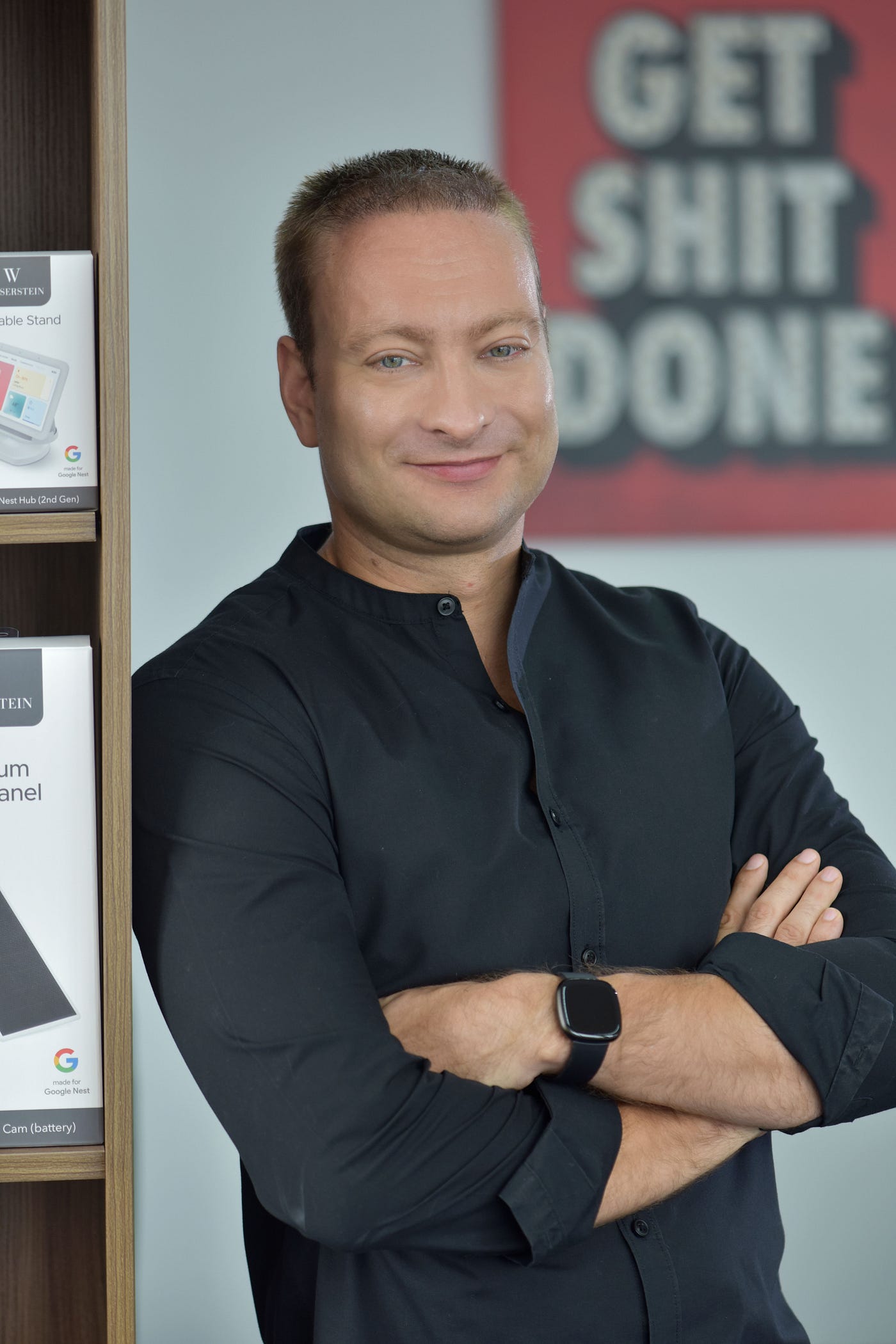
When Seekr fully blossoms and when everything we can do becomes available to the public, we know we will be impacting society for good.
Tech
Pat Condo of Seekr: Search Technology Must Empower Users to Control Information Rather Than Letting Platforms Dictate Reality
The veteran tech founder shares how his background in aerospace navigation inspired a disruptive approach to web search and digital content evaluation.

As a part of our series about business leaders who are shaking things up in their industry, I had the pleasure of interviewing Pat Condo.
With more than 30 years of experience in search technology, Patrick C. Condo is experienced in bringing cutting-edge search technology to the market. His mission is to provide consumers and advertisers with ways to objectively evaluate web-based content and create user interface design that propels the next-generation consumer-centric search experience. Condo’s career includes founding four tech companies — two of them public on NASDAQ — and providing advanced search capabilities to the defense and intelligence communities.
Thank you so much for doing this with us! Before we dig in, our readers would like to get to know you a bit more. Can you tell us a bit about your “backstory”? What led you to this particular career path?
I’m Pat Condo, Founder and CEO at Seekr Technologies Inc. Seekr is an independent internet technology company that provides a transparent, trustworthy digital experience by streamlining access to reliable information to support informed decision-making. Seekr is an alternative to existing search engines and offers objective results coupled with advanced information analysis to assist users in judging the quality of content.
I have over 30 years of experience in the search industry. What is interesting about my trajectory is that I started my career working on navigation systems, which is all about guiding people to their destination. I was involved with two of the largest programs in US technical history, the MX Missile program and the Space Shuttle program.
From there, I founded four search companies, which were all about letting people control their own access to information, whether for work or pleasure. So as you can see, navigation and search are sides of the same coin.
Can you tell our readers what it is about the work you’re doing that’s disruptive?
Consumer rating systems exist across several industries; however, until today, no one has created a system to automatically evaluate the reliability of the information on a web-scale. We can’t control what the media says or writes, but we can give people the tools to evaluate the content and make their own decisions instead of having other search engines draw conclusions for them.
What Seekr offers is disruptive because we give the users the power to control the technology. We often see something useful, such as a social media platform be created, but when the platform begins managing you we have a problem. We are entering that stage today and we at Seekr believe that now is the time for people to harness the capabilities of search using a self-determined approach not one predetermined by others.
Can you share a story about the funniest mistake you made when you were first starting? Can you tell us what lesson you learned from that?
It’s not necessarily a mistake, but it’s funny. Back in the day, my wife and I were working for the same company, on the same floor, in almost the same office. She would always make lunch plans, and quite often, I had to decline or cancel on the spot. After a while, obviously, the situation started to take a toll on the relationship, and we had to redefine the rules. That’s when we decided not to work in the same complex ever again.
If we think about it, many people must now face similar situations by sharing home offices with their partners during the pandemic. It is almost a hidden expectation that if we are under the same roof, we have to synchronize agendas, and we all know too well that that’s not how it goes. Remember, there’s no free lunch.
We all need a little help along the journey. Who has been some of your mentors? Can you share a story about how they made an impact?
I was fortunate enough to say I had some mentors throughout my journey. People that saw something in me before I could see it or know it existed. Herbert Allen from Allen & Co gave me the opportunity to become a CEO of a public company and interact with talented business people, including those appointed as board members of my companies, among other important collaborations. I had little experience, but with his guidance, I sold the company to Intel, then went on to create 4 other companies, so I guess I learned something.
In today’s parlance, being disruptive is usually a positive adjective. But is disrupting always good? When do we say the converse, that a system or structure has ‘withstood the test of time’? Can you articulate to our readers when disrupting an industry is positive, and when disrupting an industry is ‘not so positive’? Can you share some examples of what you mean?
The way I see it, a positive disruption is more of an evolution. To truly disrupt an industry takes time; it doesn’t happen as fast as people think. A real disruptor pays attention, captures the industry signals, and rapidly assembles the resources to take advantage of a particular trend. For example, electric cars have been around for over 50 years. However, people perceive them as something new and disruptive. Positive disruption is an evolution that gets magnified.
Can you share five of the best words of advice you’ve gotten along your journey? Please give a story or example for each.
- Patience = That is a virtue that quite a few CEOs have a tough time with. By listening to people and giving them directions, you can gain more than just expecting everybody to be as impatient as you are.
- Honesty = Share the risks and let the stakeholders make their own decisions. You do not want to hear, “I had no idea that that’s what we would do.”
- Curiosity = I always want people to be curious and look at things from a distinct perspective. Use your imagination. When we started Seekr, a lot of people did not follow. It would have been easier to give up. Still, as we continued to dig in and uncover how misinformation was affecting society, it was clear that Seekr was not only viable but necessary.
- Temperance = Everybody is entitled to have an opinion, but running a company is not a democracy. It must be driven by someone that has a vision and can make the decisions. Decisions are made based in part on what you can learn from the people you hired, but you are the one that needs to set the tone, the pace, and the direction. Not unlike a navigation system.
- Humor = Have fun. Bringing humor is a way to break the ice, and it gives people the room to express their thoughts and ideas, making everything a little lighter.
We are sure you aren’t done. How are you going to shake things up next?
I’m excited about what we are building at Seekr as we address big principles such as freedom of choice, freedom of speech, censorship, diversity, and critical thinking. When Seekr fully blossoms and when everything we can do becomes available to the public, we know we will be impacting society for good. Technology is incredible, but it can also hurt. At Seekr, we don’t put people in a box; we don’t categorize them; you have the choice and control to decide what information you would like to consume online. By giving people access to all sides, we believe we are helping users be more informed and make better decisions.
Do you have a book, podcast, or talk that’s had a deep impact on your thinking? Can you share a story with us? Can you explain why it was so resonant with you?
I have a few titles that taught me to see things from different perspectives.
- Mediations, by Marcus Aurelius
The book brings an intimate view of the self-improvement journal of a Roman emperor who had to lead the country by example while learning about humanity, society, and evolution.
- Leonardo da Vinci, by Walter Isaacson
Aside from being an artist, inventor, musician, philosopher, and more, da Vinci was a copious note-taker. This bestseller connects da Vinci’s art and science, showing skills we can improve ourselves.
- The Agony and the Ecstasy: A Biographical Novel of Michelangelo, by Irving Stone
For me, this book is about determination and perseverance. It offers a captivating portrait of one of the greatest artists and sculptors the world has ever known.
All inspiring readings that show you how these achievements continue to echo and impact society over time, a demonstration of what a person is capable of doing and how lessons from the past are as relevant today as they were then.
Can you please give us your favorite “Life Lesson Quote”? Can you share how that was relevant to you in your life?
“In everything, do to others what you would have them do to you.”
I’ve seen people use people in ways that are shocking to me. Throughout my life, I’m proud to say that I always asked myself, “what if I was on the other side?” so I preferred to be fairer than anything else.
You are a person of great influence. If you could inspire a movement that would bring the most amount of good to the most amount of people, what would that be? You never know what your idea can trigger. :-)
Unfortunately, multiple forces want to harm democracy and break what we have. Misinformation exists to interrupt a way of life. Therefore, I’d like people to recognize that and recognize the value of what we have.
That’s why critical thinking is so important; it’s the only way people can understand what is happening around them.
I believe people mistake silence for acceptance, and that is not the case today. The movement we need is to continue giving people access to reliable information, putting the choice and control back at the hands of people, so they can understand content in context instead of being placed in a bubble and accepting conclusions drawn by others.
How can our readers follow you online?
By following Seekr on www.seekr.com and social media channels like Facebook, Instagram, LinkedIn, and YouTube.
This was very inspiring. Thank you so much for joining us!
FG
Written by
Fotis Georgiadis
Editor & Journalist · Authority MagazineFotis Georgiadis is a senior columnist at Authority Magazine covering Tech and Business, conducting primary-source Q&A interviews with founders, executives, and industry leaders.

Published inAuthority MagazineTop Lessons, Top Authorities · 42K Followers
Exclusive, curated interviews with the leaders and changemakers shaping tomorrow. Leadership lessons, industry deep dives, and executive profiles.