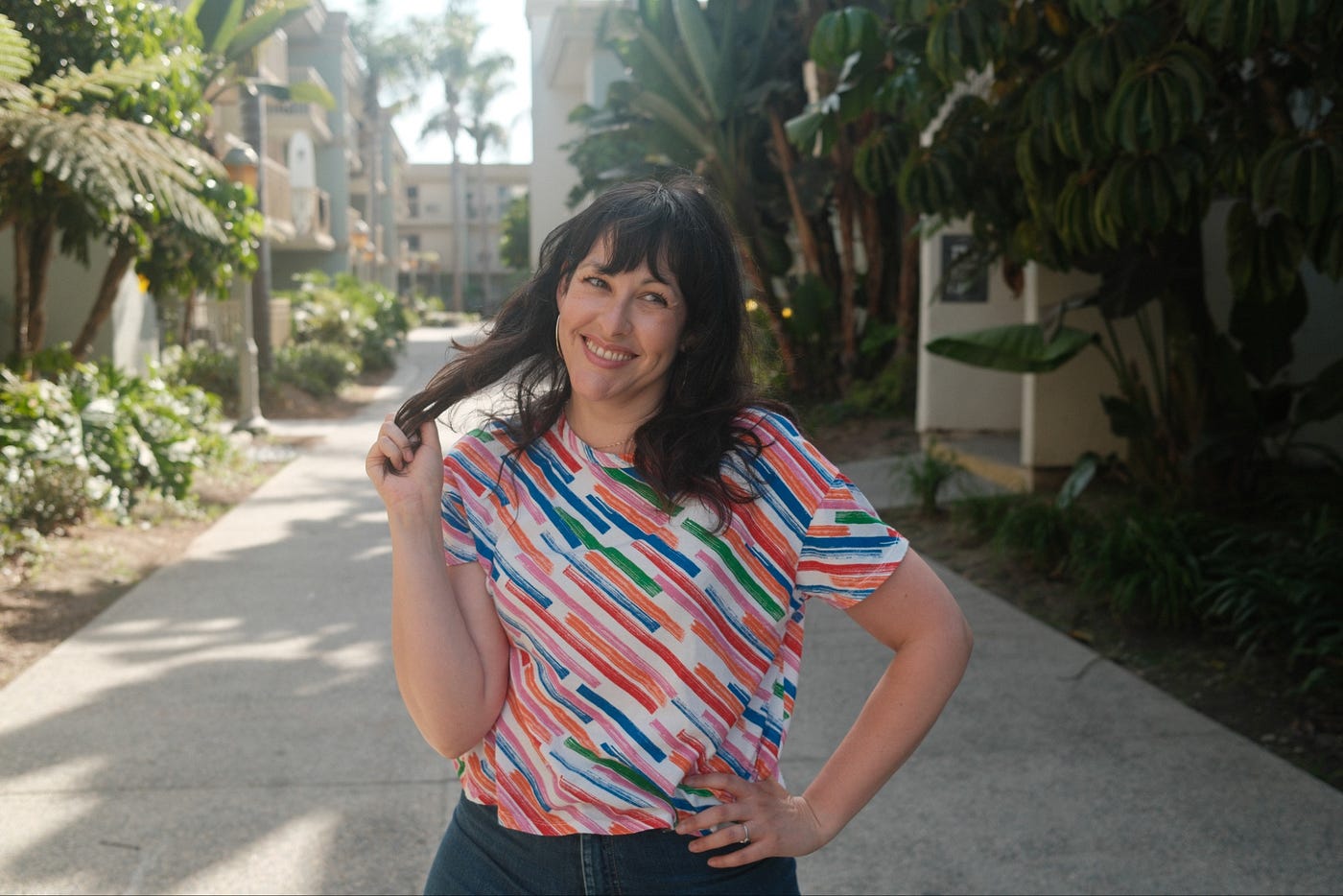
I’m Puerto Rican; I was born in Puerto Rico and raised in Orlando, Florida. I’m the youngest of four children, and I’ve always been very attracted to performing.
Three hours before a performance of Do You Feel Anger? at Circle X Theatre in Los Angeles, Melissa Alce learned that the lead actress had COVID and she was going on in her place. Alce was the understudy, and the cast stepping in with her had never rehearsed a complete run together. Worse, she was carrying the play.
Backstage, she was terrified. Then, through the noise of the arriving audience, she heard something familiar: her husband’s laugh. The sound seemed to settle the argument she was having with herself. “Okay, you can’t apologize anymore,” she remembers thinking. “You can’t be scared. There’s no room for this. You just have to go out there and do what you were born to do.”
She did. Then she did it again for the rest of the weekend.
The story captures something central to Alce’s career. She does not describe herself as fearless. In her personal life, she calls herself “timid, anxious, and cautious.” Yet the performer in her has learned to act before certainty arrives. That distinction has carried her from theater companies and graduate-school training to television sets, commercial campaigns, independent film, and projects including Matlock and Babies. It has also forced her to confront a challenge that many artists know well: creating the work can be easier than asking the world to notice it.
Alce was born in Puerto Rico and raised in Orlando, Florida, the youngest of four children. She remembers an unstable home marked by “a lot of trauma and unrest,” and theater became more than an extracurricular activity. Ballet, jazz, plays, and performance gave her somewhere else to be. “It kept me out of the house, it kept me around good people, and it kept me creative and happy,” she says. “That was sort of where I got to be who I wanted to be.”
Even so, she did not initially view acting as a sensible life plan. In college, as circumstances at home improved, she began looking for something more responsible to do. Nothing she studied held her attention. During one tearful phone call, she told her mother, “I just wish I could sing, act, and dance for the rest of my life.” Her mother’s response was considerably simpler than the problem Alce had built around it: “You can. Just do it.”
Fear of financial instability did not disappear. Alce says she entered the profession reluctantly, setting small tests for herself along the way. One was admission to the National Theatre Conservatory in Denver, a selective graduate program that provided tuition-free training and a living stipend. Getting in meant three years focused almost entirely on craft. It was also where she met her husband, actor Christian Haines.
The two continued building lives in the theater and creating their own opportunities, eventually forming theater projects together. In 2021, they moved to Los Angeles to pursue more film and television work without abandoning the stage. Alce still calls herself “a theater girl at heart.” Screen work, she says, is “icing on the cake.”
Los Angeles has provided some surreal markers of progress. She remembers landing Babies and suddenly finding herself working around Seth Rogen and Anna Kendrick, thinking, “Where am I? Who am I now?” She later booked a substantial co-star role on Matlock, playing a nun, a coincidence she found especially funny because she had played one in high school.
But one of the more revealing measures of her growth came before the booking. Sitting in a crowded casting waiting room for Matlock, surrounded by other actresses dressed for the same kind of role, Alce felt the familiar panic starting. Then she remembered Circle X. Six lines in an audition room, she realized, were manageable compared with taking over an entire play with hours of notice. The frightening experience had become a private reference point: she had already survived something harder.
Her current struggle is less about performance than what she jokingly calls “Business Melissa.” The artist is comfortable making things. The businessperson must insist that the work be promoted, relationships be built, and visibility be treated as part of the job. “You have to promote the show because it’s worthy of being seen,” that side of her says. “You have to do this Instagram post because you are worthy of being seen.”
That tension also explains why Alce keeps creating outside the usual gatekeeping structures. At the time of the interview, she and Haines were preparing the next installment of Shots LA, their one-night collection of original short plays and film work built on an accelerated rehearsal schedule. They were also developing new film projects while Behind Closed Doors, a 1970s-set spy thriller in which they both appear, was being submitted to festivals.
Alce has stopped expecting a career in acting to unfold neatly. Her preferred description is more forgiving: “Acting is a career you look back on, not one you can plan looking forward.” The auditions, understudy calls, day jobs, small readings, commercials, theater companies, and larger sets only form a pattern afterward.
For someone who once wondered whether choosing acting was logical, that may be the clearest through line. Alce is still cautious. She still gets scared. The difference is that fear no longer gets the final cue.
Melissa Alce, it’s such a delight to meet you. Before we dive in deep and talk about your amazing work, our readers would love to learn about Melissa Alce’s personal origin story. Can you share the story of your childhood, how you grew up, and particularly the seeds of all the amazing creativity that has come since then?
Melissa Alce: My personal origin story. I’m Puerto Rican; I was born in Puerto Rico and raised in Orlando, Florida. I’m the youngest of four children, and I’ve always been very attracted to performing. I did ballet, I did plays, and I did jazz. I was just doing a lot of different things.
My childhood was difficult for me. We had an unstable household; there was a lot of trauma and unrest in our home. Theater was that escape for me. It kept me out of the house, it kept me around good people, and it kept me creative and happy. That was sort of where I got to be who I wanted to be.
When I got to college, a lot of that unrest had gone away. We had resolved a lot of trauma, things were getting better, and I was looking for something responsible to do with my life. But I didn’t like any of the subjects I was studying at my liberal arts college. One day, I remember I was just crying on the phone to my mother, saying, “I just wish I could sing, act, and dance for the rest of my life.” She said, “You can. Just do it.”
I was telling a friend earlier today that I entered this art form reluctantly because I was afraid not only of failing, but just of the financial insecurity of being an actor. I just didn’t think it was a logical choice. But the more I did it, the more I was able to continue doing it. The friends I made and the seeds that I planted here and there continued to bear fruit and give me other opportunities.
Eventually, I ended up going to graduate school and getting my MFA. That’s where I met my husband, who is also an actor. Together from that, we’ve continued doing theater, and then we moved to Los Angeles in 2021 to pursue film, TV, and theater as well. I think I’m a theater girl at heart. Any commercials, TV, or film that I do is just icing on the cake. Hopefully, one day I can continue to pay my bills with it. That’s sort of how I came to be where I am.
Yitzi Weiner: Tell us a bit about your first breaks, your first opportunities, and your first entry into the industry.
Melissa Alce: There were certain pivotal moments in my life where I thought, “If I get this, then I can continue.” I would sort of set little goals for myself to achieve. There was a moment where I thought, “If I get into grad school, maybe I’ve got a real chance.” That was one of the big rungs on the ladder.
Getting into graduate school at the National Theatre Conservatory, which was affiliated with the Denver Center for the Performing Arts, was huge. They closed their doors in 2012, but they were a fully tuition-free program and they paid you a living stipend. Everyone there was on a free ride, and it was a very small class. For me, that was my artistic big break because I got to focus on the craft for three years straight.
Throughout my career, I’ve had other breaks, like creating a successful theater company with my husband. That was a huge break. Getting some really big commercials when I moved to LA was another big break.
Getting that large co-star role on Matlock was also a huge break for me. I’m playing a nun, which is funny because I played a nun in high school as well. All of those milestones have just been so affirming, letting me know that I’m still on the right path, that it brings me joy, and that I can do this.
Working on Babies was huge as well. I mean, Babies, forget it. I was over the moon when I got that part. I couldn’t believe I was looking at Seth Rogen and talking to Anna Kendrick. I was thinking, “Where am I? Who am I now?” It was great.
Yitzi Weiner: You probably have some incredible stories from your career. I’m sure this is difficult to single out, but can you share two stories that stand out in your mind?
Melissa Alce: Two standout stories. There was one shortly after I moved to LA. There’s this theater company called Circle X, a small theater company here in LA, and I really liked the work they were doing. I auditioned for their company to be in a play called Do You Feel Anger? I didn’t get the role, but they offered me the understudy position for the lead. I thought, “This play is so incredible and I love it so much, I’m going to do it.”
My husband got an understudy role as well, so we were both in the play on the sidelines together. The understudy cast was incredible, and they were kind enough to give us two performances of our own. That was great, but it was still during the pandemic era. The lead got COVID right before a weekend run. About three hours before the show, they told me, “You’re on.” I said, “What?”
I had to go on, and I was the most terrified I have ever been for any performance in my life. I remember being backstage; the other actors were nervous, I was nervous, and we hadn’t rehearsed the full run together. On top of that, I was driving the entire play. We were all scared, and I was backstage terrified. Then I heard the audience, and I heard my husband’s laugh in the audience because he was talking to friends.
In that moment, a switch flipped inside me. I said, “Okay, you can’t apologize anymore. You can’t be scared. There’s no room for this. You just have to go out there and do what you were born to do.” I put on my big girl pants, walked out there, and did it to the best of my ability.
That was the hardest thing I’ve ever done, and then I had to do it for the whole weekend. Afterward, people told me they couldn’t even tell I was an understudy. I was performing at the absolute best level I possibly could.
When I was auditioning for Matlock, I was in the waiting room at Betty Mae Casting, which apparently is a very big deal, though I didn’t fully realize it at the time. There were a ton of other women in that waiting room, some dressed like nuns, some asking questions and trading advice while chatting away. I started to panic a little bit, thinking, “Oh no, here I go. Big audition. Don’t mess it up, Melissa.”
Then I thought to myself, “You’ve done much harder things than this.” Going into a room to deliver six lines in front of people who actually want you to do well is entirely manageable. I thought back to that moment backstage at Circle X, and I told myself, “That was the hardest thing I’ve ever done. This, I can absolutely do.”
I always use that anchoring memory whenever I’m nervous before a red carpet or an audition. I remind myself: “We’ve done harder things than this, and it’s going to be okay. Just put on the actor, get out there, and do it.” If I can do that understudy performance, I feel like I can do anything.
Yitzi Weiner: What has been the most challenging project or role you’ve taken on so far?
Melissa Alce: Solo one-person shows are definitely hard and challenging, but the art itself has never felt like the main difficulty. The creative work has always been a joy for me. Developing a business mind has been the most challenging part.
Separating Melissa the artist from Melissa the business person has taken a lot of time. In my personal life, I still consider myself very timid, anxious, and cautious. The artist inside me has a lot of confidence and joy, but the business person has to push the artist to do things that feel uncomfortable, whether that’s putting myself out there or networking.
The business side has to say, “No, you have to promote the show because it’s worthy of being seen,” or, “You have to do this Instagram post because you are worthy of being seen.” There is that constant dichotomy where the artist says, “It’s no big deal, I’m just creating,” while the business person says, “If this is a career, you have to take action.” Developing Business Melissa has been the slowest and most difficult part of the process.
Yitzi Weiner: That makes complete sense. That’s the classic experience of being an artist. There’s a saying that sometimes our mistakes can be our greatest teachers. Do you have a story about a funny mistake you made when you were first starting and the lesson you took away from it?
Melissa Alce: I make a lot of mistakes! I am very easy to read, so if I’m confused or lost, it shows plainly on my face. Luckily, that tends to be endearing in most situations.
When I first started on set, I had no idea what was going on with all the industry lingo. For instance, I didn’t know that when you go to the bathroom, you’re supposed to say “10–1.” Nobody taught me what “10–1” meant in theater school or grad school!
In theater, if stage management gives you a five-minute warning, you respond with, “Thank you, five.” When I got to a television set, I started saying “thank you” every time someone spoke to me, and everyone looked at me like, “Why are you thanking me? You’re supposed to say ‘copy that.’”
Another time, I was on set for a commercial fitting, waiting around, and someone said, “You can stay here or you can go get tacos.” I stood there wondering, “What does getting tacos mean? Are we released? Is that like the martini shot being the second-to-last shot of the day? Does ‘tacos’ mean you’re wrapped?” Finally, someone said, “No, there are literally tacos around the corner. You can go eat.” Every time something like that happens, I laugh and think, “I’m clearly new here.”
On stage, my most embarrassing moments usually involve falling. I have terrible night vision, so when the lights go completely black, I have to stand still for a moment to let my eyes acclimate. There have been times during curtain call transitions where the blackouts hit, and when the lights come back up, Melissa is flat on the ground because I tripped over a prop or ran into something on stage.
Yitzi Weiner: There is a related idea that “no” is not rejection, but redirection.
Melissa Alce: Absolutely. There used to be a time where I’d leave an audition crying because I felt so terrible about what I had done, or because I was trying to please the room, which is an impossible task. You don’t know what they want, and you don’t even know if you pleased them. They might say a polite “thank you,” and you leave thinking they hated it.
I actually had to stop auditioning for a while and pull myself out of the open call pool because my mindset wasn’t ready for it. I decided I would only go if someone specifically asked me to audition.
Now, I think of auditions completely differently. They are an absolute joy to me now. I love doing them because it’s my opportunity to perform and have fun. My work belongs to me, I’m proud of it, and whoever sees it will enjoy it. If I’m not right for the role, that’s not on me.
Even with silly commercial auditions that have scripts that feel goofy or completely contrary to my personal beliefs, I just have a blast. You submit it, it goes out into the ether, and if you don’t hear back, you think, “Oh well, guess that was a no. I hope they enjoyed it.”
Yitzi Weiner: Please tell us about all the exciting new things you’re working on now. Feel free to be as elaborate as you like.
Melissa Alce: My husband and I are currently preparing for the next installment of our company, Shots LA. We just announced our upcoming theme: Ghost Town. It will be on October 29th at the Broadwater Second Stage. It’s a collection of short plays and one short film presented like a festival. Our writers write original scripts specifically for our teams of actors, we rehearse for two weeks, and then we put the show up for one night only. That’s our little artistic baby.
We also have a lot of talented writers developing projects with us. Rachel Harner is currently writing a short film for me, which is wonderful, and we’re figuring out how to bring that to life.
My husband and I are also in an upcoming feature film called Behind Closed Doors, written and directed by Joseph Sperber. They are submitting it to festivals right now. It’s a feature-length 1970s period spy thriller. Filming that over six weeks was pure joy because the cast and crew were fantastic. I learned so much on set with them, and they helped teach me all the film terminology so I don’t look like quite such a newcomer on future sets.
Yitzi Weiner: This is our signature question. Melissa, you’ve been blessed with a lot of success. Looking back to the beginning when you first started, can you share five things you’ve learned over the years that someone starting out today could really benefit from?
Melissa Alce: One: If you love doing this, do it for the love. Keep that spark alive. Love it fully and do what makes you happy. I have never regretted following what I love. It’s terrifying and I’m always scared, but I do it anyway.
Two: It’s okay to be scared; just do it anyway. The fear doesn’t necessarily stop because performing is inherently vulnerable — public speaking is considered one of the biggest phobias in the world. What we do is hard, but it’s okay to be scared and do it regardless.
Three: Know yourself and know what you can do. When I finished graduate school and met with agents, they kept asking, “Can you do In the Heights? Can you do West Side Story? Can you play the stereotypical Puerto Rican who sings and dances on stage?” Even though my showcase didn’t feature singing, my answer was just a flat “no.” But I didn’t tell them what I could do. I didn’t teach them how to cast me. I should have said, “I can do Shakespeare, I can do Chekhov, and I excel in dramatic theater.” Know your strengths and don’t be afraid to speak up about them.
Four: If you can do other things in life, do those too. A lot of people think, “I’m an actor, so I have to be acting 24/7.” But this career is a marathon, not a sprint. Sometimes you’ll step away from acting, work a day job for seven years, get a 401(k), and secure health insurance. That does not mean you’re no longer an actor. It means you are living life, hiking, making art, going to museums, and becoming a well-rounded human being. You cannot authentically reflect life if you aren’t living it. When you return to acting, you’ll be even better because of those experiences.
Five: Say yes to everything. Little shows, big shows, independent projects, and staged readings. If someone asks you to read stage directions for an afternoon reading, say yes. A lot of people say, “I’m an established actor now, so I don’t do unpaid or small gigs anymore.” If you need to pay bills, that’s understandable. But if you turn down work because you’re waiting for something monumental, your artistic muscles will atrophy. You never know where small opportunities will lead.
A personal motto of mine is that acting is a career you look back on, not one you can plan looking forward. You can’t dictate exactly what your career path will be; you simply have to embrace the opportunities in front of you and treat the entire journey as an adventure.
Yitzi Weiner: This is our final aspirational question. Because of your work and the platform you’ve built, you have a meaningful sphere of influence. If you could spread an idea or inspire a movement that would bring the most amount of good to the most amount of people, what would that be?
Melissa Alce: I am an optimist at heart, and I always try to give people the benefit of the doubt. I apply that mindset to my marriage, my friendships, my family, and every new person I meet. I start from the assumption that people are acting with positive intent rather than malice.
Approaching the world with that perspective has kept me kind, grateful, and happy. It opens the door to genuine compassion. If we all led with that understanding and avoided projecting past trauma onto future possibilities, we would all be a little kinder and a lot happier with one another.
Yitzi Weiner: That is beautiful. It has been a true joy to meet you. How can our readers continue to follow your work and support your projects?
Melissa Alce: They can follow me on Instagram @melissathemoose. That’s the best way to keep in touch. I use it to share updates whenever I’m in a show or working on projects I love.
Yitzi Weiner: It has really been a joy speaking with you, Melissa. I wish you continued success, good health, and blessings, and I would love to do this again down the road.
Melissa Alce: Thank you so much. Have a wonderful day!
Yitzi Weiner: You too.
Melissa Alce: Bye!
Photo credit: Brent Rose