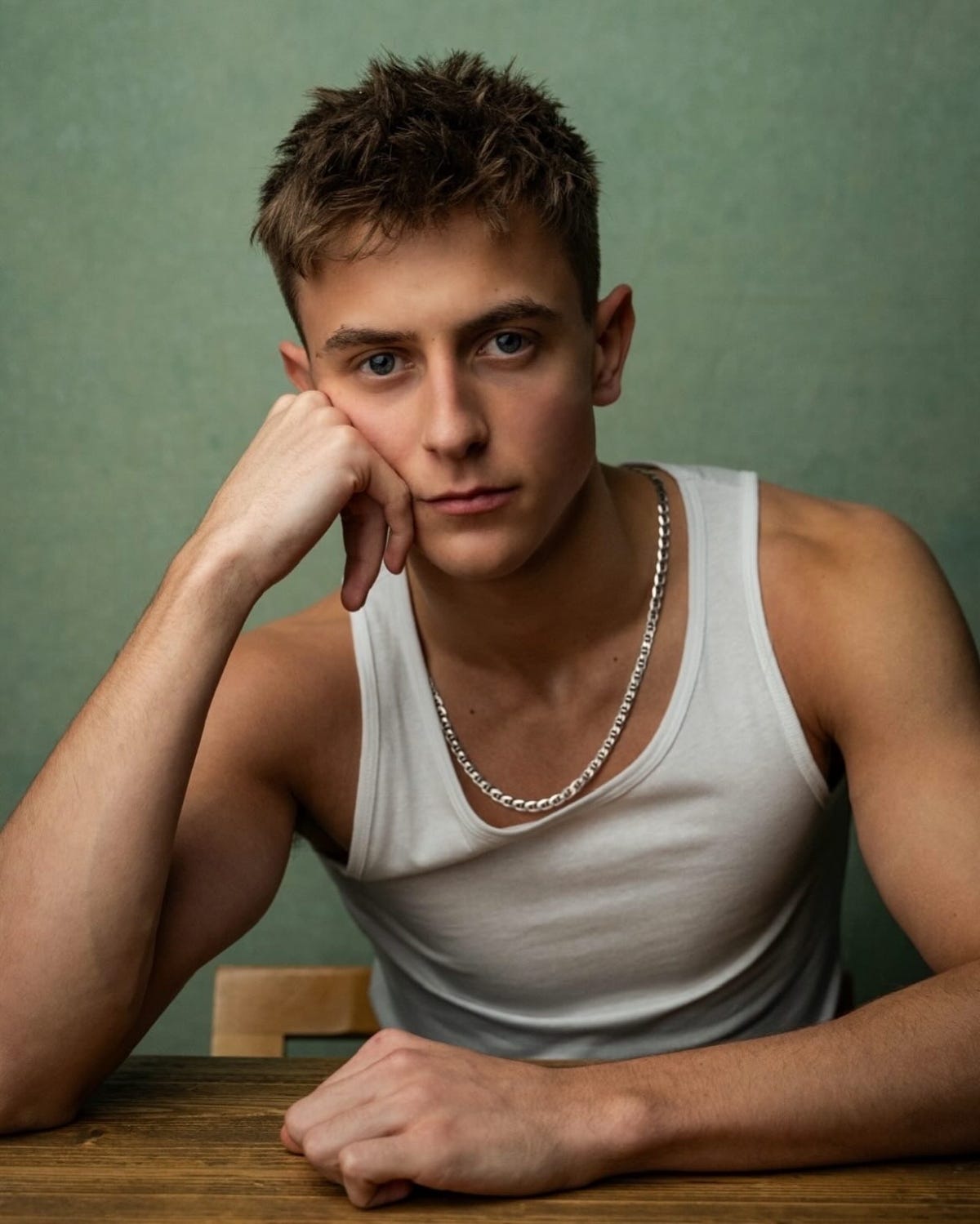
I was the youngest of three boys at my first dance school, so I had to hold my own early on. Thankfully, I had good friends who always had my back.
As a part of our series about pop culture’s rising stars, we had the distinct pleasure of interviewing Innis Robertson-Pinnell.
Innis Robertson-Pinnell is a Scottish-born performer whose career spans dance, acting, and voiceover. Trained in London and Los Angeles, he has appeared on the West End and at the Dolby Theatre in LA, marking a growing presence in the U.S. His voice credits include Thomas & Friends and Shimmer and Shine, reflecting a dynamic artistry recognised across stage, screen, and sound.
Thank you so much for joining us in this interview series! Can you tell us the story of how you grew up?
I was raised in Glasgow, Scotland but my family roots stretch back to the Hebrides, and that gave me a deep sense of heritage and identity. Most boys my age were into football, but I found my place in the dance studios. I started with hip-hop because I love the freedom and the energy of it. My teachers encouraged me to branch out, and that led to ballet, which I definitely resisted at first, I wasn’t keen on the tights. But it gave me everything I needed, strength, control, and discipline. I was the youngest of three boys at my first dance school, so I had to hold my own early on. Thankfully, I had good friends who always had my back.
Dance was my first love, but it opened up so many doors. It allowed me to move to London where I earned a scholarship to The Sylvia Young Theatre School which gave me the chance to grow beyond movement, it shaped me into a true all round performer.
Can you share a story with us about what brought you to this specific career path?
One of the first people who truly saw something in me was Mr. Bobby Barr at Dance Dreams Dance Studios in Glasgow. He was a legend in ballroom and Latin, he danced with Fred Astaire, taught at the Fred Astaire Studios in the U.S., and had an incredible eye for emerging talent. I still remember him saying, “People can learn choreography, but only a few have the presence, and you’ve got it, Innis.” That moment stuck with me, a confidence to believe I had something special.
Dance Dreams was more than just a studio, it was a family. Mr. Barr’s daughters, Bonnie and Sharon, also coached me and were the ones who entered me into my very first competition. Years later, when I landed the role of Mike Teavee in Charlie and the Chocolate Factory in the West End, they travelled from Glasgow to London to support me. That meant the world to me. Sadly, Mr Barr passed not long after that, but the foundation he gave me, the belief, and the love for performing, that has stayed with me every step of the way.
Can you tell us the most interesting story that happened to you since you began your career?
Definitely the chain reaction that started from a street dance class in Oxford. I was new, known for tricks and tumbling and when my teacher was asked if she knew a boy who could act, dance, and tumble. She said, “There’s one you should see.” That audition led to my West End debut as Mike Teavee in Charlie and the Chocolate Factory, directed by Sam Mendes.
That experience showed me what was possible. I was surrounded by professionals who treated me like a peer and they expected me to deliver. A Box Office London review called me “the strongest of the children with some great dance moves and hyperactive levels of energy “ which gave me the confidence to believe I belonged. From there I earned a scholarship to The Sylvia Young Theatre School in London and that led to stage acting and voiceover work for Nickelodeon. Voicing Zac in Shimmer and Shine and roles in Thomas The Tank Engine. Later on I was awarded an international scholarship to AMDA in LA. One of the youngest in the college’s history. I graduated with my BFA in Performing Arts in 2024. That one class in Oxford changed everything.
It has been said that mistakes can be our greatest teachers. Can you share a story about the funniest mistake you made when you were first starting? Can you tell us what lesson you learned from that?
There are too many to choose from, but let me share a couple of them with you. I still remember my first competition at the Blackpool Tower Ballroom, I was just six years old. All my teachers were waiting for my arrival but due to my mother’s attempts at reverse parking we were running late. I arrived just in time, got my number pinned to my shirt, and ran onto the floor. Everyone looked relieved… until I ran straight back off and asked, “Wait, am I supposed to do my routine now?” My teachers yelled, “Yes, Innis!” and practically shoved me back out. I won my first trophy that day and more importantly, found my purpose and learnt to believe in myself.
Another time I left my entire show costume on a train. I’d tucked the suitcase between two seats, hopped off in a rush and about 30 seconds later realised it was still on the train, which was now speeding towards its final stop. There was nothing to do, but wait for the train to return and pray it was still there. Luckily, it was and yes the show did go on!
The lesson I learnt from that was, don’t assume you’ve got everything covered just because your brain’s in performance mode. These days, I build a quick pre-show checklist.
What are some of the most interesting or exciting projects you are working on now?
It’s been such an energising season, I signed with Go 2 Talent Agency recently, which has already led to some amazing new opportunities. I just wrapped a short film with Ketchup Entertainment and danced for several independent artists on stage and in music videos.
On the performance side, I’ve been lucky to hit some incredible stages, the Armenian Music and TV Awards at the Dolby Theatre, LA Fashion Week, and the Anniversary Choreographers Carnival. Each one pushed me in different ways.
I stay consistent with training and keep sharp across styles. I work at Eighty Eight Dance Studios In North Hollywood where I am supported by co-owners, Nick Gilligan and Caoife Coleman. The energy there is unreal and I enjoy being surrounded by other creatives.
Most recently I have worked on the Street Team at the Flip The Switch Convention, where I worked alongside Alexander Chung, Gheremi Clay, and some other incredible mentors. It was an amazing experience and I loved being in an environment where I could grow as a dancer and train with some of the industry’s best like Brian Friedman, J Blaze, Diana Matos, and Ysabelle Capitulé. I also had the opportunity to work behind the scenes and help ensure the convention ran smoothly, thanks to Gheremi and Alex.
Right now I’m in full prep for Magic Mike live auditions, it’s pushing me creatively and physically but in a good way.
As a rising star, you’ve likely faced challenges along the way. How do you stay motivated and overcome obstacles in your career?
I try not to get stuck on the things that don’t go to plan. If an audition doesn’t land, I go back to work, reset, train harder, and keep moving. The next opportunity won’t care about the last one.
I think that determination comes from my Scottish upbringing. Whenever things feel tough, I think about the boy who used to dream about performing all over the world. If he could see what I’m doing now, training and working professionally in the U.S, I think he would be proud.
Most of all, I owe so much to my parents, their continuous love, and support have made my journey possible. I stay grounded because of my circle of friends and family who believe in me, even on the days I forget to believe in myself.
We are very interested in diversity in the entertainment industry. Can you share three reasons with our readers about why you think it’s important to have diversity represented in film and television? How can that potentially affect our culture?
1. Because it reflects the real world that we live in today.
When you bring in different perspectives, across cultures, body types, backgrounds, and languages, the work becomes more honest and more human. I believe that’s how you make better art.
2. Because difference, sparks growth and interest.
When I got to AMDA, I was the only Brit in my class and the teaching style was nothing like anything I was used to. Back home, everything was choreographed and precise. Then suddenly I’m being told, “Just move your body to how you feel Innis” and I froze. I literally called my mother and said “this is so out of my comfort zone” But quickly I leaned into it and embraced the difference. I learned to blend my British structured training with the American improvisational style and this helped me discover a new side of myself. That’s what diversity does. It pushes the whole room forward.
3. Because representation gives people permission to dream.
There is real power in seeing someone like you doing what you want to do. It’s sends a message: “You can do this too!” And culturally, it matters. It helps people connect with stories that aren’t their own. It changes how we see each other and it raises the bar of creativity.
What are your “5 things I wish someone told me when I first started” and why?
1. You won’t book every role and that’s okay.
Early on, every “no” felt personal. But sometimes it’s just not your time. One role that I really wanted didn’t go my way, but a few months later the same casting team brought me in for something else. “No” doesn’t mean “never.”
2. Embrace your differences; they are what makes you unique.
I used to try and fit in, but what actually made people remember me were the things, like my Scottish accent, my training style, my point of view and sense of humour. That moment at AMDA when I froze in class because I felt uncomfortable, ended up shaping how I perform and train today.
3. Take care of your body because it’s your business.
I danced through an ankle injury once, thinking it made me look dedicated, It didn’t! It actually put me out for weeks. Rest, fuel, stretch, it’s not optional if you want to last!
4. You never stop training!
Graduation isn’t the finish line. It’s just the beginning. There is always a new style to try, a teacher to learn from, a limit to stretch past. That’s what makes it exciting!
5. Say yes, even when you feel unsure.
That first street dance class in Oxford, I almost didn’t go, but thank goodness I did! That led to the audition for Charlie and the Chocolate Factory, and that opportunity changed everything.
Which tips would you recommend to your colleagues in your industry to help them to thrive and not “burn out”?
Burnout is something everyone experiences, it’s simply the nature of our craft. Allowing yourself to fail is incredibly important but also understandably hard. Try keeping in mind that failures will only make you stronger and those moments of failure make the wins even more rewarding. Keeping this mindset allows me to keep a healthy relationship with my hectic creative lifestyle.
Yes, we’re lucky to do what we love, but it’s still work. That’s why it’s essential to listen to your body and take the time to recharge. Simply stepping away and spending time with friends, family can help reset your mind and restore creative energy. Often, those breaks lead to fresher ideas and better end products.
You are a person of enormous influence. If you could inspire a movement that would bring the most amount of good to the most amount of people, what would that be? You never know what your idea can trigger. :-)
A global movement to break down the barriers between talent and opportunity. When I was on holiday in Africa, I met a young dancer who had amazing raw talent, but unlike me he did not have access to studios and major venues. That stayed with me and I would love to run open access workshops in areas where dancers can train and shine without the need for studio memberships in places that are often overlooked.
None of us are able to achieve success without some help along the way. Is there a particular person who you are grateful towards who helped get you to where you are? Can you share a story about that?
At AMDA, I had the privilege of training under Kyle Mchargh. He saw my potential and refused to let me settle for ‘good enough. His tough love approach and honesty combined with humour made training fun, he gave me the confidence to stretch myself even when the class had ended.
I remember that “Kyle glare” as I called it. Equal parts terrifying and motivating . He would make me repeat across the floor exercises until I had nailed every detail.
What I admire about Kyle is his mentorship style, tough in class but warm and encouraging after the hard work has been done.
Can you please give us your favorite “Life Lesson Quote”? Can you share how that was relevant to you in your life?
“If it scares you a little, just do it! You never know where it might take you.”
I’ve been scared along the way, auditions, moving cities, moving halfway across the world, but each time it was the right next step for me and here I am now building my career in the US!
Is there a person in the world, or in the US whom you would love to have a private breakfast or lunch with, and why? He or she might just see this, especially if we tag them. :-)
If I could have breakfast with anyone, it would be Lance Savali. He is from New Zealand and I’m from Scotland, so I can relate to what it’s like coming from a place that’s not exactly in the industry spotlight.
I’ve been following his career and he is doing the kind of jobs that I aspire to, working with artists like Chris Brown, Beyoncé, and Usher, I would love to chat about how he handled the jump to the U.S., kept grounded and made it all happen.
How can our readers follow you online?
Instagram: Innis_rp
This was very meaningful, thank you so much! We wish you continued success!