
Over my 35 plus year career, I have been fortunate to have worked across a range of industry sectors, and geographic locations spanning operational, business development, strategic and leadership roles.
As a part of this series, we had the pleasure to interview George Spink.
George Spink, Executive General Manager of Decoda, is a leader in strategic transformation and technology innovation within the global mining industry. With over 15 years entrenched in mining and a background in executive roles across major firms, George’s mission is to drive productivity and safety by transforming key, often-forgotten, assets. Under his guidance, Decoda developed Decoda Detect, a first-of-its-kind technology providing live, half-meter interval insights into haul road conditions, enabling proactive road management and significant efficiency gains. George is spearheading the company’s strategic growth at a tipping point for moving to the next level.
Thank you so much for joining us in this interview series! Can you tell us a bit about your ‘backstory’ and how you got started in the automotive industry?
I began by managing fixed infrastructure assets like high-rise commercial buildings and telecommunication assets. I saw how those sectors used operational telemetry to optimise physical assets. In 2013, I transitioned into mobile industrial transport when I joined Hastings Deering, Sime Darby’s Caterpillar dealership. I led operations and technology across the dealership. By 2016, heavy machines were generating massive streams of data. The challenge was that heavy transport fleets were data-rich but insight-poor regarding the under-tyre road conditions that dictate productivity, asset life, and safety. In 2022, we established Decoda to solve that multi-million-dollar blind spot. We moved from consultancy to building hardware and artificial intelligence systems mounted directly onto 400-tonne haul trucks to scan the haul circuit beneath them.
Can you share the most interesting story that happened to you since you began your career?
Over my 35 plus year career, I have been fortunate to have worked across a range of industry sectors, and geographic locations spanning operational, business development, strategic and leadership roles. While there are many stories, the one story I always come back to is know your customer and understand your customer’s problem(s). Every industry has its nuance, as does every culture and geographic location. The story I always share with my team is take the time to understand a customer’s pain points, how the pain manifest in their business and find/develop solutions that help resolve the problem(s) to relieve their pain. A problem solved results in a satisfied and loyal customer, along with team satisfaction in making a difference for that customer.
Can you tell our readers about the most interesting projects you are working on now?
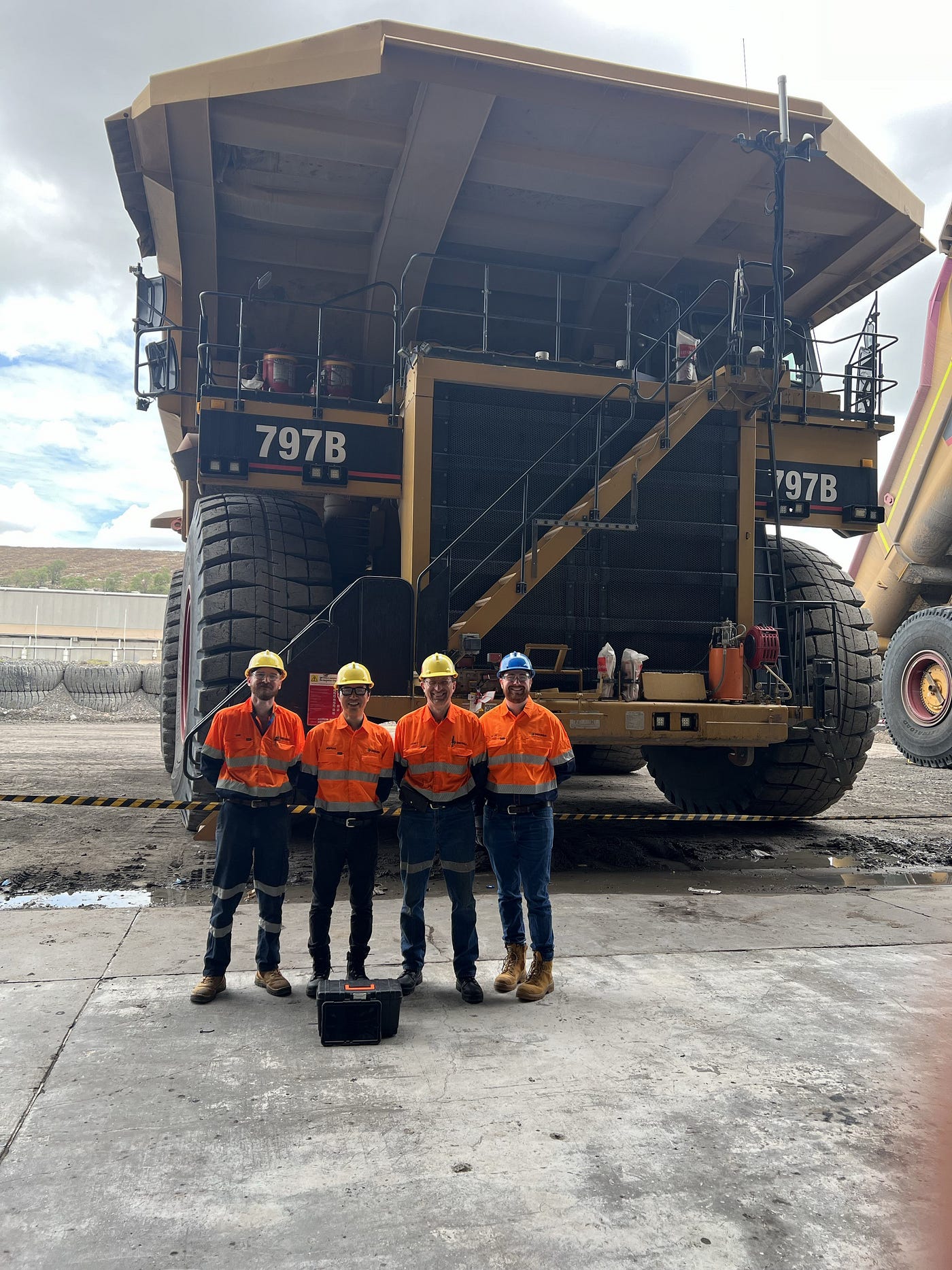
While we were deploying our tech in Queensland’s Bowen Basin, our technology was being installed on electric-drive haul trucks that caused electromagnetic interference, making sensor data drop out intermittently. Having a sense of the problem, our engineering team flew out to the remote site to investigate. The mine gave us a strict 30-minute workshop window while a truck was in for routine service. The truck rolled in, the operator tapped his foot, and our engineers climbed over the machine to isolate the issue, swap the cabling, and rectify the issue in under 30 minutes. We sat back in Brisbane and watched the live feed as that truck went straight back on circuit, logging clean data shift after shift. It felt like a Formula 1 pit stop. Real-world engineering requires that level of speed, commitment and problem solving.
What makes this project and all the projects we work on interesting, is that every truck, whether an autonomous, an electric drive, or a mechanical drive truck has its own personality. Even a fleet of the same brand and class of truck has a range of personalities. A mixed fleet only adds to the dynamic nature of fitting aftermarket technology. This makes every deployment interesting and challenging.
How do you think this might change the world?
Unsealed roads are critical arteries for heavy transport and global mining, yet their maintenance has remained reactive for decades. Across open-pit operations, ultra-class tyres worth up to $100,000 each fail at 40% to 60% of their engineered life. That sends over 100,000 tonnes of rubber to landfill every year in Australia alone. Poor road surfaces also force heavy trucks to work harder, increasing rolling resistance and driving up fuel burn by 8% to 12%. By delivering real-time haul road intelligence, our technology extends tyre life by 20%, cuts fuel consumption, and prevents thousands of tonnes of rubber waste. Removing surface friction makes heavy transport cleaner, safer, and far more productive.
Keeping “Black Mirror” in mind, can you see any potential drawbacks of this technology that people should think more deeply about?
The primary drawback of advanced vehicle telemetry is operator cognitive overload and digital surveillance fatigue. Modern transport cabs are flooded with buzzing alarms, alert screens, and fatigue cameras. Flooding an operator with complex data streams creates distraction or causes drivers to turn systems off. We designed our platform to process sensor data at the edge, distilling millions of data points into a single red or green visual alert. Technology must support the human operator, not police them or create dangerous distractions during high-pressure shifts.
What are a few things that most excite you about the automotive industry as it is today? Why?
The convergence of autonomy, electric powertrains, and spatial intelligence is fascinating. In commercial heavy transport, battery-electric trucks and driverless fleets demand near-perfect road conditions to operate efficiently. An electric haul truck bleeds battery range quickly when it fights rolling resistance from unmanaged road undulations. Autonomous vehicles require objective spatial maps to maintain target circuit speeds. Watching heavy industrial transport evolve from mechanical brute force into self-optimising, connected environments is an incredible shift.
What are a few things that most concern you about the automotive industry as it is today? What must be done to address these challenges?
Many operations acquire technology for technology’s sake without changing site practices to capture actual value. Companies install complex sensor platforms, dump raw telemetry into back-office servers, and end up with dashboard paralysis. To fix this, technology providers must deliver actionable, closed-loop solutions rather than standalone reporting software. The focus must remain on change management in the field, turning raw data into immediate physical actions that frontline crews execute automatically.
Based on your vantage point as an insider in the automotive industry, what other exciting disruptive technologies will we see in the next few years? Can you share some of the new developments that will make vehicles smarter, safer, and more sustainable?
Edge computing, paired with spatial sensing like LiDAR and AI vision, will transform vehicle safety. Processing data directly on board enables sub-five-second response times without relying on cloud connectivity. Predictive digital twins will map real-time infrastructure wear before mechanical failure occurs. In heavy haulage, applications like BundAwareTM use LiDAR to continuously audit safety berm heights and road widths, replacing dangerous manual surveying on foot near steep drop-offs.
In your opinion, how much longer will fossil fuel powered cars be produced? When do you think EVs will be the majority of vehicles in use? Can you explain?
In commercial heavy transport, diesel and diesel-electric hybrid machines will operate for at least another decade due to extreme power demands and duty cycles. Passenger electric vehicle adoption is accelerating, but industrial fleet conversion depends on ready surface infrastructure. Electric haul trucks require smooth road surfaces to prevent rapid battery drain. Commercial electric fleets will dominate once charging networks and under-tyre road quality are systematically upgraded to support energy efficiency.
When do you think we will see fully autonomous vehicles deployed in a mainstream way? What do you think are the main barriers to reaching that stage?
Urban passenger robotaxis operate today across structured, sealed city grids. In heavy industry and open-pit mining, autonomous fleets face major adoption hurdles on unsurfaced roads and a changing road network based on the mine plan. Driverless vehicles don’t report surface road defects. When a 400-tonne autonomous haul truck encounters unmapped road undulations, deep rutting, or soft ground, it slows down or stops completely because its fail-safe programming can’t assess the risk. Autonomous fleets require a smooth, managed ‘beautiful’ road surface to maintain target speeds. Until unsurfaced corridors are equipped with continuous sensory infrastructure that updates spatial maps in real time, road surface friction will remain the primary barrier to mainstream heavy autonomous adoption
How else will our driving experience be different over the next five years?
Vehicles will proactively manage surface friction and under-tyre conditions. Instead of reacting after a tyre loses pressure or a chassis cracks, in-cab systems will offer real-time spatial guidance. For example, RockAware LED guidance strips mounted above haul truck cabs show drivers exact positioning relative to dig faces/loading areas, preventing rock cuts before they happen. Vehicle intelligence will manage environmental friction before the human driver even notices a surface defect.
What are your “5 Things You Need To Create A Highly Successful Career In The Automotive Industry?
1. Focus on the environment under the tyres. When investigating why mining haul trucks stopped unexpectedly, everyone assumed the trucks or sensors were failing. The real issue was severe road surface undulations causing chassis stress. Understanding the operating environment matters as much as understanding the vehicle.
2. Convert data into operational simplicity. Early deployments flooded crews with analytical dashboards. Distilling millions of data points into a single red-or-green visual alert achieved 100% operator adoption.
3. Build closed-loop workflows. Identifying a hazard is only half the job. Routing hazard data directly into fleet dispatch systems generates automated work orders for grader operators, closing the loop between detection and repair.
4. Scale through strategic alliances. Rather than building a massive internal sales force, Decoda partnered with global leaders Kal Tire and TECWISE Latam. Embedding technology into trusted platforms reached 150 mine sites across 19 countries.
5. Target the highest controllable cost first. A single bottlenecked haul truck costs up to $10,000 per shift in lost time. Proving that haul road maintenance directly impacts cost per tonne turned road management into an urgent production priority.
You are a person of great influence. If you could inspire a movement that would bring the most amount of good to the most amount of people, what would that be? You never know what your idea can trigger.
I would inspire a movement to remove humans from high-risk industrial zones using objective spatial intelligence. In heavy transport and mining, tyre maintenance is among the most dangerous routine tasks, carrying ten times the risk of standard vehicle servicing. Ultra-class tyres store immense pressure and can explode with fatal force during high-impact damage. Manual berm measurement forces personnel to walk near reversing 400-tonne haul trucks. Automating road hazard detection and berm measurement with LiDAR keeps workers out of the line of fire so everyone returns home safely.
How can our readers further follow your work online?
https://www.linkedin.com/company/decodamining/
Thank you so much for the time you spent on this. We wish you continued success!