Good design worked for us, and we expanded on that and made that iconic bottle an integral part of our brand, as opposed to just a product.
Business
Food visionary Greg Steltenpohl on Sustainable Scaling, Packaging Design, and Building Values-Driven Beverage Brands
The pioneering founder behind Odwalla and Califia Farms shares hard-earned lessons on scaling natural food companies, mastering disruptive packaging, and navigating leadership challenges.
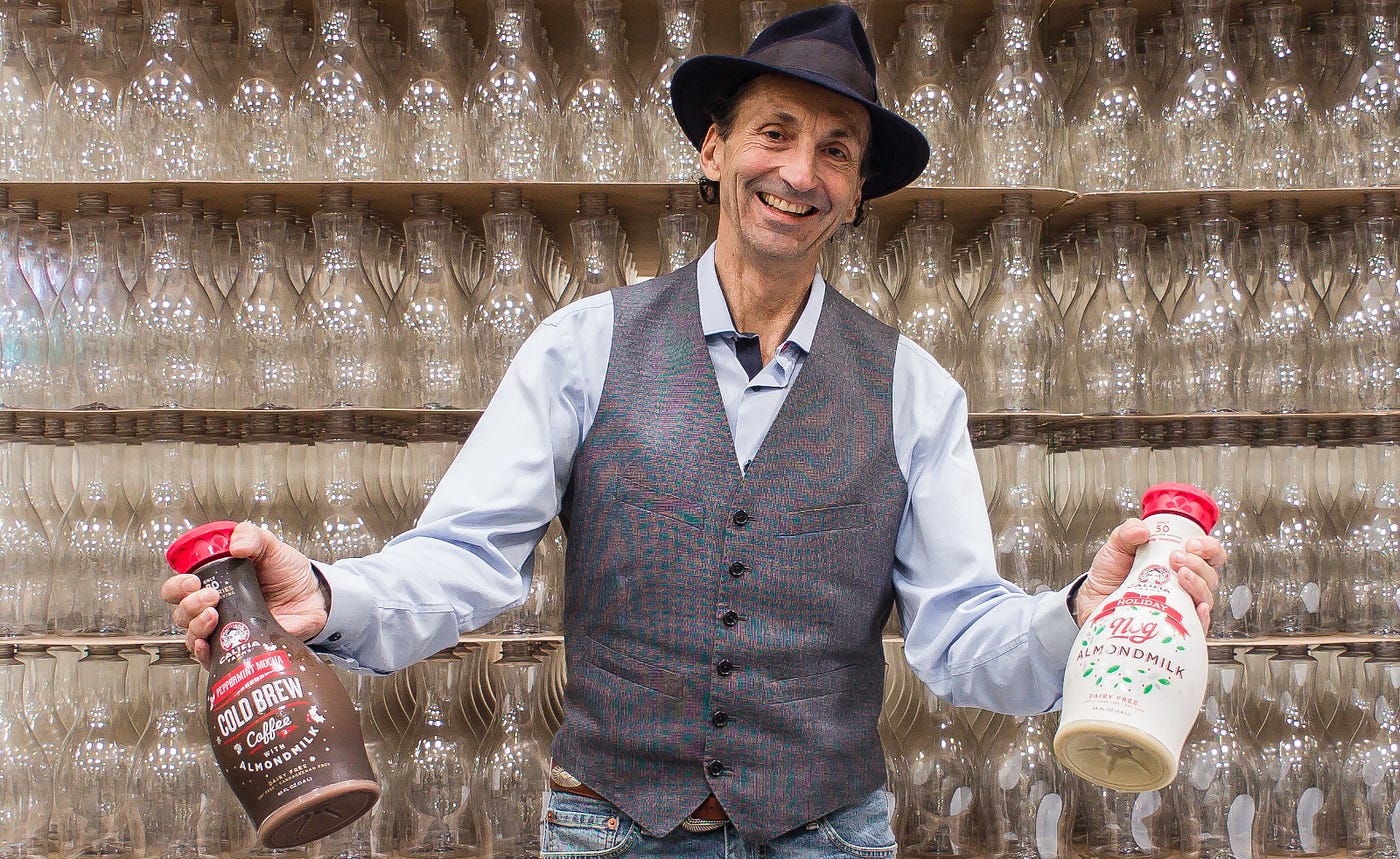
I had the pleasure of interviewing Food visionary Greg Steltenpohl.
Greg is the co-founder and CEO of Califia Farms, the California-based company whose award-winning, plant-based beverages have become top-selling plant milks, cold brew coffees, dairy-free creamers and probiotic yogurts. Greg has led Califia Farms’ meteoric growth as an innovative leader in premium, natural beverages that make it easy and delicious for consumers to live a plant-based lifestyle.
Greg has been a pioneer in Natural Foods since 1980 when he co-founded the Odwalla Juice Company in Santa Cruz, CA by selling fresh-pressed juice out of a VW van. His innovative approach to the beverage industry transformed a small start-up to a publicly held corporation and helped change the face of the juice industry into what we see today. Odwalla proved a values-based approach to business that emphasized a creative culture that could be successful — lessons that have fueled the explosive growth of Califia Farms.
Greg’s vision for producing nutritious, plant-based products that embody Califia Farms’ “something different, something better” spirit directly shapes how the company conducts business — balancing environmental sustainability, employee empowerment and creative corporate culture with profit. This holistic approach to business has led to Greg being recognized with numerous leadership awards, including the Specialty Foods 2016 Business Leadership Award, Specialty Food’s Hall of Fame, BevNet’s 2016 Big Shots: Power Punchers and Goldman Sach’s 100 Most Intriguing Entrepreneurs of 2017.
In addition to his work with Califia Farms and Odwalla, Steltenpohl co-founded the Interra Project in 2000 and Adina for Life in 2004. He has also served on the board of numerous organizations, including Slow Money Alliance, Social Venture Network and Frontier Natural Products. Greg holds a degree from Stanford University in Environmental Science.
Thank you so much for joining us! Can you tell us the story about what brought you to this specific career path?
I’m a serial entrepreneur who got started as an environmental science major and always had a passion for changing the food system. In 1980, I started Odwalla by selling fresh-pressed juice with my fellow bandmates out of a VW van. Odwalla grew exponentially, went public, and after twenty years, sold to Coke. Following that, I started several other companies. Then, trying to solve a food waste issue led me to create Califia Farms. The owner of Sun Pacific, who grows the little mandarin oranges that are sold as Cuties, called with a problem — he was throwing away 20% of his product due to cosmetic defects. We formed a partnership and started to make juice from those imperfect oranges. Shortly after starting the business up, I had a personal health crisis and, when I was recovering, I couldn’t find any good tasting plant-based proteins to help nourish me or any good plant-based milks that combined well with coffee, so I pivoted the company towards producing plant-based beverages.
Can you share one of the major challenges you encountered when first leading the company? What lesson did you learn from that?
When I first started Califia Farms, I was faced with the challenge of taking a supply-side agricultural company with a $30 million manufacturing plant as an asset and figuring out how to use that asset to create a consumer beverage product that would sell enough for the owners to see a return on their investment. Starting from ground zero and breaking into a beverage category filled with big players and big budgets is never easy. This time, the solution was to use one of my passions, art and design, to create a packaging shape that could generate attention on the shelf, without spending on a marketing budget. The curvy bottle we ended up developing made consumers want to know more about the product, out of pure curiosity. The lesson I learned, right from the get-go, was the power of disruption and to always challenge yourself to think outside the box (or the bottle, in this case).
What are some of the factors that you believe led to your eventual success?
There are a few factors I believe that has led to my success. First, from that initial challenge, I learned to lean into what works. Good design worked for us, and we expanded on that and made that iconic bottle an integral part of our brand, as opposed to just a product. Second, resilience. As an older entrepreneur, I had the experience to rely on, which taught me to create not only resilience for myself, but to embed it into the company — from the culture to creating a diverse product line and supply chains, to establishing authentic relationships with the brand (rather than just a product) and to be continually checking back into the consumer’s changing point of view.
What are your “5 Things I Wish Someone Told Me Before I Became CEO”? Please share a story or example for each.
- The importance of hiring right: For years, I wanted to bolster the marketing team by adding someone who could build a strong performance-based approach like what’s used in the tech industry. I felt (what was actually a false) sense of urgency and impatience that drove me to quickly hire, based on one prestigious recommendation. The hire turned out to be a terrible cultural fit and caused havoc within the department and company. From that hiring situation, I learned to enlist the greater team to ensure new team members are as close to a 365-degree fit for the company as possible by asking probing questions beyond the obvious hard skills and capabilities: like saying “how effective will this person be within this team?” “What are their softer skills?” “How does this person get along with other department heads?” Mental matchups like this can expose red flags.
- How to better trust my intuition: I’ve learned that it’s important to separate hopes and dreams from gut-level instincts, which can be harder to articulate but are really important. I’ve realized that what we call intuition is sometimes an overlay of a different type of knowing — observing a dynamic in one area and then applying it to an unrelated area, which can lower your risk of the unknown. For example, when we launched our plant-based creamer, I had already experienced how consumers responded to the feminine message of our curvy bottle and so intuitively I applied that principle by attaching a playful name to the new creamers– “Better Half.”
- To understand the power and benefits of diversity: This is something a lot of companies are talking about right now, as they should, but not out of obligation or image. I have learned over the years that diversity really is a gift, and it always pays off. Different viewpoints and contributions help to expose and shore up blind spots and weaknesses of a monocultural viewpoint. It creates a more robust and exciting result that will appeal to a wider variety of people. If I had fully understood this earlier on, I think we would be even more successful.
- Realize the importance of alignment between key stakeholders within the company: When companies have a clear vision and mission, it inspires leaders to teach, share and engage other employees and stakeholders in alignment with that vision. This is something I admit I haven’t yet been able to successfully do in Califia. As a result, I have had to expend a lot of extra energy in negotiating alignment versus having an energized flow where challenges are collectively viewed as just new opportunities to apply those values.
- Understand the power of listening, appreciation and recognition in building trust vs placing too much emphasis on the entrepreneurial drive: It can be hard for many entrepreneurs and myself, in particular, to recognize the point in which their passion needs to take on a different energetic configuration. The new configuration needs space and a spirit where others are invited in to make decisions and feel the impact. There is a point when entrepreneurs need to see that organizations can be full of distributed leadership, and experience the liberation of making others feel empowered.
What advice would you give to your colleagues to help them to thrive and not “burn out”?
Practice what you preach: if you’re part of a company trying to help people create healthier lifestyles like ours, create one for yourself. Pacing is also important. First, find what really wins with your consumer while generating cash for the company and then build on that foundation so you have some cushion to expand into other product categories without risking the core. At Odwalla, that superpower was focusing on directly serving super accounts with amazing profit margins, and at Califia, it was doing a blitz-scaling rollout of our best-selling Unsweetened Almondmilk product in the curvy bottle.
None of us are able to achieve success without some help along the way. Is there a particular person who you are grateful towards who helped get you to where you are? Can you share a story?
One person who inspired and supported me was Steve Jobs. He always emanated so much passion and confidence. Most people hear that he was extremely challenging and difficult, but he could also make you feel like you could accomplish anything. When we were recovering from a product recall crisis at Odwalla, and I was having doubts, he told me to cold call the smartest person in the world regarding microorganism detection and the smartest in the world regarding beverage bottle seals, and get their advice. He made you feel like if you had an idea that the world needed and you were pursuing it with all your heart, then you had earned the right to talk to anyone in the world that you needed to.
What are some of the goals you still have and are working to accomplish, both personally and professionally?
Personally, my goal is to find a path to use my creative interests to benefit the existential challenges facing the world, like climate change. Which is a lead-in to the professional goal that I’ve been working on since I launched Califia: building a company that creates a carbon balance where consumers are substituting plant-based products for dairy, to the benefit of the environment.
What do you hope to leave as your lasting legacy?
I hope to contribute to a changed food system that is aligned both with nature and human benefit. We’re still operating within a food system today that is mostly based on serving the profit principle. It was mostly built up to globally distribute calories at the lowest cost — but that’s not really what’s needed anymore. We need a food system that is ecologically designed in harmony with planetary processes, delivers a much wider diversity of nutrients effective for human health and considers the ethical treatment of animals as a fundamental priority.
You are a person of great influence. If you could start a movement that would enhance people’s lives in some way, what would it be? You never know what your idea can trigger!
I would love to see everyone realize the wisdom of a more plant-centric diet and to know that their food choices will matter for generations to come.
AM
Written by
Authority Magazine Editorial Staff
Editorial Desk · Authority MagazineThe Authority Magazine Editorial Desk produces, verifies, and edits long-form primary-source interviews with executives, innovators, clinicians, creators, and social impact leaders across Business, Tech, Pop Culture, Wellness, and Social Impact.

Published inAuthority MagazineTop Lessons, Top Authorities · 42K Followers
Exclusive, curated interviews with the leaders and changemakers shaping tomorrow. Leadership lessons, industry deep dives, and executive profiles.