People will only follow your illusion if they trust your intention.
(If you are unable to download it, please click File-Download)
Please answer the questions, and leave the questions formatted as they are in the document. We may schedule a follow-up call or zoom to round things out.
(Kindly insert your three-sentence bio, written in the third person here.)
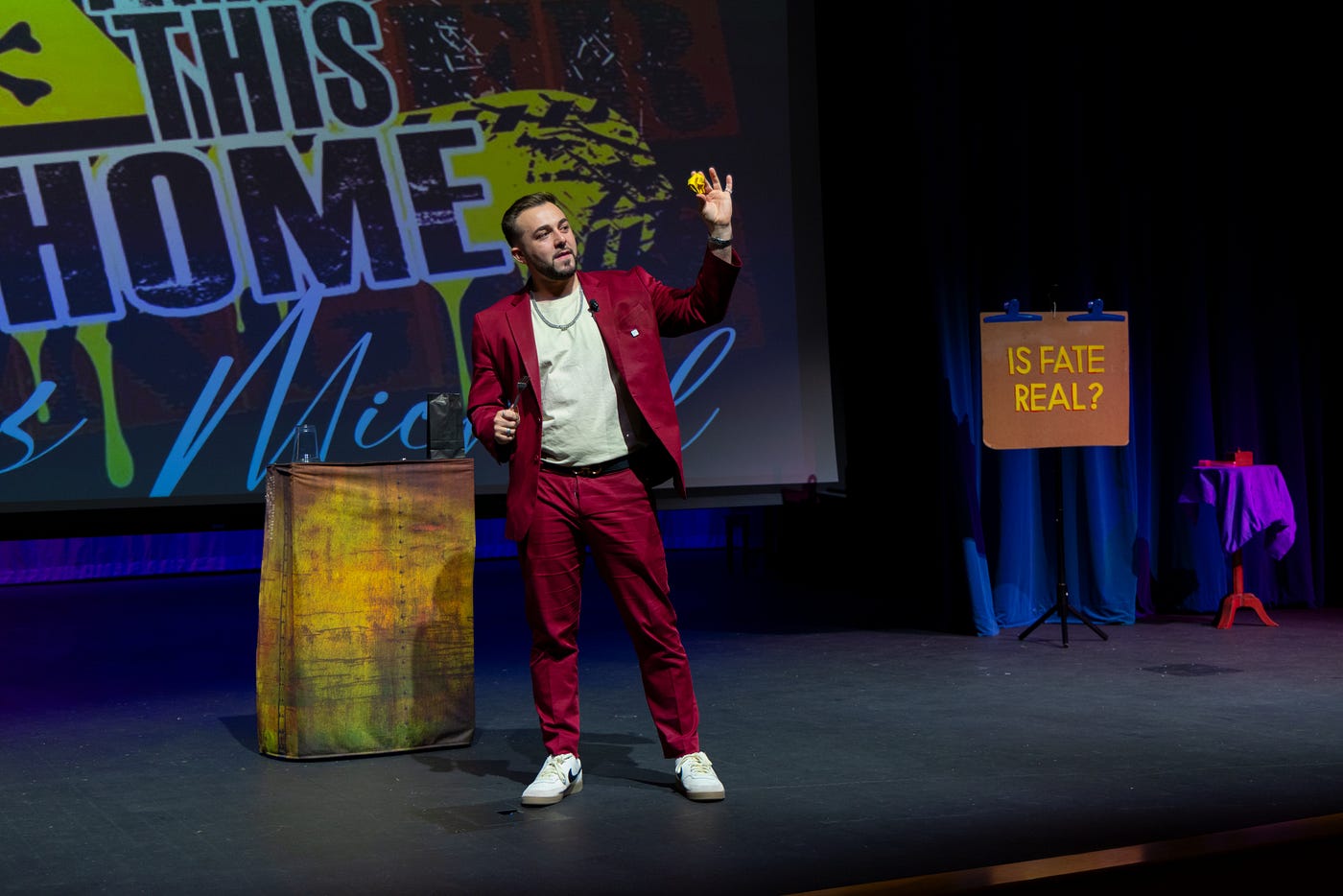
Chris Michael is a global body language expert, intelligence trainer, and founder of Decode Behavior™—a training platform that teaches people how to read nonverbal cues, detect deception, and learn how to drive decisions through behavior. He has worked for the FBI, White House staff, Fortune 500 companies, and royal families, while also training corporate teams in trust, influence, and communication. Chris blends entertainment and neuroscience to make human behavior feel like a superpower anyone can access.
Thank you so much for doing this with us! Before we dig in, our readers would like to get to know you a bit more. Can you tell us a bit about your “backstory”? What led you to this particular career path?
I was obsessed with human behavior before I even knew what to call it. I’ve had ADHD my whole life, though I didn’t realize it until adulthood. As a kid, I was constantly chasing patterns, energy, and reactions, because I was hyper sensitive to them. I liked, controlling perception and that got me into magic. It was an outlet thatrewarded curiosity, intensity, and thinking differently. I could read and understand their tells, their choices, their emotional shifts. But over time, I realized that there were more useful applications for being able to understand and control peoples behaviors. That curiosity turned into an obsession with body language, psychology, and human behavior. Today, I use that same hyperfocus to decode people in real-time to understand what drives them, how to make them successful, and help them discover how learning this skill can benefit their working and personal life.
Can you tell our readers what it is about the work you’re doing that’s disruptive?
I’m disrupting two fields at once: body language education and sales training by approaching both from a mentalist’s point of view. Mentalism is the art of creating the illusion of reading minds using psychology, suggestion, and behavioral cues. As a mentalist, I’ve spent years decoding people in high-pressure, real-time situations in front of live audiences where I have to get it right. That experience gives me a sharper, more practical understanding of nonverbal communication than most traditional training methods offer. Most body language books and courses are rigid, outdated, or overcomplicated. And sales training often relies on scripts or surface-level psychology that doesn’t account for how people actually behave in real life. What I bring is a fresh model based on how mentalists really read people and I do it live, under pressure, in unpredictable environments.
Instead of just listing cues, I teach how to read context, spot incongruence, and influence behavior in the moment. And I show sales teams how to use those same skills to earn trust faster, recognize unspoken objections, and create more persuasive conversations. What makes it disruptive is the blend of novelty and authority: the novelty of seeing someone decode people in real time like a “mind reader,” and the authority that comes from explaining the exact psychological and behavioral science behind it. It’s engaging and it sticks.
Can you share a story about the funniest mistake you made when you were first starting? Can you tell us what lesson you learned from that?
Early on, I was hired to lead a behavioral training session for what I thought was one large company. It turned out it was actually four smaller companies that had just been acquired and merged. The training was meant to help unify the teams and deepen their skillsets. What I didn’t know was that none of the employees had actually been told they’d been acquired yet. So when I casually mentioned, “It must be exciting to be part of the new company,” the room went completely silent. Then chaos. People stood up, asked questions, got on their phone; it turned into a panic.
The lesson? Always, always get clarity on context, especially during transitions. Now, I make it a point to ask not just who I’m training, but what they’ve been told, what they haven’t, and what the emotional landscape is walking in. Always have complete clarity when entering the room.
We all need a little help along the journey. Who have been some of your mentors? Can you share a story about how they made an impact?
I learned from the best in two worlds: magicians and behavioral scientists. One of my early mentors, Zach Alexander, taught me how to blend credibility with mystery. He told me, “People will only follow your illusion if they trust your intention.” That stuck with me. On the science side, studying under Joe Navarro and Paul Ekman gave me frameworks I still teach today. They helped me bridge the gap between showmanship and science.
In today's parlance, being disruptive is usually a positive adjective. But is disrupting always good? When do we say the converse, that a system or structure has ‘withstood the test of time’? Can you articulate to our readers when disrupting an industry is positive, and when disrupting an industry is ‘not so positive’?
Can you share some examples of what you mean?
No. Disruption without direction can cause more harm than progress. Jumping th curve should benefit the people you aim to serve. Disrupting can be unwelcome if it doesn’t solve a problem that you can describe with one sentence. Look at Apple AI, what problem does it solve? Hard to think of one right?
That’s why it hasn’t broken through. Some systems are resilient for a reason. But the iphone allowed you take a computer and put it in your pocket. The problem they solved was “use your computer anywhere.”
One of the biggest mistakes I see in business is people chasing novelty without authority.
They create something flashy or weird just to stand out, but there’s no depth, no substance. Novelty alone grabs attention, sure, but it doesn’t build trust. To be successful, you need novelty AND authority. Take Gary Vaynerchuk and Alex Hormozi. Both are incredibly disruptive, but in different ways. Gary Vee leans heavily into novelty. His delivery, his energy, and the rawness of his advice grab attention fast. But what gives it staying power is that it's backed by years of execution and real business ownership. He's built actual companies. That’s authority.
Alex Hormozi, on the other hand, leads with authority. His style is more subdued, but his frameworks are airtight and backed by data and personal results. He earns attention differently by being undeniably credible. Even he uses novelty strategically: the mustache, the gym gear, the way he titles his videos. It's the blend of the two. Novelty to hook you, authority to keep you, that makes them both effective. If you only have one, the disruption doesn’t stick.
If you're going to shake things up, you have to back it up. Otherwise, it’s just noise. I’m all for disruption, but only when it leads to better outcomes. Aim for transformation and to solve problems, not just to stand out.
Can you please share 5 ideas one needs to shake up their industry? If you can, please share a story or an example for each.
Don’t look at what has worked.
People habituate patterns. Once it gets out to the public that something works and becomes “best practice,” it quickly starts to fail. That’s because we’re not wired to respond forever to the same stimulus. What once felt novel becomes noise. What once broke through now blends in.
Take email newsletters. A few years ago, the gold standard was flashy formatting with logos, banners, custom graphics, bold CTAs. Now? Those look like ads, and people skip them. What cuts through today is plain-text emails that look like they were written by a real person. No formatting. No sales tone. Sometimes even lowercase subject lines. It feels personal because it breaks the pattern. The more something looks like a template, the more we tune it out. That’s because we got used to it, we knew people who did that had the intention of selling us something.
If you want to be disruptive, don’t just study what’s working, study why it worked before everyone copied it. Then, apply why it worked and go in a different direction.
Stop trying to be “professional”, instead have authority.
That might sound simple, but it’s disruptive because the default in business is posturing. Most people are trying to prove they’re credible by sounding like a LinkedIn robot. But people don’t respond to that. They respond to warmth. To clarify. To someone who listens and makes them feel seen.
I teach people how to connect (really connect) by showing them how confidence, leadership, gratitude, and even discipline are contagious. It’s behavioral. It’s visible. It’s teachable. And it spreads.
So when I work with teams, I don't focus on “executive presence” or “personal branding.” I focus on human behavior. Do you make people feel safe when you talk to them? Can you stay calm when others lose it? Are you the person who makes people feel confident just by being in the room?
Because here’s the truth:
Confidence is contagious.
Discipline is contagious.
Gratitude is contagious.
Leadership is contagious.
Enjoyment is contagious.
Display Skill. Being good at something (skill or knowledge) is VALUABLE!
People either catch those qualities from you or they catch your stress, your self-doubt, your negativity. If you want to lead, sell, inspire, or connect, it starts with your behavior. Not your words. Not your title. Not your resume.
Just be the kind of person others want to be around and you’ll be successful at whatever you do. That’s not just good life advice, it’s also good business.
Simplify complexity without dumbing it down.
Neuroscience and deception detection can be overwhelming. So I break it down in a way that even a third grader could understand. Not because my audience isn’t smart—they are—but because the brain remembers simple things better. The prefrontal cortex, which handles logic and language, gets overloaded fast. But if you speak in clear, simple terms, it reaches deeper parts of the brain tied to memory, emotion, and intuition.
So I use everyday examples like dating, meetings, negotiations, arguments with your partner. I make it feel familiar. That’s what makes the material stick. Not big words. Not technical charts. Just powerful ideas, delivered clearly. That accessibility is part of what makes it feel disruptive, because the moment someone realizes, “Wait… I can actually use this,” they will start to change how they think and behave.
Make working with you addictive.
Not because you chase people down.
Not because you overpromise.
But because the experience of working with you is so engaging, useful, enjoyable, and different that people want more.
Give people small wins fast.
Make them feel smarter, seen, and sharper just by being around you.
Make it fun. Make it real. Make it stick. And make them get what THEY want out of it. Focus on the micro outcomes someone get’s personally from what you offer.
When you blend value with novelty and back it up with authority,and your audience enjoys it, people throw money at you, refer you, and come back again and again.
That’s just human nature.
Be a mirror, not a spotlight.
My job isn’t to help myself; it’s to reflect something back that people didn’t realize was already there. The best reactions I get aren’t “Wow, you’re amazing.” It’s “How did you know that about me?” or “Wait… I’ve never thought about it like that before.”
You don’t change people by impressing them. You change them by showing them a version of themselves they hadn’t seen yet, more capable, more aware, more in control.
That’s what real influence looks like.
Not shouting louder. Not standing taller.
But helping someone see what they’ve been missing in their own behavior, their own mindset, their own potential. Once they see it, they can’t unsee it. And that’s where transformation starts.
I don’t want to be the hero in the story.
I want to hand people the mirror that makes them the hero.
We are sure you aren’t done. How are you going to shake things up next?
Do you have a book, podcast, or talk that’s had a deep impact on your thinking? Can you share a story with us? Can you explain why it was so resonant with you?
We’re scaling Decode Behavior™ into an online training platform for sales teams, government agencies, and corporate leaders. I’m also planning a workshop that teaches one high-impact behavioral skill like spotting deception or gaining instant trust in a meeting. Behavioral change based in real science not pop psychology is the mission.
Can you please give us your favorite "Life Lesson Quote"? Can you share how that was relevant to you in your life
?
Malcolm Gladwell’s Talking to Strangers reshaped how I think about assumptions. It made me realize how often we misjudge people. We trust the wrong signals. That book helped me sharpen my work in teaching others how to read behavior more accurately.
“People will forget what you said, but they’ll never forget how you made them feel.” – Maya Angelou.
In my world, whether on stage or in a negotiation, that’s everything. If you can master how you make people feel, you’ll never be forgotten.
You are a person of great influence. If you could inspire a movement that would bring the most amount of good to the most amount of people, what would that be
? You never know what your idea can trigger. :-)
I’d teach emotional literacy and nonverbal communication in schools. Imagine a generation that can spot manipulation, recognize distress, or connect deeply just by reading body language. It’s not hippy-dippy stuff, t’s science.
How can our readers follow you online?
You can find me on Instagram and TikTok at@chrismikemagic, or visit www.DecodeBehavior.com to learn more about live trainings, keynotes, and upcoming events.
This was very inspiring. Thank you so much for joining us!