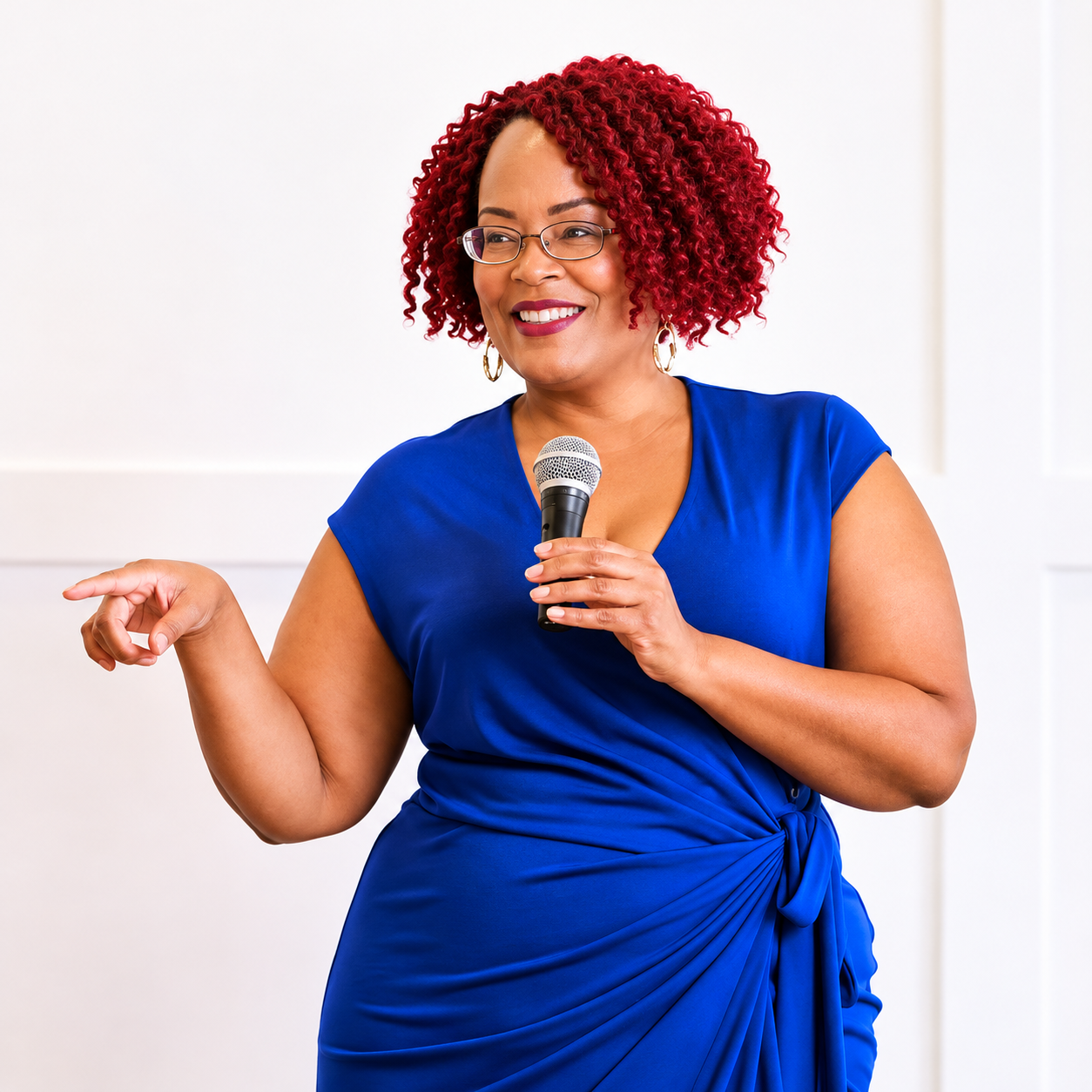

I think a lot of the confidence I have today comes from learning to trust that younger version of myself again.
I had the pleasure of speaking with Caitlin Collins, Founder of Lupus Style Society, about living with lupus and the advocacy work that grew from her diagnosis. Diagnosed in 2018, Collins lives with severe sensitivity to light, which affects many aspects of her life, even making routine medical examinations challenging. During a recommended eye examination, the brightness of the testing equipment became so painful that she began seeing spots, feeling dizzy, and struggled to complete the exam. The very test intended to help protect her eyesight had become almost impossible to endure.
For Collins, the experience points to a larger gap in healthcare: Clinicians may understand a disease’s clinical characteristics without fully understanding what patients endure. The people living with a condition are not always included in conversations about how their care is delivered.
Collins is an attorney, whose profession is built around advocacy and making a case for her position. She now finds herself advocating in a different arena; using luxury fashion, philanthropy, and personal storytelling to make an often-invisible illness more visible. The confidence required to speak up for herself and advocate for those with invisible illnesses has become central to her next chapter.
That confidence, she explains, was something she had to reclaim.
As a child, Collins was opinionated and knew what she wanted. Adults sometimes labeled her “bossy,” treating her assertiveness as a trait that needed correcting. Over time, she says, she became less comfortable expressing herself and more inclined to hold back. In recent years, she has made a conscious effort to reconnect with the more outspoken, self-assured parts of her personality.
Her lupus diagnosis prompted a deep reconsideration of both her work and her desire to speak up for herself and others. Lupus affects everyone differently, and its symptoms can fluctuate dramatically. For Collins, severe light sensitivity has changed the way she approaches everyday activities that most people don’t think twice about. The uncertainty of the disease also challenged her earlier assumptions about accomplishment, productivity, and personal value.
Searching for people who understood those experiences, she joined a Lupus Foundation of America support group. The conversations were revealing. Fellow patients could offer a kind of understanding she had sometimes struggled to find in medical appointments. Their experiences helped her recognize how much remained misunderstood about the daily realities of chronic illness.
Hoping to help others reclaim their voices and feel comfortable taking up space, Collins connected with the luxury house Balmain about organizing an event to support lupus awareness. The resulting gathering directed 10 percent of sales to the Lupus Foundation of America. The experience convinced Collins that luxury fashion could provide an unexpected platform for conversations about an illness frequently hidden beneath outward appearances. That became the foundation of Lupus Style Society, an organization she established to connect fashion, philanthropy, and the lupus community.
Her willingness to speak openly has brought criticism alongside encouragement. Collins understands the hostility directed at chronic illness creators online, including accusations that people discussing their conditions are exaggerating symptoms for attention. Yet the responses that stay with her are often the quieter ones.
One woman wrote to Collins after visiting Miami and discovering that she could participate in social activities more comfortably simply by making sure she had somewhere to sit. Watching Collins discuss accommodations had helped her feel less embarrassed about asking for them herself. It was a modest adjustment, but one that gave the woman more freedom to enjoy an evening with friends.
Those small practical victories matter to Collins. They also help explain why she is interested in expanding Lupus Style Society beyond fashion events.
The organization remains young, and Collins is candid about the ordinary difficulties of building something new, from coordinating corporate partnerships to getting people engaged in something they don’t experience. Her ambitions extend beyond what she has accomplished so far.
The little girl whose opinions were once dismissed has become a woman willing to express uncomfortable truths publicly, even when the response is sometimes unpredictable.
“Leadership means having the courage to stand behind something you believe in,” she says, “even when doing so leaves you vulnerable.” Collins cannot eliminate the uncertainty of lupus, and her advocacy cannot resolve every weakness she sees in medical care. But she can make space for conversations that might otherwise never happen.
Before we dive in and talk about your amazing work, our readers would love to learn about Caitlin Collins’ personal origin story. Can you share a story of your childhood, how you grew up, and particularly the seeds of all the creativity and leadership that’s come since then?
Caitlin Collins: As a kid, I knew what I wanted. I was very particular because I had a strong intuition about what felt right to me. Sometimes that was at odds with what the adults around me wanted or expected of me. Over time, some of that confidence was gradually conditioned out of me.
I think we try to treat little girls differently now, but when I was growing up, it was, “Oh, you’re so bossy,” or “Doesn’t she have a lot of opinions?” I was told that I should be an attorney, which, at that time, was code for calling a little girl “argumentative.” Those qualities weren’t necessarily celebrated in a young girl; they were things I was expected to soften.
For a while, I did exactly that. I became more conscious of how I was coming across and less comfortable taking up space. Then, around my 30th birthday, I started to reconnect with that part of myself. I began to understand that being opinionated, decisive, and comfortable taking the lead weren’t qualities I needed to apologize for. They were actually positive qualities that had been there all along.
I think a lot of the confidence I have today comes from learning to trust that younger version of myself again.
In your own words, can you tell us a bit about all the amazing things you’re doing?
Caitlin Collins: Lupus Style Society is an organization I founded about a year ago to bring together the worlds of fashion and philanthropy in support of the lupus community.
The idea was born out of my own experience. I was diagnosed with lupus in 2018, and I wanted to find a way to use my background and connections in the fashion world to bring greater visibility to a disease that is often invisible. Lupus Style Society brings together brands, advocates, and those suffering from lupus to spark meaningful conversations around a disease that’s otherwise unseen.
We’re using fashion as a platform for awareness, advocacy, and connection, while also creating experiences that make people feel seen and included. Ultimately, I want Lupus Style Society to become a community that welcomes and inspires other people with lupus and chronic illness — a place where they can find information, connection and a sense that they don’t have to navigate their experience alone.
Do you feel comfortable sharing the story of how you started it and what your first steps were? Tell us the origin story of Lupus Style Society.
Caitlin Collins: I knew I wanted to become more involved in the lupus community. As I was navigating my own diagnosis, it was important to me to meet other people who had lupus. Sadly, there aren’t a lot of obvious ways to find that community.
I joined a support group through the Lupus Foundation of America, and that’s where I first started meeting other people with lupus. The perspective I gained from those conversations was much different from what I was getting at the doctor’s office. There was a level of validation that came from talking to people who actually understood the day-to-day experience. That made me realize how important it is to increase awareness — not just among people who may have never heard of lupus, but throughout the healthcare community as well.
Physicians understand the clinical aspects of lupus, and of course some listen intently to each of their patients describe their experiences, but there can be a gap between understanding a disease medically and understanding what it actually feels like to live with it. I wanted to find a way to contribute to that conversation and I knew I had a unique avenue through my own professional and personal interests.
I began discussions with Balmain and they were more than thrilled to support me.
We put together an event, invited people into the store, and donated 10% of sales to the Lupus Foundation of America. The response was so positive that I realized there could be something there. What started as one event became a much bigger idea: using fashion and philanthropy as a way to create visibility, bring people together and build a community around lupus.
For those who aren’t aware of what lupus is, you said doctors may know what it says in the books, but not how it truly feels. Can you share your experience, in your own words, of what it is?
Caitlin Collins: Lupus is a chronic autoimmune disease. Essentially, the immune system — which is supposed to protect your body — becomes dysregulated and mistakenly attacks the body’s own tissues. This can cause inflammation and, in some cases, damage to different organs and systems.
Lupus can affect many parts of the body, including the skin, joints, kidneys, heart, lungs, blood, and brain. And what lupus looks like can be very, very different from one person to another. Symptoms can range from mild to severe, and they can come and go, with periods of increased disease activity and periods of fewer or no symptoms.
What that means for each person with lupus can be different. For me, the onset of my disease was quite different from my experience now. I was in so much pain that I barely left my apartment for months. Now, I’m part of society again, but I still have really severe light sensitivity. I’m always wearing sunglasses. It really controls how I live my life and every aspect of my day.
Someone else with lupus might not need to wear sunglasses all day. Each person is different, each day is different, and each hour is different. You can have a great day followed by a horrible one. That variability is a great challenge, and maybe one of the more difficult things for family and friends to understand.
You said you started with a fashion event. What other events do you do to raise awareness for lupus?
Caitlin Collins: We are in the process of exploring some different options. We’re still so early in our journey. I would love to expand and stay open-minded.
One thing we’re currently planning is a dance class. Movement is really important for everyone, but especially for people with chronic illness. Doing things in a low-impact, safe way is important, and dance is a really great way to do that. I have a dance background myself, so I love to share it with others.
Ultimately, I plan to build out an online community so that other people with lupus can participate in Lupus Style Society, even if they aren’t able to attend events. Stay tuned for exactly what that looks like.
You probably have some amazing stories from the work that you do or from your career. Could you share one or two stories that stand out in your mind?
Caitlin Collins: One of the most interesting things I’ve discovered since starting Lupus Style Society is how many people I’ve known socially for years also have lupus.
It’s not something they share publicly, and I completely understand why. Health information is deeply personal, and the decision to disclose your illness is an individual one.
I’ve chosen to be open about my own experience, but I have tremendous respect for those who make a different choice. At the same time, I feel incredibly lucky and honored when someone trusts me enough to share their story. Those conversations have created a deeper sense of connection for me and, in some cases, have brought a new dimension to friendships I already valued.
I’ve also been struck by how enthusiastically the luxury fashion community has embraced the message. There’s been such genuine excitement and willingness to participate.
Can you share a story about another person who was impacted in a positive way by the work you’re doing?
Caitlin Collins: I hear stories from people on social media all the time, and those messages are one of the things that keep me going. There are, of course, plenty of trolls on the internet. For every batch of negative comments, there is at least one person who tells me that something I shared helped them. To me, that makes it worth it.
In fact, I received one just a day ago:
“Hi, I just wanted to reach out directly to share that your page has helped me so much. I’ve been in Miami for a week of work and play, and play isn’t something I’ve been able to do with my illness.
But through your stories, I’ve learned to always find a seat. I was able to have a ton of fun and hang out with the girls all night just by making sure I had somewhere to sit.
You make it look so chic, and I wasn’t embarrassed to ask for accommodations or feel like an 80-year-old lady because of you. Thank you for all your inspo and sharing your light and dark.”
That’s exactly why I do this. If something I share can make someone feel less self-conscious, give them permission to accommodate their body, or help them participate in life, that’s incredibly significant. Messages like that remind me that the more people I reach, the more people I have the opportunity to help. That makes all the noise on the internet worth navigating.
Are there a few things that the community, society, or government can do to help address the root of the problem you’re trying to solve? What can we do on an individual level, on a community level, and on a governmental level?
Caitlin Collins: One of the most important things we can do is involve patients in developing diagnostic testing and designing the healthcare experience in a more meaningful way. For example, many people with lupus take hydroxychloroquine, a medication that can cause retinal toxicity. Because of that risk, patients need regular ophthalmologic screening. Some of that screening involves a field-of-vision test.
Here’s how it goes: You go to the eye doctor. You sit in front of a machine. You cover each eye for 10 minutes. You stare into this bright white machine, which, if you have light sensitivity, is excruciatingly painful on its own.
While keeping your eye open, you stare at a bright light in the middle while many other little lights go off on the sides. You click a clicker every time you see another little light.
During that test, I started to black out, see spots, and become dizzy. By the time I got to the second eye, I couldn’t see well enough to complete the test. That makes me wonder: are there ways to make these tests more tolerable without compromising clinical accuracy?
I’m not a doctor nor a scientist, and I’m certainly not suggesting that patients should determine how medical testing is conducted. But I do think patients should have a seat at the table when these experiences are being designed and evaluated. If a patient physically cannot tolerate a test, that’s important information for the people developing and administering it.
More broadly, I think we need better education about lupus across the healthcare system. Too often, different specialties operate in silos, while the patient is the one left trying to connect the dots. Lupus can affect multiple organs and systems, so the care really needs to feel more coordinated and holistic.
On an individual level, it’s important for patients to develop their self-confidence. You know your own body and experience better than anyone. That means you should feel comfortable asking questions and seeking additional opinions when something doesn’t feel right. Different doctors can have different opinions, and sometimes getting another perspective can help you decide what to do. Ultimately, patients should participate in their own healthcare.
You’re leading a social impact organization. How do you define leadership? Can you explain with an example or a story?
Caitlin Collins: I think leadership means having the courage to stand behind something you believe in, even when doing so leaves you vulnerable. For me, that has meant being willing to share my story even when it feels uncomfortable, as well as continuing to speak about lupus even when I’m criticized for it. Leadership isn’t just about starting something or building an organization. It’s about being willing to stand in front of it even when it isn’t easy. Hopefully by doing that, you make it a little easier for other people to find their own voice.
That can be difficult when you start receiving criticism. I’m sure you’ve seen the coverage around the term “sickfluencer,” which was used to criticize people who share their experiences with chronic illness online and suggest that they’re exaggerating or even fabricating their illnesses for attention.
When you read something like that, or when you encounter particularly cruel comments online, it can make you question what you’re doing. But if you believe deeply enough in what you’re doing, you have to be willing to withstand some discomfort and keep going. When you put yourself out there and make something visible, you can create space for others to do the same.
For me, leadership is about paving the way. Sometimes you have to be willing to go first, even when you’re not sure who’s going to follow. If nobody is willing to go first, nothing changes.
This is our signature question. Caitlin, you’ve been blessed with a lot of success, and you’re doing great work. Can you share five things you’ve learned over the years, sometimes the hard way, that someone starting out today can really benefit from?
Caitlin Collins:
- Getting people excited about the idea of something is different from getting them to actually show up. That’s an important distinction. At my events, I always try to offer something beyond the cause itself. Maybe there’s an artist, a great caterer, or an interesting activation. I want people to have good food, good drinks, and a good experience. I want them to enjoy being there while they’re advocating for lupus. Ultimately, I want them to feel that their time is valued.
- Never assume people know what you know. I made the mistake of thinking that autoimmune diseases are more widely understood than they are.
- People need to hear something more than once in order for it to stick. Building awareness is cumulative. Repetition across different channels is important because the more someone hears something, the more likely it is to stick.
- Put your expectations in writing — and get confirmation in writing. This is especially important when you’re working with corporate partners. A corporation is not a person, which means that things can easily get lost or misunderstood as they move from employee to employee.
- Starting is an accomplishment in and of itself. It’s easy to focus on how far you still have to go or compare yourself with established organizations. You don’t have to have everything figured out before you begin. Sometimes starting is the hardest part — and simply having the courage to start is an accomplishment in its own right. You can figure out the rest as you go, and you can make a difference long before you have everything perfectly in place.
Caitlin, how can our readers continue to follow your work? How can they get involved and support Lupus Style Society? How can a reader support you in any possible way?
Caitlin Collins: I think one of the most accessible ways people can support Lupus Style Society is simply by following along and engaging with the stories we’re sharing. One of the goals of Lupus Style Society is to make the daily realities of living with lupus and other chronic illnesses more visible, and every person who listens, learns, or shares that message helps us reach someone who may need it. I share videos on my social media about the realities of living with this condition — the things that aren’t always visible from the outside, as well as the ways I’ve learned to navigate them while still living a full life.
You can follow me on Instagram and TikTok at @MissCaitlinCollins and follow Lupus Style Society on Instagram at @LupusStyleSociety.
You can also find me at MissCaitlinCollins.com. We’ll be launching a dedicated Lupus Style Society website soon, where I’ll be sharing updates and information.
Honestly, one of the best ways to help is to share what we’re doing with someone else. If something I post resonates with you, send it to a friend, start a conversation, or help us reach someone who might not otherwise encounter the message. Awareness is how we build community, and community is ultimately what Lupus Style Society is about.