My dad worked hard to support our family and my mom always made sure our bellies and hearts were full.
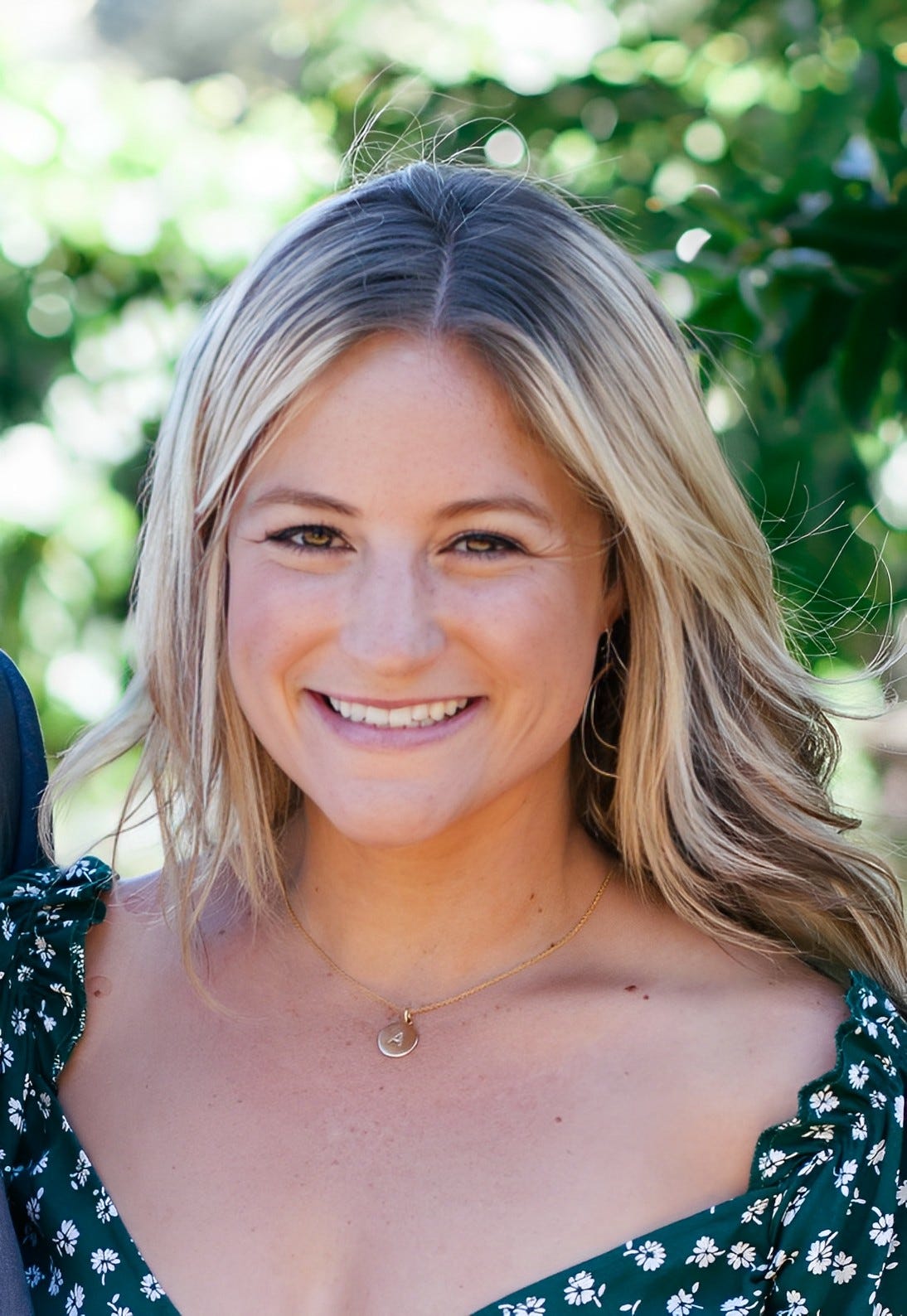
Amanda Stevens graduated from UC Berkeley in 2013 where she played collegiate soccer for the Bears. She holds a Bachelors of Arts degree from Cal and a CA teaching credential and Master of Arts in Teaching with Honors from St. Mary's College of CA. Amanda met her husband Eric Stevens at Cal, where he played football. She taught second grade for 7 years in Southern CA and Eric was an LA City Firefighter after having a short stint in the NFL. Amanda and Eric got married in July of 2019. One month after they tied the knot, Eric was diagnosed with ALS, or Lou Gehrig’s Disease, at the very young age of 29. After receiving this devastating news, Amanda and Eric were forced to quit their jobs and have now dedicated their lives to fight this disease. Together they started The axeALS Foundation in 2021. Amanda and Eric are working tirelessly to spread awareness for ALS, raise funds for research and to allow better patient access to treatment, and help other ALS families as they battle this disease. Amanda and Eric have a daughter named Peyton who turned two in January 2023.
Thank you so much for doing this with us! Before we start, our readers would love to “get to know you” a bit better. Can you tell us a bit about your childhood backstory?
I was raised in a small town in Northern California called Danville. When I think back to my childhood, it was pretty uneventful, and I mean that in the best way possible. I had a very loving and present mom and dad, an older brother, and a younger sister. My dad worked hard to support our family and my mom always made sure our bellies and hearts were full. I started playing soccer at a very young age and almost every memory I have as a kid involves a soccer ball at my feet. The beautiful game taught me a lot of life lessons, it took me all over the US, and it landed me a scholarship at UC Berkeley which then led me to find my husband & forever soulmate. My husband Eric had a similar upbringing with football and we both felt that our backgrounds prepared us for hardships and taught us how to persevere. But I don't think anything could have helped prepare us for the biggest challenge lying ahead: a terminal diagnosis of ALS.
Can you please give us your favorite "Life Lesson Quote"? Can you share how that was relevant to you in your life?
A life lesson quote that I love is “Once you choose hope, anything’s possible” (Christopher Reeve)
After my husband received his diagnosis, I did not know how I would go on another day. I thought my life was over because the one person I wanted to be with forever was dying. I soon realized that having that mindset was not going to change what was happening to us.
When we found hope, things started to change. We looked at each day as an opportunity to educate ourselves and others about the disease. We strived to bring more awareness to the disease in hopes to raise more money for research and treatments. Hope was and still is the driving factor behind everything we do.
You have been blessed with much success. In your opinion, what are the top three qualities that you possess that have helped you accomplish so much? If you can, please share a story or example for each.
When looking back at the past 32 years of my life, I think these three qualities have helped me get to where I am today:
Resilience. My husband and I have been hit with one of the biggest blows life can throw at you. And even though we have been given this seemingly impossible challenge, we are not giving up and we are not backing down. Every day we wake up ready to fight. While Eric fights for each movement, I am fighting to save his life. Quitting is and never will be an option for us.
My Drive & Passion. I am passionate about helping others and I strive to do whatever I can to make a positive impact on someone or something. Being faced with adversity has made me stronger and more driven than I have ever been to help not only my husband but others suffering from this disease as well. I dedicate every day of my life to being the best wife and mom I can be, which will always be my most important passion. My experiences have taught me that because of my drive and passion, I have a lot to offer others and I can make a difference in their lives.
Optimism. I think it is important to remain realistic, and feel emotions when necessary but I also believe that attitude is everything. I pride myself on trying my hardest to maintain a positive outlook even when things get tough. I fight hard to find solutions and try not to dwell on the negative. My husband and I have found a way to turn this devastating diagnosis into a way to help suffering ALS patients and fight for change.
Let’s now shift to the main part of our discussion about ‘Healing after Loss’. Do you feel comfortable sharing with our readers about your dramatic loss or life change?
My husband Eric and I met in college at UC Berkeley. We were both collegiate athletes–I was captain of the soccer team at Cal and he was captain of the football team. We met through mutual friends and pretty much had that “love at first sight” moment that you see in movies. He invited me to a party at his house that night, and the rest is history.
After college, Eric played in the NFL (St. Louis Rams) while I pursued my teaching credential and masters. He soon realized football wasn’t his forever job, and so Eric became a Los Angeles City firefighter. I was a second-grade teacher in Orange County. We were living in an area we loved with our chocolate lab Duke, and had dream careers we both worked so hard for.
Eric and I got married in front of our family and friends on July 27, 2019. It was the most perfect day ever. We had an adventurous honeymoon exploring Yellowstone and Glacier National Park and fly fishing in the Montana rivers. We were so excited to start this new chapter in our lives as husband and wife. Starting a family and seeing Eric become a father was the thing I was most excited about.
When we got home from our honeymoon, Eric started to tell me about some symptoms he had been having for a few months. Him being the selfless man he is waited until after the wedding to express these health concerns. His left hand was feeling weak, his biceps were twitching nonstop, and his whole body felt super fatigued. Being an athlete and fireman, Eric was very in tune with his body. He knew something wasn’t right. We skipped the primary doctor and went straight to the neurologist.
After many doctor visits, genetic tests, blood tests, MRIs, and X-rays, everything seemed to look normal. The last test was an EMG, which looks at your muscle-nerve connection. Eric’s symptoms paired with the irregular results from the EMG pointed to one thing: ALS. My healthy, strong, 29-year-old husband was diagnosed with ALS on August 27th, 2019, exactly one month after we said: “I do”.
I’m sure you remember the Ice Bucket Challenge back in 2014, but many people do not understand the seriousness of this disease. ALS is a progressive neurological disease that has no cure. The life expectancy is 2-5 years with paralysis hitting much sooner. Patients lose the ability to eat, swallow, walk, talk, and eventually breathe. We were told Eric was a fast progressor, and that maybe football or firefighting contributed to the diagnosis, but doctors still don't know what causes it. As you can imagine, our worlds were flipped upside down.
What was the scariest part of that event? What did you think was the worst thing that could happen to you?
The scariest part I think for me was knowing that ALS was 100% fatal. No one has survived this disease. I was scared of the many losses we would face. Not only would I lose my husband, but I would have to watch him suffer as ALS took everything away from him. He would lose his independence and rely on me and others to take care of him. I was so scared of the future and the unknown of what was to come.
How did you react in the short term?
The first couple of weeks were a blur. I was absolutely devastated and terrified, and part of me still is. Seeing how scared Eric was made my heart break over and over again. I couldn’t understand why this was happening. I remember thinking: HOW? It didn’t seem real and it just wasn’t fair.
After the dust settled, what coping mechanisms did you use?
I found that getting outside, going on walks, exercising, doing things for myself, and being around my close family and friends were very beneficial to my mental health. I was so focused on my husband and his battle that sometimes I forgot about myself. When I started taking care of myself, I was able to take better care of him.
Can you share with us how you were eventually able to heal and “let go” of the negative aspects of that event?
I don’t think I can say that I have fully healed because we are still very much in the thick of this disease. Seeing the effects ALS has had on Eric has been devastating. He went from being the weightlifter of the year at UC Berkeley to not being able to lift a spoon to his mouth. The same fire department he once dedicated his life to is now showing up at his door and treating him as a patient. He can no longer drive, write, feed, or bathe himself. We have lost a lot, but I have gotten better at coping with the losses and focusing on what Eric can still do and what we can do as a family. Eric is still here and still very present. He can still sing to our daughter, read her books, and teach her about things he loves. Although Eric’s physical body has changed drastically, his mental toughness has remained strong and very motivated. Our entire perspective on life has changed. We definitely don’t sweat the small stuff anymore, and we truly cherish every moment we have together. No one is guaranteed tomorrow, and with that mindset, we are able to focus on the day ahead of us and make the most of it.
In my own grief journey, I found writing to be cathartic. Did you engage in any writing during that time, such as journaling, poetry, or writing letters? If yes, we’d love to hear about any stories or examples.
A little bit. I do have a journal app on my phone and I sometimes write down things that happened that day. I write about the good days and the bad days. And to be honest, sometimes it’s harder to go back and read about the good times because I miss the things we used to be able to do.
One day I would love to write a book about this whole journey. ALS is a very private disease. Many times ALS patients hide inside their homes with their loved ones and enjoy the time they have left together. I think that people need to see the good and the bad, the happy and the sad, the pretty and the ugly. People need to see the hard things in order to really care about this disease and fight for change.
Aside from letting go, what did you do to create an internal, emotional shift to feel better?
The first few months after we received the diagnosis, I had that pit in my stomach where I couldn’t sleep, couldn’t eat, and couldn’t get through the day without breaking down in tears. We cried a lot and even now, three and a half years later, we still cry…a lot. And that's okay! But being sad was not going to fix or change what was happening. It was up to us to channel that sadness into something meaningful and purposeful. That’s when we started focusing on how we are going to beat this disease instead of having the mindset of “why did this happen to us”.
Is there a particular person who you are grateful towards who helped get you to cope and heal? Can you share a story about that?
I would have to say there are actually two people who have helped me cope and heal. The first is my husband. He is the strongest, most resilient person and he has shown that when life throws you this unimaginable situation, you have to remain strong and keep fighting. When I see how he has responded to this illness, it inspires me to gather my strength and keep going. Eric wakes up every day with a smile on his face. He cherishes every moment spent with our family. He truly appreciates each day and lives it to the fullest. Not many people can say the same.
The second person is our daughter Peyton. Obviously, this isn’t how we pictured our life, especially as a family of three. But we always say that if Eric didn’t get ALS, we don’t know if we would have been blessed with our little girl Peyton. She is so smart, so kind and so incredibly special. Her smile and spunky personality can brighten anyone’s day. Peyton is the best thing that has ever happened to us and she is the reason why we fight so hard every day. I try my best to remain strong and show her that even though life is tough, so are we. She inspires me to push harder and we are trying to give her the best life possible, even through this terminal disease.
Were you able to eventually reframe the consequences and turn it into a positive situation? Can you explain how you did that?
Because of my husband's background in firefighting and playing football, we were able to create a viral campaign called axeALS that helped raise awareness for the disease. We have done many podcasts & interviews, a TedX talk, & even appeared on the Ellen Show three times. We soon realized that we were given a platform where people were starting to see us and hear us. Now it was up to us to make something out of it.
In November 2021, we started the axeALS Foundation with hopes to raise awareness and funding for ALS treatments and clinical trials; to help ALS patients and their families live as full and normal lives as possible; encourage research for the prevention, alleviation, care, treatment, and (one day) cure of ALS.
Right now, ALS has some very promising treatments in clinical trials. My husband was actually a participant in a clinical trial for a stem cell treatment called NurOwn and he is living proof that access to experimental therapies can make a huge difference. I explained above how Eric was labeled a “fast progressor”. Well here we are, three and a half years later, and Eric is still walking, speaking clearly, eating normally, and breathing strongly. Not many ALS patients who are three years into the disease can say the same.
ALS patients need better access to treatment. We need more urgency and flexibility from the FDA when it comes to ALS therapies. Cancer therapies and other fatal diseases have different pathways and are often approved based on real-world evidence. We are fighting and asking that the FDA treat ALS the same way. These dying patients do not have time to wait. They just want a chance at fighting this awful disease.
What did you learn about yourself from this very difficult experience? Can you please explain with a story or example?
I learned that you will do anything and everything for the ones you love. That you will step out of your comfort zone and do some things that you didn’t even know you were capable of. I went from teaching second graders how to read and write, add and subtract, and be kind to one another to meeting with government & FDA officials, starting a foundation, and fighting to save my husband's life. I learned that I am strong and that I will not back down. I recently heard the quote “Adversity doesn’t build character, it reveals it” and I cannot think of anything more true. You aren't even aware of what you're capable of until a challenging situation presents itself and you're forced to respond.
Everyone has their own hardships and challenges. Everyone has their own story. This is ours, and although it has been extremely difficult, it has made me stronger. I feel like I can now handle anything this crazy life will throw at me!
Fantastic. Here is the main question of our interview. Based on your experiences and knowledge, what advice would you give others to help them get through a difficult life challenge? What are your "5 Things You Need To Heal After a Dramatic Loss Or Life Change? Please share a story or example for each.
As I look back on the process of dealing with this difficult life challenge, these five things helped me get to where I am today:
Take the time to grieve. With any loss, you need time. Go through the process of feeling all the raw emotions that come to you. It is okay to be sad and angry.
Lean on your support system and loved ones. The grieving process is hard and can be very long and very lonely. While going through this tough time, we found that surrounding ourselves with friends and family was a true blessing. On our darkest days, they helped us see the light. Be vulnerable and reach out to someone when you need them. I remember not wanting to talk about anything because that made it feel more real to me. But once I started expressing my feelings to my husband, my friends, and my family, I started to feel like I wasn’t alone.
Ask for help. This is definitely one of the hardest things for me to do. As my husband's disease progresses, as our daughter Peyton gets older and becomes more active, and as the axeALS foundation continues to grow, I am being pulled in many directions and oftentimes get stretched thin. I have learned to ask for help when I need it. We are extremely lucky to have help close by and available. A friend walks our dog every day. My mom and my mother-in-law helps with our daughter Peyton or stays with Eric when I need to go on longer errands. They do laundry and the dishes and help me keep the house clean. A neighbor brings us home-cooked meals and the most delicious desserts. These acts of kindness from others take less pressure off of me and allows me to be a more patient, present, energetic mom and wife.
Find a way to channel the sadness & anger into purpose. After a while, we were able to look at our challenging life change in a new perspective. We were able to channel those negative emotions into something positive. We started the axeALS Foundation with hopes to help other ALS families and find effective treatments for the disease. This gave us purpose and helped drive us to create change.
Take it one day at a time and really enjoy that day. We are so lucky to have today. As Eric would say, “Today is my best day”. Be gentle with yourself, give yourself grace, and focus on the present. Unfortunately, sometimes it takes a traumatic event to figure out what really matters to you in life. It helps you find your purpose. Put your time and energy into that.
You are a person of great influence. If you could inspire a movement that would bring the most amount of good to the most amount of people, what would that be?
If I could inspire a movement right now, it would be to put an end to ALS. This disease is just too devastating for any family to endure. I would love to educate others about the disease, raise funds for research and treatments, and put pressure on our government and the FDA to treat ALS the same way they have treated cancer and COVID.
My husband was 29 when he was diagnosed. Every day we meet a younger individual that has been devastated by this disease. It is unfortunate that we have joined this ALS community, but I can easily say that I am so fortunate for every ALS patient and family I have met. These patients just want a chance to fight, a chance to live. And we can come together and help with that right now.
We are very blessed that some very prominent names in Business, VC funding, Sports, and Entertainment read this column. Is there a person in the world, or in the US with whom you would love to have a private breakfast or lunch with, and why? He or she might just see this if we tag them. :-)
I would love to meet Reese Witherspoon. First of all, I just love her and admire her so much as an actress. Secondly, I know she has a personal connection to ALS–her friend and publicist Nanci Ryder passed away in June 2020 after a six-year battle with ALS. Reese is someone with a megaphone that could help bring more awareness to the disease. More awareness means more funding and more support that can drive change and care for those impacted by the disease. Reese has been known to support ALS fundraisers before and I would love to chat with her about using her platform to help us axe ALS forever!
How can our readers further follow your work online?
You can visit our website at www.axeals.org. You can follow our journey on my personal Instagram page: @amanda___stevens or the axeALS Foundation page: @teamstevensnation. We are on Twitter: @stevens_nation and Facebook as well: Team Stevens Nation.
Thank you so much for sharing these important insights. We wish you continued success and good health!