When you have to defend a positioning argument in a second language, in front of people who have no reason to be polite to you, you learn fast which arguments hold up and which ones you repeat.
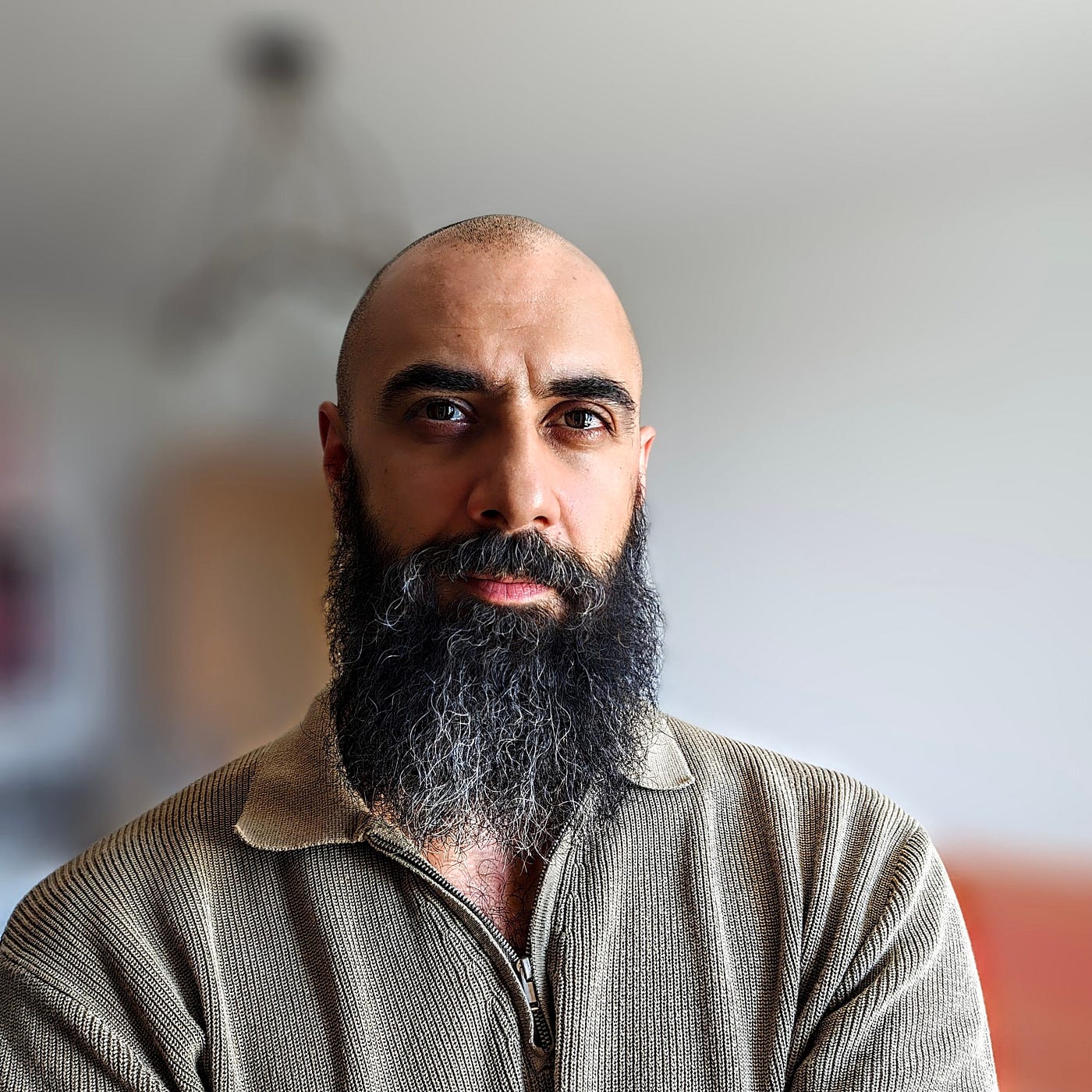
As a part of this series, we had the pleasure to interview Adrian M. Peticila.
Adrian M. Peticila is a Bucharest-based brand strategist and software builder with over twenty years of experience across fintech and enterprise software, where he has repositioned 30+ brands across more than twenty global markets. He runs the executive positioning consultancy Aah, Monster!. Recently, he also started building grai, a local-first writing app that checks whether a draft matches the writer’s own cadence. He has more than 22,000 followers on LinkedIn.
Thank you so much for joining us in this interview series! I know that you are a very busy person. Before we dive in, our readers would love to “get to know you” a bit better. Can you tell us a bit about your ‘backstory’ and how you got started?
My career looks pretty linear from the outside, mostly because I kept taking jobs that scared me. I am a painfully shy introvert, so early on I pushed myself into brand and marketing roles across European markets, often in languages I was still learning. I did not want my own anxiety to shrink my life.
When you have to defend a positioning argument in a second language, in front of people who have no reason to be polite to you, you learn fast which arguments hold up and which ones you repeat. For the past few years, my main sandbox has been positioning work for founders and executives.
I am not a software engineer by trade, and I never had the patience to learn programming from scratch. What changed recently is that I can feed marketing and positioning, applied psychology, and game theory into a model, test every output rigorously, and build working tools I stand behind. Sticking to textbook marketing would never have shown me this side of the work.
None of us can achieve success without some help along the way. Is there a particular person who you are grateful for, who helped get you to where you are? Can you share a story?
I never had a single mentor who took me under their wing. Most of what I know came from difficult clients and skeptical colleagues who would read a paragraph I had spent a week on, look up, and ask why it mattered.
That used to annoy me early in my career. Now it is the only feedback I actually trust, because if you cannot explain a line in 30 seconds without hiding behind jargon, the draft is not ready. I don’t have one person to thank for that. I had a few hundred.
You are a successful business leader. Which three character traits do you think were most instrumental to your success? Can you please share a story or example for each?
First is skepticism, or plain realism. I have a touch of ADHD, so missing details bother me almost physically. In the short term that makes me annoying to clients and teams because I flag every flaw I see. Yet planning for dozens of worst-case scenarios upfront usually saves the deliverable before it hits the market.
Second is adaptability. I run Aah, Monster! as a sandbox where I test positioning angles and messaging experiments constantly. Roughly 95% of what I try fails and maybe 5% sticks. I work with clients in slow, static industries where changes take years, and with AI teams where a positioning strategy that worked 30 days ago is already dead because a new model or tool shifted the market overnight. You learn not to get attached to last month’s deck.
Third is humor. I never trust executives who act like every quarterly meeting is a hostage negotiation. When I have to tell a founder that their positioning reads like it was written by a legal committee, I try to get them laughing first so they actually hear it.
Thank you for all that. Let’s now turn to the main focus of our discussion about how AI leaders are keeping AI safe and responsible. To begin, can you list three things that most excite you about the current state of the AI industry?
First is that a non-technical practitioner can now build real software tools with patience and a high tolerance for wasted time. I am working 16 to 18 hours a day right now, not out of obligation, just because I have not had this much fun in years.
Second is running capable open-weight models locally on my own laptop. Being able to process client work on local hardware without sending drafts to a third-party cloud feels like getting real ownership back.
Third is what AI reveals about human taste. If someone wrote dull copy or did sloppy SEO before AI, they will do the exact same thing now, only with an AI flavor on top. Good judgment and domain expertise suddenly stand out much faster.
Conversely, can you tell us three things that most concern you about the industry? What must be done to alleviate those concerns?
First is the widening gap between the small group pushing AI seriously and almost everyone else. Most people I meet still use AI as a slightly smarter search engine or a toy for generating pictures of cats. Meanwhile, a small group is learning how these systems actually work and building things with them, and that capability gap is growing every week.
Second, AI works like a hardware-store axe. You can use it to split firewood, or you can chase people down the street with it. In the wrong hands, a system that multiplies creative and distribution speed becomes a dangerous weapon.
Third is half cliché and half joke: if we actually reach Artificial General Intelligence, there is a decent chance it wipes us all out. I do not pretend to have a neat technical answer for AGI-level risk yet, beyond keeping real oversight on anything major today.
As a CEO leading an AI-driven organization, how do you embed ethical principles into your company’s overall vision and long-term strategy? What specific executive-level decisions have you made to ensure your company stays ahead in developing safe, transparent, and responsible AI technologies?
I run a small consultancy and build software tools rather than a massive corporation, so I look at this as the person who writes and signs off on the code. Once a deadline gets tight, nobody reads a five-page ethics PDF, so I treat privacy as an architectural constraint rather than a policy promise.
When I started building grai to analyze writing rhythm, I decided early on that text analysis had to stay on the user’s own computer. We never upload a writer’s draft to our servers. Even when someone publishes a verification badge online, the public registry only receives a cryptographic hash rather than the text itself, so we cannot read our users’ private drafts even if we wanted to.
Have you ever faced a challenging ethical dilemma related to AI development or deployment? How did you navigate the situation while balancing business goals and ethical responsibility?
The temptation I run into lately is the easy money sitting in automated ghostwriting. Founders and agency owners regularly ask if I can set up an AI pipeline that clones their voice and posts under their name automatically so they never have to write again. Taking those retainers is easy money, but it means helping clients fake their own presence.
Turning down that work stung at first, and it pushed me to build the opposite tool. Instead of generating fake posts, grai checks a draft against eight structural rules and a minimum burstiness score before issuing a signed audit card recording which checks passed. I would rather sell a tool that helps people write better than another pipeline that writes for them.
Many people are worried about the potential for AI to harm humans. What must be done to ensure that AI stays safe?
I do not think most AI safety debates are aimed at the right problem. People argue about killer robots 50 years from now while ignoring the boring failures happening today. Rule-based code works well for things you can define and test, like file permissions, secret scanning, and spending limits. It cannot tell you whether a paragraph is factually true. For anything touching customer money, data or medical records, you still need a hard pause where a human reviews the action and takes responsibility for approving it.
Despite huge advances, AIs still confidently hallucinate, giving incorrect answers. In addition, AIs will produce incorrect results if they are trained on untrue or biased information. What can be done to ensure that AI produces accurate and transparent results?
A lot of trouble starts when companies treat a language model like an encyclopedia. A language model predicts the next token based on patterns learned during training and the context it receives. It does not independently verify whether a statement is true. If you want accurate outputs in production, you have to connect the model to verified records and force it to say “I do not know” whenever a source is missing.
Companies also create half of this mess themselves. Executives complain that chatbots get basic facts wrong about what their business sells, yet their own homepage is three paragraphs of vague slogans that could describe an accounting firm or a logistics startup. When the source is ambiguous, the machine guesses wrong.
Here is the primary question of our discussion. Based on your experience and success, what are your “Five Things Needed to Keep AI Safe, Ethical, Responsible, and True”? Please share a story or an example for each.
- Check the workspace before an agent runs.
Autonomous agents can retry broken commands, bleed context between folders, or leave API keys and .env files exposed before a commit. I built Gorgona as a pre-flight gate using only the Python standard library, so it runs in milliseconds with zero external dependencies. It scans for leaked secrets, enforces brand boundaries, and checks the memory graph for cycles so a bad run halts with exit code 1 during our pre-flight check.
2. Keep sensitive drafts off remote servers when cloud processing is not necessary.
Vendor privacy policies can change when a company gets acquired or needs fresh training data. Grai processes drafts locally, so we never need to receive the original text to run the analysis.
3. Do not rely on one language model to grade another.
Chaining a second model to check the first one doubles your API bill and can still miss the same mistake. On pricing or compliance, the final gate has to be deterministic code or someone who actually understands the domain.
4. Look at structural writing habits rather than banning buzzwords.
Many marketing teams think they have an AI policy because they banned a handful of obvious giveaway words. To see what was actually happening, I audited 134,522 organic LinkedIn posts across 1,499 founders. Writers cut that notorious five-letter AI verb from 4.2% down to 0.5%, yet formulaic arrow bullets jumped from 0.6% to 12.3%, a 1,950% relative increase, while “Here’s why” transitions climbed from 1.3% to 9.6%. Deleting a few cliché words changed the surface vocabulary, not the underlying habits.
5. Use AI to stress-test your thinking, not to write your opinion.
Language models are trained to predict likely continuations based on patterns in their training data and the context they receive. That works well for summarizing a transcript or formatting a table. It does not mean they understand what makes a point of view worth remembering.
Looking ahead, what changes do you hope to see in industry-wide AI governance over the next decade?
Right now, most AI governance consists of long compliance questionnaires that big corporations can easily staff while smaller software teams drown in paperwork. Over the next 10 years, I hope we trade some of that bureaucracy for verifiable technical proofs. Instead of asking a vendor to sign a forty-page promise about how their system behaves, buyers should be able to inspect execution logs and cryptographic signatures showing what checks actually ran.
What do you think will be the biggest challenge for AI over the next decade, and how should the industry prepare?
People are increasingly going to question anything they see on a screen. We are already halfway there in B2B sales and hiring, because when anyone can generate thousands of convincing cold emails or job applications in an afternoon, most recipients assume an unsolicited email is automated until proven otherwise.
Software makers will have to build simple provenance tools directly into the apps people use every day. Whether it is an article or a piece of code, I suspect we will need a way to tell work someone actually thought about from something generated in bulk.
You are a person of great influence. If you could inspire a movement that would bring the most good to the most people, what would that be? You never know what your idea can trigger. :-)
I would love to see a movement where smart people in business go back to speaking plain English. So much time gets wasted in companies because people hide behind complicated buzzwords when they are afraid to say “I do not know” or “This part is broken.” If everyone dropped the corporate act by even 20 percent, work would be a lot less exhausting.
How can our readers follow your work online?
I write almost every day about brand positioning and building software on LinkedIn (linkedin.com/in/adrian-peticila), where more than 22,000 people put up with my sense of humor. My longer essays live at peticila.ro. Anyone curious about my positioning work can visit aah.monster, while builders and writers can check out grai at grai.page.
Thank you so much for joining us. This was very inspirational.