For me, and what I’ve learned from reading poetry, is that poetry is a door. Like a closed door. When we read the poem, we’re slowly opening the door. And, by the end, we can either walk through it or turn away from it.
Poetry is growing in popularity and millions of people spanning the globe have a renewed passion for embracing the creativity, beauty, and art of poetry. Poetry has the power to heal and we make sense of the world through the human expression of writing and reading. Are you wondering: What does it take to become a successful poet? What is the best medium and venue to release your poetry? What are some techniques to improve or sharpen your skills? In this interview series about how to write powerful and evocative poetry, we are interviewing people who have a love for poetry and want to share their insights, and we will speak with emerging poets who want to learn more about poetry either to improve their own skills or learn how to read and interpret better. Here, we will also meet rising and successful poets who want to share their work or broaden their audience, as well as poetry and literature instructors.
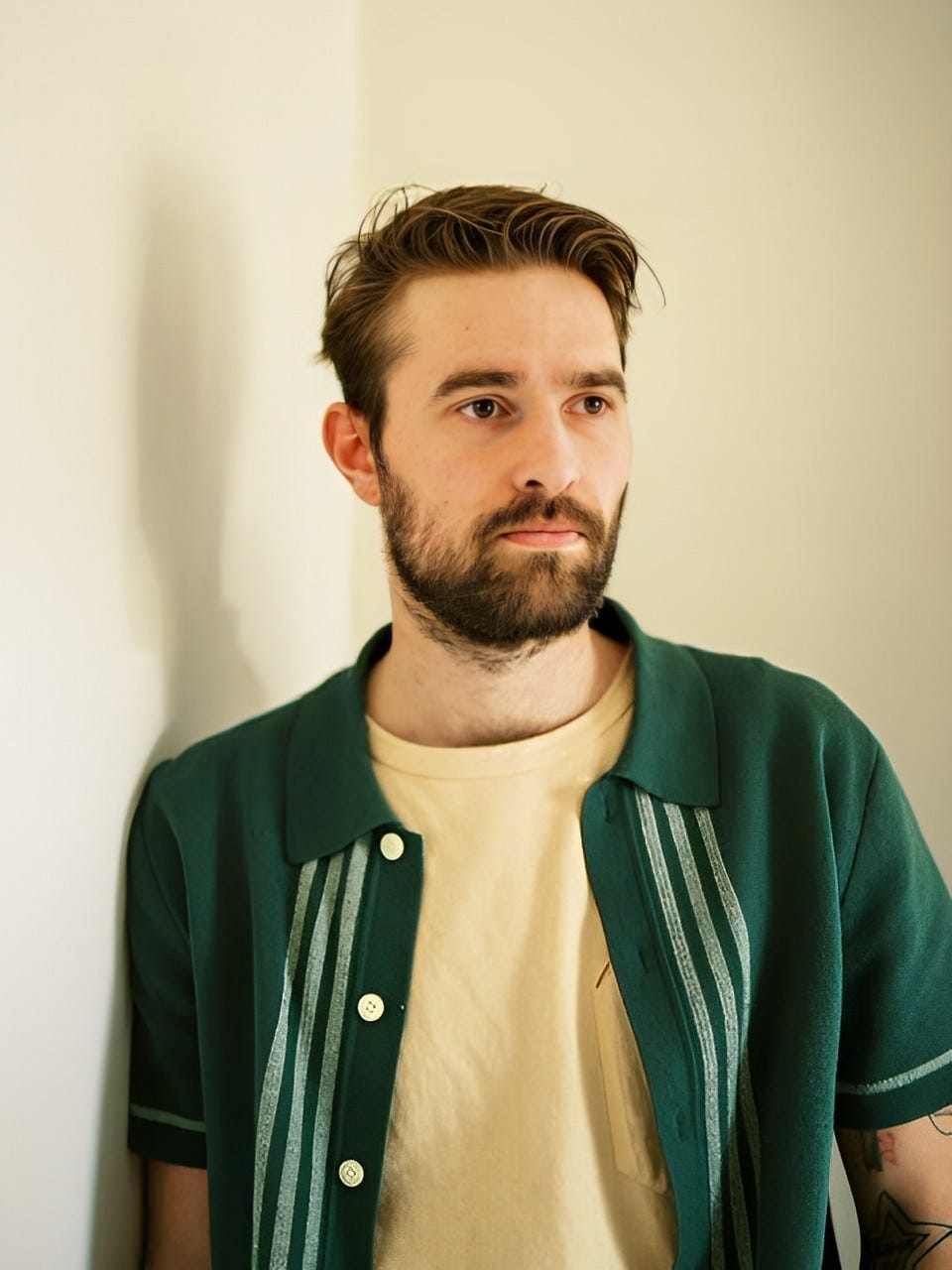
As a part of this series, I had the pleasure of interviewing William Bortz.
William Bortz (he/him) is a husband, poet, and editor from Des Moines, Iowa. His poems appear in Okay Donkey, Oxidant Engine, Empty Mirror, honey & lime, Turnpike Magazine, Back Patio Press, the Lyrical Iowa Anthology, and others. He is the author of The Grief We’re Given and the chapbook The Sky Grew Back with Clouds. Growing up, William spent time in foster care, in homelessness, and in shelters. His aim in writing is to explore how joy lives in uncertainty and mourning.
Thank you so much for joining us in this interview series! Before we dive into the main focus of our interview, our readers would love to “get to know you” a bit better. Can you share a story about what first drew you to poetry?
Thank you so much for having me! Lame or not, I am definitely one of those millennials that at some point in my life has stated that “music saved me.” I remember listening to music like it was an activity, not doing anything else—before smartphones were a thing and the internet was as easily accessible. I would just sit in my room and listen to music for hours.
I would think about my life, the life I wanted, what I disliked about my life, and any small, meaningless thoughts a human being could have. I never got a solid answer to any of it, and I was content in just wondering. Years later, when I discovered poetry, it was the same experience. I could just read and think, get more questions than answers, and just wonder.
Can you tell us a bit about the interesting or exciting projects you are working on or wish to create? What are your goals for these projects?
I’ve always loved other art mediums; some I am particularly good at are poetry, video, and music. I feel like so many of these things can be and are poems, and I love the idea of an actual written open existing alongside and with them. I’m not sure what the end product could look like, but I really love daydreaming about them.
A couple of years ago I had an idea to start a zine. I got a bunch of my friends’ disposal cameras and told them to take pictures of whatever they thought was cool or weird. We complied it into a crudely made zine and accompanied the pictures with poems. I had so much fun taking pictures, thinking about the zine, and looking at the pictures that I never actually bothered to create the thing. It was just fun to look at stuff that I wouldn’t normally pay attention to.
I also spent a few years working on a novel and a screenplay. Neither of those came to fruition either. But they were a joy to work on. For now, I’m just sticking to poetry, exploring form, and daydreaming.
Wonderful. Let’s now shift to the main focus of our interview. Let’s begin with a basic definition so that all of us are on the same page. What is your definition of poetry? Can you please share with us what poetry means to you?
For me, and what I’ve learned from reading poetry, is that poetry is a door. Like a closed door. When we read the poem, we’re slowly opening the door. And, by the end, we can either walk through it or turn away from it.
I mentioned it earlier, but poetry doesn’t really give me answers—just more questions. And that satisfies the part of me that is always wanting an answer to everything. It’s freeing to not get an answer and choose to lean into that or walk away.
What can writing poetry teach us about ourselves?
I think it can show us what we’re running away from and what we’re holding onto. It can also teach us how little we look up and find joy in the present.
Who are your favorite poets? Is it their style, the content or something else that resonates with you?
A few of my favorite poets that I revisit often are Hanif Abdurraqib, Louise Glück, and W.S. Merwin. It’s definitely a different aspect with each.
W. S. Merwin has his brevity—in whatever theme he’s writing about.
Louise Glück writes with so much intensity, and she always seems to be exploring the relationship between people and nature. Her work just leaves you breathless.
Hanif Abdurraqib dabbles in a few different styles—poetry, essays, and cultural criticism. He writes as if appreciation is a different language. Whether I’m reading an essay he wrote about a band I grew up listening to or a poem existing somewhere near the intersection of sports and grief it makes me step back for a moment and just look around.
If you could ask your favourite poet a question, what would it be?
What are the best habits or practices you’ve developed in your life that have helped you find more appreciation?
Poetry can be transformational. Is there a particular poem that spoke to you and changed your life or altered a perspective you held in some way? Can you share the story?
Oh, definitely. Over the years there have been many. The one that sticks out most is the title poem in the book Calling a Wolf a Wolf by Kaveh Akbar. The poem is absolutely astounding. There are a handful of lines that I revisit often: “here I am dying at an average pace, I try to find small comforts / purple clover growing in the long grass / a yellow spider on the windowsill / I am less horrible than I could be.”
But the line that really hit me is “I’ve given this coldness many names / thinking if it had a name it would have a solution / thinking if I called a wolf a wolf I might dull its fangs.” The line is so self-aware—so simple yet so profound. When I first read this poem, I was working a job I didn’t like. It was also the first year of my marriage, and I was starting to see some unresolved issues from my childhood starting to surface and affect my marriage. So, for me, it was the realization of focusing inwardly and not noticing what was happening around me. All my attention was directed inwardly that I was becoming the thing. This poem knocked the wind out of me.
Today's world needs so much healing. Can you help articulate how poetry can help us heal?
Poetry lets us know we aren’t alone. There are people going through what we’ve gone through and can give us the words to describe how it feels when we can’t come up with them ourselves. On top of that, poetry teaches us to ask better questions instead of demanding incomplete answers.
We’d like to learn more about your poetry and writing. How would you describe yourself as a poet? Can you please share a specific passage that you think exemplifies your style or main message?
I’m always thinking about my relationship with the present and with the past. Considering where I’ve been and what I’m missing but looking back so often.
A specific passage that exemplifies my style is from my upcoming poetry collection, Many Small Hungerings:
CURRENTS
“what is a memory but two currents / pulling away from one another / yes, I am here but I am also / every place I have held someone / that I love”
What do you hope to achieve with your poetry?
I just want my poetry to be a lighthouse—as so many other poets’ work has been for me.
In your opinion and from your experience, what are 3 things everyone can learn from poetry?
There are so many things! What sticks out to me—and what really hits me in the gut when I’m reading a good poem—are one of these things: how to hold onto hope, how to be vulnerable, and how to ask good questions. In a lot of ways these all overlap, but this is what poetry has taught me and allowed me to live with a lot more graciousness, patience, and wonder.
Based on your own experience and success, what are the “five things a poet needs to know to create beautiful and evocative poetry?” If you can, please share a story or example for each.
What a fun question! While I’m sure these are entirely subjective—these are five things that I’ve learned from poetry and have permeated other areas of my life as well. In practice and posture, I can’t write a poem without them.
The first, and one of the most important (in my opinion), is a relationship with the world. You could also say nature, though I know some folks live in places that are more concrete than nature. A handful of years ago, I was watching an interview with Hanif Abdurraqib, and he spoke about how we must live life, so that when we return to an empty page, we will have something to share. I have carried that sentiment with me. I don’t think this necessarily means that we are to go live a wild and dizzying life, but one that is full to you. Invest in yourself, in your people, in your community, and in the world that you interact with. Take a walk in your neighborhood, wave to the stranger walking a dog, stop into a local shop and chat with the person working. Because this, too, is vulnerability. This looks different for everyone, but the idea remains the same: go and live so that you can speak to the relationship you have with the world around you.
I’m a big believer in the benefits of spending time in silence. Whether it’s early morning with your coffee or tea or whatever you like, or on your drive to work or to the store—spend some time in silence. Just ruminate on the day, go over your thoughts, unravel any frustrations and joys. Just get a grasp on what you’re feeling and why. Silence is just giving yourself space to air out everything going on in your head and make it feel less… chaotic.
I think that we all have this inherit ability to sense the honesty in a piece of art, whether it’s writing or photography or anything in-between. Much like the soul of a person, I don’t think it can be measured or quantified tangibly, but you know it’s there. The most prominent thing I come across when talking to newer writers is the fear of sharing the work, of people seeing you. I totally get it. I felt the same way when I first started sharing my work. It is scary. Being honest and being vulnerable is scary. But this is what saves people. I mentioned this poem earlier: “Because right now there is someone out there with a wound in the exact shape of your words.” And for that person to see the wound, to get the healing word or sprig of joy or sprinkle of wonder, you have to show the wound.
For better or worse, I always consider writing in a similar way to basketball. We see the announcement for our favorite writer’s newest book and it’s super exciting! We celebrate. We share in that joy. We get the book and start reading and it is just flawless. You ask yourself how this person created this. They make it look easy. In the same way we sit down with our friends and watch a basketball game. Men and women—which in my case are ten years younger than me—are showing off a degree of athleticism that seems natural. They make precision passes, cover an entire halfcourt with two steps, and glide past defenders. It’s insane! We see that and wonder how it looks so easy. Well, it may look easy but it’s not. To quote AI: “We’re talking about practice.” To understand writing, language, syntax, form, and everything else, you have to play with it. Read it. Write it. Over and over. Write a line and delete. Be okay with writing a lot more than one line, maybe even an entire manuscript, and delete it. Like basketball, it comes more naturally to some, I’m sure. And I’m not saying I want to be the best writer; I just want to communicate what I think is worth being communicated in the best way that I can.
A great majority of our life is spent in monotony. Driving to work. Eating the same meal. Walking the same block. Living in the same house. Going to the same grocery store or the same coffee shop. Etc. etc. etc. I am not the first person to say or even acknowledge this, but have you ever walked down a road you’ve driven down a million times and the act of walking makes it feel completely different? You notice this bush with super colorful leaves, a house with a dog that never leaves one spot in the yard, another house that has the best porch of all time—one that you could spend hours on. All this is to say that by simply looking where we don’t normally makes an incredibly familiar-to-the-point-of-boring place feel new and refreshing. What of this isn’t appreciation? When most of our life is spent waiting in line, we may as well look around and notice something new.
If you were to encourage others to write poetry, what would you tell them?
The best answer to this question is another poem. Sean Thomas Doughtery writes in his poem “Why Bother” from The Second O of Sorrow: “Because right now there is someone out there with a wound in the exact shape of your words.” I started writing because I didn’t have anyone to talk to when I was a kid and I felt alone. I felt there was a lot that I needed to get out of my head. When I got older and started sharing my writing, I realized I wasn’t the only one who felt this way, and sharing it made other people feel less alone in whatever they were going through.
How would you finish these three sentences:
Poetry teaches…to pay attention.
Poetry heals by…asking us to pay attention.
To be a poet, you need to…wonder.
We are very blessed that some of the biggest names in Entertainment , Business, VC funding, and Sports read this column. Is there a person in the world, or in the US, with whom you would love to have a private breakfast or lunch, and why? He or she might just see this, especially if we both tag them :-)
Dwayne Wade. I love basketball and Miami is my team. He just seems like a dude that wants to have a good chat and a laugh over a good meal. I’m sure we could talk about whatever and it’d be a good time. Just something super casual.
How can our readers further follow your work online?
I’m active on all socials—some more than others! You can find me on Instagram at @william.bortz and on Twitter at @william_bortz. Come by and say, “hey!”
You can also purchase a copy of my new poetry collection, Many Small Hungerings.
Thank you for these excellent insights, and we greatly appreciate the time you spent. We wish you continued success.