That messy, humbling journey across the equator taught me a vital truth about business; it's rarely clean or easy. Just like that naval tradition, business demands that you dive headfirst into the chaos.
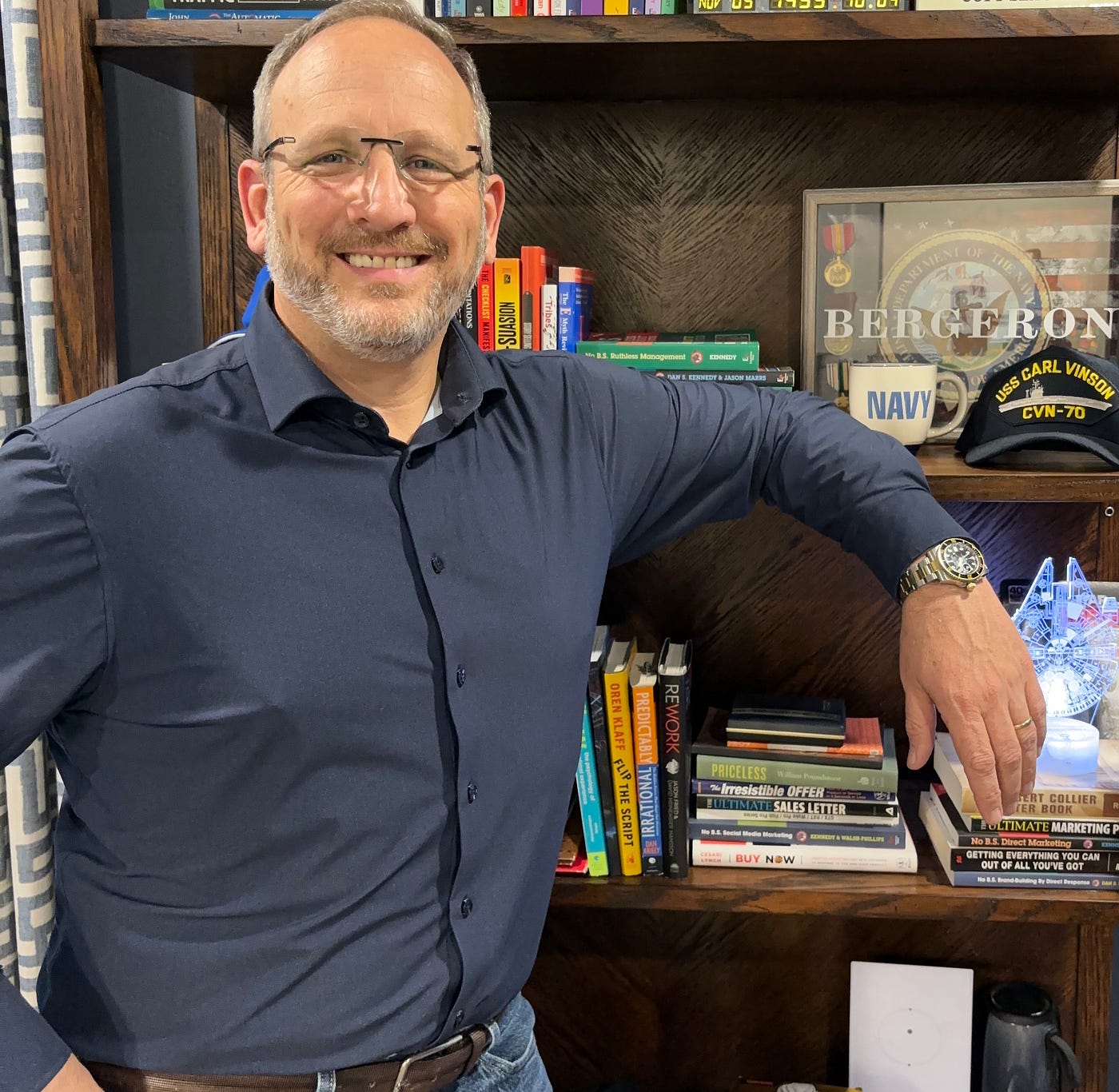
Walter Bergeron is a U.S. Navy veteran with over 30 years of entrepreneurial experience and is recognized as “The Million Dollar Man,” the 2012 “Marketer of the Year,” and the co-founder of The Driving Force Company, a hub for problem-solving. His latest venture, PI Connection™, is a groundbreaking system that merges FDA-cleared, patented personal injury diagnostic equipment with medicolegal empire-building techniques to help clinics provide better care and personal injury attorneys win more cases for their clients. To learn more, visit https://drivingforcecompany.com/.
Thank you so much for joining us in this interview series. Before we dive in, our readers would love to learn a bit more about you.
Can you tell us a bit about your childhood backstory and how you grew up?
I am the oldest of five children and was raised in a hardworking, lower middle-income family. With my parents both working full-time to support our family, financial constraints were a constant part of life. This spurred my entrepreneurial spirit, and at the tender age of 12, I started a car detailing business right in our driveway.
Later on, I’d roll up my sleeves and go to work at my Dad’s struggling oilfield business every day after school. By the time I turned 19, I craved a change of pace and some adventure, so I enlisted in the U.S. Navy. There, I received training to operate nuclear reactors. By 21, I found myself stationed on an aircraft carrier in the Persian Gulf amidst the first Gulf War.
After completing a six-year service, I returned with a renewed determination and founded an industrial electronic repair business from a modest shed among the sugarcane fields of Louisiana. This venture, which I began with humble beginnings, flourished. And 16 years later, it culminated in a $10 million sale.
After the sale, I granted myself and my family a well-deserved hiatus, indulging in some rest and recreation. That break recharged me, and I soon delved back into the entrepreneurial world, this time directing my energy toward the medical technology sector. Today, I oversee a portfolio of companies that drive technological advancements in medical practices. This reflects not just a career but a journey from humble beginnings to innovation leadership.
Can you share the most interesting story that happened to you since you began your career?
In the navy, I learned one of the most unforgettable business lessons, not in a classroom or boardroom, but crossing the equator. See, there's this age-old tradition called the “Crossing the Line” ceremony. It’s a rite of passage, turning “pollywogs” — first timers like I was — into “shellbacks,” or seasoned sailors who've earned their sea legs.
This wasn't your average initiation. It was a day of mayhem and mischief where we pollywogs faced a gauntlet of gags, tasks, and good-natured ribbing, all under the watchful eye of King Neptune himself. It was messy, embarrassing at times, and it tested your mettle. But as you emerged on the other side, covered in slop, pride swelled up because you made it. You were a shellback, complete with a certificate to prove it.
That messy, humbling journey across the equator taught me a vital truth about business; it's rarely clean or easy. Just like that naval tradition, business demands that you dive headfirst into the chaos. You'll face your fair share of embarrassments, obstacles, and hardships. But here's the thing — getting messy is part of the process. It’s in those moments of trial that you learn the most, growing from a novice to a veteran, a pollywog to a shellback, in your own right.
The path from where you are to where you want to be is never a straight line. It's a voyage across your own equator, where the storms of challenge whip you into shape…. so, embrace the mess. It means you're pushing boundaries, learning, and most importantly, transforming. And just like us new shellbacks, when you come out on the other side, you'll not only have the scars and stories to tell, but also the wisdom that only comes from a journey well-traveled.
None of us are able to achieve success without some help along the way. Is there a particular person who you are grateful towards who helped get you to where you are? Can you share a story about that?
In 2016 and 2017, we were able to work with Marcus Lemonis. It was a pivotal point in one of our companies, and we were in a desperate search for a game-changing idea to scale our business. We had to face the harsh truth that our growth had plateaued. We needed an epiphany, a radical departure from the usual path of copying other mediocre industry peers. Our ambition was to catapult our business to extraordinary heights, emulating the giants who had scaled their ventures to billion-dollar valuations.
Our problem was glaring… we lacked connections to the billionaire moguls who could mentor us. Without their guidance, our dream seemed to be slipping away, and we found ourselves on the verge of resigning to the same old routines that had kept us stagnant.
Then, on an otherwise ordinary Wednesday, inspiration struck. It was the morning after watching Marcus Lemonis on "The Profit." His approach on the show, albeit part of a reality TV spectacle, revealed glimpses of true business acumen, of building an empire. That's when it clicked for us… Lemonis was guiding entrepreneurs on national television. His insights, if applied carefully, could be our roadmap.
We were outsiders to his world and needed to get his direct advice. The journey began with tracking down his agent, which proved to be an odyssey of its own, filled with research, applications, and a series of bureaucratic hoops. Our first attempt to connect with Lemonis through his agent was a flop. Unprepared, we stumbled through the conversation, lacking the compelling value proposition that would pique Lemonis's interest. It wasn't about the money; it was about presenting something he would find irresistible.
Undeterred, we tapped into our entrepreneurial tenacity. We rethought our strategy and discovered a common connection with Lemonis' affiliation with the Purple Heart Foundation, something that we were already a part of from my days in the U.S. Navy. So, we made a large purchase from a company of Lemonis’ that sold watches, and a condition of that purchase was a five-minute call with his agent. This call finally bridged the gap to Lemonis, and it was a strategic move that didn't just give us a conversation; it gave our business a new purpose and direction.
Later on, in a private rooftop meeting sipping on an afternoon lemonade, Lemonis sat with us and provided a direction with a new sense of purpose and a detailed path to a new, bigger, and more impactful destination for our companies. That’s where we are today. We acquire businesses to accelerate the way we get to help the causes that mean the most to us with the help of someone that had been there and done that. Thank you, Marcus Lemonis for your guidance!
Can you please give us your favorite "Life Lesson Quote"? Can you share how that was relevant to you in your life?
“Get comfortable being uncomfortable.” In just about every situation where one of my businesses had some type of breakthrough moment, just before that breakthrough, there was a time of being uncomfortable. This included feeling truly out of my league and scared to death of the unknown… but moving forward anyway.
For example:
During the “Crossing the Line” ceremony, I was young and scared to death of the stories told by the guys who had done it before, but I went through it anyway.
In 2012, I won the Marketer of the Year contest, scared to death before I got up on stage in front of thousands of peers to give my presentation… But I did it anyway.
To become a nuclear engineer, I had to sit in front of a panel of naval reactors for an intense examination after years of training, a very uncomfortable, all-day ordeal.
And finally, for our current company, we had the FDA come in and inspect our quality system, a very uncomfortable time, but you have to get comfortable being uncomfortable to have any level of success.
You are a successful business leader. Which three character traits do you think were most instrumental to your success?
Internal drive – Like my story with Marcus Lemonis, my partner and I were driven to get him to guide us, nothing was going to deter that from happening. It wasn’t a promise of money or success. We were simply determined and driven to consult with him, and we did.
Resilience – As a business owner, I was punched and knocked down over and over, and you have to just get back up, knowing full well that you’re likely just going to get knocked back down again. It’s all about your ability to withstand adversity, bounce back and grow despite what life throws at you.
Being honest with yourself about your own strengths and weaknesses – Sometimes, you have to sit by yourself and reflect on the things that you’re good at. Plus, you need to get uncomfortable and think about the things you’re really bad at and be honest with yourself. Then, you shore up your weaknesses by finding others that can do these things better, or maybe you just get better at doing these things yourself. But being honest with yourself about those things is the first step.
Ok super. Let’s now shift to the main part of our discussion about the technology or medical devices that you are helping to create that can make a positive impact on our wellness. To begin, which particular problems are you aiming to solve?
Right now, we are pinpointing the source of back pain for people who have been in some type of accident where other testing has failed to find a problem.
How do you think your technology can address this?
We can pinpoint the pain generator down to a tenth of a millimeter so these people can get the right treatment for their pain. And probably just as important is that they DON’T get treated for the wrong diagnosis. Vertebral Motion Analysis, or VMA®, can see the spine while its weight bearing and in motion and measure all the movements. No other technology exists to do this, not MRI, not static x-rays, nothing can see what the VMA® can see.
Can you tell us the backstory about what inspired you to originally feel passionate about this cause?
My Mom was involved in a car accident. And one of my early childhood memories is of my Mom laid up in bed with her back hurting her so badly that my Dad had to rig up some ropes and pullies (and a homemade contraception) to relieve some of the pressure on her back so that she could get some rest.
She had all sorts of treatments trying to help her pain, and it took her months to recover just enough to be able to function and years before the pain finally subsided when they got her treatment right. I can remember her crying because of the pain, hunching over trying to get around in the house while holding her back and wincing just to do things to take care of us kids.
She also complained every time they looked at her images, X-ray, or MRI because they really couldn’t find the source of her pain. Because of this, her treatments were very non-specific, and it took what seemed like forever to her before they finally got it right and alleviated some of her pain.
This is one of the reasons clearly remember the first time I watched the VMA® imaging package video showing the visual of the vertebrae moving with the detailed measurements overlaying the video. I couldn’t help but think of how this type of diagnosis would have significantly decreased the amount of pain and suffering my mother incurred. Why didn’t this technology exist when it could have done her some good?
How do you think this might change the world?
The VMA® is modernizing spinal diagnostics allowing patients to receive an accurate diagnosis for an injury that, up until now, has either been completely missed or improperly diagnosed. Previous technology has not been able to find injuries with the level of accuracy, consistency and reliability of the VMA®. It’s literally like going from photograph to a motion picture showing a doctor where the pain is being generated.
Keeping “Black Mirror” and the “Law of Unintended Consequences” in mind, can you see any potential drawbacks about this technology that people should think more deeply about?
Wow, That’s a Sci-fi type of question. I could see extreme pre-screening of employees and employment being denied for pre-existing back problems. You see this with drug screening, and it could be used as a quick and less expensive pre-screening for jobs related to chronic back issues, like delivery driver positions where they are bouncing around in a truck all day complaining of back problems. This would rule out anything pre-existing, and taken to an extreme, could stop anyone with back problems from even getting those high paid union jobs in the first place.
Here is the main question for our discussion. Based on your experience and success, can you please share “Five things you need to know to successfully create technology that can make a positive social impact”? (Please share a story or an example, for each.)
It’s ok to be an outsider.
Embrace the perspective of being an outsider in the industry and use that to your advantage. You don't necessarily need insider expertise to contribute in a meaningful way to a new business opportunity that comes your way. Often, fresh perspectives from outside the established norms lead to breakthrough innovations. In our latest venture with the VMA®, this breakthrough technology was running into problems getting the right level of market penetration to make it successful. With our outside-the-industry viewpoint, we brought in an entirely new type of client that uses the VMA in a slightly different way, and that slight change in viewpoint blew up this opportunity. Now, we can make a much bigger impact than if we had stayed confined to industry norms.
You’ll never have all the answers.
Understand that uncertainty is inherent in the process of creating technology with social impact. You won't always have all the information you need to make decisions confidently. Instead of waiting for perfect clarity, rely on your judgment and intuition to make the best choices with the available information. Embracing uncertainty allows you to move forward, iterate, and adapt as you learn more.
Seek out mentorship.
Recognize the value of learning from those who have traveled similar paths before you. Mentorship provides access to the wisdom, experience, and guidance of individuals who have achieved success in their field. By seeking advice from multiple mentors, you gain diverse perspectives and insights that can help navigate challenges and accelerate your progress toward impactful technology solutions.
Make a mess.
Embrace the messy nature of the innovation journey. Success rarely follows a linear path, and setbacks and failures are inevitable. Instead of striving for perfection, be prepared to encounter obstacles, imperfect solutions, and unexpected challenges along the way. Embracing the messiness of the process allows you to experiment, learn from failures, and ultimately refine your approach to achieve meaningful impact.
You don’t need to build it from scratch.
Understand that innovation doesn't always require starting from scratch. Sometimes, the most effective approach involves leveraging existing technology or solutions developed by others. By recognizing and acquiring valuable resources, whether through partnerships, acquisitions, or collaborations, you can accelerate progress and maximize the social impact of your efforts. Building upon existing foundations allows you to focus your energy on refining and adapting existing solutions to address specific social challenges effectively.
Can you share a few best practices that you recommend to safeguard your technology or medical devices from hackers?
Team up with an industry leading expert, and don’t assume you are secure… it’s ok to be a little paranoid here. We are regulated by the FDA, and they have permitted us to do routine software updates without a full review which helps us keep the software in our devices up to date with the latest and most secure technology.
If you could tell other young people one thing about why they should consider making a positive impact on our environment or society, like you, what would you tell them?
What you do may seem small when you think about society as a whole. But remember that when one person makes a change, it inspires others to do the same, and before you know it, you have all collectively made a tremendous impact on a societal scale.
Is there a person in the world, or in the US with whom you would like to have a private breakfast or lunch, and why? He or she might just see this, especially if we tag them. :-)
John Morgan, CEO of Morgan & Morgan Law Firm
How can our readers further follow your work online?
Website, LinkedIn, Facebook
https://drivingforcecompany.com/
https://www.facebook.com/drivingforcecompany
https://www.linkedin.com/in/walter-bergeron/
https://www.linkedin.com/company/driving-force-massive-business-growth/
https://www.youtube.com/channel/UCKtqDsnSCNsnLMVXp8Q9GRQ
Thank you so much for joining us. This was very inspirational, and we wish you continued success in your important work.