I truly believe that our society is obsessed with the idea of a human ideal. That at some point we will reach a destination where we have chiseled away at ourselves enough to be worthy.
As a part of our series about Mental Health Champions helping to promote mental wellness, I had the pleasure to interview Sarajane Case.
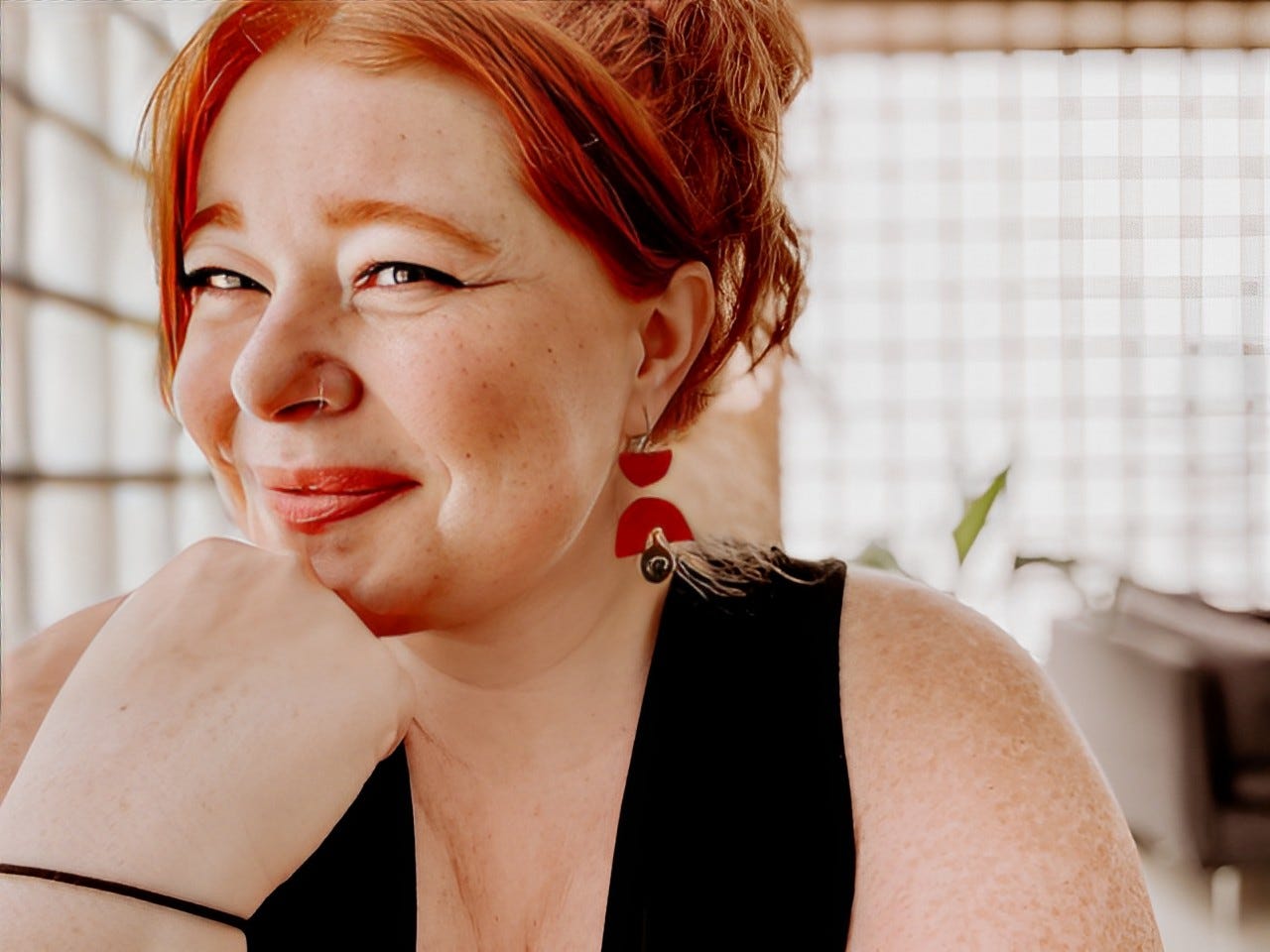
Sarajane Case is a trained enneagram teacher, author of The Honest Enneagram and The Enneagram Letters, and host of the Enneagram & Coffee Podcast. Her work is here to support people in finding their perfect balance between self-care and growth so they can release shame on their path to doing less harm.
Thank you so much for doing this with us! Before we dig in, our readers would like to get to know you a bit. Can you tell us a bit about how you grew up?
I grew up moving around a lot. My mom remarried multiple times and we were in and out of different houses. We were very poor often living in trailer parks. One home I remember the bathtub was falling through the floor. I also grew up having a lot of fun. I was often playing in the woods and learning early on how to rely on myself and how to make the most out of what we were given.
You are currently leading an initiative that is helping to promote mental wellness. Can you tell us a bit more specifically about what you are trying to address?
I work with a tool called the enneagram. It shows us the pressure we are carrying to be a certain kind of person. Some people carry the pressure to be successful while others carry the pressure to be strong or easy to get along with. It’s broken up into nine types—each carry their own fears, motivations, and worldviews.
I do this work because I see so clearly that we overwork as people just to get by in the world. It’s so easy to get caught up in constantly fixing ourselves. But I hope that through the enneagram we can learn to release these expectations and be more of who we truly are.
Can you tell us the backstory about what inspired you to originally feel passionate about this cause?
I found the enneagram when I was working with business owners to prevent and recover from burnout. We would work on all of their behaviors. We’d set up a calendar system, we’d streamline their workdays, and we’d set boundaries or talk about time management. When I found the enneagram and started to use it in my work, we were able to go much deeper and make much more lasting change. Instead of trying to fix their systems, we were able to get into why they were doing what they were doing and what was driving them to burnout. In that process, I fell in love with the system as a whole. It’s a brilliant map for our growth journeys.
Many of us have ideas, dreams, and passions, but never manifest them. They don't get up and just do it. But you did. Was there an “Aha Moment” that made you decide that you were actually going to step up and do it? What was that final trigger?
Getting up and doing it for me was really about claiming a space. I’d researched the enneagram for a while before I ever spoke about it publicly. It got to a point where it was all I wanted to talk about in my personal life. I was clearly so passionate about it that a friend encouraged me to start talking about it specifically. I took the leap and grew a following more rapidly than I could have ever anticipated. It felt like I stepped into a calling, and everything fell into place.
Can you share the most interesting story that happened to you since you began leading your company or organization?
For me, it was serving on a panel with enneagram teachers who have been working in their field for over 30 years. I was sharing my expertise alongside the people whose books I read when I first found this system. It was a moment of stepping into confidence and trusting that all of my research and trainings were paying off.
None of us can be successful without some help along the way. Did you have mentors or cheerleaders who helped you to succeed? Can you tell us a story about their influence?
My friend Tyler is the one who told me to start talking about the enneagram. He has a vision for this passion of mine that I didn’t even have for myself. Additionally, my husband who stood by me when I doubted myself, listened to me read every single word of my latest book out loud to him and has breathed belief back into my bones every day of our lives together.
According to Mental Health America's report, over 44 million Americans have a mental health condition. Yet there's still a stigma about mental illness. Can you share a few reasons you think this is so?
I truly believe that our society is obsessed with the idea of a human ideal. That at some point we will reach a destination where we have chiseled away at ourselves enough to be worthy. This manifests in a lot of ways. For some, it shows up as constant self-improvement and incessant tinkering and fixing. For others, it shows up as hiding the parts of themselves that they don’t see as valuable. My hope is that we step into true self-love that isn’t so conditional. That we recognize that love isn’t unconditional if it’s only reserved for the parts of us that we think are worthy of them.
When we struggle to love our complexity—we struggle to love the complexity in others. This can lead us to want to hide or fix or solve the part of us that may struggle with mental health issues because they’re not so easily tied up in a bow.
In your experience, what should a) individuals b) society, and c) the government do to better support people suffering from mental illness?
I believe individuals should learn to offer themselves compassion in their own imperfection, which will then allow more space for others to be different than they think they’re “supposed” to be. Offering yourself patience creates more patience in others. Additionally, ask the people in your life how they’re doing and if they want support. Be willing to sit with them without fixing the problem.
As far as society—we grow in community. We need other people. Currently, we are so quick to cast people out to claim ourselves as good and others are bad. I hope for everyone’s sake that we can find a place of inviting people in instead of casting people out.
The government has the largest responsibility here in my opinion. I wish for them to prioritize workers’ rights. Not just their right to not work themselves to death but the right to mentally thrive. The right to not just get by but to experience peace of mind when it comes to their wages. They can provide healthcare including mental health care. They can offer response teams that are led by social workers and not police. They can offer childcare for those in need. There are so many countries doing this right now, and their happiness rates are off the charts. We have so far to go in terms of truly caring for the people who live in our country.
What are your 5 strategies you use to promote your own well-being and mental wellness? Can you please give a story or example for each?
Journaling
I’ve been journaling since I was nine years old. I have nearly every single day of my life written about or reflected on. This has been my greatest tool for processing my thoughts and feelings. I ask myself questions, explore my feelings, and express my concerns. I am someone with racing thoughts and ideas and having a place to clear my mind at the beginning of the day has helped me to grow but also to manage stress and prioritize my time creatively.
Yoga
I started yoga around the time I left my religion. I remember being in one of my first few classes and the teacher said, “thank yourself for being here.” This is something I’d never done before. I’d never thanked myself for anything. I realized in that moment how much my religion was built on the idea that I was bad, and that I needed to be fixed. That was close to 12 years ago and now I thank myself for something every day if not every hour. Yoga has also taught me the power of breath, how to sit with discomfort and how to honor my limitations.
Mediation
Meditation has offered me the space between my thoughts, feelings, and reactions. As someone with a significant amount of childhood trauma, I am often quick to think, feel, and react. Moving from a trigger into a rapid response before I can think about how that will impact myself or others. Meditation slows that process down allowing me to become an observer. Seeing the trigger and my response from the outside and choosing how I’d like to show up instead of just reacting.
Somatic
I am someone who struggled to really know how I felt or to honor my negative emotions. This was a great coping skill when I needed it. However, as I got older it became a bit of a hindrance to my growth. I would leave relationships or jobs too early because they didn’t feel good in a moment. I would chase new exciting experiences hoping to feel good all the time. When I finally started to allow myself to feel, I found it easier to do so when I focused on where my feelings lived in my body. Through doing this I was able to not only identify and name what I was feeling but I was able to allow my feelings to be there without trying to fix them.
The enneagram
Learning my enneagram type offered me the clarity of what my strengths are but also how those same strengths when overused or used at the wrong time or in an unhelpful way weren’t always serving me. I learned how much of my personality was built in order to run away from pain and guarantee my freedom. Through studying the enneagram, I was able to bring in tools like meditation, mindfulness, and somatics to be a more grounded and committed individual.
What are your favorite books, podcasts, or resources that inspire you to be a mental health champion?
I love the book The Artist’s Way by Julia Cameron as well as The Body Keeps the Score by Bessel A van der Kolk and The Desire Map by Danielle LaPorte. We Can Do Hard Things with Glennon Doyle is my favorite podcast right now.
If you could tell other people one thing about why they should consider making a positive impact on our environment or society, like you, what would you tell them?
Why not try? More good in the world is always a good thing. When you approach your work as an act of service you can let all of the trappings of what we think it’s supposed to look like go and just focus on serving the next person who could benefit from what you have to offer.
How can our readers follow you online?
Follow me on Instagram @sarajanecase
I podcast five days a week at The Enneagram & Coffee podcast
And my latest book, The Enneagram Letters, is out at theenneagramletters.com
This was very meaningful, thank you so much. We wish you only continued success on your great work!
Thank you!