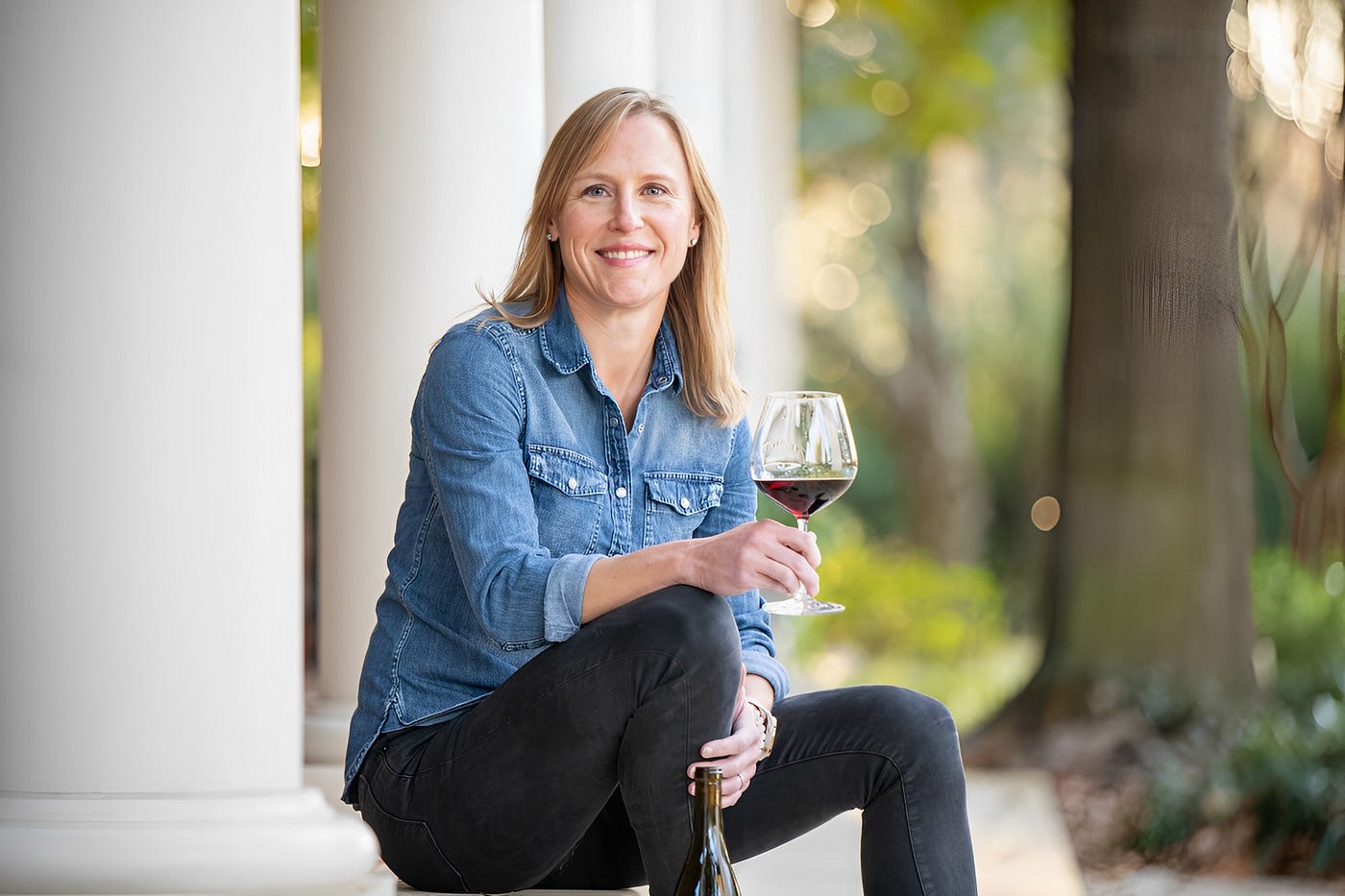
I knew that if I really wanted to make the standard matter, I had to pull the wine from the collection and suffer whatever consequences came with that decision.
SARAH SHADONIX BIO:
Founder, CEO, and Head Wine Taster of Scout & Cellar, Sarah Shadonix, began her career as a litigator. After discovering the hundreds of additives permitted for use in wine production, she knew something had to change. She left her almost decade-long career to pursue her passion for wine full-time. In just four years, she launched Scout & Cellar by sourcing and producing an entire collection of brands and organizing an internal infrastructure overseeing more than 17,000 independent consultants. Shadonix earned her Advanced Certificate from the Wines & Spirit Education Trust and became a Certified Specialist of Wine. Using this knowledge, she developed a soil-to-sip process that culminates in a commitment to grow grapes without toxic pesticides and make wine without artificial processing aids and ingredients. This process was given a name: the Clean-Crafted Commitment®, which is the standard to which every Scout & Cellar product is upheld. In February 2022, Shadonix led Scout & Cellar to double down on its Clean-Crafted Commitment® and make waves in the wine industry by adding ingredient labels to its bottles and providing Soil-to-Sip Reports™ for every wine it makes. In 2022, Shadonix’ leadership and innovation earned Scout & Cellar a Stevie Award in the Achievement of Sustainability, and inclusion in the Inc. 5000 honorees for company growth. Sarah Shadonix has been called many things: wife, mother, mentor, and music nerd, but she’s added visionary, trailblazer, and rule-breaker to that list by changing the way people experience wine.
AUTHORITY MAGAZINE INTERVIEW QUESTIONS:
Less than 20% of winemakers and distillers are women. Traditionally, women were excluded from these industries. This number is slowly rising as more women choose to study this profession and enter the wine and spirits fields. What is it like for those women who work in this male dominated industry? What are some of the challenges that these women face? Is there hope for better representation, and better wages, for women in the wine and spirits industry?
Thank you so much for doing this with us! Before we dive in, our readers would love to get to know you a bit. Can you tell us a bit about your origin story, and your childhood?
My dad grew up on a farm in Iowa and wanted that life for his family. However, when I was young, we lived in the city because he worked as an attorney in Dallas. When I was eleven years old, he and my mom picked us up and moved us out to the country to a little farm. There, we raised cows and donkeys. We had a garden and a water well. Our neighbors were coyotes, bobcats, barn cats, catfish, grasshoppers, and other wildlife on the land. We spent time fixing fences, trimming trees, mowing pastures, and baling hay. This way of life engaged our curiosity, our sense of discovery, and instilled in us the value of solving problems. It also taught us that if we take care of the land, it will take care of us.
Can you tell us the “backstory” about what brought you to the wine and spirits industry?
I didn’t start my career in the wine industry, but I got here as fast as I could. I’m a recovering attorney and spent my first eight years following law school practicing in a traditional law firm environment. After my second child (a daughter) was born, I decided it was time to pursue my passion -- which was in wine.
My first job in the wine industry was a sales position at an e-commerce wine company based in Sonoma, California. I was responsible for sourcing and working with wineries to position their products for sale online.
I learned so much in this role. Most notably (as it relates to what I’m doing now), I learned about the business of wine, the commercialization of wine from soil-to-sip, and the impact that commercialization has on the flavor of wine.
I discovered that my favorite wines – those that inspired me – were not commercialized. I could literally feel the difference when I drank them because they tasted real and fresh, like the difference between a tomato from a farmer’s market and a tomato from a big box grocery store.
I also learned that these wines came with the best stories about the land, the vineyard, the grower, and the winemaker. Many of whom were families who owned and cared for the land that was giving birth to the grapes used to make these wines.
These treasures, both the wines and the stories behind them, weren’t widely shared or available. They didn’t line the store shelves. The soil-to-sip standard that united them -- no toxic pesticides in the vineyard and no chemical additives or added sugar in production – didn’t exist under a unifying brand, so I created it in what became our Clean-Crafted Commitment®.
Can you share the most interesting story that happened to you since you began leading your company?
Can you tell us what lesson you learned from that?
At Scout & Cellar’s launch, our initial collection included eight wines. The Clean-Crafted testing results for one of those wines – a Chardonnay and a pillar wine of the collection – came back with a teeny, tiny bit of insecticide residue. At this time, the Clean-Crafted Commitment was just an idea, so I faced one of my very first defining moments as it relates to building the integrity of that standard.
I knew that if I really wanted to make the standard matter, I had to pull the wine from the collection and suffer whatever consequences came with that decision. That’s what I did, and it fortified the foundation upon which we built our Clean-Crafted Commitment.
The rest of the story is that we sold out of wine in two weeks, and we learned very quickly how to source new wine with lightning speed!
It has been said that sometimes our mistakes can be our greatest teachers.
Can you share a story about the funniest mistake you made when you were first starting?
We launched Scout & Cellar in August 2017, and the company took off in a way I never could have expected. From day one, it was a sprint to keep up with the demand and growth. Before we knew it, the 2018 summer shipping season was upon us, and we didn’t have the 6 months of runway to design eco-friendly shipping materials to protect the wine from the heat.
We had two choices: continue shipping in pulp and risk damage to the wine, or ship in Styrofoam and protect the product. We are a product-first company, so we chose the foam.
A few weeks into the summer shipping season, I received a package in the mail. It was a four-bottle Scout & Cellar branded shipping box. Inside the box was the Styrofoam we had included in the original shipment and a note from the customer that said, “I am returning your packaging because as a new consumer/customer, I thought your ‘clean crafted’ could go further...Choose better so I can continue to choose you!”
She was right. We immediately began planning for the 2019 summer shipping season and Scout Safe Ship - our proprietary strategy for summer shipping designed to protect the product through sustainable shipping methods – was born. Since then, we have doubled down on our commitment to sustainability, setting a goal to be carbon neutral by 2028.
Can you tell us what lesson you learned from that?
Mistakes are nature's reminder to learn and do better. Through this experience, I learned that our Clean-Crafted Commitment should go beyond how grapes are grown and how wine is made. The Clean-Crafted Commitment means sustainability from soil-to-sip -- literally in the vineyard, the cellar, in the product, its packaging, and how we ultimately deliver it to your doorstep.
None of us are able to achieve success without some help along the way. Is there a particular person who you are grateful towards who helped get you to where you are? Can you share a story?
In 2004, while we were still in law school, my husband and I went on a backpacking trip in Europe. This was the kind of trip where you save money by eating apples and peanut butter sandwiches to fill your stomach and camp in a tent at night.
The last night, we treated ourselves and ate at a "fancy" restaurant in Paris - a brasserie. There was a table tent that recommended a village wine from Languedoc in France. It was Syrah-based red blend from Val Joanis. After experiencing where we were and where we’d been, it was the most magical bottle we’d ever opened.
When we returned to the United States, I wanted to recreate that experience. However, this wine was impossible to find. The only place I could find the wine was, remarkably, at a wine shop in Dallas (where we lived at the time). I called the shop, and a woman answered the phone. I asked about the wine, and she said she had it. I said, “I can't believe you have that wine!” She replied (in a sassy tone), “I can't believe you know that wine!”
Unbeknownst to me at the time, this was the beginning of one of the most impactful relationships of my life with Francois and Anne Chandou, owners of this wine shop. Francois is from Bordeaux and started the wine shop in the 1970s. As our relationship with Francois and Anne grew, Francois began to mentor me on a journey that lasted more than five years and inspired me to start Scout & Cellar. We remain very close friends today – they are like family.
You are a successful business leader. Which three-character traits do you think were most instrumental to your success? Can you please share a story or example for each?
Resilience: To be successful, you can’t quit. Instead, you must find a way no matter.
Communication and Vision Casting: As a leader, it’s critical to repeatedly explain where you’re going and why you’re going there so you can inspire excitement and get people on the bus with you.
Curiosity and learning: You must always be asking the tough questions – what, why, how, why not? And you must be committed to learning. Read. Reflect. Admit failure. Learn from it…and don’t repeat mistakes.
Are you working on any new or exciting projects now? How do you think that will help people?
In 2023, we are fortifying our position on sustainability as it relates to our Clean-Crafted Commitment from soil-to-sip. We’ve put a stake in the ground by declaring a goal to become carbon neutral by 2028. We have embedded this commitment in our Core Values and are in the process of working towards carbon neutral certification.
We have also recently partnered with WineDirect -- the wine industry leader in fulfillment services and a carbon neutral company -- to provide fulfillment services for Scout & Cellar nationwide. The reality is that we can change the world using our purchasing power, and we want to provide consumers with access to delicious products that are made and delivered in a way that will leave our planet better than we found it.
Ok. Thank you for all that. Let's now jump to the main core of our interview. Despite great progress that has been made we still have a lot more work to do to achieve gender parity in this industry. In Napa Valley, the percentage of lead women winemakers or winery owners is about 12%. Overall, men account for about 80% of winemakers and winery owners.
In your opinion or experience, what 3 things can be done by:
individuals
companies and/or
society as a whole to support greater gender parity moving forward?
The alcohol beverage industry has a diversity problem that includes, but also extends beyond gender. We're missing out if we don't have our customers in the boardroom, on our leadership team, and on our marketing team. This makes it hard for us to authentically speak to all of our customers and our prospective customers. It's about not only creating opportunity for workers, but also creating opportunity that does, in fact, unlock opportunity for businesses. That is what we've done with our majority female executive team and field of independent consultants, however, we have a long way to go. We can do so much more to broaden our diversity beyond gender.
You are a “Wine and Spirits Insider.” If you had to advise someone about 5 non-intuitive things one should know to succeed in the wine and spirits industry, what would you say? Can you please give a story or an example for each.
It’s OK to start small. Begin with an idea or position, a hobby or side gig, or a goal. Just start. The most important thing is to start.
Be fiercely curious: ask questions and ask for help. Find someone to be an advisor or serve as a mentor. I’ve learned that people want to help, but they need an invitation.
Walk the aisles: not just alcohol and beverage, but across industries. Look for inspiration in packaging, colors, and words. These are all leading indicators of where we're going and what consumers want.
Observe consumers: in person, on social, and globally. Look for trends and needs (both met and unmet) to discover where you might add value or bridge gaps.
Taste everything! If it's not delicious, it doesn't matter. Also remember – “deliciousness” is subjective, so keep an open mind.
Can you share 3 things that most excite you about the industry?
Innovation - I love what I’m seeing with packaging and products, particularly in the arena of sustainability. Consumers aren’t going to stop buying products to save the planet. That is not a scalable strategy to drive sustainability. It’s up to us, as business owners. How we make and package products can greatly impact our planet in positive ways, and that’s scalable.
Non-alcoholic and alternative alcoholic beverages - It’s our job to solve consumer problems. Through non-alcoholic and alternative alcoholic beverages, we’re doing exactly that, which unlocks a broader audience. This will drive business growth and our ability to impact the world in more ways.
What's old is new - There’s a trend towards celebrating the romance again. That’s what hooked me on the wine industry in the first place, and I’m glad to see it taking hold and driving how companies are engaging consumers.
Can you share 3 things that most concern you about the industry?
If you had the ability to implement 3 ways to reform or improve the industry, what would you suggest?
The regulatory environment - Technology and the internet have permanently changed the way people shop, and I like to meet people where they are. The regulatory environment creates unnecessary obstacles and challenges for people who are trying to do business in this industry in non-traditional ways. I’d love to see freer commerce, regardless of which channel you choose for your business.
The speed of innovation - The wine industry is slow to evolve, but we are getting better. We need to get out of our own way and challenge the status quo every day.
Industrialization of farming - Not just in alcohol and beverage but in food in general, industrialized farming methods damage the soil and contribute to the effects of erosion. It is said that we only have 67 harvests left and that’s deeply concerning. We need to use farming to heal the land, not harm it. I’d like to find opportunity to grow food to nourish people economically in harmony with the earth, not in opposition to it.
Can you please give us your favorite "Life Lesson Quote"? Can you share how that was relevant to you in your life?
“You have nothing to fear from knowing the truth.” No one wants to hear bad news, but we should never avoid it. Instead, we should live outside our comfort zone, lean into the bad news, and learn from it.
Don't surround yourself with people that deliver only good news. There’s no growth there. As Michael Dell said, "One of the greatest fears faced by anyone who succeeds is living in a bubble of good news and hearing just what you want to hear."
Empower people to share their own mistakes by vulnerably and authentically sharing your own. This will create a culture of curiosity, learning, and growth; that is how you will succeed.
You are a person of great influence. If you could inspire a movement that would bring the most amount of good to the greatest amount of people, what would that be? You never know what your idea can trigger. :-)
It’s what we’re doing right now. When I launched Scout & Cellar, our Clean-Crafted Commitment was just an idea. I had no idea how significant it would be, but it took root quickly. It has evolved into a movement championed by our internal team, our field of independent consultants, our grower partners, and our vendors. Our community is one that is passionately impact-driven. I have never been more excited about our business than I am right now. I believe with great confidence that Scout & Cellar’s best years are ahead of us.