I think the overarching big thing I want to drive home is that you should only focus and worry about the things you can control. There are so many external factors and distractions that we as drivers have no control over. I think this applies to all high performance professions from sports to business and everything in between. If you’re worrying about things outside of your control you’re wasting valuable energy.
Pop Culture
Racing Driver Robby Foley On How Athletes Optimize Their Mind & Body For Peak Performance
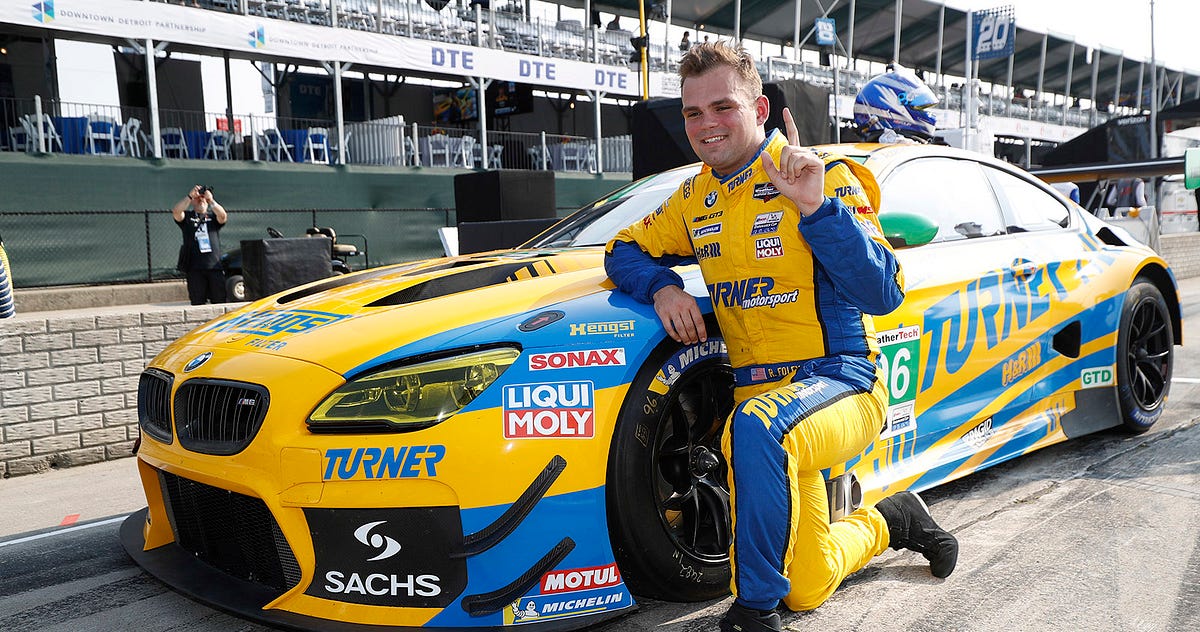
As a part of our series about “How Athletes Optimize Their Mind & Body For Peak Performance”, I had the pleasure of interviewing Robby Foley.
Robby Foley is an American racing driver who currently competes as a BMW factory driver in the IMSA WeatherTech SportsCar Championship, a division under NASCAR. Foley was the IMSA GS Champion in 2023, a GT4 SprintX Champion in 2020, has taken the top 3 spots at Petit Le Mans and held the second podium in IMSA GTD in 2019.
His passion for racing came at a young age when his father was involved with the SCAA (Sports Car Club of America) and competed in autocrossing, an intense form of motorsports. After watching in amazement the precision and speed of cars, he did what any 8-year-old would do; took up go-karting and started competing nationally in the young division of SCAA. Foley was born with the focus and an innate sense of athletic capabilities to accomplish whatever his goals are. At age 12, Robby was toppling at 6-feet and grew out of his go-cart and turned his focus to football and baseball. After a serious injury at age of 14 that left him immobilized, homeschooled, caused serious weight gain and fear that he may never walk again; his future in sports seemed bleak. His spirit was relentless and his resiliency powered through with an aggressive rehab program. Nothing was going to stop him from walking again and pursuing his dream as a racing driver. As a testament to his tenacity, Robby made a deal with his father that when he could apply pressure to his leg and if would be diligent in his academics by accomplishing straight A’s across the board, that he would be allowed to train at the Skip Barber Driving Academy. In 2015, Foley won the 2015 Global MX-5 Cup and was granted a $100,000 scholarship by Mazda leading to a full season campaign with Atlanta Motorsports Group in 2016.
For being under 27 and already accomplishing so much; this emerging talent’s goals are even bigger. Foley anticipates conquering all the major endurance sport car races in the world; by taking home the largest purse at Le Mans 24, Daytona Rolex 24 and Sebring 12; proudly standing at the top of the champagne podium and being considered one of the greats.
In his spare time; he likes to travel, cooks and considers himself a foodie, continues to educate himself in racing, loves technology, especially in watches and of course, cars. Born and raised in Randolph, NJ; he now calls Brickell, Miami home.
Thank you so much for doing this with us! It is a great honor. Our readers would love to learn more about your personal background. Can you tell us the story of how you grew up?
I grew up in Northern New Jersey, spending most of my childhood in Randolph. I went to Randolph public schools and played football and baseball. I was always an athlete, but had a great passion for cars. I grew up middle class in a small town with a younger sister.
What or who inspired you to pursue your career as a high-level professional athlete? We’d love to hear the story.
No one specific person, although I always admired great athletes like Derek Jeter who could outperform other peoples talent and ability with hard work. My main inspiration was a life event that kind of turned my world upside down. The moment that was the catalyst for me to pursue racing again was a leg injury I suffered playing football. I tore my ACL,LCL, PCL, broke my tibia, fibula, ankle and have permanent foot-drop from nerve damage.
This was a tough period in my life being a 14-year-old high school kid. I didn’t walk for over a year, gained over 100 lbs and was homeschooled. After a year, I rehabbed aggressively for about 4 times a week. Once I could put pressure on my leg I made a deal with my dad that if I got straight A’s in school I could go to skip barber racing school. I recovered and drove a race car for the first time in 2011 at Laguna Seca in Monterey, Ca From there I started in their race series
None of us can achieve success without some help along the way. Was there a particular person who you feel gave you the most help or encouragement to be who you are today? Can you share a story about that?
There’s so many. First, my parents who lay the foundation for your life. My parents never pushed me in any direction. I was always self driven, but they supported me in whatever I wanted to do. They were by my side and hugely helpful with my injury. I became my mom’s full time job and without her aid I would have been in a lot of trouble.
Next is someone who’d rather remain nameless, but this person was extremely helpful in getting my true professional career started and besides that was a guise of wisdom for me in my young professional life. I met him and became his racing coach. From day 1 he believed in me and gave me the chance to prove myself in high level equipment. We eventually went on to drive together and have had some great successes including a championship. We have an amazing relationship away from the track and he’s been like a big brother or second father to me.
Lastly would be my current team boss Will Turner. He has supported me through my “rise” and development as a driver. Without his belief and his great team Turner Motosport I wouldn’t have had the resources and home to prove myself. I certainly wouldn’t be a BMW Works Driver without his guidance. Beyond our professional side we have a great relationship as friends. We come from similar backgrounds and often have similar views of things, so we get along great. I’m very lucky to work in such a great environment.
Can you share the funniest or most interesting mistake that occurred to you in the course of your sports career? What lesson or takeaway did you learn from that?
I think the most memorable was my first mistake racing cars. It was in 2016 and I was racing for Mazda. I was leading a race in the rain and it began to dry out and I started to push the car harder. I exited a corner and got on a painted surface which I thought was dry. Turns out it was still wet and very slippery and I lost the car crashing out of the lead. This was tough to swallow and had big implications on the rest of my season. Like in anything, you learn more from your losses than your wins.
I learned a few lessons. One was the simple fact that I shouldn’t hit a wet painted line! Additionally, I learned a lesson in controlling my emotions of wanting to attack and win the race. I needed a big picture approach to take less risk at that moment.
What advice would you give to a young person who aspires to follow in your footsteps and emulate your career?
There is no right path or recipe to make it in car racing. Everyone’s story is different and because there are so many barriers to overcome to get into racing a lot of it is being at the right place at the right time. I truly believe if you want it bad enough you can make it happen, but at the same time you can’t be bitter because this sport is not fair.
Work hard and look at the total big picture. Racing is a business…treat it like one.
What are some of the most interesting or exciting projects you are working on now? How do you think that might help people?
I would say the driver coaching I do. Coaching helped me get opportunities in racing and it’s something I still enjoy doing. In addition to driving professionally, I’m mentoring some drivers at the beginning of their careers.

OK, thank you for all of that. Let’s now shift to the core focus of our interview. As an athlete, you often face high-stakes situations that involve a lot of pressure. Most of us tend to wither in the face of such pressure and stress. Can you share with our readers 3 or 4 strategies that you use to optimize your mind for peak performance before high-pressure, high-stress situations?
I think the overarching big thing I want to drive home is that you should only focus and worry about the things you can control. There are so many external factors and distractions that we as drivers have no control over. I think this applies to all high performance professions from sports to business and everything in between. If you’re worrying about things outside of your control you’re wasting valuable energy.
One of my strategies is routines. For example, before every time I get in the car during a pit stop I think of the same things and do everything the same way. In the kind of racing I do we have driver changes, so I regiment that whole process to perfection. This makes it automatic. The 10,000 hour rule….Another strategy is clearing my mind to just focus on the task at hand. It’s important to blank all other distractions out and building off the previous point routines help with that.
Do you use any special or particular breathing techniques to help optimize yourself?
Nothing crazy too crazy. I will close my eyes, breathe in count to 5, then breathe out counting down from 5. This helps me clear my mind before getting in the car.
Do you have a special technique to develop a strong focus, and clear away distractions?
Simple, just learn to breathe. This really helps in any environment.
How about your body? Can you share a few strategies that you use to optimize your body for peak performance?
Racing is a very physical sport, something many don’t realize. I’ve developed some workouts and fitness baselines that I know I need to hit to perform at my best. In general I don’t use a lot of energy to drive relative to some other drivers, but you still need to be fit to withstand the g force and heat.
I’m also very tall for a driver and the car cockpits are often not designed for people my height. Because of this I sometimes end up with back pain so I have specific workouts to strengthen certain muscles in my back. This helps me stay pain free and at peak performance.
Beyond that it’s important to have a good baseline cardio level and a strong neck. Our body is supported by the seat and belts in the car but we have to hold our head up with a helmet on at up to 5g’s.
These ideas are excellent, but for most of us in order for them to become integrated into our lives and really put them to use, we have to turn them into habits and make them become ‘second nature’. Has this been true in your life? How have habits played a role in your success?
- 100% as stated above I’m very routine and habitual in all aspects.
- To think outside the box I’m even like this when I travel. I have an insane travel schedule and my habits and routines carry me through that. For example everything has a place in my backpack so that when I’m tired and jet lagged in Europe I don’t wonder where my passport is.
- For me habits and routines make things automatic. In racing, driver changes need to be second nature, pulling into your pit box, etc. These things have to be done the same every time to achieve close to perfection.
- My workouts have become habitual and this carries me through days where I’m tired or want a break.
- To an extent I operate like a robot, but it’s helped me immensely
Can you share some of the strategies you have used to turn the ideas above into habits? What is the best way to develop great habits for optimal performance? How can one stop bad habits?
- Simply put the 10,000 hour rule. Practice makes perfect and I’ve always believed that I can achieve by outworking others. I’m not the most naturally gifted, but I’ve worked hard to refine my craft. Away from the track I put a lot of hours in on my racing simulator to stay fresh. I study racing video at nauseum. This is key to outperform people at a high level.
- To maintain these habits you need a no BS approach and you have to be consistent.
- To break bad habits you need to first realize that you’re not going to achieve what you want on your current path. After that point it becomes a lot easier to put in the work and when you can see the results of that work it’s truly gratifying. For me I had to change my lifestyle habits. After my injury I was 300 lbs and that wasn’t gonna cut it if I wanted to be a race driver. Losing 100 lbs was incredibly challenging, but also one of the most rewarding things.
As a high-performance athlete, you likely experience times when things are in a state of Flow. Flow has been described as a pleasurable mental state that occurs when you do something that you are skilled at, that is challenging, that is meaningful, and comes with ease because you have practiced so much. Can you share some ideas from your experience about how we can achieve a mental state of Flow more often in our lives?
- I have an interesting story related to this. At times I achieve what feels like a subconscious state in the car while driving. I would eventually snap out of this and it used to really freak me out. I felt like I was almost waking up and realizing I was in a racecar. I later realized through the guidance of some great mental doctors at Formula Medicine (a group I’m fortunate to work with through BMW) that I was actually achieving an automatic state where I was truly in a flow state. Instead of it freaking me out I then learned to embrace it. This helped me with my peak performance.
- I think to achieve this you have to be so comfortable operating near your body’s maximum that it doesn’t take a lot of mental energy to perform whatever high level task you’re doing. This allows your mind to relax and have room for other things.
Do you have any meditation practices that you use to help you in your life? We’d love to hear about it.
Breathing techniques. A lot of breath work is so important.
What do you do to prevent injuries during your workouts or during your competitions?
Training with caution and experience. I know my body very well post injury. I make sure not to push myself too hard. This has been a key to maintaining good shape and avoiding injuries.
What type of workout regime has helped you to rehabilitate from injury?
Focused strength training. I’ve been lucky to work with some great people who have taught me how to relieve and stop pain. The tough part is convincing yourself that movement heals when feeling pain.
Ok, we are nearly done. You are by all accounts a very successful person. How have you used your success to bring goodness to the world?
I’ve tried to share my experiences with other young drivers. Drivers are way more relatable than what it seems and I’ve tried to share my experiences to younger people to show them that they aren’t crazy for having to deal with certain things.
Can you share your favorite “Life Lesson Quote”? Why does that resonate with you so much?
You get out what you put in, but that isn’t always what you want in a perfect world. Too many people get bogged down by the negativity and lose sight on the big picture. It’s easier said than done, but you have to keep going. You have to get up when you get knocked down and keep going.
We are very blessed that some of the biggest names in Business, VC funding, Sports, and Entertainment read this column. Is there a person in the world, or in the US whom you would love to have a private breakfast or lunch with, and why? He or she might just see this, especially if we both tag them :-)
That’s a tough question, but I really appreciate the underdog stories of people who beat the odds to achieve greatness. Through my injuries and in life I’ve had to overcome obstacles and I’d love to compare stories and learn from a guy like Derek Jeter. I grew up a die hard Yankees fan and was always inspired by his work ethic. Similarly guys like Julian Edelman and Tom Brady both beat the odds to achieve great things. People like them really motivate me to work harder, because ultimately hard work will beat natural ability. There are many other great examples of this, but those three resonate with me through my childhood love of sports.
Thank you so much for joining us. This was very inspirational, and we wish you continued success in your important work.
AM
Written by
Authority Magazine Editorial Staff
Writer & ContributorContributor at Authority Magazine covering leadership, innovation, and industry insights.

Published inAuthority MagazineTop Lessons, Top Authorities · 42K Followers
Exclusive, curated interviews with the leaders and changemakers shaping tomorrow. Leadership lessons, industry deep dives, and executive profiles.
More from Authority Magazine
See all stories →
Y
Yitzi WeinerStar Trek Star Marina Sirtis On Her Childhood, Her Early Career, The Enduring Popularity Of Star Trek, & How Hollywood Has Changed Over Her 46-year Career
Pop Culture1 min read

A
Authority Magazine Editorial StaffAyelet Zurer Talks ‘Daredevil’ Return, Steven Spielberg’s Life-Changing Call and Her Passion for Storytelling
Pop Culture16 min read
A
Authority Magazine Editorial StaffLilah Richcreek Estrada on Skipping Drama School, Trusting the Long Game and Finding Her Moment on ‘A Man on the Inside’
Pop Culture18 min read
A
Authority Magazine Editorial StaffOuter Banks Star J. Anthony Crane on Embracing Failure and the Beautiful Danger of Playing Villains
Pop Culture27 min read