It was when I was in the movie theatre watching “Close Encounters of the Third Kind.” The aliens and the humans were communicating through melody. Five notes. If you’ve seen the movie, you’re probably hearing the melody now.
INTERVIEW QUESTIONS:
As a part of our interview series with leaders, stars, and rising stars in the music industry, we had the distinct pleasure of interviewing (Kyera)
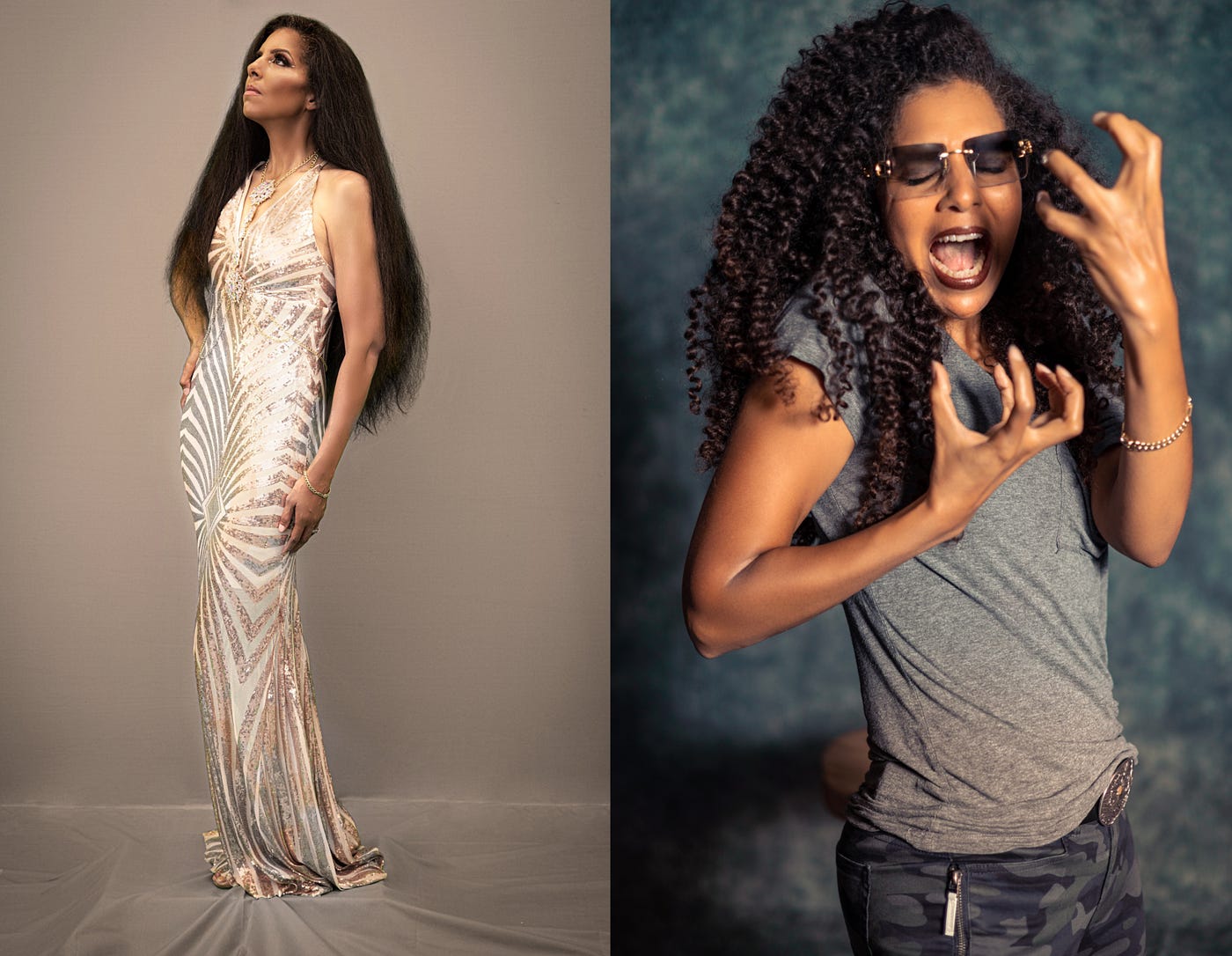
It takes courage to walk away from a hot career as a prime-time TV writer, but that’s exactly what Kyera did to pursue her passion in music. Kyera’s aptitude for songwriting was evident at a young age, however her low, “non-commercial” singing voice did not encourage support from her practical parents. She continued to pursue her love for music as a hobby until the day that she spotted her own truth; this is her life and she’s not living it for anyone else’s approval. So Kyera took a leap of faith to pursue her passion. Her perseverance, “non-commercial” voice and trust in herself landed her in collaborations with Grammy winning producers and artists like the legend, Carlos Santana, who is featured on her rock anthem, appropriately titled, “Passion.” Passion has now been remixed as an Afrobeat song “Passion Amapiano Remix” featuring viral rapper, Goya Menor who’s record breaking song, “Ameno Amapiano Remix” has received 9.7 Billion views. “You want to bomba? You want to chill with the big boys?” Check out www.Kyera.World for everything KYERA.
Thank you so much for joining us in this interview series! Before we dive in, our readers would love to learn a bit about your “origin story”. Can you tell us the story of how you grew up?
I was born and raised in Shaker Heights Ohio, a suburb of Cleveland known for its sprawling mansions. If people know about this area, they immediately assume that I grew up with a silver spoon in my mouth. Well, “across the tracks” there is a definite lower/middle class community; this is the area where I grew up. I was raised in a middle class “practical” family where “You get an ‘A’ in band, but you don’t go and be a musician.” I actually do understand and appreciate my parent’s concern in wanting a safe stable path for me, but it was up to me to recognize and trust my own truth and pursue my dreams despite resistance. I played the clarinet, the bassoon and the piano (more like a toy organ). I taught myself these instruments so I could give a voice to the music I heard in my mind. I started composing and song writing at the age of 7, and from as early as then, I was told I could not sing; I had a bad voice. This didn’t bother me much because I got pleasure out of composing and writing, so, at that time, I figured I’d write for other people… as a hobby.
Can you share a story with us about what brought you to this specific career path?
It was when I was in the movie theatre watching “Close Encounters of the Third Kind.” The aliens and the humans were communicating through melody. Five notes. If you’ve seen the movie, you’re probably hearing the melody now. Not only was I intrigued by music being a common language used in the movie, but the combination of those five notes was able to create an effect on me in the audience; that melody was essential for emotionally telling that story. I immediately went home and drove my parents crazy repeating that melody over and over on a little toy organ I had. I was already musically inclined, but that’s the moment that a decision was made that I’m going to communicate, tell stories, move people emotionally through music.
Can you tell us the most interesting story that happened to you since you began your career?
When I was learning the guitar, I began transitioning from composing instrumentals to writing songs with lyrics. Since I didn’t have a voice like what you hear on the radio (but I could carry a tune) I had uncertainty on presenting myself as “the artist” so, I would go to coffee shops/open mics just to try the songs out. Years later, a fashion designing friend asked me to fill in for a charity fashion show. At first I refused as I had never modeled before and had built a career, comfortably behind the scenes, as a TV writer. But this opportunity caused me to confront the idea of being front and center with all eyes on me. After I agreed, the designer remembered that I was a musician and, one day before rehearsal, asked me to sing her one of my songs. I politely declined and told her that I was not “that kind of an artist.” The fashion designer persisted, she wanted to hear my voice. She created a very safe space for me and I got over my momentary embarrassment. As I sang, her eyes began to glisten. I was creating some kind of effect; either she was going to say, “Please stop,” or she was genuinely moved. When I finished, the tears poured and she emphatically told me that no one should ever sing my songs except me and that I have such a powerful voice. This was extremely confusing to me and I didn’t know what to do with it. She asked me to, not only model in the show, but sing that song as the opening act. Again, that moment of embarrassment came over me, but then the thought occurred to me — the purpose of music is to create an emotional impact and I had done that. Who cares if I don’t sound like Whitney Houston, my song and my voice reached someone on the emotional level. So I agreed. The night of the show, I was so nervous - border line panic attack as this is the biggest crowd I’d ever sang in front of. Once I walked on stage, it took about 10 seconds for me to get comfortable, but when I did, I owned the space; it was my opportunity to shine. When the song ended, I received this roaring standing ovation! Camera flashes flickering. I was like, “Okay, this is what I do!” Then and there I made the decision to be more than a songwriter, but to be the artist as well and deliver all of my communication to an audience. The name of the song is “Perfect.” I had written it for a wedding.
It has been said that our mistakes can be our greatest teachers. Can you share a story about the funniest mistake you made when you were first starting? Can you tell us what lesson you learned from that?
It’s a good thing that I sang “Perfect” FIRST, with a professional guitar player, AFTER I had locked in the decision that “This is what I do.” I was asked to sing two songs for the fashion show. I had not taught the guitar player the second song called “Time” which I had just recently written. So, I’m on the stage performing when all of a sudden….blank. I have NO IDEA what the next line is. I stop. It’s dark so I can’t see any faces. I’m like, “Um…..” I’m trying to run through the lyrics in my head. “Time” is just ticking away. When I finally remember the words, I start over and clumsily stumble through the rest of the song. No standing ovation on that one! But I learned a valuable lesson; whatever I do, be so well practiced that I don’t have to think about it; if it’s not ready, don’t do it. Also, part of the experience of “KYERA” is the intensity of my delivery, the way I move my body. It’s all part of my communication. So outside of coffee houses, I’ll have someone else play the guitar so I can comfortably take my place front and center.
What are some of the most interesting or exciting projects you are working on now?
After the fashion show, I set out to write and produce my next album, rewriting my story from a behind-the-scenes TV Writer to front-and-center recording artist. Years of songwriting, performing and social media posting bared no real fruit, except that of mastering persistence and patience which proved to be quite valuable. Five years later, someone introduced me to a music consultant in the industry who had worked with music royalty. This consultant listened to my album, “Ethereal,” and had a similar reaction as the fashion designer; he was moved by the unique quality in my voice and liked what I wrote about. This lead to collaborations with several grammy winning producers and artists, including Carlos Santana, who is featured on my rock anthem, “Passion." Since then, I’ve had several people attempt to do a remix of “Passion,” but nothing I heard was clicking for me. Then one day I heard this voice on a song; this gruff voice that just grabbed me. And the juxtaposition between his voice and the captivating melody, I was hooked. It was Nigerian rapper Goya Menor’s “Ameno Amapiano Nektune Remix.” After buying it (I still buy artists who I support) and listening to it on replay, I decided to check out who this guy was with no thought in my universe of a collaboration. I had no idea that his song was a viral hit with, at that time, 9.5 Billion views. I made a comment on one of his Instagram posts stating my connection to this song and encouraged anyone reading my comment to support this artist; “Buy it! Stream it!” Goya Menor read my comment and pinned it to the top of his post. This opened the door to our communication. At first it was very light, but when he found out about the artists I’m collaborating with on my upcoming album and heard “Passion,” he loved the song, my voice and Santana’s signature guitar. Our creative energy and respect for each other’s artistry was so high that we soon began collaborating on our new hit "Passion Amapiano KV Remix” and I am part of Goya Menor’s U.S. tour.
We are very interested in diversity in the entertainment industry. Can you share three reasons with our readers about why you think it's important to have diversity represented in music, film, and television? How can that potentially affect our culture?
Education comes in all forms; music, film and television offers the opportunity to learn more about different cultures by making people more real to each other. The less real people are to each other, the more “over there” they are and this opens the door to hate and bigotry. But when realities are shared, it makes people more relatable and, as a world, we can focus on those things that unite us rather than those things that divide us.
An important factor in diversity is making sure that different aspects of a race or culture are represented. As not all white people are alike, not all Black people, Latin or Asian people are alike. There may be a similarity in culture between a race of people, but the culture is not their individual story. An excellent example of this is I just recently watched Wu-Tang: An American Saga. My experience as a Black person living in America is an entirely different experience than the young men who made-up this exceptional rap group. But within this story, even though the culture was shared among this particular group, their individual stories are so different. After seeing who they were and what each of them came through, it’s more difficult for someone to make a “people” in a particular group the same. This should be obvious, as people are people and we all have our different stories; but too often I’ve experienced people stereotype a whole race or culture based on one representation.
Diversity isn’t achieved by having “token minorities” to fulfill a quota. Now this is better than “no representation” but when this happens, it can feel like nothing really occurred; no forward progress. An opportunity was there to really give texture and depth, but if the person in charge is not thinking like that, and just trying to get a “brown skin” to hit a quota, then it feels superficial. It starts with the consciousness and awareness of the person in charge to really take advantage of the opportunity of diversity. It doesn’t have to be deep or have a huge message - the person just needs to be seen for who they are; not as a statistic.
What are your "5 things I wish someone told me when I first started" and why? Please share a story or example for each.
Beware of people who harp on this idea of “You don’t trust me.” That doesn’t mean that any time someone says something about TRUST that it’s an alarm, but someone who is continuously badgering you because they feel you don’t trust them — I would be very weary of that person. They usually are up to no good and are trying to hide that from you by guilting you into believing that you did something wrong by questioning something that they did that was suspect to you. You should never have a problem communicating your ideas or what’s going on with you and not have someone turn it around and be angry and accuse you of not trusting them. This leads me to number 2.
Show me. Don’t tell me. I picked this up when I was a television writer; we can get all caught up in the exposition of telling the audience what they should be seeing or feeling instead of showing them. Same thing with an artist, who is dealing with people who are promising them X,Y and Z. Show me. Don’t tell me. Just do it. You don’t have to explain and go into all these details of what you’re going to do. Tell me what I need to know and then present it. Some people like to be “the savior” - they like the feeling of saying, “I can make that happen.” I was working on a project and I needed a particular kind of help. So this guy strapped on his superhero cape and was letting me know that he can handle it, all the people he knows and assuring me he can get that done with no problem — I don’t have to worry about it. Of course I lit up and fed the flame of gratitude and appreciation. There’s like this adrenaline rush when you feel someone is really happy about what you’ve said. That feeds them. But, this person wasn’t as connected as he claimed. I kept being strung along day after day after day and the person was never able to deliver. This is happened several times with several different people; it took more than once for me to learn this. This leads me to number 3.
Keep your mouth shut. When someone says they can do something for you, keep it to yourself. Go along with your business. Handle the things that you’re doing. Don’t go and tell other people everything that you’re doing. Especially if you don’t have the product in front of you because then, if it doesn’t come through, you’re wasting time and energy explaining the “reason” it fell through. But also, your energy is very valuable. Keeping things to yourself is powerful. You don’t need approval. You don’t need others saying, “Oh my gosh, that’s so cool!” You know it’s cool. Just know what you know, keep it moving and keep producing. You don’t have to tell anyone anything until it’s time to tell them.
You have to learn to wear your own CEO hat. You are the executive of you. We love being the artist, we love being the creative and that’s amazing. But we need to look at ourselves a corporation. You need to give yourself orders as the CEO, whether they’re creative or administrative, and you need to be a really good employee and follow through and deliver the product that you (CEO) is asking for. It’s actually very powerful when you can differentiate the different hats that you wear as an artist and when you’re wearing THAT hat, you just do THAT thing. You’re not doing 5 other hats at the same time. When you’re being your PR, you’re being your PR. When you’re being your Executive, you’re being your Executive. When you’re being your Artist, you’re being your Artist. It puts a lot of order into my life. It makes things easier to manage.
I flow power to those who I know will contribute to creating a better world with their power.
Which tips would you recommend to your colleagues in your industry to help them to thrive and not “burn out”?
As artist we perform a lot of repetitive actions, and if you have the mindset that you’re doing the same thing over and over, or playing the same song over and over, it’s easy to feel burnt out. But when I deliver each practice or performance in its own NEW unit of time, it’s a different mindset than just repeating the same song over and over. I am more present, authentic and interested in what I am doing.
You are a person of enormous influence. If you could inspire a movement that would bring the most amount of good to the most amount of people, what would that be? You never know what your idea can trigger. :-)
I have a virtual book club that meets weekly addressing personal ethics, integrity and self respect. It covers things such as taking care of yourself (diet and hygiene), being industrious, and treating others they way you’d like to be treated. This book club has changed the lives of many people as some of these basics are not being taught or addressed in life and sometimes it’s just good reminders. People get to share experiences and give examples; it’s very therapeutic. It takes about 3 months to get through the book meeting via zoom once a week for about 2 hour. There are also films that go with each chapter that we watch together. Currently I’ve been getting about 5 people through the book at a time. But I’d like to have it as big as 100 people and each week, 5 people are pre-selected to discuss that week’s chapters. I believe that the issues we are facing on this planet stem from the core basics of lack of self-respect and understanding what responsibility means as it relates to yourself, other people and the environment. When we depend on ourselves to create our own happiness and not put our fate into the hands of others, we begin to make better, saner decisions. Elevate the awareness of people and things like war, crime and drugs no longer become the solution. And stop binge watching/reading the news!
None of us are able to achieve success without some help along the way. Is there a particular person who you are grateful towards who helped get you to where you are? Can you share a story about that?
One day I was reading my emails and I got a message from a classmate from high school. We weren’t friends or not friends, just someone I knew. This classmate was reaching out, because a friend of hers, living in Asia, had turned her on to this artist named Kye the Artist on SoundCloud. My classmate didn’t pay attention to the picture of the artist, but loved the song, “Dragon Slayer,” and had it playing on a loop. Eventually she got curious to what this artist looked like. She looked at the picture and thought, “That looks like Kyera!” But who she knew me to be in high school did not align with the presence and vibe of Kye the Artist. So in this e-mail, she explains the story of how she came across Kye the Artist and asks if this was me. Obviously it was! It was an incredible feeling to learn that my music was creating desired effects in different areas of the world. This classmate and I both happened to be in the LA area at the time. In her eyes, I was a superstar and all the world should know my name. Even though she is not involved in the music industry, she’s very competent and can handle administrative cycles. So she became my consultant and helped me to properly get that album, “Ethereal,” copyrighted, on the proper streaming platforms and assisted in creating my website. Her belief in me and the effect that my music created on her helped me to take things to the next level of my career. This is the album that opened to the door to all the projects I’m currently working on. You never know who’s listening to your music or the effects you’re creating, so never stop creating.
Can you please give us your favorite "Life Lesson Quote"? Can you share how that was relevant to you in your life? “Greatness is not measured by what a man or woman accomplishes, but by the opposition he or she has overcome to reach his goals.” - Dorothy Height
Sometimes people try to live their life running from problems, they want no problems. But problems aren’t bad when they are the expected course of expansion and you are able to overcome them and not “become” the problem. Every goal you want to achieve, you are going to have problems. Handling problems is what helps us grow, sharpens our thinking. If things have just been handed to you, without having to handle any problems, then you need to find a bigger or different game.
Is there a person in the world, or in the US whom you would love to have a private breakfast or lunch with, and why? He or she might just see this, especially if we tag them. :-)
If I were to have lunch with someone it would be Beyonce. I would be interested in two areas. 1. What policies you had to put in place to achieve and maintain the level of success you have achieved. What circumstances happened that caused you to put those policies in place based on trial and error of people, family, money, employees, schedule, rehearsal, food, etc. 2. Not just anyone, no matter how talented, can have the status of international superstar. What are the actions that you’ve taken that align with that magnitude of power? There are lots of constructive and productive actions out there, but that doesn’t mean they are the correct actions to attain power and stability. So what have been to most constructive actions for yourself?
How can our readers follow you online?
Instagram, Facebook & Twitter @kyeraworld
Website KYERA.world
This was very meaningful, thank you so much! We wish you continued success!