My parents had the same values but different political views so it was a real lesson in respectful debate.
As a part of this series, we had the pleasure of interviewing Paige Mazzoni.
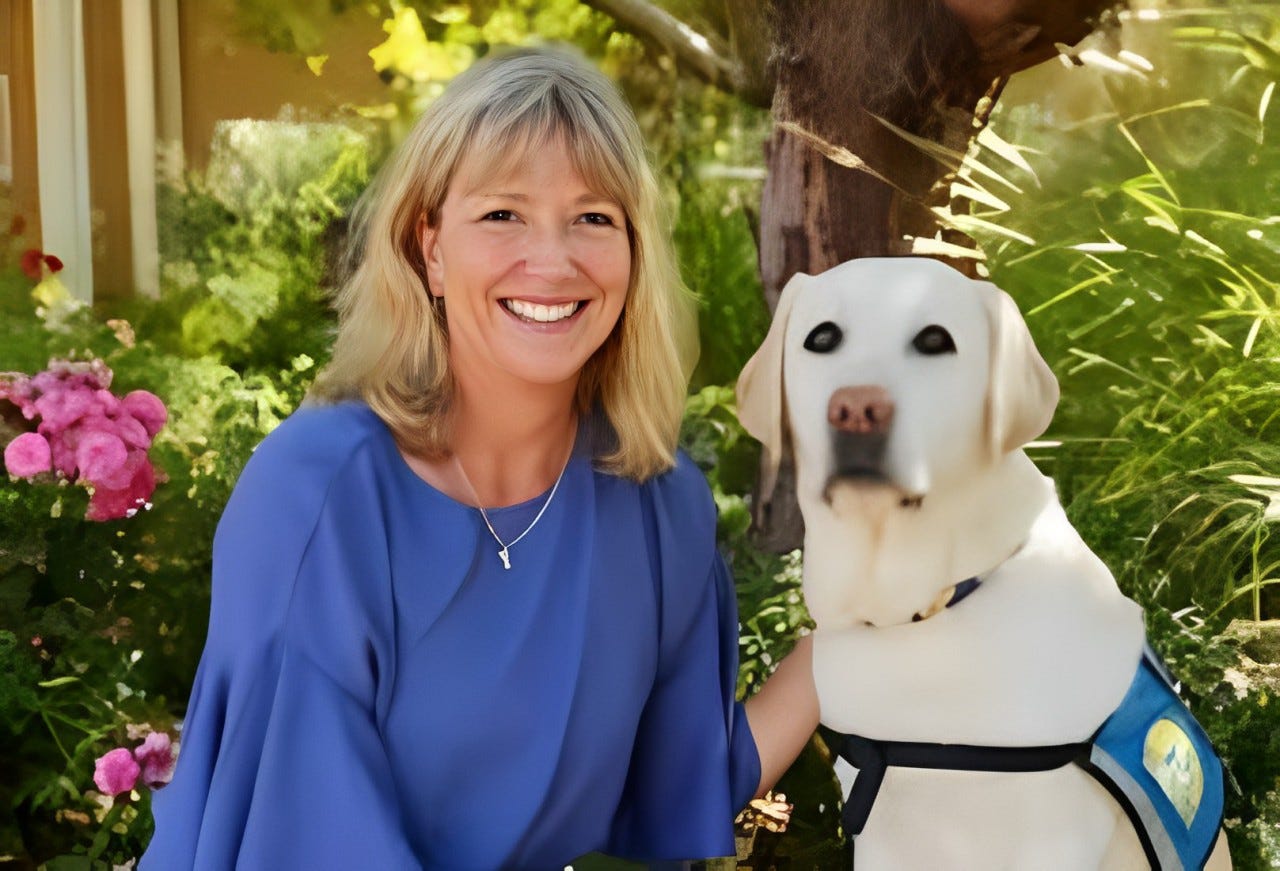
Paige Mazzoni joined Canine Companions as CEO in 2018, bringing 25 years of experience in both for-profit and non-profit sectors to the oldest service dog organization in the country.
Previously, she was the chief marketing officer at VIP Petcare and held management roles at Oracle, Sybase, Fair Isaac and the Nelson Family of Companies. Paige has served on several non-profit fundraising boards, including the Buck Cardinal Board at Stanford University.
Thank you so much for joining us. Before we dive in deep, our readers would love to learn about your personal origin story. Can you share with us, the story of your childhood and how you grew up?
I was born and raised in Healdsburg, a small town in Northern California. It is quite a tourist mecca today because it’s in the middle of the wine country. When I grew up it was rural. My family are ranchers and vintners on one side, going back five generations and San Francisco Irish on the other, going back four generations. Needless to say, I grew up with a lot of family and in a tight knit community. I didn’t go a day in my community without seeing a cousin or relative. My father was an attorney and my mother a teacher turned full time mom. They both had high expectations of their kids. Growing up we ate dinner together every night and talked about everything — politics, religion, culture, television, civil rights. My parents had the same values but different political views so it was a real lesson in respectful debate. Growing up in an agricultural family definitely affected my outlook on life quite a bit. For example ranchers can lose it all in a bad weather year. This builds resilience and gives you a strong understanding of your place in the universe.
Can you share with us a story of how you decided to follow your particular career path and eventually led you to your position at Canine Companions?
I started my career in tech — in people, product and service roles which included everything from recruiting, organizing conferences and events, to product management to roles in management, strategy and marketing. I think because I was never quite satisfied I’d found my perfect job I moved around to find my niche. I was always the person doing the special projects or re-evaluating and redefining business processes. After working for several large companies, I moved from the Bay Area back to Sonoma CA when I had a family. At that point I worked at a number of startups, mainly in marketing, product management, partnerships and strategy. Again, my roles morphed as new needs appeared at the company. It was also during this time that I got more involved in volunteering and was on a number of on nonprofit boards. This was the work that fed my soul while I was working hard at my career. Eventually I ended up as the CMO at a mobile vet clinic company. I was hired to help package the company for a sale or to go public. When it sold, I got a stock payment which gave me the ability to fund my kids’ college educations. At that point I had been a single mom for about 14 years and I was finally in a position to find my “soul job” — which is what I called it. I always envisioned being able to use my career experience to help a non-profit organization. This is how I got to Canine Companions®.
There are many interesting parts to your career. Can you share the most memorable or interesting story that happened since you began your career?
One of my most unique career experiences happened when I was at Sybase and running their international user conferences. These were large events for that time — hosting about 6000 people with a multimillion-dollar budget. I had negotiated a contract with the City of Dallas to hold our event in their new convention center but they soon decided they wanted to break the contract for a better offer. Our public company was going through a difficult period and the alternative space they wanted us to take would have signaled to the public the erroneous message that the company was running out of money. We took them to court and I was the lead. Picture a 5’3” 27-year-old in a convention center, arms crossed and standing in front of a forklift. I didn’t move as it came closer and kept saying “You have to stop. According to the settlement time is up.” It was an incredible learning experience — and we won!
Do you have a favorite life lesson quote, and can you share an example of how it has been relevant in your life?
“The purpose of life is to contribute in some way to making things better.” Bobby Kennedy. Ralph Waldo Emerson also has a quote similar to this which I included it in my high school valedictorian speech. It has always been a bit of a North Star for me. “Every day try to do something to help someone or make life better for someone. If you do that, you are never failing.” It helps me keep perspective especially on bad days.
You are a successful leader. Looking introspectively, which three-character traits do you think were most instrumental to your success? Could you share an example or anecdote about each one?
Flexible Creativity — I’m not artistic but I’m good at problem solving and coming up with solutions. I’ve also always been flexible in terms of my roles. If things need to change I try to see it as an opportunity not a problem. I came up with a new pricing model for one of my companies by interviewing customers and finding out what they valued about our offering and what they didn’t. We changed the pricing model based on their replies and increased sales.
Integrity — When you are committed to your values it makes decisions easier. I learned this the hard way early in my career. My boss at a tech company pitted me against a coworker often, to see who was stronger. I was up to the challenge because I thought it was the path to a promotion. One night my coworker came to my office and said, “Paige in the end, you have to be able to look at yourself in the mirror. You have decide how much this is really worth it.” At that moment I realized I had to live by my own values. Thanks to her we decided to work together and to rise together. It made day to day life not only more productive but more enjoyable. I learned a lot about integrity from her.
Listening- You have listen to everyone at every level. There is nothing like a good listening journey. If you ask questions and listen you learn so much about your team. When I started at Canine Companions, I traveled to all of our locations and talked to employees, volunteers, clients and donors from different backgrounds and at different levels of experience. I kept notes and then went through and highlighted common themes. Those themes became a huge part of my strategy for managing the organization.
Leadership often entails making difficult decisions between two good paths. Can you share a story with us about a tough decision you had to make as a leader?
Inclusion and Diversity is a critical pillar of the strategic plan for Canine Companions®. Initially this was one of the areas deemed less critical in terms of timing when I started in 2018. Then the summer of 2020 brought these issues to the forefront and it forced me to rethink our timing. While we are not activists or politically affiliated, I knew it was the time to make inclusion and diversity a top priority. I wanted to ensure there was no unconscious bias driving our decisions or affecting how we treated members or potential members of the Canine Companions® community. I did not have unanimous support from all parts of our community on prioritization or approach, but we have focused on bringing as many people as we can along with us on our journey. I believed and still do, that prioritizing this work is important for the strength and future of our organization.
In your experience, which aspect of running an organization tends to be most underestimated?
People tend to think that once you are a CEO you aren’t dealing with the “little” stuff anymore. To some extent this is true but a level of it still creeps in and sometimes it becomes big stuff. So while you aren’t managing it all, you still must be informed and aware of basically everything to some extent, in order to make good decisions. The sheer volume of what you are dealing with is what I think people underestimate.
Based on your experience, can you share the five things you need to be a highly effective C-suite leader?
Integrity
Listening Skills
Prioritization Skills
Humility
Emotional IQ
In your opinion, what are a few ways that leaders and executives can help create a thriving and fantastic work culture?
I don’t think I have the silver bullet but there are certain elements that I believe are critical in sustaining a thriving work culture — giving people a voice; creating a culture of respect and trust; and fostering relationships between divisions and teams. Something that I think has become quite important post Covid, in the Zoom era, is ensuring there is interaction between teams across departments and geographies. It is critical that people build relationships with their colleagues — whether this means having quarterly offsite gatherings or having teams come into the office together on certain days. Building and nurturing these relationships is something I think leaders have to prioritize in today’s corporate culture.
This is our aspirational question. Paige, because of the great work that you’ve done, you’re a person of enormous influence and people take your words very seriously. If you could spread an idea or inspire a movement that will bring the most amount of good to the most amount of people, what would that be?
I would love to create a movement that would bring civil, informed, respectful discourse to the world. Getting people to listen before speaking so they understand the other party’s perspective before immediately responding– is a rare occurrence today. We’ve lost the ability to have civil conversations with each other. What brings us together despite our differences is the respect we show each other when listening to each other’s opinion.
How can our readers continue to follow your work at Canine Companions online?
They can sign up for our newsletter on our website at canine.org and can also follow our news on social media @canineorg.
Thank you so much for the time you spent with this interview. We wish you continued success and good health!