The arts were important to them, and even though we didn’t have much money growing up, what we did have was spent going to museums and the opera.
I had the pleasure to talk with Miriam Shor. Actress and director Miriam Shor was born in Minneapolis, Minnesota and grew up splitting her time between Detroit, Michigan and Italy, where her academic parents were teaching and studying. She is fluent in Italian, having first lived in Venice, and then Torino.
Her interest in theatre began after she attended her first opera at the age of two-years old in Venice. Shor performed in plays throughout high school and honed her craft at the University of Michigan where she was one of the first students to receive a B.F.A in Theater. Shor also earned a B.A in English. Upon graduation, Shor moved to New York City to pursue a career in the theatre.
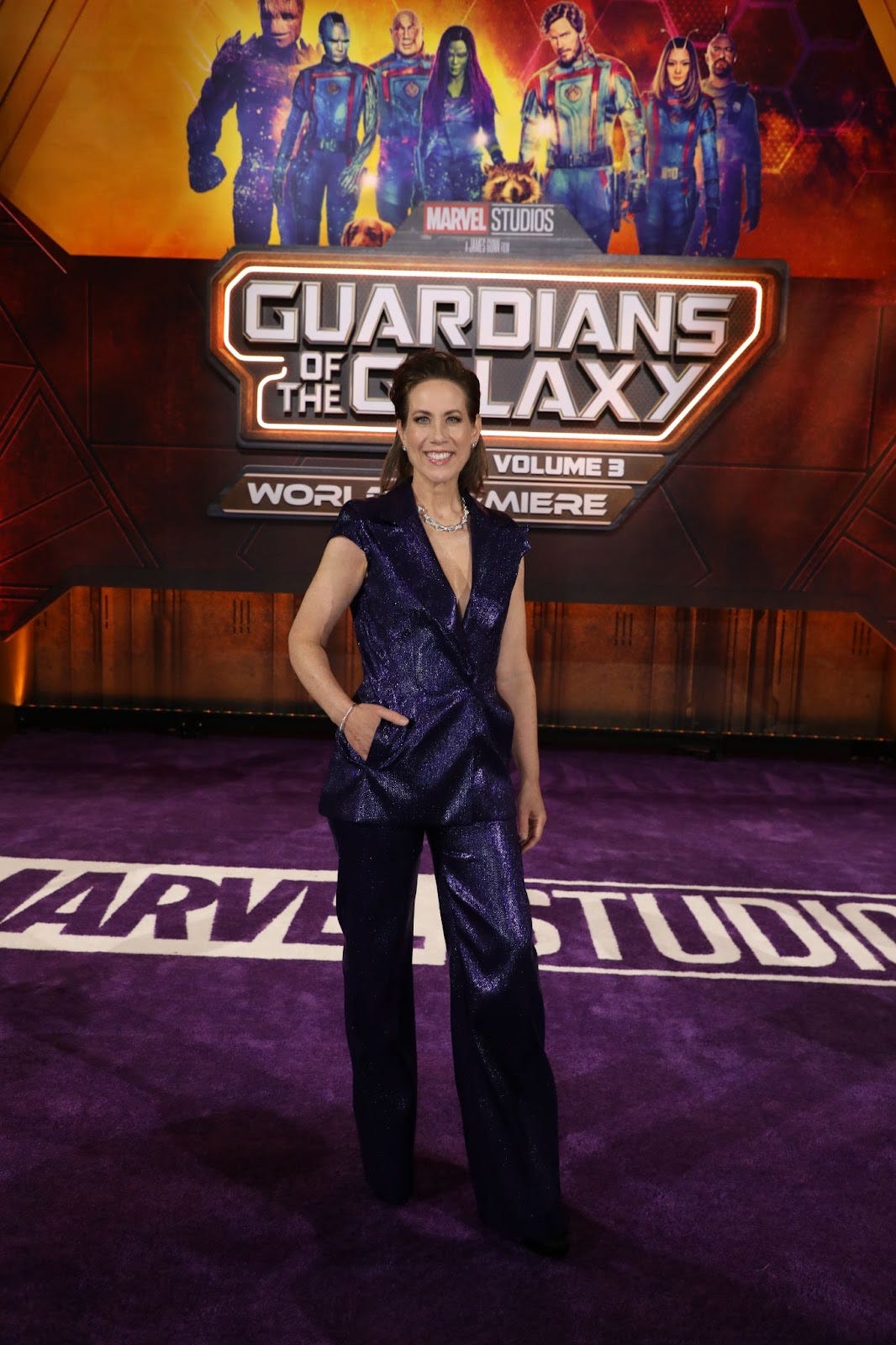
Shor currently stars opposite Chris Pratt and Chukwudi Iwuji as the character Recorder Vim, one of the High Evolutionary’s most trusted henchwomen, in Marvel’s GUARDIANS OF THE GALAXY VOLUME 3. Later this year, Shor will star opposite Bradley Cooper and Carey Mulligan in Netflix’s MAESTRO. She will portray actor and model Cynthia O’Neal, a friend of Leonard Bernstein and his wife Felicia Montealegre. Additionally, she recently completed production on Cord Jefferson’s untitled feature film alongside Jeffrey Wright, which will be released by United Artists Releasing.
In 2020, Shor starred in the post-apocalyptic Netflix drama THE MIDNIGHT SKY opposite Kyle Chandler and directed by George Clooney. She also starred in the Netflix feature film LOST GIRLS with Amy Ryan and Thomasin McKenzie. Directed by two-time Oscar nominee Liz Garbus, the film is based on the book Lost Girls: An Unsolved American Mystery by Robert Kolker and depicts the harrowing true story of a mother searching for her missing daughter on Long Island.
Shor is well known for her starring role as “Diana Trout” in the hit TV Land/Paramount+ series YOUNGER from “Sex and the City” creator Darren Star, for which she earned a 2018 Critics Choice Award nomination for “Best Supporting Actress in a Comedy Series.” Shor made her directorial debut on the series. In 2018, Shor starred in the final season of FX’s THE AMERICANS, and earned a SAG Award nomination alongside the ensemble cast for her critically acclaimed performance as “Erica Haskard,” a bedridden cancer patient and wife of a nuclear arms negotiator.
In the early 1990s, Shor landed a variety of roles in several off-Broadway productions. Most notably was John Cameron Mitchell’s rock musical “Hedwig and the Angry Inch,” where Shor originated the role of “Yitzhak” and subsequently starred in Mitchell’s critically acclaimed 2001 film adaptation. Shor also lent her voice to the film’s GRAMMY-nominated soundtrack and received an “Outfest Screen Idol” Award for her iconic performance in this bona fide cult classic.
Shor’s film credits include John Cameron Mitchell’s SHORTBUS, Mary Stuart Masterson’s drama CAKE EATERS and the Harold Ramis-directed comedy BEDAZZLED. She has starred in television series such as ABC’s 2012 comedy GCB alongside Kristin Chenoweth and Annie Potts; SWINGTOWN (CBS); BIG DAY (ABC) with Wendie Malick; INSIDE SCHWARTZ (NBC) and THEN CAME YOU (ABC). Shor’s numerous television credits include recurring roles on THE GOOD WIFE (CBS); DAMAGES (FX) and the HBO miniseries MILDRED PIERCE. Guest star credits include MRS. AMERICA (FX), HIGH MAINTENANCE (HBO), BROAD CITY (Comedy Central), JESSICA JONES (Netflix), BORED TO DEATH (HBO) and THE WEST WING (NBC), among others.
Having gone back to her theatre roots many times, Shor has worked with a range of renowned artists such as Stephen Sondheim, Terrence McNally and Lanford Wilson as well as many emerging playwrights and directors. In 2016, Shor co-starred in the Public Theater’s “extraordinarily moving drama” (The New York Times) “Sweat” by Pulitzer Prize-winning playwright Lynn Nottage, which received a Tony nomination for “Best Play.”
Shor currently lives with her husband and two daughters in Manhattan. She loves to travel, but having established her status as a true New Yorker, detests driving.
Yitzi Weiner: Miriam, thank you so much for joining us. It’s a delight to meet you. Our readers would love to learn about your origin story. Can you share with us the story of your childhood and how you grew up?
Miriam Shor: Well, it’s kind of interesting actually. I was born in Minneapolis, Minnesota. However, when I was about a year old, my mother, father, older sister, and I moved to Venice, Italy. My dad received a Fulbright to teach at the academia there, which was an exciting move for my young parents who had never been to Italy before. Reflecting on it as a parent now, it seems like such a bold, fabulous move.
We spent a couple of years in Venice. My first memories, those early experiences of taking my first steps and realizing my individuality, all happened there. I initially learned Italian and Venetian along with English, though I only retain my Italian now. Venetian, an interesting dialect given Venice’s history as a port city, has sadly slipped away from me.
Our next move was to Detroit, after which my parents got divorced. My mom, who had become an honorary Italian, returned to Italy while maintaining joint custody of my sister and me. We alternated between living one year in Italy and one year in Detroit. When my mom moved back to Italy, we lived in Torino until I graduated from high school. It was quite a unique experience, to say the least.
Yitzi Weiner: That’s amazing. So, what brought you to the career path as an actress?
Miriam Shor: You know, it’s so interesting. The arts were always something my parents loved. My grandfather sold furniture in Pittsburgh but was also a lifelong jazz musician who played the upright bass. My mom occasionally performed, loved to sing opera, and even had this good morning Detroit TV show, which was super 70s in a small black box studio. I was always surrounded by creative people. My dad was a professor, my mom taught and was in education, eventually becoming the headmistress of various international schools around the world.
The arts were important to them, and even though we didn’t have much money growing up, what we did have was spent going to museums and the opera. In Italy, attending the opera was more accessible and not seen as elitist or reserved for the wealthy. Listening to music, engaging with art, and experiencing performances were very much a part of my life.
What really sparked my interest in acting was watching my sister perform in her high school musical, “Hello, Dolly!” It was transformative. My older sister means so much to me, and seeing someone you know and love perform can be a tremendous, formative experience. I didn’t know you could make a living doing it, but I went to college, studied acting, and eventually, someone paid me to do it. A couple of decades later, I’m still doing it.
Yitzi Weiner: You must have had a lot of fascinating experiences. Can you share with our readers one or two of the most interesting or humorous stories from your storied career?
Miriam Shor: Well, doing the show and movie “Hedwig and the Angry Inch,” which was a seminal theater piece and, in my opinion, a seminal film, gave me the opportunity to meet people I idolized as a teenager. I was in a capacity where they were coming to see me perform, which were incredible moments.
I remember hanging out with Lou Reed in our little dressing room off-Broadway. In the show, I played a man named Yitzhak, and sometimes people didn’t realize I was a woman until the end. I asked Lou Reed if he thought I was a man when he watched the show, and he held my hand, looked into my eyes and said, “Well, you know, you looked like a man, but your eyes said woman.” I had no idea what that meant, but it was Lou Reed, and he was holding my hand. At that moment, Laurie Anderson was standing next to us, another person I idolized. Those experiences of interfacing with people who mean so much to you as artists are quite something.
Another story involves my audition for Twyla Tharp. I had to sing and dance for her, and though I love to dance, I’m not a dancer. So there I was in her apartment, with the lead male dancer from the American Ballet Theatre, and she was choreographing in French. It was a giant failure in so many ways, but the whole time I was thinking, “This is insane, and I can’t wait to tell this story.” I mean, I might not survive this moment because it’s so awful, but if I do, it’s going to be a great story. I kind of live for moments like that, where I can step outside of the situation and see the humor in it.
Yitzi Weiner: So, what happened at the end of that story? Did you get the part?
Miriam Shor: Oh no, not at all. The hilarity of the situation was infusing my entire body, and we weren’t on the same track. Bear in mind, I had a great deal of respect for Twyla Tharp, which is why I was there in the first place. I really shouldn’t have been dancing, I mean, that space deserved someone who actually knew how to do it. I would’ve done the choreography if I could, but I couldn’t, which was the point.
Yitzi Weiner: Was there a person who made a profound impact on your life? And if so, could you please share a story about that person?
Miriam Shor: There are so many people who have impacted my life. I believe that our connections to people define who we are. They make up the web of support as we walk through the world and the more connections we create, the more supported we are. My family has always been incredibly supportive and loving. If I’m a performer, then they’re my first audience. They never made me feel like what I was doing was pointless or worthless. They always made me feel like there was worth to it, not to the point of being uncritical, but in a way that encouraged thoughtfulness about what I do. I walk through the world knowing I’m loved and supported, and I understand that’s not a small thing. It’s something that truly matters.
Yitzi Weiner: That’s beautiful. Let’s pretend for a moment that you are the queen of Hollywood. What changes are you happy about seeing over the past decade or so in the industry? And what changes would you want to implement moving forward?
Miriam Shor: Certainly, society always changes, ebbs and flows, and Hollywood is a reflection of that. Hollywood holds a mirror up to people, even though that mirror can be distorted at times.
I think we’re currently recalibrating the stories that we tell and who gets to tell those stories. It’s not about dictating who can or can’t narrate, but more about giving as many people as possible the chance to share their stories. The backlash against the diversity we’ve been pursuing implies that by affording another person the opportunity, we’re taking it away from someone else. However, that’s not how I see it. Every story we’ve withheld or suppressed, we’ve robbed ourselves of. Each story we get to hear enriches all of us who listen.
I’m delighted about the inclusion that’s happening. I’ve heard terms like “over-correction,” but I believe such terms stem from fear. Hollywood can be a fearful place, marked by desperation and a scramble for what seems like one or two brass rings, while the rest of us grovel. It’s very hierarchical, but it’s a false hierarchy.
Those at the top have many reasons to try to maintain this illusion because it’s comfortable up there. Mel Brooks said it best: “It’s good to be the king.” However, I don’t believe in that hierarchy; I believe collaboration is an intriguing way to create.
I appreciate the inclusion and the different, new stories we’re seeing. We still have a long way to go, and I think we need to change the way we discuss diversity. There also needs to be more equity in the hierarchical pay structure in Hollywood, which we’re currently seeing as writers go on strike.
This issue is true in all societies, not just Hollywood. We need to ensure that all creators are paid fairly and receive a living wage.
Yitzi Weiner: Okay, let’s shift our focus to your work. You have an impressive portfolio. Could you share with our readers what you’re currently working on and what you hope to release in the near future?
Miriam Shor: Absolutely. The most recent movie I’ve been involved with is a Marvel production, “Guardians of the Galaxy Vol. 3.” I think it’s the project my kids are most excited about that I’ve ever been a part of. To be fair, I’m also really thrilled about it. I’ve always been a huge fan of this genre. It was a significant part of my childhood and sparked my interest in storytelling. To be a part of it now is personally exhilarating, and the fact that my kids love it too is really great. It’s truly the first thing I’ve done that they’ve been remotely impressed by.
A lot of people love this film. PETA even labeled it as one of the best anti-animal cruelty films they’ve seen, and I have to agree. That’s a project I’m really proud of, and it’s out now.
I also worked with Bradley Cooper, who voices Rocket in those movies, on a film he made called “Maestro.” I play a small part in it, but it was an extraordinary experience. Additionally, I worked on a movie with Cord Jefferson and Jeffrey Wright. Cord Jefferson wrote and directed it, and Jeffrey Wright starred in it. I’m really excited about it.
In this era, where all actors are like double agents — we keep so many secrets — it’s challenging to disclose everything I’ve been working on. There are projects I’m thrilled about but can’t yet discuss.
On top of that, I’ve ventured into co-directing and producing a documentary, which is a new avenue for me. Although I’ve been at it for a couple of years, it’s still a learning experience and a fascinating way to tell stories. I’m gaining a lot from it, and it’s proving to be a remarkable journey.
Yitzi Weiner: That’s great. You mentioned Guardians of the Galaxy earlier. What do you think it is about this particular series that has captivated people’s hearts and minds?
Miriam Shor: I believe it all starts with James Gunn, who is the director and writer of the Guardians series. He genuinely understands and loves the genre, which isn’t always the case. I think it’s the theme of feeling like a misfit, being accepted for who you are, and finding a family that resonates with people. The notion that this acceptance and sense of belonging is your true superpower is incredibly powerful.
James knows how to write with heart and humor that truly speaks to people because he’s genuinely invested in the emotional truth of it all. He’s intelligent and funny, and he approaches his work with a wonderful sense of play. I mean this in the best possible way, not in a childish manner, but in the sense that he remembers the profound feelings he had sitting in that dark theater as a child, being inspired by what he saw on the screen.
That genuine love and enthusiasm shine through in the films. The cast genuinely cares for each other, and they’re so welcoming and loving. I think audiences can sense that, and it’s part of the reason they enjoy the movies so much. Everyone’s having a fantastic time.
Yitzi Weiner: How do you compare and contrast your personal character, Miriam, with the character you play in Guardians of the Galaxy? How are you similar and how are you different?
Miriam Shor: We’re quite different, to be honest. For one, I have hair, and she doesn’t. She’s bluish, and I’m not, although on a cold day my skin can turn a bit bluish. Jokes aside, I’m a nerd at heart and love all things sci-fi and fantasy. I’m the type to deep dive into my roles, which I find fun and important. I approach each role with seriousness, regardless of the context.
The character I play is a zealous follower, committed to creating a perfect species alongside the leader she devoutly follows. She sees herself as emotionally detached and a scientist, willing to follow her leader off a cliff, so to speak. She does experience a crisis moment, which is fascinating to portray.
While this might seem like a far-off, fantastical situation, it’s not only relevant to a galaxy far, far away. It’s a question for our history books and our current events. Why do people follow leaders with bad intentions? What happens when they realize they’ve made the wrong choice? I’m both outraged and fascinated by this phenomenon, and I think it’s something we all need to examine.
Yitzi Weiner: Perhaps it’s obvious, but I think it’s helpful to articulate it. What would you say are the lessons society can take from Guardians of the Galaxy?
Miriam Shor: What can we take away? The series really explores the idea of a higher life form and who gets to determine that. That’s one of the main questions it poses. There’s also a deep questioning of one’s purpose: what were you made for, and do you have to stick to that? Can you change your thinking about who you are and what you were meant for? Can you decide why you’re here?
These are some profound questions. We can talk about it being a Marvel movie or a kids’ movie, but I think where superhero sci-fi, science-fantasy movies and comics excel is in their willingness to tackle big questions. They’re not afraid to confront these questions head-on while also delivering entertainment.
This movie does just that. On the surface, it’s an incredible spectacle. I saw it in 3D and it was one of the most extraordinary things I’ve ever seen. It’s fun, and you’re going to have a great time. But it also poses these questions. I cried when I watched it, and I wasn’t the only one. There were grown men weeping around me. It is profound. If you allow yourself to go on that journey, you’ll realize that’s what great stories are for.
Yitzi Weiner: If someone approached you to be their mentor, and asked, what are the five things they would need to make it in the entertainment industry, what would you answer?
Miriam Shor:
- To make it in this industry, first of all, I’d advise you to be thoughtful and careful about how you define success. If you define it in a narrow way or allow it to be defined for you by someone else, you’re setting yourself up for deep disappointment. You need to consider what success means to you and what would make you a happy and whole person. This is a lifelong lesson, and it’s a hard one.
- Secondly, continue to learn, ask questions, and be curious about the entire creative process. If you want to be a creative person or artist, don’t just stay in your lane. If stories matter to you as a storyteller, learn how the entirety of the story is made. Life is short, so learn as much as you can. Don’t let fear stop you from exploring new things.
- Thirdly, don’t forget to enjoy yourself. Ambition can be blinding and if you’re always looking forward, you’ll never appreciate where you are. You need to stop, take in the moment, be grateful and really experience it, whether it’s good or bad.
- Fourthly, don’t try to conform to someone else’s idea of what you should be. It doesn’t serve you. The energy you put into this is better spent investigating who you really are. Success comes from being fully yourself. Even though we receive a lot of messages saying the opposite, my experience is that the things that are unique, quirky and hard to pigeonhole are what have led me to success.
- Lastly, try to document what you’re going through. Think of yourself as a reporter on your own life. This helps you to take stock, learn and enrich any experience you have. I often find myself wishing I’d journaled more. It would’ve provided a fuller understanding of my journey.
Yitzi Weiner: Miriam, you’re a person of enormous influence. Given the platform you’ve built and the work you do, you have considerable sway. If you could spread an idea or inspire a movement that would bring the most good to the most people, what would that be?
Miriam Shor: I think the notion that we function better collaboratively is something we need to appreciate more. We seem to be in love with the idea of a singular genius. It’s an easier concept to grasp than that of a collective. However, the truth is, we are a collective. We have to learn to work in that way, and in fact, we do work this way every day. I like the idea of emphasizing and appreciating our collective nature a bit more.
Yitzi Weiner: This is our final question. We call it our ‘matchmaker’ question. Is there a person in the world, or the US, with whom you’d like to have a power lunch, or a coffee, or a beer? We could tag them, and perhaps we could connect you.
Miriam Shor: I tend to freeze in moments like this. I was once approached by a guy who owns an ice cream company I love, being a huge ice cream lover myself. When he invited me to come up with a flavor, I froze. It was too much.
In this industry, there are so many people I’d love to meet. One of the great joys of what I do is getting to connect with people who have influenced me. Names like Olivia Coleman come to mind. I don’t know what meeting her would do, other than giving me a chance to tell her how much I admire her work. She’s an actor who brings to her roles what I truly want to see from storytellers. There’s none of the Hollywood nonsense. When I see someone so talented who isn’t being forced into conformity, it makes me feel hopeful about our industry.
I feel like she would be a great person to have a good time with. So, a somewhat fan-girl answer, but there you have it.
Yitzi Weiner: It would be exciting if you two could work together.
Miriam Shor: As someone who has branched out from just acting into directing, storytelling, creating, and producing, I’m realizing that I don’t have to wait for someone to tap me on the shoulder. Collaborating with someone as extraordinary as Olivia would be fantastic.
Yitzi Weiner: I can’t wait to see it happen. Even if she doesn’t respond, it’ll be out there permanently in ink and might somehow trickle down.
Miriam Shor: At the very least, as a performer, it’s always lovely to hear that your work profoundly affects people. I’m one more person that she’s done that for.
Yitzi Weiner: How can our readers best continue to follow your work and support you online?
Miriam Shor: I have to admit that I’m not on any social media. It’s not a judgment on people who are because there are incredible things being done through social media. However, there are caveats to consider, especially if you have kids. We understand on a deeper level now that this is something to handle with great care. So, hopefully, people will just find the work I’m doing and engage with it in a way that speaks to them. That’s part of the cultural conversation we have between creators and those who enjoy their work.
Yitzi Weiner: It’s been so delightful to speak with you. I wish you more success and blessings and hope we can do this again next time you have another exciting project.
Miriam Shor: It was so lovely to meet you.
Yitzi Weiner: Thank you so much, Miriam. All the best.