When Angel came on, she came to me and said, 'I really like this, and if I just mix and master it as-is, it would be great.
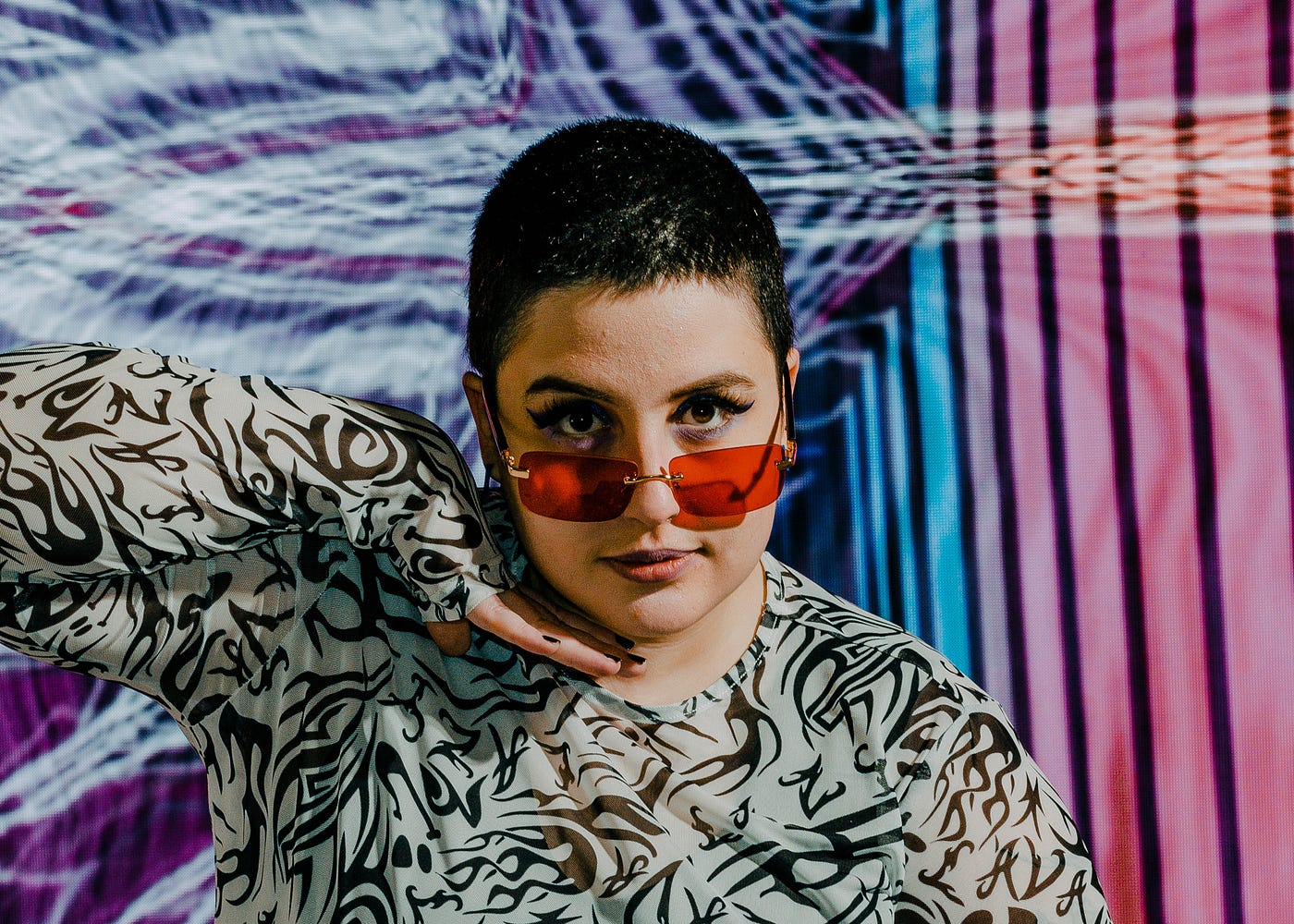
We had the pleasure of interviewing Liz Lehman. The Scary Jokes is the solo project of Pennsylvania-based queer musician, activist and visual artist Liz Lehman. Like their band name, Lehman’s music hits an oxymoronic tone, with ethereal synths innocently backing deeply personal, often dark lyrics. Scary Jokes explores the dark side of dreamy bedroom pop, with a sound more befitting descriptors like hallucinogenic, surrealist and nightmare pop.
For Scary Jokes’ latest album, Retinal Bloom, Lehman reinvents their sound while maintaining their idiosyncratic edge. Inspired by artists such as Kate Bush and Brian Eno, Lehman sought the warmth of equipment that was new to them — analog synths.
“I really love the sound of vintage synthesizers,” Lehman says. “It’s hard to get that character if you’re not using hardware synths. I especially like ’80s art-pop albums, like Kate Bush, so I was interested in exploring sounds like that.”
In another departure from their prior work, Lehman often chose to express the depths of their emotions via animal-like screams and wails, with the lyrics exploring themes like intrusive thoughts, human cruelty, cults (including the cult of personality), and a willingness to protect your loved ones at all costs.
Lehman’s songwriting process is primal and instinctual. To create Retinal Bloom, they experimented with their Elektron Model:Cycles synth, drum machine and sequencer, sculpting sounds in their home studio, eventually combining the best beats and improvising animalistic vocal sounds over them.
“The Elektron Model:Cycles has this great kind of crushed sound,” Lehman says. “The synths on it — you can obviously use the presets or do your own thing, but they have a very spooky quality to them. So I really enjoyed playing with that.”
Once Lehman had established a sound for each song, they fleshed out the lyrics. In this case, the subject matter was largely influenced by the overwhelming global effects of the pandemic, the oppression of LGBTQ+ people, women and people of color, and the protective rage that burns within as a response.
“I would say that, personally — and also on a global scale — it’s been a rough few years. I had a lot of feelings that I felt like I needed to express about isolation — not just pandemic stuff, but frustration with how other people can be, both on a personal and a systemic level. In the past few years, I’ve become very defensive over people I care about, just because unfair things happen all the time. Sometimes things are so sad and frustrating, and all you want to do is protect the people around you. And that’s where I was coming from, big time, with this album — almost this feral protectiveness over people.”
Retinal Bloom’s opening track and lead single “Our Murderous Descent” was initially inspired by the terrifying awe Lehman experienced in the presence of a massive, powerful waterfall, which became a metaphor for living in a hostile environment and forming a community in the face of crushing oppression.
“There’s this big waterfall where I live now that’s kind of a tourist attraction,” they say, “and I started off that song with the idea of writing about the intrusive thought you have when you’re by a huge waterfall where you’re just like, ‘What if I stood under that?’ It’s so powerful. So I was writing about it from that concept. But then I started working in the feelings I was talking about before, about feeling like you’re in a hostile environment with a bunch of people, clearly all under the same circumstances, and what can you do but be there for each other?”
Pulsing, frenetic and urgent, “Uzumaki” delves into having recurring, nostalgic dreams about people with whom you’ve had a falling out, badly wanting things to be okay as they are in the dream (and were in the past), but then waking to the bleak realization that the friendship is gone. “When I have dreams like that,” Lehman says, “all the context for why we’re not friends anymore is inaccessible in that moment. “But as soon as you wake up and have some clarity, everything comes rushing to the forefront of your brain. I often get frustrated by the senselessness of making an enemy. I don’t want to have enemies; I want to be friends with everyone. ‘Uzumaki’ is about those feelings being at odds with each other.”
The song “Riptide” draws from the story behind the Diablo Cody-penned film Jennifer’s Body, as well as the exploitation star Megan Fox has experienced in her acting career. “I thought it would be kind of fun to write a song about Jennifer’s Body,” Lehman says. “So I included some references to the movie, but I also got caught up in how frustrated I was for Megan Fox during the release of the movie, and also throughout her whole career — how much abuse she’s faced, and how she’s been taken advantage of. So I channeled that same feeling of frustration into the song.”
“Elephant Foot” provides another clever metaphor. In the song, the Elephant Foot — a mass of nuclear waste leftover from the meltdown at Chernobyl — stands in for Lehman’s complicated feelings about fame. As The Scary Jokes gain notoriety, Lehman faces ever more vitriol from people reacting to them as if some frightening, untouchable thing. In turn, their desire to be left alone grows, as do the parallels to the song’s titular radioactive formation.
While the analog synths Lehman used for Retinal Bloom allowed for a greater depth of control than the sonic tools they employed on previous albums, and while their songwriting method is solitary, they didn’t make the album alone. Lehman worked closely with musician and producer Angel Marcloid (aka Fire-Toolz), who remixed and remastered The Scary Jokes’ 2016 debut, April Fools. Marcloid polished Lehman’s existing material, artfully adding guitar, drums, and distortion to fill in every aural corner and redefine the sound of the album. Marcloid and Lehman’s common vision for Retinal Bloom led to a truly collaborative effort.
“When Angel came on, she came to me and said, ‘I really like this, and if I just mix and master it as-is, it would be great.’ But she’s so good, and I really wanted her to have a good amount of creative freedom on it too. So she contributed some guitar, some really cool drums and distortion. She filled in every bit of empty space in the album that existed — just filled up every single corner of it. And that was really, really cool. It defined the sound of the album in a really exciting way.
“It’s interesting because I think — even though we have a lot of the same influences — we make very different kinds of music. But with Retinal Bloom we were on the same page with every single decision. So it was really cool for it to be that easy and inspiring and fun to work with her. I thought it was cool that we had such a similar goal in mind for the album.”
Thank you so much for joining us in this interview series! Before we dive in, our readers would love to learn a bit about your “origin story.” Can you tell us the story of how you grew up?
Thank you for having me! I would say I had a pretty normal upbringing, but I was definitely a strange kid. I think most other kids didn’t quite know what to do with me, and I ended up being a target for a lot of bullies, which made me pretty shy. But I did find my niches here and there — I really immersed myself in visual art and performing, as a means of communicating and demonstrating to people what was really going on inside my head. Whether or not that actually worked at the time is anybody’s guess, but I do think it was the best way I could’ve dealt with my less-than-ideal public school experiences. Nurturing those interests so intensely back then sowed seeds that have grown far past that part of my life, and it resulted in what, so far, has been a very rewarding lifelong endeavor.
Can you share a story with us about what brought you to this specific career path?
The very first time I considered that art might be the answer was when I was in first grade and Pokémon was very new and very, very popular. I was drawing Pikachu at my desk, and my classmates were freaking out because it looked “just like the real Pikachu.” I think it probably did not look just like the real Pikachu, but the response definitely lit something up in my brain, and I’ve been craving that kind of positive attention ever since.
Can you tell us the most interesting story that happened to you since you began your career?
So, this actually happened during my music career, though it’s not directly related to it. I was in my early 20s and still feeling out what I wanted to do long term. I’d been working on [my 2016 album] April Fools for a few months and it was nearing completion, but at the same time I was on the board of this new theatre company that was formed by a few of my college classmates. Specifically, it was immersive theatre, which was popularized by the show Sleep No More in NYC. The performance takes place in a multi-room space that the audience walks through, and various scenes unfold throughout the different rooms. You can go to these things with a group of friends, and everyone can come out of it with a totally different experience. It’s pretty neat. We had just done a show at the Morris-Jumel mansion, which is an absolutely beautiful historic building, and that itself was a very unique experience. We quickly found out that people really enjoy getting wasted at these things, and one of my jobs throughout the evening was preventing drunk twentysomethings from stumbling into a 5 million dollar painting, or some such disaster. It was a lot of fun, honestly. I composed the “soundscape” of the play, which was comprised of mostly uneasy ambient music, and I’d have to run from room to room and covertly select each song to play on a hidden bluetooth speaker. I’d start each night with an armful of the cast and crew’s phones, each of which would each have their own track loaded up on it. It was a bit low tech but I loved that about it; I did a lot of directing in college, and it was always so much fun figuring out how to make things work on a limited budget and with very few hands. Anyway, that’s not even really the crazy part. Being based in NYC, we did a lot of schmoozing and got a lot of interest all at once, often from people with a lot of money and influence. The production caught the attention of some very wealthy and powerful Russian entertainment moguls, and they wanted to bring the production to Russia. What I’ll say about it is that interacting with people on that echelon of success is very surreal, and it was kind of what led me to decide that sort of world isn’t really for me. I’m quiet but surprisingly headstrong and I don’t think that gelled with them too well, but it was a really exciting and fascinating time and I’m thankful for the experience. Also the adaptation became one of the biggest productions in Russia during its run, so it was cool to be a small part of that. It would be cool to be a musical collaborator on a project like that in the future. Though I might have to sit out the “talking to billionaires” element next time.
It has been said that sometimes our mistakes can be our greatest teachers. Can you share a story about the funniest mistake you made when you were first starting? Can you tell us what lesson you learned from that?
I’ve honestly already made countless mistakes, some funnier than others. I can tell you I’ve never been a “tech” person — the whole audio engineering / production end of music has always been my least favorite part because it doesn’t come even slightly naturally to me. I’m very very thankful for [my producer] Angel Marcloid of Fire-Toolz and the talent and expertise she brought to my upcoming release, Retinal Bloom. As far as funny screw-ups go, the one that’s coming to mind happened during that aforementioned theatre production. I was using a ton of different personal devices to make the ambient soundscape work. There was this very intense one-on-one scene between a priest and an audience member that took place each night. That room was set to have just a couple tracks playing on a loop the entire night so I didn’t have to sneak in there and change the track. Little did I know that the person whose laptop we were using unintentionally added an additional track to the playlist I was using, and in the middle of this super intense scene, Justin Bieber’s “What Do You Mean?” started playing at about 8 million decibels. The show was a period piece so this was not really ideal, but I was told that the audience member was apparently into it. I was very embarrassed though.
None of us are able to achieve success without some help along the way. Is there a particular person who you are grateful towards who helped get you to where you are? Can you share a story about that?
There are so many people! It’s really hard to choose. I think something that really helped early on was sharing my works-in-progress with my friends. My lifelong best friend Amy and I would get together all the time when I was working on my second album, April Fools. I would come over and play whatever iteration of the album existed that week, and we’d sit and talk and she’d share her thoughts, and it was so fun and encouraging. We’re both creative people and we’ve always loved sharing our projects and ideas, and having someone to share my progress with at every step gave me so much confidence. It’s a period in my life that I’m really nostalgic for.
Can you please give us your favorite “Life Lesson Quote”? Can you share how that was relevant to you in your life?
“Honor thy mistake as a hidden intention.” This quote from Brian Eno is constantly relevant to my life as an artist, because it’s impossible to make something flawless. I’d go as far as to say that’s actually somewhat undesirable at this point. I’m sure everyone is tired of hearing this, but we are coming into an age where machines are learning faster and faster how to create convincing images and even music. Someday, possibly someday soon, their output could be something one would consider “perfect”. And I think in response to this, we might enjoy a rise in popularity of “imperfect” art, stuff like folk or outsider art. I’ve always loved that sort of thing, and I think it’s becoming increasingly apparent to people where its appeal lies. In a way, flaws in our work reveal more about us than the parts that are added with careful intention and curation. They’re also as unique as a fingerprint. Arguably, imperfection is the most interesting and rich element in a piece of art. As hard as I work to make something good and as much thought as I put into that process, I don’t know if I believe anyone truly has a flawless grip on their own process and output. That’s why analysis exists. People have qualities and thoughts that they themselves are ignorant of… I can’t tell you how many times someone has read into my work and discovered something I didn’t have the specific, conscious idea to include, but is absolutely aligned with how I feel about the piece, and which is sometimes actually inextricably linked to the themes and emotions that I did add intentionally. It’s so tempting to lie and be like, “Yes, I’m totally a master at what I do and everything I make is the way it is on purpose.” But I think it’s way more fun and interesting to have people discover things about you and your work that you yourself weren’t even aware of. It’s one of the ways that art is a great tool for communicating and connecting with other people.
What are some of the most interesting or exciting projects you are working on now?
I finished my latest album quite a while ago, but the rollout has been a big project in and of itself. This album had a bunch of music videos made for it, some of which I had a lot of creative input on, and I think that’s been my favorite part of the whole post-album-completion period I’m in now. I really can’t wait for people to see all of those. As far as other projects go, I quit my full-time job last year to pursue music exclusively, so I’m pretty much always working on something. Right now I’m writing a ton of Instrumental tracks, which I’ll probably consolidate into longer songs later. I’m also doing some stuff just for my Patreon, like these sort of sound collage tracks with Patron-submitted audio. It’s really different from what I usually do, and it’s been really fun. I’m learning a lot about sampling and combining samples into a cohesive song. There’s also a lot of room for humor in it — so far the results have been something akin to Neil Cicierega’s Mouth albums. I was also thinking of doing a cover album of Daniel Johnston’s Retired Boxer, which is something I’ve wanted to do since I started making music.
We are very interested in diversity in the entertainment industry. Can you share three reasons with our readers about why you think it’s important to have diversity represented in music, film, and television? How can that potentially affect our culture?
From a personal perspective, I’ve found that the biggest thing representation has done for me is alleviate shame and social discomfort. I have kind of a lot going on — I’m genderqueer, I’m fat, I have a lot of mental health quirks, and I was actually reflecting recently on how relentlessly mocked these things used to be when I was growing up. Things aren’t perfect now, but I do think they’re a lot better. Of course, now that things are getting better there are people pushing back against it; that’s what always happens. I have to believe our culture is evolving to be more compassionate, but beyond even that, it’s important for people to see positive portrayals of people like them. The shame and isolation that comes from living in a world where you’re treated like a joke or a deviant is crushing. Changing hearts and minds is one important part of positive representation in media, but it’s just as important for people to know there’s a place for them in the world and that they can be successful. It truly does help. It’s also important that people who are oppressed or othered by society have a place in it professionally — as actors, artists, crew members, leaders… I am thrilled that the tide is continuing to turn and that more people have these opportunities.
What are your “5 things I wish someone told me when I first started” and why? Please share a story or example for each.
1. You don’t need to reach a certain level of experience to start creating.
This was actually something I got over pretty quickly, but I think it’s always an important thing to keep in mind. It’s easy to want to give up when you’re just getting started because, to be honest, making art is really embarrassing. You have to be much more vulnerable than you would ever be in a normal situation, and on top of that you probably aren’t going to be very good at what you’re doing right out of the gate. But if I waited until I felt sufficiently “good” at art, I don’t think even one of my albums would exist. Every project you do is a learning opportunity, and they’re all important. They’re windows into your life. You’d be surprised at how many people will be invested in you before you feel like you’re “good enough,” and those people will love seeing you learn and grow. Sometimes I feel self-conscious about how everything I’ve ever made is publicly accessible, but when I think about it, I love hearing my favorite artists’ earliest work. Other people will love hearing your early work too!
2. Don’t be afraid of leaving your comfort zone, you can handle it.
I really do wish I’d gotten into synthesis and learning how to use various equipment sooner, mainly because I’ve found that I really enjoy those things. It’s very daunting to try to approach something new and you don’t even know what you’re looking at. Honestly, I’m also a major advocate of “baby steps” and taking your time with learning a skill before taking it to the next level. At the same time, don’t wait too long just because you’re intimidated. Most things are surprisingly learnable, and you might even develop a new passion.
3. Your flaws and limitations are really a valuable resource.
Again, this is something I was mostly able to shake by the time I started getting into music, but it’s still something that can hold you back. When I started out, I barely knew how to play a keyboard and I had no idea how to use music production software. The period when you have to pull something together in spite of your lack of knowledge or skill should be viewed as an exciting time, because you will end up making things that surprise you, and this is the beginning of the never-ending process of “finding your sound.” It’s also harder to break rules once you know them. Instead of feeling like you can’t do something because you don’t have the knowledge or resources, try to approach new things with curiosity and excitement. Side note: don’t worry about having a “good” voice. There’s so much room for unique singing voices in music, and there are always people out there who will love the way you sound.
4. Don’t compare your progress to other people’s.
I touch on this a bit in the next question, but nothing made me more miserable than looking at the prolificness of my peers and being frustrated with myself because I’d have periods where I could only work on music like once a month. It’s fine. It really doesn’t matter, especially looking at the many huge acts that take years between releasing albums. Some people are happy creating constantly, and I still think that’s really cool and impressive. But it’s totally okay if it’s not like that for you personally. There’s truly no rush, and any amount of time and effort you put into your work is worthwhile. Be patient with yourself.
5. Try to strike a balance between being outspoken and choosing your battles.
Despite being pretty reserved I am somehow kind of a loudmouth by nature. And honestly, people love that. Personally, I really enjoy seeing people whose work I admire being passionate and willing to take a stand about things that are important to them, so I get that. I think the world would be a worse place if everyone always toed the line and kept everything to themselves. That being said, there are times I wish I’d thought a little longer before speaking. Ask yourself how important it is for you to “take on” some other person, and consider the impact of your words. At the same time, making some people mad at you sometimes isn’t the end of the world. Just be careful with your words and reserve your passionate energy for things that matter — especially if you’re lucky enough to find yourself with an audience who cares about what you have to say.
Which tips would you recommend to your colleagues in your industry to help them to thrive and not “burn out”?
This might not be the most practical advice for everyone — I know for a long time it wasn’t feasible for me — but if you have a day job you feel is impacting your ability to live your dreams, I would recommend quitting as soon as you’re able to and focusing solely on what you want to be doing. I was burnt out for years, to the point where I was questioning if I even liked making music. As soon as I could focus all my energy on the career I wanted, it became as fun and easy as it was when I first started. I’m not as financially comfortable as I used to be, and in that regard making a change like this isn’t easy, but I’m happier than I’ve ever been and I’d do it again in a heartbeat. If you can’t do that, I’d recommend just getting as much work done as you can when you’re not working your other job, and that doesn’t mean working constantly. It means working WHEN you can, and understanding that this doesn’t require you to spend all your “free” time working. Don’t be hard on yourself about your productivity. That was very draining for me in and of itself, feeling guilty for not spending all my spare time making music. I’ve found that there’s this expectation with indie artists where you’re supposed to release one or more albums a year. Just ignore that. It’s okay if it takes a long time. When it’s finished you won’t be thinking about the times that you had to go to bed early instead of grinding nonstop. After the process, all that exists is the final result. Trust that it’ll get done, even if it takes a while.
You are a person of enormous influence. If you could inspire a movement that would bring the most amount of good to the most amount of people, what would that be? You never know what your idea can trigger. :-)
What I wish for, more than anything, is for our society to take care of each other. I want to live in a world where everyone has a safe place to sleep and where being poor isn’t a death sentence for anyone. I want to live in a society where people, due to circumstances beyond their control, don’t just hit a dead end or run out of options. It would be a wonderful start if the United States had some kind of UBI, and of course free healthcare. The hardest thing is hearing about these personal tragedies every day, thinking about all the people who are struggling or even losing their lives over things that have a solution, but as one person you’re powerless to do very much. I guess I’m a big believer in paying it forward. If there aren’t enough resources to help people in need, it’s great to volunteer at shelters. Send people money on GoFundMe if they can’t afford rent or medical bills. I don’t think it’s fair that we live in the richest country in the world and so many people’s needs aren’t being met. That shouldn’t be. But community action and the general human impulse to help other humans gives me a lot of hope. Most of all I just want people to recognize the humanity in one another and treat people like people. Some of my biggest regrets come from times when I wasn’t empathetic enough. And I am desperate for people who dehumanize others — and in doing so, make their lives harder — to wake up to the fact that the people they’re crushing under their foot are as human as their own loved ones. We are really all that any of us has.
Is there a person in the world, or in the US whom you would love to have a private breakfast or lunch with, and why? They might just see this, especially if we tag them. :-)
This is a tough question to answer, because in the few instances where I have interacted with a personal idol, I usually feel like I totally screwed up the interaction. In a perfect world, where I am a very socially adept person, I’d probably want to meet someone who makes me laugh. I got really into the show Joe Pera Talks with You — a fantastic Adult Swim comedy that was unjustly cancelled — earlier this year. I’m sure he’s heard it all before, but I’d love to tell Joe that his program has brought me a lot of comfort and has genuinely influenced me to be a more positive and grateful person. Another funny guy I’d love to sit down with would be Gregg Turkington, aka Neil Hamburger. I really think he’s one of the funniest people on the planet, and his ability to remain relatively anonymous while having a successful career is kind of aspirational to me. He’s had a really fascinating life too, and I think it would be fun to talk to him about music, since that’s been a big part of his career. He’d be an interesting person to talk to, provided I could bring myself to say more than “You’re so funny” during our breakfast / lunch. Maybe after a mimosa or two.
How can our readers follow you online?
I’m on all kinds of social media! I’m mostly on twitter (@thescaryjokes) but I’m working on using Instagram (thescaryjokesband) and TikTok (thescaryjokess) more. I also have a Bandcamp (thescaryjokes.bandcamp.com), a YouTube channel, and a Patreon (patreon.com/thescaryjokes). You can find my music on pretty much every service that exists!
Thank you for this really great interview!
Thank you again for having me, I really enjoyed answering these questions :)