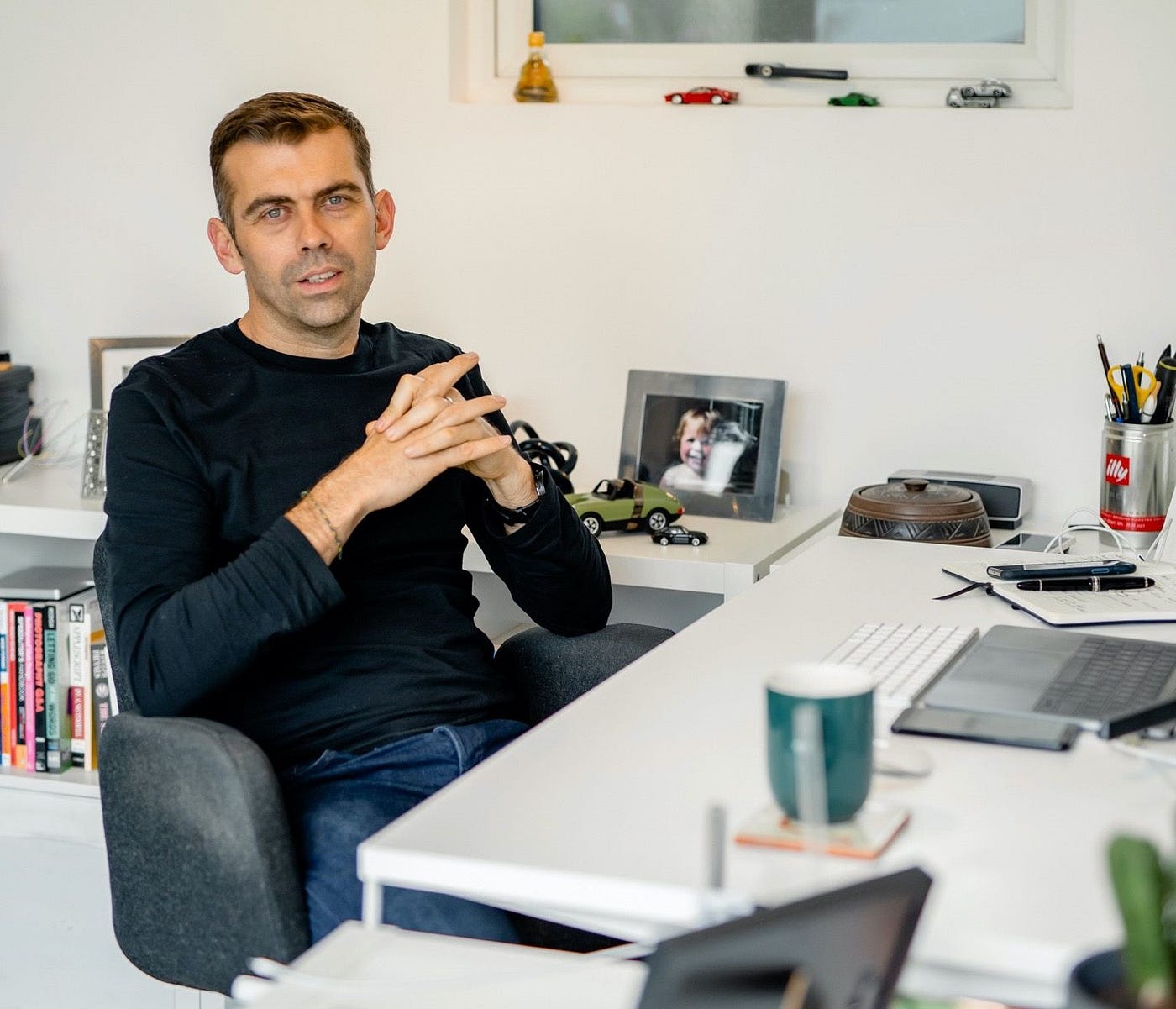
Software engineers tend to want to overprocess, and control everything. My belief is that you shouldn’t let processes hold you back. They should guide you but not restrict where you want to end up, otherwise you’ll never truly innovate, but will simply be following in the footsteps of innovators.
With technological advancements, particularly in the AI space, an increasing number of tasks can be either fully or partially automated. In this series, we are talking to People experts about how they’re utilizing new technologies to make their jobs easier and provide greater strategic value. As a part of this series, we had the pleasure of interviewing Lewis North, CTO of WorkBuzz.
Lewis North is the Chief Technology Officer (CTO) of employee engagement specialist, WorkBuzz, and has over 20 years’ experience in creating apps, software platforms, and digital solutions across mobility, education, medtech, and HRtech. A passionate technologist and team leader, Lewis is driven by the opportunity to embrace technology, integrate systems, and enhance people’s lives through innovative solutions.
Thank you so much for your time! I know that you are a very busy person. Before we drive in, our readers would love to “get to know you” a bit better. Can you tell us a bit about your ‘backstory’ and how you got started?
While at University, I was fascinated by HTML and designed my first website. This gave me the experience needed to secure my first proper job developing an intranet for a bank. Within just a few months I had a team of five people, which was certainly a baptism of fire - I had to learn what I was doing, and quickly!
I soon moved on from the bank and started my own web and app development agency, Method & Class, where we really pushed the boundaries of what was possible, from pioneering augmented reality, to developing telemedicine platforms and contactless mobile car hire apps. I ran the agency for 20 years before deciding to join employee engagement specialist, WorkBuzz earlier this year as its CTO. This new role has given me a whole new challenge. I’m now developing cutting edge technologies, including AI, to help people leaders improve employee engagement among deskless and frontline workers.
I love that I’m involved in bringing a whole new generation of tech to the HR space, helping organizations to add value and free-up their people to do more meaningful work.
It has been said that our mistakes can be our greatest teachers. Can you share a story about the funniest mistake you made when you were first starting? Can you tell us what lesson you learned from that?
I had an idea to build a mobile app that was an electronic guide to how to drive racing circuits. It was designed to eliminate the need for users to carry around a huge paper-based guide as everything would be accessible from people’s phones. As I was starting to get some traction with it, I received a solicitors’ letter about trademark infringement for using the Nürburgring name (which is a German racetrack) in the App Store. I thought I was going to get sued by them, which terrified me, so I quickly changed the name of the app. That was a life lesson about always getting your legal position right before developing anything new!
None of us are able to achieve success without some help along the way. Is there a particular person who you are grateful for who helped get you to where you are? Can you share a story?
There are a number of people who have helped me during my career. The first I’d like to mention is David Mann who was my first client when I set up my own agency. It took a lot of trust from his point of view, and thankfully his confidence in me was repaid in the quality of work he received in return.
Spence Knudson has also been a great support over the past few years. Spence was my mentor during the pandemic when we were trying to deliver a number of apps at the same time, while navigating the challenges brought on by COVID. He really helped me through this time, and more recently, Spence introduced me to Steven Frost, the CEO of WorkBuzz when the company was looking for a CTO. This opportunity is one I’m incredibly grateful for.
Can you please give us your favorite “Life Lesson Quote”? Can you share how that was relevant to you in your life?
What I’ve learnt is that as demands on your time become more pressing, you need to figure out the difference between what needs your attention now and what can wait until later.
There’s an Eisenhower quote which epitomizes this: “I have two kinds of problems, the urgent and the important. The urgent are not important, and the important are never urgent.”
I tend to use a priority grid as a useful framework to figure out what I need to do now, and what I can schedule, delegate or delete.
I also like the saying “Don’t let process stop progress”. Software engineers tend to want to overprocess, and control everything. My belief is that you shouldn’t let processes hold you back. They should guide you but not restrict where you want to end up, otherwise you’ll never truly innovate, but will simply be following in the footsteps of innovators.
Thinking back on your own career, what would you tell your younger self?
Keep learning and consuming knowledge. I did an AI course with Oxford University in the U.K. earlier in the year, and I loved going back to learning in a structured way.
Secondly, do more networking! You can never have enough connections. In fact, I recently joined a CTO networking group which is great for validating and sharing ideas.
Plus, don’t shy away from public speaking. It can be daunting to a lot of people including myself, but it’s a great skill to learn and develop.
Let’s now move to the central part of our interview. How have recent technological advancements such as AI made your job easier?
You can’t underestimate the impact of AI, specifically the Large Language Models (LLMs) which are what tools like ChatGPT have been built on. LLMs process natural language inputs and then make predictions based on what they’ve already learnt, predicting the next word, and then the next, until the answer is complete.
I just love experimenting with LLMs and combining tools to discover what’s possible. I currently use them to write simple scripts for software development.
They also take away the time and effort involved in writing content such as job descriptions and adverts. By providing a great starting point, this removes the toil that’s normally involved.
In which processes do you utilize automation the most?
I use LLM all the time for turning a few notes into a narrative that I can use, sense checking my work, and asking AI to rewrite something to make it easier to read.
It’s also useful for learning – explaining complex concepts in useful ways; cleaning data in Excel spreadsheets and helping me speed up creating tricky Excel formulas!
I really enjoy playing around with LLMs and automation tools to see how they can solve real-world business problems. For instance, we were quoted $130,000 for an agency to create some content for us. What we did instead was to use an LLM to provide us with the bare bones of the content, and then hired a consultant to sense check it and make it polished, saving us thousands of dollars! The final content was of a really high standard.
What should people bear in mind when automating processes?
It’s always important to remember the mantra “rubbish in, rubbish out!” So, if your data is poor, your outputs will reflect this. You also have to understand the importance of AI prompts when using the likes of ChatGPT, as what you ask, will reflect what you get back. Always be prepared to iterate and test any AI outputs. It’s unlikely to be perfect first time round and so will require human oversight for sanity checking.
Recognize that you can never trust AI fully as biases and errors will occur, and so always remember that there needs to be human governance around it.
What are your “Top Five Tips For Harnessing AI Technology to Propel People Operations”? Please share a story or an example for each.
1 . Don’t be afraid of AI but do set boundaries
AI is like adding superpowers to your people. Embrace AI as the opportunities it presents are huge, but you do need to set a framework around what is and isn’t okay when it comes to its use. So for example, you may permit your employees to use AI for drafting certain pieces of content such as job descriptions, however employees must know not to share confidential or sensitive information with ChatGPT as it could compromise the business if made public.
2 . Teach your people how to converse with AI
You need to ask an LLM tool - such as ChatGPT – a question to get an answer – makes sense! However, WHAT you ask and HOW you ask it will influence the answer. Teaching employees the basics of LLM prompts (how to phrase questions in the best way) is important here, as well as educating them on how to adjust the complexity of responses they receive. This could be as simple as asking the LLM to “give me the answer like I’m a 10-year-old”.
Some LLM tools will automatically adjust the complexity of their answers/readability scores according to the employee’s job and/or level of understanding. The smartest LLM tools will use more than the written word to convey information, with some deskless and frontline workers responding better to audio replies or visual prompts, for example.
3 . Do your due diligence to prevent data issues
If you’re partnering with an AI tech provider, ensure you ask the right questions to find out what’s ‘under the hood’ of the AI tool. Is the tool simply plugging into OpenAI and so the data is essentially a ‘free for all’? Where is the data being hosted? Is your company data being used to train the model (you don’t want any data leaks)? And so on. You certainly don’t want to find out that your company’s employee data is going across borders and contravening data protection such as the California Consumer Privacy Act (CCPA).
4 . Cleanse your data!
If you are using more traditional machine learning tools at your organization, you need to ensure your data is of a decent quality. Using my favorite “rubbish in, rubbish out” mantra, it must be remembered that if the data is low quality, has bias or inaccuracies then these will be amplified by the AI responses your people receive. So, if a HR professional asks a chatbot to draft a health and safety guide, and all the health and safety information at the company is outdated, the output will be unusable.
5 . Implement self-service tools
We now have access to highly advanced technology that allows every employee to quickly and easily answer their own HR questions. This is made possible by Retrieval Augmented Generation (RAG) tools which are powerful databases that can store and analyze a huge number of documents, from training manuals through to reward and benefits information. Using an LLM, these documents can be interrogated to answer employee queries, enabling employee self-service.
With self-service in place, it’s like having little experts sat on your employees’ shoulders, answering any questions they may have about the business. Queries normally directed to people managers can be answered by AI, with just a small number being escalated by the LLM to the HR team. The HR team’s time is now freed-up to focus on value-adding activities.
What are your favorite “I couldn’t live without these” tools?
I use OpenAI for writing small software scripts as well as Bedrock which is the AI part of Amazon Web Services (AWS) to help with transcriptions. I actually find the summarizations in Zoom really helpful and most importantly, I use ChatGPT to write wacky bedtime stories for my children.
How do you see technology impacting the HR space in the future?
We’ll begin to see technologies changing the HR landscape in a number of crucial ways.
Firstly, tech will enable hyper-personalization so that the employee experience is highly tailored to the individual. This could be modifying content for a neuro-diverse worker or according to where they work. For instance, if a worker is deskless and uses their mobile phone for keeping connected, company communications need to be mobile-friendly, succinct and easy-to-digest, and so AI can re-write the comms to suit each worker’s requirements. Similarly, the most appropriate learning and development opportunities for each worker can be identified and offered to them using the power of AI.
We see hyper-personalization in the consumer world like being able to alter the color and design of a product to suit the recipient’s wants. This will very soon trickle down into the business world.
Everyday HR tasks will also become automated so that HR teams can more readily focus on strategy and urgent, value-adding tasks. It’ll soon be common to see detailed emails being written from just a few quick bullet points, 90% of training manuals written by AI and a large portion of onboarding automated while remaining personalized.
Employee engagement will also become increasingly supported by AI to improve the employee experience, with key insights from engagement surveys quickly collated, dissected and analyzed. In fact, I’m currently working on a new AI tool at WorkBuzz which analyzes all employee engagement survey responses with lightning speed, and for each people manager, it distils the key takeaways into a focused 3-minute summary. This removes the manual collation and analysis of surveys while significantly reducing the time between HR receiving the survey answers and actioning the insights.
And of course, self-service will become crucial for freeing-up time within people operations as AI will be able to answer the majority of employees’ queries.
We are very blessed to have some of the biggest names in Business, VC funding, Sports, and Entertainment read this column. Is there a person in the world whom you would love to have a private lunch with, and why? He or she might just see this.
I love a raconteur. Being able to tell a story is such a skill and the most interesting people are those with colorful pasts, so someone like Dennis Rodman would be a really entertaining lunch guest. And then there’s Starbucks’ Howard Schultz and Amazon’s Jeff Bezos – you can’t fail to admire how they have kept their companies agile and grown them into such powerful and recognizable brands.
How can our readers further follow your work?
Follow me on LinkedIN: Lewis North | LinkedIn
And for the latest innovations at WorkBuzz follow www.workbuzz.com
Thank you so much for sharing these important insights. We wish you continued success and good health!