When I was first getting started and overwhelmed about taking on this new project, my husband encouraged me to just focus on helping ten people. And if I reached ten people, I could focus on the next ten.
As part of my series about “individuals and organizations making an important social impact”, I had the pleasure of interviewing Leah Witman Moore.
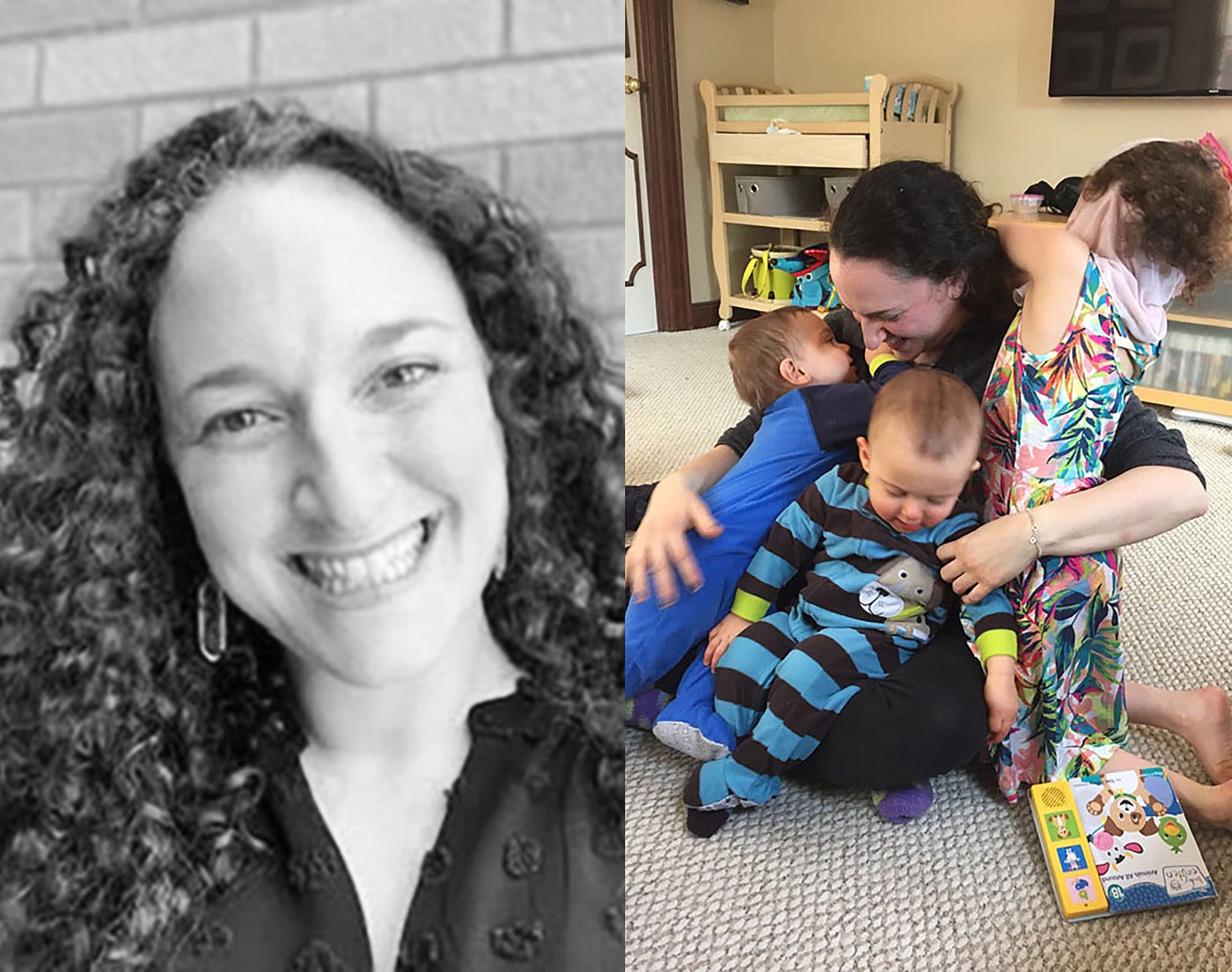
Leah Witman Moore, has been teaching English and theater for over sixteen years. She is a graduate of the University of Wisconsin- Madison and has a Masters in education from New York University. She was the recipient of the prestigious, Teacher of the Year award, presented to ten New York City Teachers annually. She first premiered her writing on her parenting blog, www.lovingyoubig.com, which has an international audience in over 57 countries. Her family has been featured in a documentary about Cri Du Chat, a rare chromosomal disability. A book by the same name will be debuting in late summer, 2021. She is a guest lecturer for the educational organization, Facing History Facing Ourselves. Through her teaching and writing, she is working to shift the narrative to create more stories centering around individuals with disabilities. She lives in New York with her husband and three children.
Thank you so much for joining us in this interview series! Can you tell us a story about what brought you to this specific career path?
Ihave been a high school English and theater teacher for sixteen years. I have always been interested in storytelling — whose stories are told, who gets to tell them? When my daughter was born ten years ago, we learned she had a rare genetic disability called cri du chat and may never walk or talk. With this life-altering news, I searched for support in books for both myself as her caregiver and for my daughter to see herself represented in the pages; however, I found very little available for both of us. As a result, I started Loving You Big, a website that provides an honest space for parents to create community, conversation, and change. Based on my experience with this site, I moved to write books to continue my mission, changing the narrative about individuals with disabilities. My memoir comes out in September, and I am working on finding a home for my middle-grade novel.
Can you share the most interesting story that happened to you since you began leading your company or organization?
The interesting aspect of writing about your own life is that it continues to unfold while you are in the middle of a story. Taking a moment to write about my challenges as a special needs mother and also an advocate has allowed me to become more present in my own life. Rather than being overwhelmed by the challenges I face raising my daughter and twin boys, I use writing as a means to recenter myself. In telling my stories, I am connecting with other families that motivate me to continue moving forward. However, some of the biggest changes have happened within my own family. I used to bristle when someone commented on my child, used harmful language, or made disparaging comments, but refrained silent. I never knew what to say and didn’t want to be confrontational. However, now with more practice, I can practice what human rights educator Loretta Ross coined, “Calling in.” By inviting someone to learn how their thinking is problematic, rather than shaming them for it, I can educate more people and make more societal changes. Unfortunately, I have had to do this on several occasions on behalf of my daughter, but now I have the tools and confidence to do so. Being able to stand up for my child is the greatest change that could come from any of this.
Can you share a story about the funniest mistake you made when you were first starting? Can you tell us what lesson you learned from that?
When I was interviewed for my first news program, I spent hours with my children creating a background that would look suitable for virtual filming. The plan was for my husband to take the children on a car trip so the house was quiet for filming. When it came to the day of the shoot, my husband came down with the flu, so I had to resort to tv and candy to keep them occupied for a few minutes. Then, in trying to get ready, because of the pandemic, I didn’t have any make-up, so I dug through my daughter’s makeup case to find something to help prepare me for the camera. I was so flustered when we started rolling that about five minutes into the conversion, I asked the reporter when we were starting the interview, to which he kindly replied, “we started five minutes ago.” No amount of children’s make-up could cover my blushing. He was very gracious and politely allowed me to start over.
Can you describe how you or your organization is making a significant social impact?
The scope of my work is continuing to grow. With each parent, caregiver, educator I meet, I can articulate what is problematic about perpetuating stigmas about individuals with disabilities in texts. As I describe it in my memoir, “this misguided representation of ability is a story rooted in the historical oppression of the eugenics movement, a period when individuals with cognitive, physical, and emotional disabilities were abandoned, sterilized, and filling our institutions. With every depiction of individuals with disabilities seen as pitiable, an object of violence or ridicule, nonsexual, or unable to participate fully in society, the media are perpetuating this misrepresentation (Contact, 1991). It is the reason why individuals with physical and cognitive disabilities were on the periphery of my life. It is the reason the word normal should be avoided. This is the root of an ableist society. This discrimination of people with cognitive, intellectual, or emotional disabilities, whether visible or invisible, needs to change.” It is my hope by changing how individuals are represented in texts, for people of all ages, the impact can continue to grow.
Can you tell us a story about a particular individual who was impacted or helped by your cause?
When I was first getting started and overwhelmed about taking on this new project, my husband encouraged me to just focus on helping ten people. And if I reached ten people, I could focus on the next ten. Last week, I received a message from another parent in France who described receiving their child’s diagnosis as a mountain of unknown problems, but after hearing our stories, he realizes, “mountains haven’t disappeared but [we] now get the idea that the path is signposted.” It is the reason I keep writing, for moments like this. I do not know this man and will never meet his child, but knowing that someone is finding the tools, support, and outlook they need because of the work I am doing is what keeps me balancing this with my other responsibilities as a teacher and mother.
Are there three things the community/society/politicians can do to help you address the root of the problem you are trying to solve?
- Create accessible playgrounds for children with physical disabilities in all public spaces.
- Open the opportunities for inclusion in school environments. . Due to the way most American public schools are structured, most students do not encounter a child with significant special needs until middle school, if at all.
- Create more opportunities for inclusive texts to be used in a classroom (Fill classroom libraries, educate faculty about implicit biases, make stories about disabilities mainstream)
How do you define “Leadership”? Can you explain what you mean or give an example?
Leadership is knowing how to support and amplify other people to have agency in a given situation. It is not about taking over, stepping in, or fixing a situation, rather guiding others to feel comfortable to take up space that feels authentic to them. It is the same philosophy whether I am working with fourteen-year-olds in my classroom or a group of adults making systemic changes.
What are your “5 things I wish someone told me when I first started” and why? Please share a story or example for each.
- You are not too busy to accomplish something you care about. With three children and three children with medical needs, I would not likely be the first choice for someone to add more to their plate. However, once I could add my voice to the larger mission, I found I had more time and energy in the day to get it all accomplished.
- There is no perfection when it comes to writing. As a writing teacher, this is something I espouse to my students, however, in my own practice it is much harder to own. It took me about eight years to finish my memoir, mostly because it was hard to find a place to pause the storytelling since something new happened every day.
- You can still add your voice to the conversation, even if you don’t have a larger platform. I have heard a lot of “no’s”. It is difficult to get a book published when it is about a marginalized group, and I do not have a platform. I had to continue to build smaller connections and remember to focus on my ten people at a time.
- Ask questions to people with experience. I have written an email to Lin Manuel Miranda more times than I should admit, and while I imagine he hasn’t had a chance to get my note in his inbox, it does not deter me from reaching out to advocates, trailblazers, and revolutionaries in their field. I have received so much advice from famous authors, podcasters, and educators, continuing to educate me about my practice. I understand when someone does not have the time and am always so grateful when someone takes a moment to turnkey what they have learned.
- Don’t forget the “AND.” It is so easy to doubt yourself when starting any new adventure. I can easily reduce myself to what didn’t happen, (ie: but, I didn’t get accepted.). By changing my mindset to the “and,” I have been open to so many more experiences. “The publisher denied my piece, and gave me specific feedback for my next submission,” My daughter has a rare diagnosis and we are learning so much about how to be better parents to meet her needs.
You are a person of enormous influence. If you could inspire a movement that would bring the most amount of good to the most amount of people, what would that be? You never know what your idea can trigger. :-)
Change the way individuals with disabilities are represented in literature. Too many times characters are reduced to the archaic stigmas — it is why after reading Of Mice and Men with John Steinbeck, my students explore to what extent the book perpetuates stereotypes about individuals with disabilities. We need to notice. This does not mean we want to rely on what is called “inspirational porn.” (So and so was told they would never x, and then they did — we should learn from them.) An individual with a disability should be a part of the story, not be the story. We have more work to do. According to the Cooperative Children’s Book Center at the University of Wisconsin (my alma mater), only 3.4% of all literature contains a character with a disability, and in many cases, that character is perpetuating an archaic narrative. This is not acceptable.
Can you please give us your favorite “Life Lesson Quote”? Can you share how that was relevant to you in your life?
This is a hard question for an English teacher. When you walk into my house there is a large sign with the Maya Angelou quote: ‘I’ve learned that people will forget what you said, people will forget what you did, but people will never forget how you made them feel.” This work is about empathy and extending kindness towards other people. Angelou’s quote reminds us that the way we treat one another is what remains. I am also motivated by Toni Morrison’s words: “If there’s a book that you want to read, but it hasn’t been written yet, then you must write it.” It is what inspired me to start writing. There was a story I needed to read, so I followed her advice.
Is there a person in the world, or in the US with whom you would like to have a private breakfast or lunch, and why? He or she might just see this, especially if we tag them. :-)
I would love to hear what Lin Manuel Miranda has to say about the questions in my email. As a teacher, performer, storyteller, and parent that also watches too much PJ Masks, there is a lot to cover.
How can our readers follow you on social media?
@lovingyoubig
This was very meaningful, thank you so much. We wish you only continued success on your great work!