The mind is not a vessel to be filled, but a fire to be ignited.
Social Impact
Larry Frye: The Mindset Shift From Rote Memorization To Genuine Discovery That Can Transform Modern Education
Veteran educator Larry Frye shares insights on overcoming the pitfalls of testing-oriented schooling, expanding student agency, and fostering education for a sustainable future.
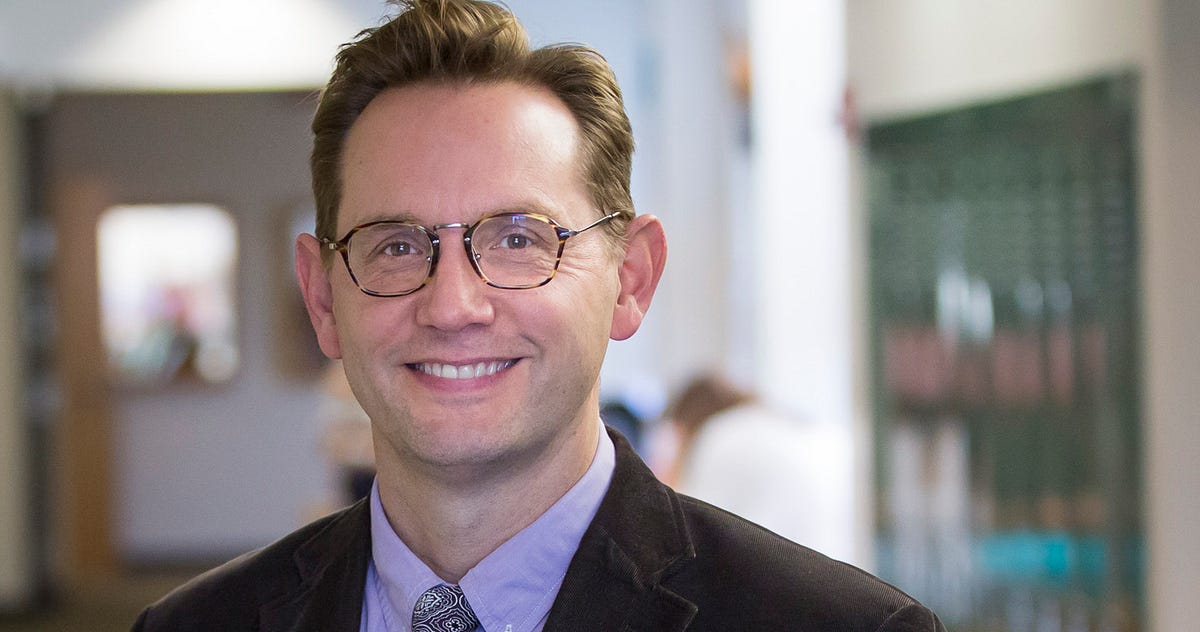
Larry Frye is a progressive educator with over twenty-five years of experience in independent schools, including The Cambridge School of Weston (near Boston) and The Harley School. His roles have included: college counselor, teacher, dorm head, Associate Director of Admissions and Director of Financial Aid, Director of Communications, Dean of Students and Boarding, and Head of Upper School. Additionally, he served as Senior Assistant Director of Admission at Wheaton College in Norton, Massachusetts and Assistant Dean of Admission at Hamilton College, in Clinton, New York. Larry has been part of the Harley community since 2004 when he became the Head of our Upper School. During his tenure, he helped create the programs that live in The Commons, all concerned with education for a sustainable future: civic engagement; mindfulness and empathy education; food and farm; citizen science; design thinking. Larry also founded, chaired for many years, and continues to serve on the Harley Diversity Committee. Additionally, he has worked with the Board on three cycles of strategic planning.
His own education led him first to Hamilton College, where he received his B.A. in English Literature with a minor in Religion. Larry was also a recipient of Manley F. Allbright Fellowship for graduate study in theology during his time there. He continued his education at the Harvard Graduate School of Education where he earned his Ed.M.
Larry believes a good education has life-transforming potential for every child, and so — while an experience of school should certainly be joyful — it is also among the most consequential things adults do for children. “A better world begins with the best possible education for our children.”
He is married to Robin Damrad Frye, Ph.D., who is the Assistant Director of the Center for Excellence in Teaching & Learning at the University of Rochester.
Thank you for joining us Larry! Can you share the “backstory” behind what brought you to this particular career path?
I was a first-generation college student and the ideas I was exposed to in college changed my life. Literally — ideas changed my life. Up until that time, my education was really typical: a lot of rote learning, a strong orientation toward testing, not a lot of inspiration.
Can you share the most interesting story that happened to you since you started your career? Can you tell us what lesson you learned from that?
We once admitted a student who, because of a long bout with encephalitis, had sustained some brain damage which rendered him unable to speak or to recognize characters (i.e., numbers and letters). Though you might think that it would be close to impossible to work with such a student in a college preparatory school, there were people on the faculty who saw in him an extraordinary intelligence, and so they elected to take a chance. We found “workarounds” for his limitations, and he is now in his third year of university. The lesson? Look deeper, and look for the way forward, even if it’s quite unconventional.
Are you working on any exciting new projects now? How do you think that will help people?
My school, The Harley School, has a significant commitment to education for a sustainable future. For us, that means not only old-fashioned environmental stewardship and environmental science, but food and farm, maker education, civic engagement, mindfulness and empathy, and systems thinking. We believe that a commitment to education for a sustainable future is an educational and moral imperative given the climate crisis, and we think of all these strands as part of the fabric of sustainability.
Can you briefly share with our readers why you are authority in the education field?
Thirty years in schooling as a teacher, coach, administrator, house parent — you name it — and a Master’s in Education from the Harvard Graduate School of Education.
From your point of view, how would you rate the results of the US education system?
The main narrative in the US is that it’s a tale of haves and have-nots, that if you live in a well-heeled school district you can get a fine education, but if you live an impoverished one, your chances are far lower. I think this is basically correct, but I would also offer that almost all American public education is too testing-oriented, which is a disservice to all students, haves and have-nots alike. The emphasis on testing forces the teaching and learning to be much more rote than is necessary, taking much of the inspiration and joy out of both.
Can you identify 5 areas of the US education system that are going really great?
- The growth of charter schools, home-schooling, religious schools, and schools with a distinctive focus is a good thing. Diversity of thought, offerings and methods is good for everyone.
- There is a great deal of innovation in the world of American independent (private) schooling, which is also great.
- Consciousness of bias and legislation such as Title 9 has meant that access has changed for the better for populations that were formerly denied access.
- There is a greater awareness of student learning differences, and in many places, the services are often excellent.
- A key area of growth in US schools has been in the area of Social-Emotional Learning. This increased focus has allowed schools to do a better job of teaching the “soft” skills of self-regulation, collaboration, mindfulness, etc.
Can you identify the 5 key areas of the US education system that should be prioritized for improvement? Can you explain why those are so critical?
- The orientation toward testing is just wrong-headed. There are very substantial areas of learning that just aren’t accurately measured by a test, yet that is how we assess not only how well our students are doing, but in many cases, our teachers.
- Plutarch wrote, “The mind is not a vessel to be filled, but a fire to be ignited.” However, most American education is vessel-filling: cram heads full of facts, sit them for a test before leaks spring, and then the kids forget 90% of it.
- Choice: students need some sense of agency, of control, over what they learn. Otherwise, learning turns into a factory job.
- Access: data suggests that schools are more segregated today by class and race than before busing began. The two-tiered system I mentioned above has to change or we will lose any sense of unity and see whole groups of people fall even further behind.
- Social-Emotional Learning and support of mental health and wellness should continue to be emphasized. Many have pointed out the rising levels of anxiety, depression, and disconnectedness in America’s youth, and I worry about the current generation’s wellness going forward.
How is the US doing with regard to engaging young people in STEM? Can you suggest three ways we can increase this engagement?
Engaging? If it were engaging everyone would be interested in it. STEM education really is about having an orientation towards problem-solving, discovery, and design, and that orientation isn’t exclusive to the STEM fields, or at least here at Harley it isn’t. So, while we have fantastic offerings in the STEM fields, we also see that approach applied to the humanities, arts, etc. for a more holistic approach.
Can you articulate to our readers why it’s so important to engage girls and women in STEM subjects?
Girls and women are underrepresented in the four fields of STEM education, so the commitment to engaging them in these fields is a commitment to equity and access. Also, the work in those fields is better for a diverse workforce; great ideas can come from anywhere.
How is the US doing with regard to engaging girls and women in STEM subjects? Can you suggest three ways we can increase this engagement?
I can’t emphasize the importance of role models in those fields enough. It says something special when your advanced mathematics or science teacher is a woman. Here at Harley we are fortunate to have some great female role models, whether it be the upper school science teacher with a PhD in microbiology, the lower school technology and maker space teacher, or the industrial design instructor who runs our fabrication shop. Another thing that can be done is to carefully consider how we unintentionally (or intentionally?) push boys and girls into gendered classes. Why, for instance, do girls with artistic ability end up in art class, while boys with artistic ability get steered towards drafting and mechanical design classes?
As an education professional, where do you stand in the debate whether there should be a focus on STEM (science, technology, engineering and math) or on STEAM (STEM plus the arts like humanities, language arts, dance, drama, music, visual arts, design and new media)? Can you explain why you feel the way you do?
Honestly, I don’t like any of these acronyms, as they oversimplify things in an unhelpful way. But given the question, any society that ignores or diminishes the arts, languages and humanities does so at its own peril. These are the disciplines that cultivate the creative imagination, empathy, insight, and understanding of the human condition; to graduate STEM students who don’t have these qualities is to graduate worker bees, not the people who will lead us to a better future.
If you had the power to influence or change the entire US educational infrastructure what five things would you implement to improve and reform our education system? Can you please share a story or example for each?
- Abolish college entrance exams and Common Core tests. These tests force schools to teach toward them, and there’s a “trickle down” effect that changes both the curricula and the way material is taught. It forces us toward memorization and away from deeper learning.
- We need class sizes across the country to be about ⅔ the size they are presently (from about 24 to about 16, on average). There is no substitute for really knowing a child, and it is just plain harder to do that with larger class sizes.
- Choice: school curricula should have an element of choice. Students will be more engaged and take greater responsibility for their education when they are given a voice in how their schooling is shaped.
- A focus on Social Emotional Learning throughout, but especially in the lower grades.
- Stop driving school funding through the assessment of property taxes.
Can you please give us your favorite “Life Lesson Quote”? Can you share how that was relevant to you in your life?
“Wherever you go, there you are.”
PB
Written by
Penny Bauder
Editor & Journalist · Authority MagazinePenny Bauder is a senior columnist at Authority Magazine covering Tech and Social Impact, conducting primary-source Q&A interviews with founders, executives, and industry leaders.

Published inAuthority MagazineTop Lessons, Top Authorities · 42K Followers
Exclusive, curated interviews with the leaders and changemakers shaping tomorrow. Leadership lessons, industry deep dives, and executive profiles.