For many people, life works in stories. One event leads to another, sort of thing. But I’ve never thought that way. This is romantic, but I’m convinced there are some things in the world we are simply drawn to. No reason. No trigger. No story.
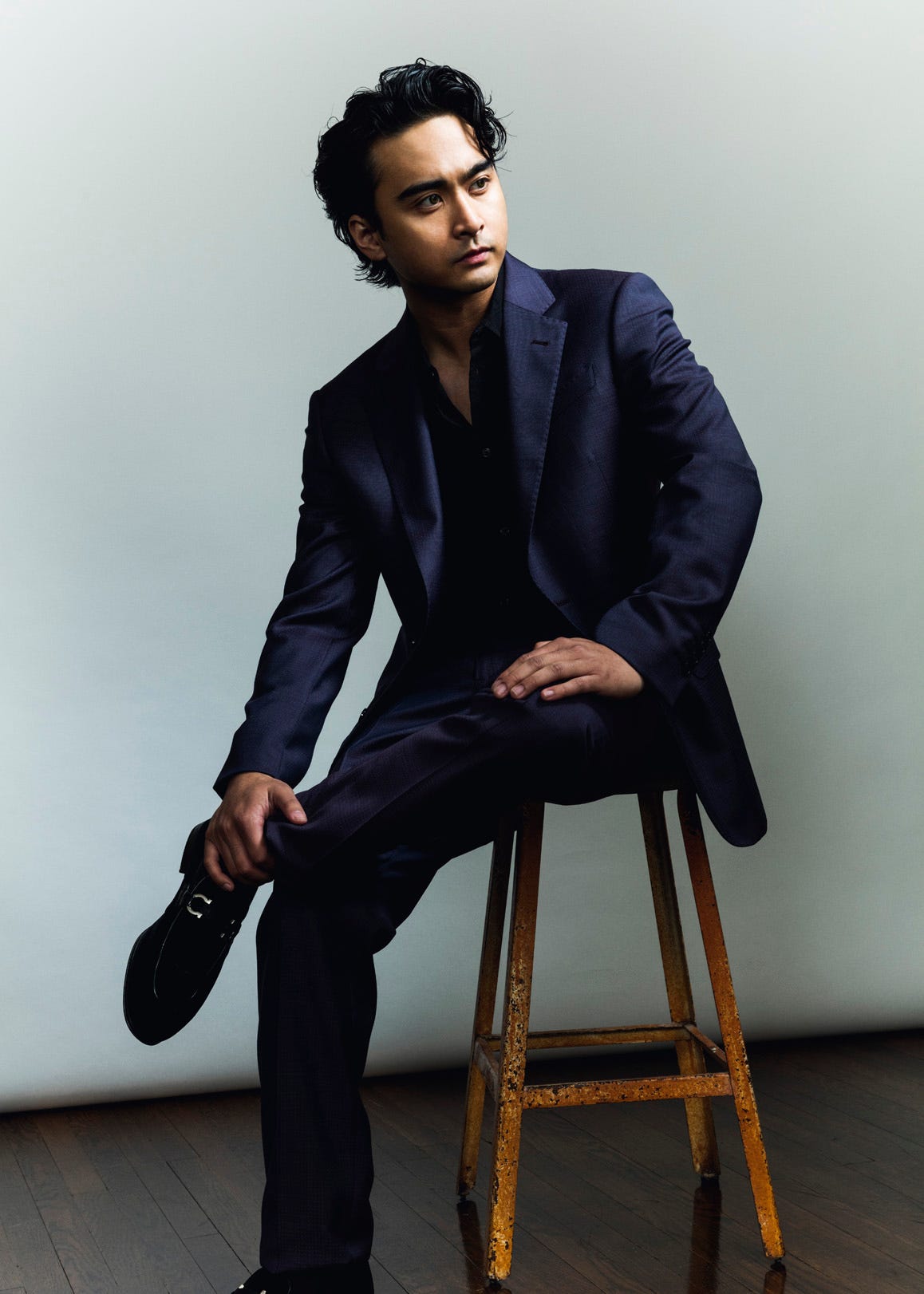
We had the pleasure of interviewing Kristian Flores. Kristian known as Hollywood’s ‘Dark Horse,’ is a classically trained actor and graduate from the University of Southern California with a B.F.A. in Acting. According to a Deadline exclusive, after completing his program, Kristian sparked a signing war amongst some of the biggest agencies in the industry, competing to sign the young star on the rise. His leading role as Simon Elroy in School Spirits (2023) on Paramount+ positioned him as one of the industry’s most sought-out young actors today.
Flores excelled in his conservatory, studying voice, movement, text analysis, improvisation, and Shakespeare. Kristian’s theatre credits include transforming as Richard III and various plays by Tennessee Williams and Russian playwrights. His intensely emotional performance in School Spirits (2023) had endeared the hearts of audiences worldwide, as he grieves and investigates the death of his best friend, portrayed by Peyton List. Kristian previously recurred in Reboot (2022) (20th Fox) as Connor in the series created by Steven Levitan. Darkening his trajectory, Flores accepted the part of Jack in Hulu’s Grimcutty (2022) and a supporting role in HBO Max’s science-fiction thriller Gray Matter.
Kristian’s skillset continues to increase with each role that demands it, so far: advanced skateboarding, piano, guitar, foreign languages, ballet, and fight combat. Kristian has a skill to humanize obscure characters. He is represented by Jennifer Patredis at Innovative Artists and managed by Vision Entertainment.
Thank you so much for joining us in this interview series! Can you tell us the story of how you grew up?
We lived in rooms. Me, my mother, and my sister. Different rooms. Different places. Some of those rooms were rotten, some were grand. But never owned a house. The longest room we ever secured was at a senior care home. All those years I’d come back from school to a group of elderly citizens who didn’t remember who I was. Sometimes, I’d catch them trying to hop the fence and escape. Many became my friends. There was freedom and sunlight. It was a strange, happy childhood.
Can you share a story with us about what brought you to this specific career path?
Hm… I don’t think so. I can’t. For many people, life works in stories. “One event leads to another,” sort of thing. But I’ve never thought that way. This is romantic, but I’m convinced there are some things in the world we are simply drawn to. No reason. No trigger. No story. On that note, I’ve always questioned the relationship between careers and existence. Take technology for example. It has created so many new occupations. I’ve met people who are obsessed with AI or the mechanics of 3D printers and nothing else. But what would they have done if they were born 500 years ago? No luck. The timing of our advancements seemed to perfectly align with their specific passion, which raises my suspicion to the integrity of our interests. There are definitely some souls out there whose intended career has never been invented yet. At least not entirely. Those are our odds. I have always felt that acting is the only thing on this earth that makes me comfortable to be alive — it makes sense to me. I’m drawn to it by no precise story — just me being here and it happening to be there, too. I feel very lucky for that love.
It has been said that mistakes can be our greatest teachers. Can you share a story about the funniest mistake you made when you were first starting? Can you tell us what lesson you learned from that?
I was looking for the proper agent. I was 19. This was during college — where we’re performing classical pieces from sunup to sundown. I scheduled a meeting with the head of an agency. He sat me down, we had a conversation, and then he asked me to do a monologue. There was this one I liked, so I stood up from the chair and started. I curled my wrist, deformed my spine, tilted my neck, twisted my knee to the side, and I limped around and did this monologue of Richard III (“Ay, Edward will use women honorably”) and this Hollywood agent was so confused. His doors were open, so the partners and interns at the company heard me full-on yelling in rage inside this man’s office. I loved Shakespeare and thought this would showcase what my interests are with character and writing, but it wasn’t the most marketable thing to do. I was making a ruckus. He cut me off and said: “Woah, hey, hey. Okay, that’s enough!” He sighed. “Alright, look. Three things. First, I’m going to need you to find a new monologue. Second, choose a character around your actual age. And third, preferably one that’s not deformed. Okay?” We signed that same day.
Can you tell us the most interesting story that happened to you since you began your career?
The first job I ever booked was not at all what I thought it’d be. I came out of class and got a phone call from an assistant at my agency. He said, “Hey Kristian, are you available? We got a job for you!” And I jumped up in the air because I knew what it was. I had just sent in a tape. “Is it the Carmen Cuba pilot?” He said, “No. Actually, some lady walked into our office, freaking out because her son needs a lead in his student film in like an hour.” I said: “Oh, cool. What university?” The assistant was like, “Um, yeah, so he’s in high school. He’s like 16 and submitting this in order to get to film school. She ran in and begged us for an actor.” I respected the mother’s drive, and I was really thankful at the time because they had a large roster and so for my name to pop up in their mind surprised me. But I still wondered if I should do it and he said, “They’ll buy you a burger and pay you $50.” I was crushed, but I hadn’t eaten dinner yet and took the role.
What are some of the most interesting or exciting projects you are working on now?
I recently wrapped on School Spirits. The story is unique. What excited me most were the specific situations the characters are placed in. You have a dead girl watching her childhood friend fight for her life, but they can’t see each other. She spectates him while he searches for her. That metaphysical situation in the show is pure gold — it cuts straight to the meat of our existence. It was great to read and even more incredible to perform. Those are the stories I like — the ones that do not waste time and just go for the daring.
You have been blessed with success in a career path that can be challenging. Do you have any words of advice for others who may want to embark on this career path, but seem daunted by the prospect of failure?
An actor naturally seeks advice. There’s desperation and no antidote. I would encourage others to accept their dissatisfaction and disregard their need to control things. There are too many sources that claim to know the answer, but who is that credible? Stay focused. Retire your neediness. Keep soft. It’s hard, but it’s okay. The life of an actor means surrendering to the eternal tremor in our hearts. There will be a constant agitation every day because of the nature of our career and the only relief will be the reminder that we are part of a community of artists who’ve had to endure the same life. Unpredictability is our pain. Universality is our solace.
We are very interested in diversity in the entertainment industry. Can you share three reasons with our readers about why you think it’s important to have diversity represented in film and television? How can that potentially affect our culture?
Sure. One is that movies are about people — and people come from everywhere. If we want to do our jobs, we will adhere to what our earth looks like. The second is that inclusion will stretch our minds to understand that diversity isn’t restricted to ethnicity, but the different appearances of humans. What’s a leading man? That term doesn’t make sense to me. Any guy on the street is his own main character — and he may be large, hairy, scarred, anything. Conventional genetics is a very narrow way of looking at who stories can be about. When we see a movie, it honestly should be Hamlet: “Hold as ‘twere the mirror up to nature.” I don’t consider audiences to be some third party — they’re the movie. My work is to be the mirror. I want to find people to work with who understand that. Third is that eventually, we get to create a balanced industry and produce movies without forced plots that revolve around the characters’ respective ethnicity, but instead stories that follow their life and relationships. To be clear, you don’t make identity secondary — it just becomes holistic.
What are some things you wish someone told you when you first started?
One: If you’re training, do your best in class. At USC, there were a few plays in our curriculum that I didn’t find interesting. I put less effort in analyzing them and ruled out its worth. But an interesting thing happens after you graduate: you dehydrate and feel a thirst for art. I rediscovered the plays and later understood what the playwright was going for. Except I was alone, in my apartment, with no teacher or classmate to have that conversation with. I felt myself needing those lost lectures. There’s a reason certain plays have survived this long. The lesson is of naiveté. During our education, we cannot decide what to invest in. The chances are that the biggest opportunities in learning will be in the areas we regard as ‘uninteresting.’
Two: Clean yourself up. This one hurts. Sometimes, the advice artists give is less to help the world and more to perpetuate their self-image. I try to aim for the second, but this one is definitely for the boys. We may want to think that only our work matters. But that’s laziness. You are the face of your work. And you have to enter a room eventually. I wish someone told me earlier on to assess myself from head to toe. Take time to work on your appearance. It isn’t vain — it’s taking care of what we’re given. Shave. Take fresh showers. Brush well. Make sure your clothes fit. Trim your nails. Smell good. Lotion your skin. These are basic things, but they all add up. You become an entirely different person.
Which tips would you recommend to your colleagues in your industry to help them to thrive and not “burn out”?
Read at all times. Always be in the middle of a book. The longer the better. Let it run in your mind. And read dead people’s work. Save the living for later if you can. Right now, it’s your time to get what you can from the past. This will help us artistically. We need to hear true voices, and these voices will sustain us — as ‘burning out’ is usually a result from hearing false voices. An overstimulation of false voices. Let’s all read old books together and be friends.
You are a person of enormous influence. If you could inspire a movement that would bring the most amount of good to the most amount of people, what would that be? You never know what your idea can trigger. :-)
There’s a quote I like. Albert Camus wrote it. During the pandemic, I thought of reading The Plague and one part lit me up. The line is: “To fight the plague… there is nothing admirable about this attitude. It was merely logical.” That is how I see service. The world is lacking. And it doesn’t need to. Our neighbors do not have homes and many children do not have access to water or know where their families are. I hope one day to lead others in surrendering to the practical nature of kindness.
None of us are able to achieve success without some help along the way. Is there a particular person who you are grateful towards who helped get you to where you are? Can you share a story about that?
All of my teachers at USC have sharpened my eye and body for performance — such as Mary Joan Negro and Joseph Hacker. And my mom is my mother, and it’s as simple as that. But on a more day-to-day level, certain strangers are responsible for my journey. My theory is that we are all lucky enough to meet at least one extraordinary human being on this planet. They will speak differently, move their body in new patterns, and you’ll admire every gesture to them. I’ve come across four, maybe five, of these inspiring people in the past ten years. I call them “comets.” Most of these comets are in different countries. I do not talk to them anymore. I don’t know how they are doing. But each of these people were bold and individual. I even based my book A Happy Ghost on one man named “Andrei.” These comets deserve a planet of gold to themselves for their freedom of mind and bravery alone. They are themselves all the time — hilarious, strange, pure — and refuse to accept their given place in the world. Those comets being innocently extraordinary shaped me somehow. How can you ever be the same? Some people have called me ‘interesting,’ but I feel I was just the audience member molded by a handful of truly remarkable humans who at one point drifted my way.
Can you please give us your favorite “Life Lesson Quote”? Can you share how that was relevant to you in your life?
“Talking about something and doing it fight for the same resource.” I’m sensitive with how I use my time. What I’ve intentionally practiced is to refrain from vocalizing or articulating my own process. I would rather improve my skill. That’s my job. We have limited time and at one point, we will have to make a choice of how we want to spend our lives. I’d regret excelling at presentational skills rather than strengthening my acting. And it won’t have words — it’s done. It lives. My work runs through my body and through my breath. I love language, but I’m not good at talking about my job. And I do not think I ever want to be.
Is there a person in the world, or in the US whom you would love to have a private breakfast or lunch with, and why? He or she might just see this, especially if we tag them. :-)
Breakfast is my favorite meal of the day. I would love to enjoy some tea and toast with Jacinda Ardern. She’s an excellent communicator. I’d ask her about leadership and her dreams. I think it’d just be splendid.
How can our readers follow you online?
@kristianxflores on Instagram.
This was very meaningful, thank you so much! We wish you continued success!