My parents taught me to see plants as medicine and I’ve always maintained a deep reverence for animals and earth. I suppose you could say nature is my family’s religion.
Business
Krista Berlincourt: Fearless Risk-Taking Is the True Engine of Modern Corporate Reinvention
The Kensho Health CEO and co-founder shares how an unconventional childhood in the Oregon wilderness fueled a high-stakes career scaling top technology companies and reinventing her professional identity.
Many successful people reinvented themselves in a later period in their life. Jeff Bezos worked in Wall Street before he reinvented himself and started Amazon. Sara Blakely sold office supplies before she started Spanx. Dwayne “The Rock” Johnson was a WWE wrestler before he became a successful actor and filmmaker. Arnold Schwarzenegger went from a bodybuilder, to an actor to a Governor. McDonald’s founder Ray Croc was a milkshake-device salesman before starting the McDonalds franchise in his 50's.
How does one reinvent themselves? What hurdles have to be overcome to take life in a new direction? How do you overcome those challenges? How do you ignore the naysayers? How do you push through the paralyzing fear?
In this series called “Second Chapters; How I Reinvented Myself In The Second Chapter Of My Life “ we are interviewing successful people who reinvented themselves in a second chapter in life, to share their story and help empower others.
As a part of this interview series, I had the pleasure of interviewing Krista Berlincourt.
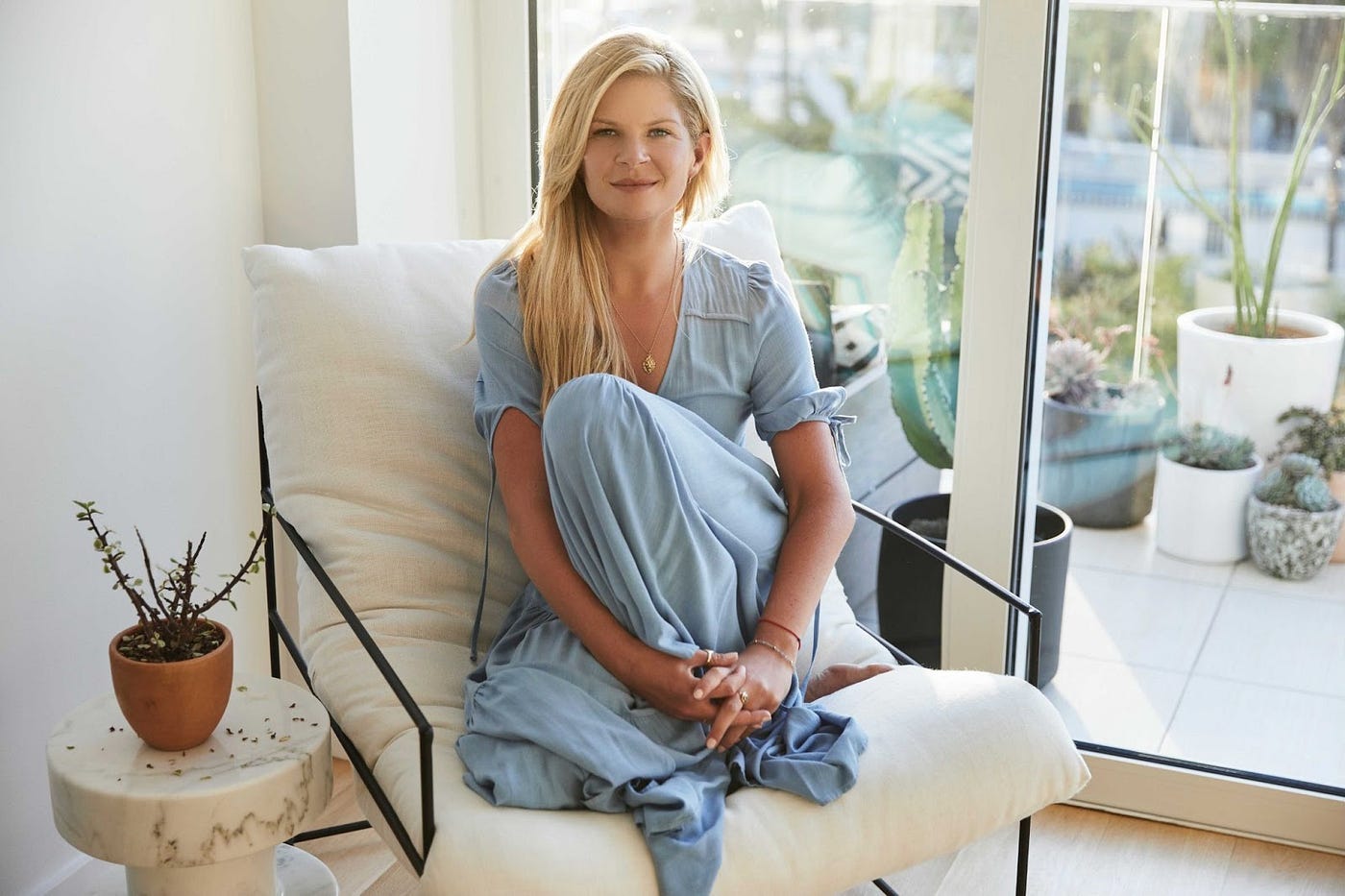
Krista is the CEO & Co-Founder of Kensho Health. Krista has spent the past decade driving social innovation through transformative technology for top tech companies like T-Mobile, Microsoft, Simple, and Acorns. She was named a Top Female Founder to Watch, is a founding member of both The Forbes Councils and The Aspen Institute’s Fringe Diplomacy. Krista is an internationally accredited coach and author whose work traverses transformation and all that makes us human — exploring the science of shame, emotion, and connection. An Oregonian at heart, Krista is an avid cyclist, naturalist, and outdoorswoman.
Thank you so much for doing this with us! Before we start, our readers would love to “get to know you” a bit better. Can you tell us a bit about your childhood backstory?
I’m an only child of two unique individuals, which means I’ve always been independent and was raised to chart my own path. My dad is a bit like David Attenborough meets Bear Grylls, while my mom is more Oprah with a side of Jane Goodall. Both are naturalists and pillars of Oregon’s outdoor community, so we spent *all* of our time outside. It wasn’t uncommon for my parents to pull me out of school to ride horses cross country through the mountains or white water raft off grid for weeks at a time. I learned to ski before I could walk, to rock climb at 5, raft at 6, and build an igloo at 7. This rooting in the wild gave me an intellectual appreciation and spiritual connection to the natural world. My parents taught me to see plants as medicine and I’ve always maintained a deep reverence for animals and earth. I suppose you could say nature is my family’s religion. This unconventional upbringing made me fearless and the wild is where I find inner peace and truth.
If I wasn’t outside, I was writing, listening to music, and making art: masks, paintings, paper mache, sculptures, the little wire chair that my best friend squished. I loved school projects and saw them as an opportunity to go to the craft store and stay up all night tinkering in my bedroom. I’ve always been very visually driven and my parents had me make most of the aesthetic decisions in our house like styling my parents, picking out our cars, and choosing furniture. My dad even let me design a custom white water raft when I was 9 — turquoise with a purple frame. Because my parents both worked 50+ hours a week — Dad as a pro ski patroller and contractor who specialized in fine jewelry stores while Mom started the first female owned bike shop in the country — I would go to work with them. I spent my weekends chatting with their coworkers and customers, sitting in the back of the shop with a book, or spending my Saturday’s $20 allowance at the University bookstore and posting up under a book rack with breakfast: fresh OJ and scrambled eggs with spinach and mushrooms. My mom started the first female owned bike shop in 1991 and that’s about when I started working. I loved talking to the customers, working the register, and rearranging the store. I loved animals too. I always wanted to save animals and convinced my parents to let me rescue and keep four cats, two dogs, and two horses. At one point my dad brought home a duckling that had fallen out of its nest and it imprinted on me. I was 10 and spent the next 2 months with this little duck following me everywhere, including school, where I was suspended for smuggling it in my sweatshirt pocket. I guess you could say I’ve always been comfortable with risk, defying cultural norms, and designing a life that felt like my own.
Let’s now shift to the main part of our discussion about ‘Second Chapters’. Can you tell our readers about your career experience before your Second Chapter?
As an only child of earthy hippies who lived without rules or expectations, I decided to do things differently and created ambitious expectations for myself. I was from a small town and deeply in love with my highschool boyfriend, so I stayed in town and went to The University of Oregon, which means my ‘launch’ didn’t come until a bit later. Then one day, I looked around and thought ‘I’ve got to get out of here’
so I hustled and found a full-time role navigating crisis and reputation management for T-Mobile USA while I was still in undergrad. I’ll never forget the day my first boss gave me a Blackberry so I could go back to walk at graduation and still be 100% available and on call. This set the tone for the next ten years of my career: always on and always busy. From here, I moved over to Microsoft and climbed the corporate ladder quickly during a time when mobile technology was just being invented. I was young and ‘tapped in’ so I was given very autonomous roles with a focus on forecasting trends and figuring out what was next, where our latest invention would fit, and how we could translate complex ideas into things people might actually use and love. I was also exhausted by the travel and corporate life, so I joined a startup, Simple, the first digital bank in the US, to lead marketing. I was only 25. The company moved quickly and we found success. Having come from a family where tension around money and lack thereof was constantly felt but never discussed, our mission to help people find financial wellbeing spoke to me at my core, and so I worked harder than I ever had. I was also wildly fortunate to be surrounded by an executive team of men who came to feel like older brothers. They mentored me, supported me, and saw things in me that I hadn’t yet discovered in myself: leadership and vision. My small town world expanded 10x when we were acquired by BBVA, one of the largest banks in the world. I began traveling even more, holding conversations with luminaries and speaking at conferences at Harvard with Warren Buffet, and leading complicated projects. Suddenly, people wanted my perspective. I started speaking at more conferences and joined The Aspen Institute on international diplomacy missions to developing regions like Myanmar and Lebanon where we brought design thinking and entrepreneurial innovation to business and government as we helped these countries move from revolution to rebuilding.
And how did you “reinvent yourself” in your Second Chapter and why did you want to?
When Simple sold, I went to a party where I instantly fell in love with a guy who lived in a different city, so I started splitting my life: Portland was home and my company’s headquarters, Austin was love, and NY was business. I built my own bermuda triangle of burn out and got lost amidst the travel. I began experiencing symptoms that ranged from fatigue and rashy skin to hair growth on my face — sexy — intense chest pain and the inability to wake up. Testing revealed that my adrenal fatigue had turned near fatal and my Cortisol — the hormone that wakes you up in the morning — was at zero, so my body was using adrenaline alone. I worked with a team of the best conventional physicians and then a Naturopathic Doctor (who was covered by my insurance!) for nearly a year before I found myself hospitalized after one of the aforementioned travel sprees. I landed in Austin and felt an intense pressure in my chest that I thought was a heart attack then called my Naturopath who told me to go to the emergency room where I found out I was in Addisonian Crisis, or ‘acute adrenal crisis’. When I asked what to do to avoid having the same thing happen again, the ER docs told me the only solution was more drugs, more often.
This was my wake up call. Here I was, the byproduct of natural living and a slower pace of life, and something in me knew that there had to be a better answer. So, I left the relationship, Austin, the job, and in turn NY, and finally Portland in search of purpose, passion, and the aligned life that I instinctively knew would hold the answers to my healing. I spent the next 6 months entirely focused on my health and wellbeing. I explored holistic medicine from board certified practices like Acupuncture and Chiropractic to mental health support from a coach and dug deeper into integrative therapies like meditation and yoga. I could tell I was on the right track. I traveled alone through South America where I lived in a traditional shamanic community for a few months, learning about plants and herbs as medicine before I boarded a plane from Uruguay to LA to interview for a dream executive role at a hot growth-stage startup that had been patiently waiting for months while I traveled. When I landed in LA, the city felt right, but the role
didn’t. I knew I wanted to solve for access to practices like those that had healed me on a much bigger level, so I grabbed my plants and a few suitcases from home and drove from Portland to Venice.
What did you do to discover that you had a new skillset inside of you that you haven’t been maximizing? How did you find that and how did you ultimately overcome the barriers to help manifest those powers?
When people heard I was back in the country and not working, I started to hear from founders who were looking for help better understanding their customers, their products, and ultimately the problems they were looking to solve. I went back to school for transformative psychology and coaching and leaned into the part of me that was able to listen to problems and quickly construct solutions. And once again, I was sitting alongside founders who were older than I was, with more money and years of experience, but I began to notice a pattern where these people who I perceived as “better” still needed my clarity of vision and ability to communicate their products to both their teams and customers.
After consulting and advising for several companies, two of which had successful exits, I had a realization that the keys to success were mission, vision, and execution. I had a clear mission and problem I wanted solve, a clear vision for how this would change the world for the better, so it was really the trial and error of execution and being a ‘guest star’ in the ten companies after my last big role that lead me to think: “Wait, I could CEO…”
How did you overcome any limiting beliefs about yourself? What was the biggest one? And how did you overcome it?
My greatest limiting belief for most of my life has been that I am not safe, that everything is going to fall apart and that I will be left penniless, friendless, and unable to take care of myself. As an adult, I now know that this fear is shared by most people. Younger me thought she had to power on and push through the mess, to quiet inner anxiety and play smaller to stay safe. Today, rather than telling myself ‘I can’t’ I remind myself that I can, and I have. I remind myself that my life is a direct reflection of the energy and intention that I put into it, and that I’m just as capable as the Ivy League educated men who constantly surround me, even as a country kid from a small town who went to a state school. Through consistent self work and spiritual practice, I’ve come to trust my intuition and know when to ask for help, shifting the belief that I would fail and end up bereft, penniless and alone, has been my soul’s biggest growth. When I was just getting started with Kensho Health, I met an investor, Sarra, who has since become a close friend. I opened up to her about my fears of leaving the world of security — financially, socially, and physically — to chart an unfamiliar and entirely unknown entrepreneurial path and said I felt like everything was up to chance then she reflected a different truth back at me: “you’re making a big bet on yourself and what better thing to bet on?”
Tell me the most interesting story that happened to you when you started in this new direction.
From the moment I said yes to my vision for Kensho Health — a platform and provider network that would rewire healthcare to be more holistic, affordable, and accessible — things have somehow fallen into place. When I was first exploring the healthcare space and trying to grasp just how painfully complicated most people found the process of finding high-quality, trusted holistic healthcare providers to be, I simultaneously had my heart broken. This heartbreak prompted me to call an old friend who had always been a trusted confidant and he invited me to join a group trip into the desert at the last minute. I said yes
and texted the group message thread that I would be coming from LA and asked if any of the others wanted to carpool. A guy from the group, Danny, reached out to say that driving alone was a bit dangerous and less fun and suggested that I join his caravan. We met for a tea (so he could screen me) that turned into a four hour walk around Santa Monica where we quickly discovered a shared interest in holistic health and helping people live happy, healthy lives. His name was Danny. Today he is my cofounder, confidant, truest friend, and a daily reminder that when you say yes to your vision, the next right thing always comes along.
How did you create support for yourself while you were moving into your 2nd chapter?
I was fortunate to meet a group of incredible women shortly after I moved to LA. Their boldness, honesty, and true sisterhood held me up when times were tough and kept me going when I thought about quitting. They pushed me along the way I imagine a lot of people’s families might. I also deepened my spiritual practice, built a team of expert health providers — from Masseuse to Coach to Acupuncturist to Naturopathic Doctor to Therapist — to ensure that support was there if I needed it. Financially, things were messy. My bank account went from six figures to zero more times than I can remember, and again I was lucky to have a business partner who felt like a brother and who I could be brutally honest with about it all. Finding the right business partner is the greatest support you can give yourself. Having complimentary skills and experience is one thing, but the real x-factor is the security and trust of the relationship. If you have a partner you can say anything to, you can get through anything together. And we’ve definitely been through it.
What was the biggest lesson you learned about yourself?
Soft is strong.
I spent the first chapter of my career trying to power through, to make myself tougher, more commanding, and in many ways more masculine. The truth is that soft is strong. The greatest strength of all is learning to be deeply vulnerable and have the hard conversations with ourselves, each other, and in our communities. Strength isn’t pushing something or someone aside, it’s pausing, softening and asking “How can I soften into this. How can I loosen my grasp. How can I trust?”
Turns out you don’t need to play the part of a man to be a strong woman.
How is your new initiative doing today?
Today, I’m beyond thrilled to share that Kensho Health is the first holistic medicine platform and provider network in the United States. We’ve raised $5.3 million to power our mission to rewire healthcare to be more holistic, accessible, and affordable. Our team is on the path to making holistic medical practices like Acupuncture, Chiropractic, Functional Medicine, Naturopathic Medicine, and Therapy covered by insurance. Just over a year ago, we partnered with the largest non-partisan academic consortium for integrative medicine in the United States and proved the effectiveness of acupuncture which lead to a decision by the Centers for Medicare & Medicaid Services (CMS) to cover acupuncture for Medicare patients with chronic low back pain. Medicare serves 120 million Americans. That’s a game changer for so many people, and this process of unearthing the hard science and evidence behind the effectiveness
of these practices, then making them more affordable by advocating for insurance coverage is the only thing that will make good health more accessible to all. I’ve never been more certain that this company is on the right path and that we have an answer to helping America recover from the past year’s health crisis and beyond.
Here is the main question of our interview. What are your “5 Tips” you wish someone told you before you embarked on your new chapter?
- Just believe. Your success is contingent on how deeply you believe in yourself and your vision. Maintain that conviction when the waters get rough, and come back to that place of confidence.
- People are everything. Be intentional about the people you choose to bring along for the journey. Your co-founders and team are ultimately responsible for the company’s success.
- You are in charge of you. You are in charge of your own self mastery, whether that means developing yourself professionally (i.e. staying on top of your industry) or personally (i.e. developing emotional footing and driving your growth). By doing this, you’re expanding your capacity for what is possible.
- Find something you would do for free. When you realize you would do your job even if you weren’t being paid, that is when you know you’re in the right place. If you are starting a new venture, that’s a good thing because you won’t get paid for a few years ;)
- Do good. The world is full of big problems that need to be fixed. Ask yourself: how is what I am doing building a better world?
Thank you so much for sharing these important insights. We wish you continued success and good health!
PJ
Written by
Pirie Jones Grossman
Editor & Journalist · Authority MagazinePirie Jones Grossman is a senior columnist at Authority Magazine covering Tech and Business, conducting primary-source Q&A interviews with founders, executives, and industry leaders.

Published inAuthority MagazineTop Lessons, Top Authorities · 42K Followers
Exclusive, curated interviews with the leaders and changemakers shaping tomorrow. Leadership lessons, industry deep dives, and executive profiles.