I want to change the narrative so that women and men see, engage in, and impact gender equity together for mutual benefit, moving away from rigid gender expectations to embrace vivid transformation.
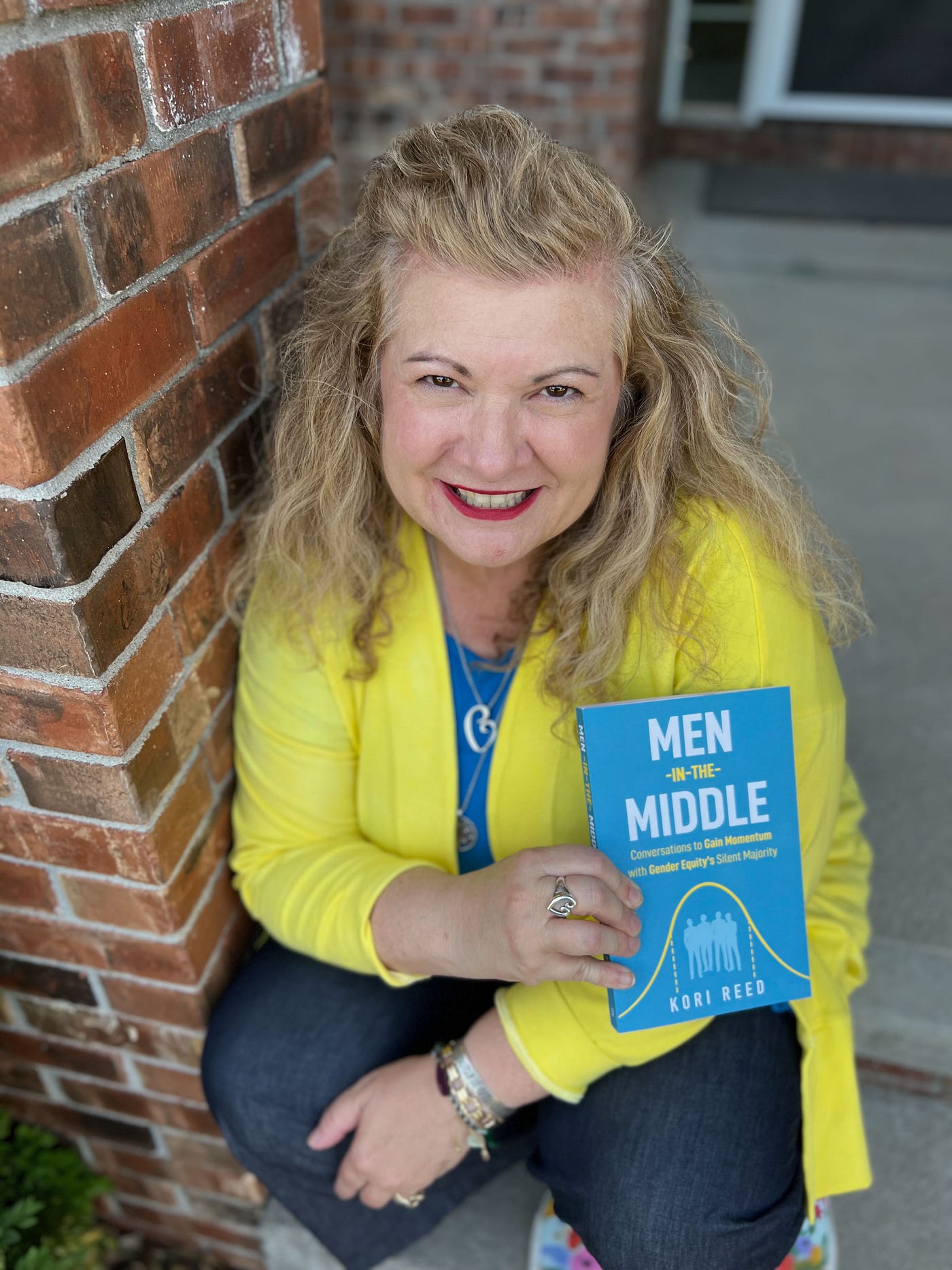
As part of my series about “authors who are making an important social impact”, I had the pleasure of interviewing Kori Reed, author of Men-in-the-Middle: Conversations to Gain Momentum with Gender Equity’s Silent Majority.
Kori is a passionate advocate for challenging deeply ingrained gender role stereotypes that perpetuate the status quo and limit beliefs for women and men. She is a wife, a mom of four adult children — two women and two men — and an experienced corporate professional. She worked for more than two decades in Fortune 500 companies, earning progressive responsibilities from manager to vice president. With an undergraduate degree in journalism and a master’s degree in communication, she leads with a natural curiosity, values meaningful connections, and collaborates to make the world better, one conversation at a time.
Thank you so much for joining us in this interview series! Before we dive into the main focus of our interview, our readers would love to “get to know you” a bit better. Can you tell us a bit about your childhood backstory?
Iam the youngest of three children. My brother and sister are nine months apart, and I arrived about four years later, which means that I learned to entertain myself, and that experience fostered creativity. I was born in the Chicago area, and we moved to Indiana and then Michigan before returning to a Chicago suburb where I went to high school. I learned to meet new people, see things from different perspectives, and navigate tensions in unfamiliar situations. When I was in the fifth grade, my mom started her career in real estate and interior design. She often played Helen Reddy’s “I Am Woman” on the record player, and we boldly and loudly sang the lyrics together. I observed and absorbed the joy that can come from the duality of being a mom and sharing talents outside the home. Each Sunday morning, while reading the newspaper comics, my dad debated with me on various pertinent and extraneous topics. Overall, I developed the skills and excitement of expressing my viewpoint and listening to other perspectives that challenged my beliefs.
When you were younger, was there a book that you read that inspired you to take action or changed your life? Can you share a story about that?
Ray Bradbury’s Dandelion Wine. When I read it, I was about 12 years old, the same age as the main character, Douglas Spalding. Douglas had this amazing epiphany early in his summer vacation that he is “alive,” the kind of alive when all discovery seems new and fresh. Bradbury described the scene so vividly that the euphoria Douglas felt woke something in me as a young reader. My family had been going to the same summer vacation place since I was preschool age, and after reading the book, I said to my mom, “Have I been here before? This place is beautiful.” More than four decades later, my family still teases me about my fascination with such epiphanies. I love when people see things in new and creative ways. It inspires change.
It has been said that our mistakes can be our greatest teachers. Can you share a story about the funniest mistake you made when you were first starting? Can you tell us what lesson you learned from that?
Oh, so many that I can’t decide on the best one. With my initials KR, I also remind myself often to Keep it Real, and I truly believe life and work goals can take serious effort, but we don’t need to take ourselves too seriously.
I started my career working with the management team at a large manufacturing plant, where I was often the only female in the room. At my first budget meeting, I noticed my department spent over the allotted dollars, due primarily to the cost of the plant manager’s company holiday cards that got shifted into my “communication” budget. All other departments were under the quarterly allocation, and I, as a new person to the team, had to explain why my budget was in the red. I naively decided to take the humorous route and said in a jovial manner, “I am glad the plant manager made his numbers and that my team could support his holiday greetings.” The other leaders gave an audible constrained laugh and the “ooh” sound you often hear when people exchange good-natured ribbing. When I got back to my desk, the plant manager was there with a piece of paper and a pen, and he drew a hill with a boulder on top, saying he was the boulder, and I was at the bottom of the hill. We both laughed, but I got his message and grew in my appreciation of the more subtle art of listening.
I learned two invaluable lessons: know your audience, and humor is a form of relief and humility. This incident occurred at a facility in the South (United States), and most people called the plant manager, Mr. “last name” rather than by his first name, as we did in the Midwest. I also learned that humor is in someone’s interpretation. I am a proponent of assuming positive intent — believing in the best in people — and I realize that not all see humor or expressions the same way.
Can you describe how you aim to make a significant social impact with your book?
I want to change the narrative so that women and men see, engage in, and impact gender equity together for mutual benefit, moving away from rigid gender expectations to embrace vivid transformation. Strengths are not gender specific, and neither is leadership. We need strong, conversational leaders to address the challenges the world faces today.
With men holding more than 75 percent of C-Suite positions in corporate America today, they influence policies and practices that enable employees to balance the demands of work and life successfully. Through collaboration, we can achieve more and lead momentum-gaining conversations for sustainable change.
The world’s challenges are too big to let gender-limiting beliefs get in the way of innovating for limitless possibilities to better ourselves, our families, and our communities.
Can you share with us the most interesting story that you shared in your book?
I interviewed professional, working men from corporate America about gender equity in the workplace, post the height of #MeToo. I had observed that women were speaking out and sharing stories, but men, for the most part, remained silent. I worked with a lot of market research professionals at the time, and they said, “Kori, don’t make assumptions; you can research that.” So, I did. I hired a researcher on my own dime and asked women in my network to reach out to their networks to invite men in positions, from managers to CEOs, to share their experiences and ideas. I asked the men to have one-on-one conversations with me about gender equity. In exchange for anonymity and a $100 gift card, they agreed to an interview and let me share their stories.
One man enthusiastically answered the call with, “I have been looking forward to this call. I have been waiting to talk about this for the past 18 months.” I was stunned at first and noted that comment as we dove into the interview guide. He shared some great advice. At the end of the call, I asked him why he did not speak up sooner. He hesitated and said, “Well, I guess no one asked me.”
I was intrigued; he had something to say, but he stayed silent. When I unpacked that, I thought, could it be that he and other men did not know their role in promoting gender equity? And that became a place to spark a broader conversation.
What was the “aha moment” or series of events that made you decide to bring your message to the greater world? Can you share a story about that?
After I analyzed the interviews, I did secondary research. There is overwhelming evidence about the positive impacts of more women and overall diversity in leadership related to increased innovation, financial performance, and more. When I asked the men in one-on-one interviews, they even said they understood and agreed with the business case for diversity at a macro level; however, they did not know what it meant for them at the micro level. That uncertainty created discomfort that they did not discuss.
This tension, related to uncertainty and discomfort, made me realize the critical importance of including these under-discussed issues in our conversations. One man who read the book said it best: “We chase the simple to tame the complex while glossing over the real issues that lay just below the surface of our daily interactions.”
On the surface, the men agreed with the business case for diversity, but we know the gender equality gap still exists and persists. Below the surface, men spoke about uncertainty, ambiguity, and the complexities of a hot-button issue. To get men to be part of the solution, my aha moment was that to engage men in the gender equity conversation and normalize their participation, we might have to acknowledge that they face issues too. The men said things like we can’t joke anymore in the office, it’s too risky to meet with a female employee alone behind closed doors, and gender equity is not my conversation to have. In some cases, they chose to disengage and remain silent.
My interviews were just after the height of #MeToo. While the media buzz might have died down, the feelings people have — discussed or under-discussed — exist and will continue until we acknowledge those in our conversations too.
As a mom of two daughters and two sons, I want to change the conversations and interactions for a better, more equitable world.
Without sharing specific names, can you tell us a story about a particular individual who was impacted or helped by your cause?
Changing the narrative is a movement that will happen one conversation at a time. After the interviews, I spoke with many people about the book. Some women said, “Kori, are you serious? Men have been oppressing women for some time; it is about time they were silent.” Some men said, “You are not a man and don’t speak for men.” Both perspectives are true; men continue to hold the majority of influential leadership positions in companies, and I don’t speak for men.
The third option, however, is where I am encouraged. A man wrote me to say, “Thank you for sharing these perspectives in writing. It gave me a chance to reflect on my own experience. While I consider myself an ally, I don’t actively speak out for gender equality. The amount of data and types of content are amazing. There is a huge need for this content.”
I led with curiosity, asked questions, and listened. While I don’t speak for men, I summarized the perspectives they shared with me, and I elevate those comments so that both men and women can advocate together from common ground, examining perspectives from both sides. As I mentioned in my Ray Bradbury fandom comments above, I love when people see things in new and creative ways, especially when it leads to positive change.
Are there three things the community/society/politicians can do to help you address the root of the problem you are trying to solve?
- Role model a better way to address hot-button or polarizing topics. This includes embracing respect, mercy, grace, and listening in a learning culture. Rather than avoid the discomfort of uncertainty and ambiguity, work in and through the discomfort to grow.
- Reform the perception of some groups that Diversity, Equity, and Inclusion efforts are a loss for some and preferential treatment for others. Equity is not a win-lose scenario. Diverse, inclusive teams open opportunities for innovative problem-solving and shared growth. Equity is a win-win.
- Reconsider dialogue and facilitation frameworks that also allow men, “the majority influence group,” a safe space to ask questions and speak out about their concerns as a first step to dealing with and removing fears that lead to silence and avoidance. The “men in the middle” don’t see themselves the way others might see them. This group has set the norm, and we often do not study the norm. Could it be time to consider a men’s Employee Resource Group or a mixed-gender work-life balance group to open the door for more productive conversations?
How do you define “Leadership”? Can you explain what you mean or give an example?
Leadership is the ability to influence, guide, and align people in a better way that benefits others. As a communicator, one of my favorite examples is the story about the janitor at NASA. As the story goes, during a visit to the NASA Space Center in 1962, President Kennedy noticed a janitor carrying a broom. He interrupted his tour, walked over to the man, and said, “Hi, I’m Jack Kennedy; what are you doing?” The janitor responded, “I’m helping put a man on the moon, Mr. President.”
True leadership is found in both the President seeking out the janitor and the people who instilled in the janitor that it takes all of us to put a man on the moon, including the importance of his role to make sure that operations run smoothly.
What are your “5 things I wish someone told me when I first started” and why? Please share a story or example for each.
Can you please give us your favorite “Life Lesson Quote”? Can you share how that was relevant to you in your life?
“Bloom where you are planted.” When I was younger, we moved about every four years, and this was my mom’s go-to saying to encourage me to regroup and rebuild my network. In elementary school, the teachers wanted me to skip a grade, and my mom said, “No if she is smart, she will need to learn to work with that gift — in other words, ‘bloom where I am planted’ — and influence people around her.” I did not understand it then, but I appreciate it now and the humble nature it taught me, whether I am planted in healthy soil or rocky grounds.
As I got older, she expanded the scope to include other new situations, dynamic relationships, unfamiliar territories, and untapped opportunities. I have worked with and learned from a number of people on projects over the years. I have come to appreciate that it takes a village to make progress and I do not have all the answers.
For me, Men-in-the-Middle is about laying the groundwork with interview insights, growing roots in a fresh perspective, and blooming new conversations with positive intent for untapped possibilities. Men and women are both stakeholders in gender equity. Men and women are heroes separately and superheroes together.
Is there a person in the world, or in the US with whom you would like to have a private breakfast or lunch with, and why? He or she might just see this, especially if we tag them. :-)
Mel Robbins! I am inspired as a faithful listener. I take copious notes during her expert interviews dealing with a range of topics, from imposter syndrome to charisma, and share the insights with family and friends. I relate to her journey as a mom and a career person. Her husband, Christopher Robbins, is the founder of Soul Degree, empowering men to create more meaning and purpose in life. With her vulnerable style, passion for learning, and desire to make meaningful connections, she is like the friend with whom I have had many conversations sharing life’s ups, downs, lessons learned, and roundabouts, but we have never actually met.
Mel Robbins relies on science-backed research to bring out new insights on relatable topics and compelling conversations! I am a fan of backing insights with research, which I did in my book.
How can our readers further follow your work online?
https://www.linkedin.com/in/korireed/
Instagram: @kori_e_reed
This was very meaningful, thank you so much. We wish you only continued success on your great work!