I learned that if I could impersonate the nurses, or people on TV, it’d make people smile and make me forget my own predicament, so I put a lot of my thoughts into writing and creating stories.
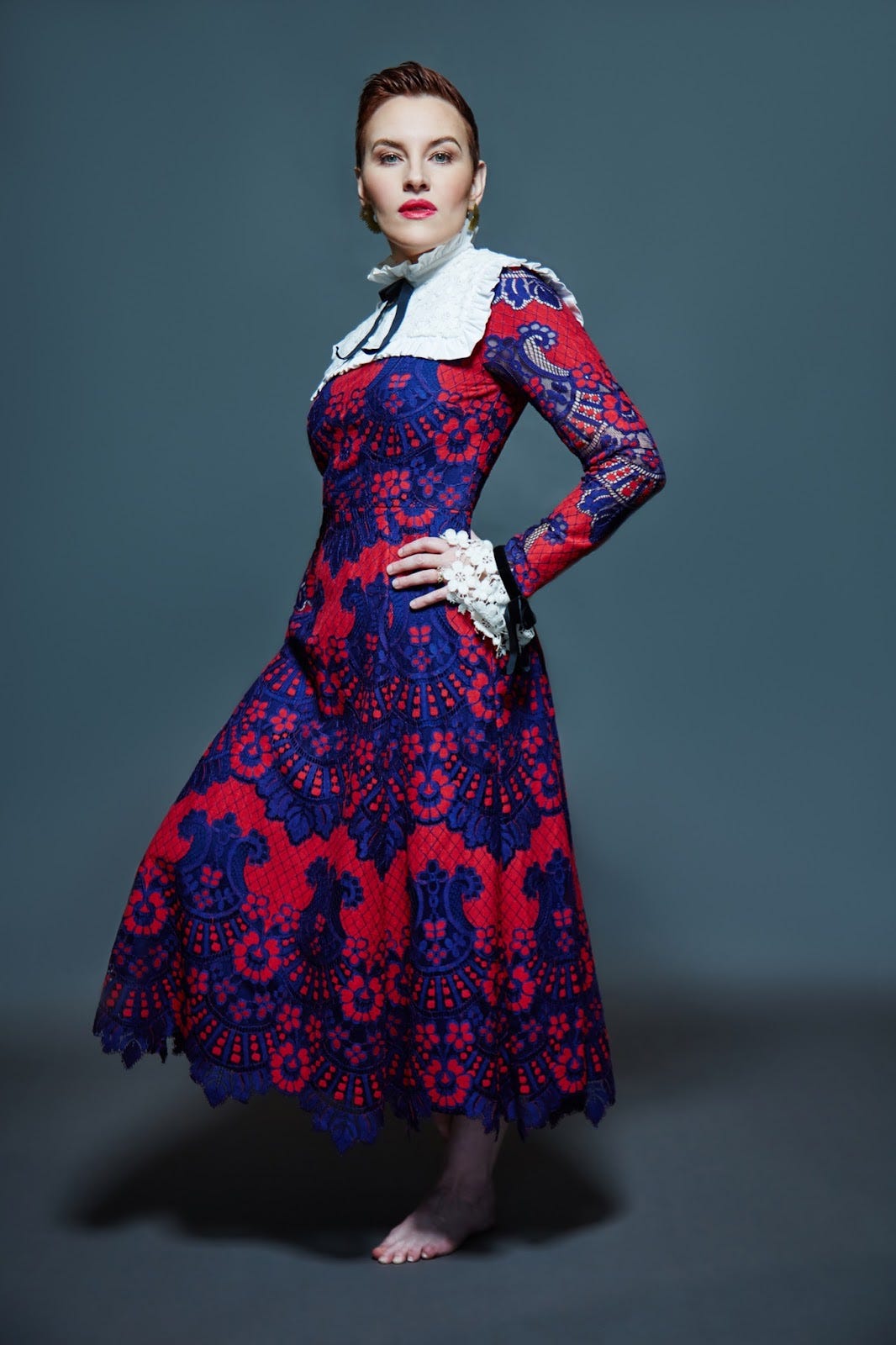
As a part of our series about Inspirational Women In Hollywood, I had the distinct pleasure of interviewing Kate Mulvany.
Kate Mulvany is an award-winning actor, playwright, screenwriter, librettist and dramaturg.
In a stage career spanning 25 years, Kate has performed onstage as Antigone, Lady Macbeth, Cassius (in Julius Caesar), Dorine (in Tartuffe), and her highly acclaimed turn as Richard of Gloucester (Richard III) for Bell Shakespeare, for which she won the 2017 Helpmann Award for Best Female Actor In A Play, and which she won again the following year for her performance in the one-person show Every Brilliant Thing for Belvoir.
Kate’s rich character work caught the eye of Baz Luhrmann who cast her as Lucille McKee in The Great Gatsby. Other feature films include The Final Winter, Griff The Invisible, The Turning, The Little Death (for which she was nominated for an Australian Academy of Cinema and Television Arts Award) and The Merger. She can currently be seen as Marion Keisker in Baz Luhrmann’s new Elvis biopic, and opposite Sam Neill in the Foxtel series The Twelve.
Kate is also one of the lead actors in the Emmy-nominated series Hunters for Amazon Prime Video, produced by Jordan Peele and created by David Weil, in which she plays Sister Harriet opposite Al Pacino.
As a playwright, Kate’s adaptation of the Greek myth Medea was voted by the New York Times as one of the best Greek adaptations to hit the London stage in 2015. Her stage adaptations of Craig Silvey’s novel Jasper Jones, Kit Williams’ Masquerade and Ruth Park’s The Harp In The South trilogy have had sellout seasons across Australia, and in 2019, Kate became the first female playwright to adapt Mary Stuart for the stage for the Sydney Theatre Company. In 2021 her adaptation of Ruth Park’s Playing Beatie Bow opened the historical refurbished Wharf Theatre for the Sydney Theatre Company.
As a screenwriter, Kate has written several episodes of the Emmy-winning animated series Beat Bugs for Netflix and was the co-developer and writer on the internationally acclaimed series Upright for Lingo Pictures.
In 2020, Kate was awarded a Medal of the Order of Australia for her contribution to Australian Arts, and she holds an Honorary Doctorate from Curtin University.
Thank you so much for doing this with us Kate! Our readers would love to get to know you a bit better. Can you tell us your “Origin Story”? Can you tell us the story of how you grew up?
Sure! I grew up in rural Western Australia on the land of the First Nations Yamatji people. My town was a mix of industries — wheat and sheep farming, crayfishing, mining… Not a lot of theater, television or film, though. Luckily I was surrounded by an incredibly diverse community. I think my eventual appreciation of art came from listening to the stories, languages and experiences of the vast array of cultures that surrounded me throughout my childhood.
Can you share a story with us about what brought you to this specific career path?
I was born with renal cancer from my father’s exposure to dioxin/Agent Orange in the Vietnam War, so a lot of my childhood was spent in hospitals having surgery and treatment. I learned that if I could impersonate the nurses, or people on TV, it’d make people smile and make me forget my own predicament, so I put a lot of my thoughts into writing and creating stories. That gave me an escape from my day-to-day hospital life. I think that initial imaginative escape set me on my creative pathway.
Can you tell us the most interesting story that happened to you since you began your career?
Every single job brings something interesting — characters, collaborators, audiences, individuals… But I would say shooting Hunters for Amazon Prime has been an unexpectedly wonderful gift that I truly didn’t expect. It saw me go from being a jobbing Australian theater artist to working in New York alongside Al Pacino every day as Sister Harriet. And although the two existences feel like they are worlds apart, Al and I connected because of our shared adoration of Shakespeare’s Richard III. (Both of us have played the King in our careers — he in 1979, me in 2017.) Between scenes of Hunters we would animatedly discuss the play, the character, the history, the relevance… It was an absolute joy to not only act alongside Al in a wonderful television series, but to explore our shared joy of a past role. It made this slightly overwhelmed Aussie actor feel so much more comfortable in my new job…and acting opposite Pacino!
It has been said that our mistakes can be our greatest teachers. Can you share a story about the funniest mistake you made when you were first starting? Can you tell us what lesson you learned from that?
I was told early in my career that many things were going to “stop” me — my disability (I have a spinal disability), my lack of training, my broad Australian accent… But the one that really stuck with me was when I was about 18, and was told that the gap between my teeth was unattractive and I would never get work with it. For some reason, that really terrified me, so I went home and shoved a piece of folded paper between my front two teeth.
I even had some headshots taken like that! When the photos came back I just looked like a teenage girl with paper wedged between her teeth. I’ve never had anyone comment on my teeth since that one initial person, and since that day I don’t take anything onboard that is said to me about my body, my features, my disability, my upbringing… I’m proud of how I got here and the body that holds my experiences within it. And I still have my tooth gap.
None of us are able to achieve success without some help along the way. Is there a particular person who you are grateful towards who helped get you to where you are? Can you share a story about that?
My parents. Even though they had absolutely no connection with the arts and entertainment industry — my Dad was a road worker, my Mum was a school teacher — they never said no to me pursuing my dreams. I guess after getting me through cancer as a child, they didn’t feel the need to sweat the small stuff. So when I said, “I want to be an actor and a writer”, they said, “Go for it. We have no idea how to do this, but we’ve been through worse!”
You have been blessed with great success in a career path that can be challenging. Do you have any words of advice for others who may want to embark on this career path, but are intimidated about the prospect of constant rejection?
Well, first thing — I never use the word “rejection”. I feel like that is a terrible word that we’ve been taught to use in our industry and it shouldn’t be part of our vernacular. The fact is, sometimes we simply don’t get the job. And it’s not anything personal — we are usually part of a huge jigsaw puzzle and our bit might not fit one picture — but it will absolutely fit another. It just takes time and pro-activity.
My advice is to keep working, even when you’re not working. Write. Create. Converse. Reach out to people who you have enjoyed working with. Do your research. Ask for advice. Consider the pathway you want to take. Invite people to walk with you who may also be finding it hard to navigate. Challenge yourself. And stop using the word “rejected”!
There are so many different ways to sail the ship you’re on. You’ll find your way with strength and confidence and knowledge.
What drives you to get up every day and work in TV and Film? What change do you want to see in the industry going forward?
I adore the teamwork on set. I love my craft, but I’m equally intrigued and inspired by the work of everyone around me — watching them is my favourite part of the job. Seeing everyone create their part of story and then bring it all together, together.
I am thrilled at the important changes that are happening with authentic and diverse representation in our industry, but it’s still clear we still have such a long way to go. As someone who has lived with a disability since birth, I want to see more representation of this community onscreen and off. At the moment, the disabled community are one of the most under-represented demographics on stage and screen, which is a little strange given that much of the population will experience disability at some time in their lives. It doesn’t mean stories have to be about illness — quite the opposite! Disabled people are strong, funny, beautiful, intriguing and powerful — they can play a part in any storyline. They exist offscreen, so how about letting them exist onscreen?
You have such impressive work. What are some of the most interesting or exciting projects you are working on now? Where do you see yourself heading from here?
At the moment I’m working on a project called “The Clearing” for Disney Plus which is inspired by an infamous Australian cult that existed in the 1970s. It’s a dark, gothic piece that deals with the horrors of psychological manipulation, but also the triumph of survival. It’s got a wonderful team of people involved including Miranda Otto, Guy Pearce, Hazam Shammas and Teresa Palmer.
I’ve also just wrapped on “Better Man”, directed by Michael Gracey. It’s a biopic of the singer Robbie Williams (played by Jono Davies) and I play Robbie’s mum Janet. It’s a beautiful story of ambition, addiction and redemption. It was such a joy to work on — people are going to get quite the delightful surprise with this one, I think.
And, of course, season two of Hunters has been completed and is on its way… Stay tuned.
From here, I’ll be focusing on some writing work and returning to the stage in something I’m not allowed to name just yet. Sorry.
As you know, the story of Elvis’ life has captured the attention of millions of people around the world, over several generations. In your opinion, what was it that really captured people’s imagination about Elvis?
I guess the name “Elvis” has kind of taken on its own iconic mythology. It’s become bigger than the man himself. But really, there are so many versions of “Elvis” that intrigue us, because he started out as normal as the rest of us. The fact is, Elvis was the name of a poor kid born in Tupelo, Mississippi who went on to become a teenager who loved music, who went on to serve his country, who went on to become one of the world’s most beloved artists… He was a son. A friend. A husband. A father. And I think, perhaps, there is always that curiosity when it comes to Elvis. How did that one little boy become Elvis Presley?
And that voice… Those moves. That style. What a legacy he left in such a short life.
What lessons do you think our society today can take from the recent Elvis biopic that you star in?
That loneliness can exist in the heart of even the most beloved of people. And that we should always treat someone as a human being — not a commodity.
This is our signature question that we ask in nearly all of our interviews. What are your “5 things I wish someone told me when I first started” and why? If you can, please share a story or example for each.
- That you don’t need to “train” to be an actor. I was often told that if I didn’t get into a prestigious acting or writing school, I’d never get far. But I didn’t have the funds for such places, so I got into the industry by writing and producing my own work with other artists and independent companies who were looking for other ways. When I first started my career as a writer, I would ask my actor friends to help me workshop my new scripts. I’d get them to come over, read the work, give me feedback. In return, I’d pay them with money I’d saved from my part-time jobs. Or I’d at least repay the favour by reading or dramaturging for them if they had anything that needed workshopping. It was a grass-roots way of developing work and community and friendships. And I still work with those amazing artists now.
- There is more than enough room at the table, because the table is looooong. The arts and entertainment industry is (or should be) a place of camaraderie and connection. Our responsibility is to invite people in, not shut people out. Otherwise we miss out on incredible stories and experiences that can only enrich, educate and entertain us.
- There are no irrelevant questions. Don’t be afraid to ask, or to offer an idea. There are still things that I appeared in early in my career that I cringe at because I look so lost! I wish I’d been confident enough or encouraged to speak up. Asking questions can often open up a realm of diverse possibilities that might not otherwise have been considered.
- No audition is a wasted one. Even if you don’t get the job, you have been seen. I have gotten several jobs from auditions I did for other roles — sometimes years later.
- The best research is real life. You can read all the manuals and take all the classes and do all the training. But nothing teaches you more about the world than just getting out and experiencing it, in whatever way you can. Most of the work I write, or the stories I pursue as an actor are instigated by real-life interactions and conversations.
Can you share with our readers any selfcare routines, practices or treatments that you do to help your body, mind or heart to thrive? Please share a story for each one if you can.
As someone with a disability, my self-care routine is very important to me. First of all, I’m honest about it — I let people know, for example, that I sometimes walk with a cane. The one I normally take to work has a skull handle and is named is Yorick — I know, cool right? — and so I introduce Yorick to everyone on set so that if I need him, they’re familiar. This makes me feel safe and hopefully everyone else too.
Whenever I play a role, I indulge in a new kind of soap or body wash. After a show onstage or a day on set, I use it to wash the role away until the next time I step into the character. It helps me separate work from real life. And then I use a different fragrance of soap for the next role. It’s an odd little indulgence but one I love.
And finally…sleep. Plenty of it. Whenever I can, wherever I can.
You are a person of huge influence. If you could inspire a movement that would bring the most amount of good to the most amount of people, what would that be?
Probably a “National Empathy Day”! A day to step out of our own heads for a moment and acknowledge the experiences of others, with love, compassion, joy and support. I mean, ideally, this would be more than a day, but hey, it’s a start.
On a more personal note, I am a spokesperson for the ongoing effects of dioxin/Agent Orange that still inflicts incredible damage on the people of South East Asia and the families of those that served in the Vietnam War. I’d love to see more acknowledgement of these survivors, and more education and assistance for those affected.
Is there a person in the world whom you would love to have a power lunch with, and why? Maybe we can tag them and see what happens!
Since we no longer have the amazing Jim Henson with us, I’d ask for any Muppet. Preferably Kermit, but I’ll take Miss Piggy, Animal, Gonzo — any of them! When I was sick as a child, The Muppets were the only creatures I could relate to. As my body changed due to the effects of the cancer, the Muppets told me to be proud of myself, no matter what I looked like. No hair? No problem! Body doing strange things? That’s ok! They made me laugh at a time that I was the most afraid and I have returned to them time and again throughout my life for that same reason.
Are you on social media? How can our readers follow you online?
Find me on Instagram. I warn you, I post a lot of cat pictures.
This was so informative, thank you so much! We wish you continued success!
Thank you! A pleasure.