My biggest inspiration is color. I’ll have a “craving” for a color, and then play around with how it turns out. One of my most-collected pieces is Color Space 27: Keep Love at The Center.
As a part of our series about “5 Things I Wish Someone Told Me When I First Became An Artist” I had the pleasure of interviewing Jessica Poundstone.
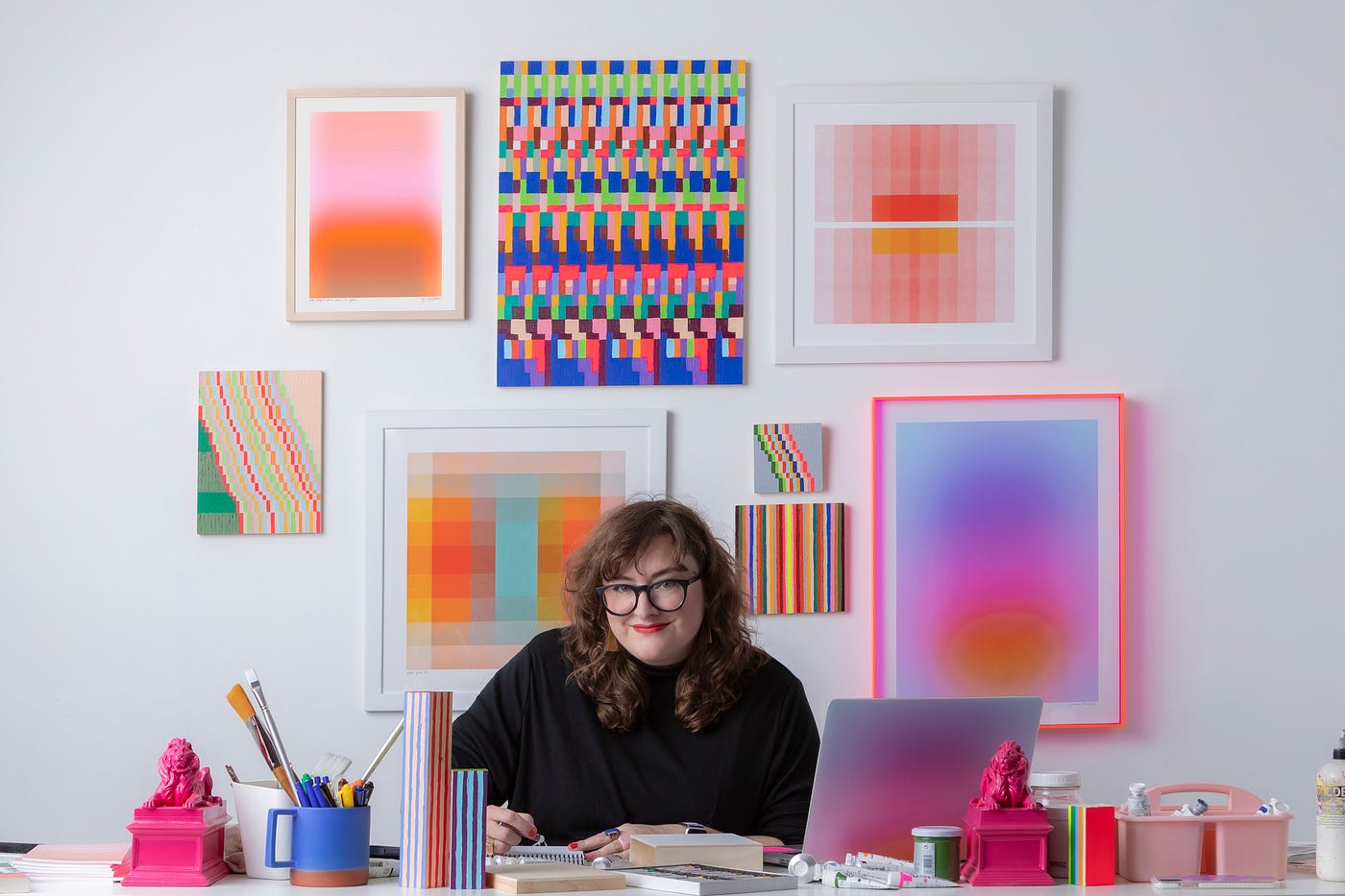
Jessica Poundstone is an abstract artist living and working in Portland, Oregon. Her work has been featured by Louis Vuitton, Dwell, Architectural Digest, SFMOMA and more. Jessica’s work is meant to help us get more deeply attuned to the joy, fun, adventure and wisdom that comes with exploring who we are and who we can become. www.jessicapoundstone.com.
Thank you so much for doing this with us! Can you tell us the story of how you grew up?
Igrew up in Portland, Oregon. I loved to read books, watch movies, snuggle with my dog, make art and generally stay inside :) I was always working on some art or craft related project — I remember creating handmade paper using our family blender, commandeering our garage as my own personal studio space, and trying to copy Edward Hopper paintings out of books from the library. My world was pretty small at the time without a ton of resources and in a pretty conservative religious setting, but the library could take me anywhere I wanted to go. (And it still does!)
Can you share a story with us about what brought you to this specific career path?
After graduating from college with a degree in Humanities and minors in writing and marketing, I launched into a 20-year career in marketing strategy and business writing, working for agencies and in-house at software companies. During all those years, I was always making art as a hobby. My art-making didn’t stop after I got married and had two kids, but it did slow down. Around 2018, I realized I wasn’t making much art at all anymore, and decided to carve out time to explore new ways of creating images digitally. Once I did that, I felt like I had discovered an entire language for myself, and was absolutely loving it. I started posting the work on Instagram, people started asking if they could buy it, and things snowballed from there! I quit my full-time job in 2021, and am now making art full time.
Can you tell us the most interesting story that happened to you since you began your career?
One of the funniest things that’s happened is when I was at the grocery store and, on an impulse, bought a copy of several different magazines — something I’d never normally do. I took the magazines to my room and was reading one of them, Real Simple, before bed. My husband was already asleep. About halfway through the magazine I turned a page and saw one of my own pieces featured in one of the stories! I was so excited I woke my husband up to show him!
What are some of the most interesting or exciting projects you are working on now?
I’ve been making a lot of repeat patterns recently, and look forward to partnering with some of my favorite companies to offer things like wallpaper and bedding. I’ll be headed to an artist residency in Washington this summer, so I’m looking forward to seeing what comes of that! My work will also be featured on a cruise ship that departs out of Italy — that’s a first for me! Other than that, I’m working away, pursuing growth and work that I’m excited about!
Who are some of the most interesting people you have interacted with? What was that like? Do you have any stories?
Many years ago I read about Rare Device, a small shop Brooklyn that was featuring art, artists and designer products. I was lucky enough to go visit it on a trip to New York. It was a magical space! Eventually, the owner of the store moved to San Francisco and the store moved there too. Years later I got to visit that store, which was then co-owned by Rena Tom and Lisa Congdon. They later sold it to Giselle Gyalzen, who — almost a decade after I visited the original Brooklyn store — asked if I wanted to sell my work there! That led to me having my very first solo show in the Rare Device Gallery. All of these women — Rena, Lisa and Giselle — are incredible businesswomen and humans, and it feels like magic that everything came full circle!
Where do you draw inspiration from? Can you share a story about that?
My biggest inspiration is color. I’ll have a “craving” for a color, and then play around with how it turns out. One of my most-collected pieces is Color Space 27: Keep Love at The Center. I was getting ready to go to bed and I literally had a vision of pink, red and yellow together. I tried, but wasn’t able to go back to sleep until I made the piece!
How have you used your success to bring goodness to the world?
If I have brought goodness to the world with my artwork, I hope it’s come in a few ways: 1) Celebrating and normalizing art as something that can serve as a source of inspiration and comfort, and 2) Helping other artists get more comfortable sharing their work with the world.
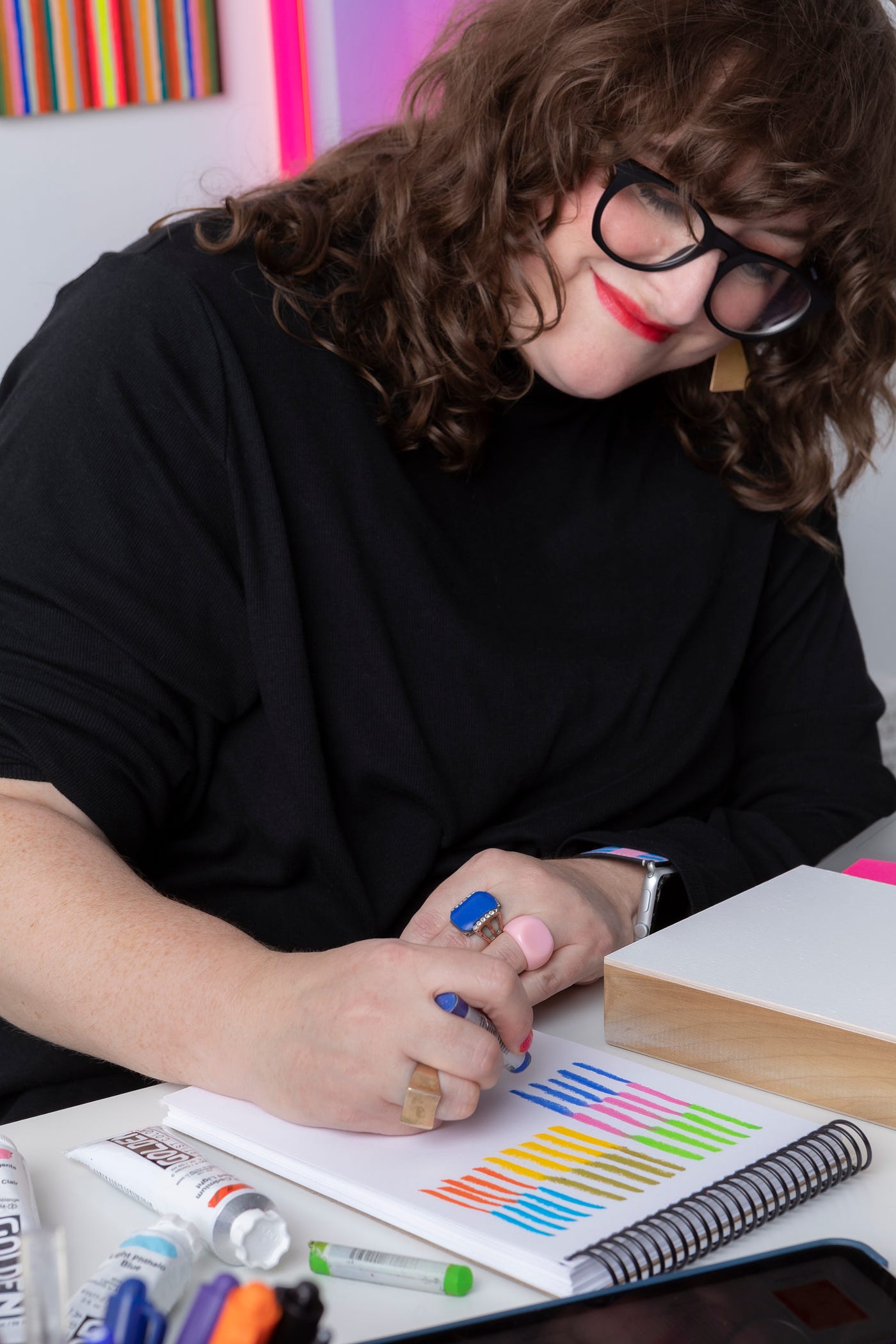
What are your “5 things I wish someone told me when I first started” and why. Please share a story or example for each.
I quit my full time job in corporate America two years ago to become an artist full time. As someone with nearly 20 years of experience in the business world and experience running side hustles, I assumed I knew most of what I needed to know about growing my art business. But, as it turns out, things are different here :)
1 . Explaining your work is imperative. People connect with meaning.
At the beginning of my art practice, I was posting pictures of the work I was making on Instagram with little or no explanation. My thought was “well, either people like the work and want it in their lives or they don’t and that’s fine.” When I reached out to an art mentor to get advice, they said, “Yeah, this work is great, but there’s lots of great work out there. Why should I care about this work?” That unlocked it for me: I realized that this was true for me as well: I don’t just connect with images, I connect with stories, and connect with artists as people. I want to understand the “why” behind work: it gives it so much more resonance and meaning.
2 . Titles of your artwork matter. From a practical standpoint, when cataloging your own work, it’s very helpful to have unique titles for each one. A long series of “Untitled” work is going to get difficult to manage. It’s also missing an opportunity to connect with your collectors.
When I realized I could create artwork titles that shared the feelings I wanted people to explore in my work (For example, my Color Cloud series has titles like, “A New Thing Is On the Way” and “Leave It Open” it made titling so much more fulfilling, as well as creating an opportunity to share a deeper connection with my collectors.
3 . Defining exactly what you want from your art career is essential — there are so many options that don’t get talked about!
If your primary goal as an artist is to show your work in galleries, you’ll want to embark on a very specific path that involves building relationships with gallery owners, scheduling studio visits, and being an active, regular participant in the gallery world of openings, shows. But that’s only one option of literally hundreds! There are artists whose goal is to make the majority of their revenue selling work directly to their collectors through their own websites, for example. For those artists, it’s important to build a community of collectors through regular communications directly (through email newsletters) and social media, build a thoughtful brand presence, and understand how to create really positive collector experiences. Other artists earn revenue other ways — or with a mix: licensing their work to brands, creating online courses, teaching travel workshops and more. There is no right or wrong way — it’s important to get honest with yourself and decide which way is calling to you. (And don’t worry, you can always change your mind!)
4 . Pricing can be tricky.
Let’s face it, pricing in the art world is a little bit bonkers. A famous painter can sell a piece for $1 million dollars — that same exact piece might only be worth $100 for an emerging artist. That’s because so much of the value of art is about context. As an artist trying to price work, the number one rule of thumb is to pay yourself! A piece of artwork should be priced at least at a number that pays you back for the materials you used and time spent on the piece. Beyond that, the best route to setting your pricing is to look at prices for a few folks who are roughly at your same level of experience, and doing similar work and see what their prices are. Do not go by sites like Etsy where many artists (sadly!) underprice their work. Instead, look at sites like Saatchi Art, or individual artist websites with a significant following. And don’t forget to re-evaluate your pricing every year or so! As you grow as an artist, the value of your work grows too.
5 . Excellent photography- of you and your work — is an essential investment.
Because your work is visual, you’ve got to invest in the visual representation of you and your work. I waited a very long time to get professional pictures taken of myself — I submitted many selfies for a bio pic! The professional pictures I had taken (thank you Dibble Photography!) not only leveled up my brand, they actually made me see myself differently — as a “real” artist! The external shift and the internal shift were equally important, and I wish I’d done it sooner!
You are a person of great influence. If you could inspire a movement that would bring the most amount of good to the most amount of people, what would that be? You never know what your idea can trigger. :-)
I would love to inspire a movement that would help people learn how to recognize, access and share their feelings in positive, respectful ways. Thinking about the incredible connections we can make with each other when we can really listen and share what’s in our hearts and minds is so inspiring to me, and has brought me so much joy and fulfillment.
We have been blessed that some of the biggest names in Business, VC funding, Sports, and Entertainment read this column. Is there a person in the world, or in the US whom you would love to have a private breakfast or lunch with, and why? He or she just might see this.
I would love to have lunch with Tina Fey! I have felt so connected to her for so many years through SNL and 30 Rock, and honestly I just want to hang out and have an amazing time. I also recently started Improv classes and I am loving it — I’d love to hear more about the big and small ways improv has shaped her outlook, friendships and career, and learn more about her inner experiences.
What is the best way our readers can follow you on social media?
I am most active on Instagram at www.instagram.com/jessicapoundstone
This was very inspiring. Thank you so much for joining us!