For me, imagination was not just an escape — it was a way of unlocking new layers of reality that persisted even when I returned to school, my family, and to all of the scary things that loom large for a kid.
As part of my series about “authors who are making an important social impact”, I had the pleasure of interviewing Jeremy Richards.
Jeremy Richards is an executive coach, bestselling author, keynote speaker, and Senior Leadership Development Manager based in the Seattle area. Earlier this year, Jeremy released his new book, The Accomplished Creative: Overcome Imposter Syndrome, Forge Courage, and Tap Into Limitless Creativity, which recently became an international bestseller. His clients have included Amazon, Microsoft, Starbucks, The Gates Foundation, The Federal Reserve, and the US Army. Jeremy’s work has appeared widely, including in Forbes, Poetry, McSweeney’s, The Huffington Post, and on National Public Radio’s Morning Edition and All Things Considered. He holds an MA in cultural studies from The University of Washington.
Thank you so much for joining us in this interview series! Before we dive into the main focus of our interview, our readers would love to “get to know you” a bit better. Can you tell us a bit about your childhood backstory?
Well, I can share a specific story that marked what I see as the end of my childhood and the revelation that set everything else in motion. Growing up, my parents both struggled a lot financially, and after their divorce, my father and I were living in the carpeted attic of a halfway house. I was 14, so just a kid, but feeling more and more like I needed to define my own path. We were surrounded by folks who were transitioning from prison, overcoming addiction, and also looking for their own way out.
One night, one of these neighbors was up late, blasting ACDC and throwing beer cans out of the window. My dad was fed up and he went to confront the guy, who was this big biker with a burning skull tattoo on his neck. He shoved my dad back and threated to kill him in front of me. Fortunately, we were able to call the police and find a temporary place to stay until we were safe, but that moment is what pushed me to finally ask, How did we end up here? Why do people do what they do? The next morning I rode my skateboard to the library and started a 30-year journey of studying everything I could about human behavior.
When you were younger, was there a book that you read that inspired you to take action or changed your life? Can you share a story about that?
When I was about 8 years old, a cousin gave me a copy of The Phantom Tollbooth by Norton Juster. Looking back, it makes sense why I was drawn to a story about a boy finding escape through imagination, word play, and friendship. I was transported. I remember running out into the wheat fields behind our duplex and conjuring new worlds in the clouds. For me, imagination was not just an escape — it was a way of unlocking new layers of reality that persisted even when I “returned” to school, my family, and to all of the scary things that loom large for a kid. It suddenly all felt like something I could contain.
It has been said that our mistakes can be our greatest teachers. Can you share a story about the funniest mistake you made when you were first starting? Can you tell us what lesson you learned from that?
I started in team building and corporate training about 20 years ago through applied improvisation. While we like to say that “there are no mistakes in improv,” it’s hard not to cringe sometimes when I look back at those earliest workshops. There was one event for a giant tech company, set in a bright conference room with about a hundred people packed in. I walked them through a few games as ice breakers, creativity boosters, and collaboration exercises, and assumed that all of the laughter and fun defined success. I recall one improv scene at the end of the workshop, where their Senior VP was holding me in a headlock and giving me a noogie.
But when everything was wrapping up, someone raised their hand and asked, “How does all of this apply to our work?” If you asked me that now I could give you a two-hour lecture, cite case studies, dive into the neuroscience, metrics, and suggestions for immediate application. But at the time, I hadn’t thought it through and didn’t have a good answer. I realized how crucial it is to give context and framing for any learning experience.
Can you describe how you aim to make a significant social impact with your book?
The feedback I’ve been hearing lately about the book is, “Thank you — this came at just the right time.” This is from fellow creatives who were blocked with their own creative projects, feeling intimidated at work, or just unsure how to express themselves. I focus on imposter syndrome because that phrase is in the zeitgeist and it resonates with so many people — the research says that about 70% of adults have experienced imposter syndrome at some point. But I also wanted to question our assumptions about imposter syndrome, including acknowledging systemic factors like racism, misogyny, and toxic leadership practices that influence what I call “imposter culture.”
With that bigger picture, I’m now working more with corporate leaders to help them uncover signs of imposter culture in their organizations, turn it around, and build a “creator culture” that attracts and develops high performers.
Can you share with us the most interesting story that you shared in your book?
One story that readers ask me about is my experience in a Tibetan monastery in India right after college. I stayed there for a few weeks and met with Lungtok Tenpai Nyima, also known as His Holiness The 33rd Menri Trizin. He patiently tried to teach me these abstract concepts of the ancient Bon tradition, but I wasn’t ready for it.
Then, a week into my stay, a monsoon hit and everything changed. Heavy rains washed a boulder across the main village road, and the Menri Trizin walked down the hill from his home, spinning a yellow umbrella. He stopped to observe a group of monks lined up to break the boulder down.
Wait, do I have pictures of this somewhere? Oh, here you go:

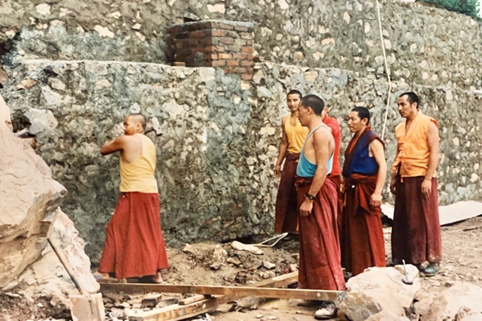
The boulder was about seven feet in diameter, blocking over half the road, but the monks looked undaunted. One at a time, each monk would take turns sitting on top of the boulder, holding a large chisel. The next monk in line would then pick up a sledgehammer and swing away. With each swing, a tiny demolition of rock and dust exploded from the chisel point.
“Are you sure that will work?” I asked. “That looks like it will take forever.”
The Menri Trizin looked over at me. He laughed and winked, then nodded at the monks, still swinging and chiseling.
Each day on my way to and from the classroom or the dining hall, I walked past the line of monks working on the boulder. Each day it looked a little smaller, but still impossible. Then, finally, about three weeks after the boulder first slid into the road, it was gone. Dust. The monks returned to their meditations and studies. I looked up the road and there was the Menri Trizin, spinning his yellow umbrella as he walked past.
“That’s amazing!” I said. “The boulder is gone!”
“Gone?” he said. “Not gone, but gone.” He laughed and kept walking.
“Did you rig that whole mudslide and boulder as an elaborate metaphor on my account?” I called back. “If so, that’s a lot of work for a lesson!”
“You think too much!” he said without turning back.
What was the “aha moment” or series of events that made you decide to bring your message to the greater world? Can you share a story about that?
Lately, I’ve been coaching and presenting a lot on corporate culture. In framing priorities, the story that changed everything for me was August 31st, 2012: My newborn daughter, Julieta, was two days old. Her tiny fists gripped the corners of her thin hospital blanket, decorated with pink and yellow ducklings. Somehow she slept with a permanent grin, cresting in a dimple on her left cheek. She was perfect.
Only, I couldn’t hold her. At this moment, she was sleeping inside an incubation chamber in Swedish Hospital’s Neonatal Intensive Care Unit. A few minutes after she was born, she was suffering from irregular breathing, and the doctors rushed her into intensive care for observation.
And if I’m honest, in that moment not only could I not hold my baby daughter, I wasn’t even there. Instead, was sitting in the waiting room next door, balancing my laptop on my knees and trying to adjust a row of green and red status dots on a spreadsheet.
You see, when I told my manager at the time that my wife was going into labor, her response was: “Congratulations!”
Then: “Can you please make sure the PMO report is ready by Thursday?”
This wasn’t just about a single manager, who was dealing with pressures from her own manager. What still sticks with me to this day is the compromise I made in that moment. Why did I feel so much pressure to perform and deliver, so much that I could ignore the bigger picture, the bigger priorities for my family and my life?
When I reflect on this and many similar stories I’ve heard from clients over the years, I recognize the patterns of poor leadership — what causes that empathy to wither, what leaves work/life balance in tatters, and what sabotages the best interests of employees, teams, and organizations. This is what I mean by imposter culture.
Without sharing specific names, can you tell us a story about a particular individual who was impacted or helped by your cause?
I’ve seen countless transformations over the years, which is always the biggest reward for a coach.
To better preserve anonymity, I’ll share a story of a client I worked with over 10 years ago. He was a senior executive with an intimidating reputation as a special forces veteran, and he carried that military culture into his approach with his team. In some ways, this served him well in driving high standards and discipline. Each member of his team was a high performer, but over time, he started losing star players. Their exit interviews frequently mentioned burnout and a lack of empathy. When I worked with this leader 1:1, it was clear that he cared about his team, and he had a vulnerable side that he rarely showed in public (plus, he taught himself how to play the ukulele and had an operatic singing voice). The burnout was affecting him, too — he would show up to our sessions washing down caffeine pills with a grande iced coffee.
Over time, with the right framework and open-ended questions, he started to realize where he was sabotaging himself as a leader. He began opening up to his team, letting go of perfectionism, and focusing supporting sustainable performance instead of spikes and dips in activity. He became what I call an exponential leader because he not only transformed himself, he started sharing these lessons with his peers, his team, and the larger organization — it was both an individual and cultural change. That’s the kind of momentum we can create with a simple, open conversation.
Are there three things the community/society/politicians can do to help you address the root of the problem you are trying to solve?
Since my graduate work was in cultural studies, I tend to ponder about the big picture, patterns of behavior, historical movements, etc. But few people wake up and suddenly change because of a lecture on Gramscian hegemony. For anyone in a position of power, I’d ask them first to get transparent feedback about their individual impact. An anonymous 360 is a good place to start. Healthy feedback also requires a culture of trust, so an effective leader needs to reward respectful push back, interrogate their own assumptions, and remain forthright about their own failures so others have the courage to own their mistakes.
How do you define “Leadership”? Can you explain what you mean or give an example?
I embrace the definition from the Greenleaf Center for Servant Leadership, which calls servant leadership “a philosophy and set of practices that enriches the lives of individuals, builds better organizations, and ultimately creates a more just and caring world.” In day-to-day practices, they demonstrate a balance of steady principles and a willingness to change, always listening and learning from their teams instead of insisting on a monolithic hierarchy. You can probably think of a few historic examples such as Nelson Mandela or Mother Teresa, or modern corporate examples like Latasha Gillespie at Amazon Studios and Radihika Duggal at CommonBond.
What are your “5 things I wish someone told me when I first started” and why?
Here are 5 things I wish I knew earlier about courage and creativity:
- There’s no such thing as an inner critic. Yes, we each have an inner voice, and it’s often critical, but I no longer call this voice the “inner critic.” Calling this part of ourselves a “critic” adds too much authority, and attacking it as an “inner enemy” is also destructive. I call this part of ourselves an inner guard, because the guard can be both your protector and your jailor. You need to understand what this inner guard fears and what it’s trying to protect you from. Then, come to terms with the part of you that can move through that fear in a more courageous way.
- Creativity isn’t a bank. Once I was back stage before a big improv show, and when someone made a joke, I said, “Hey, save it for the stage!” Our artistic director, Randy Dixon, turned to me and said, “What do you mean, ‘Save it for the stage?’ Creativity isn’t a bank, it’s a muscle!” That changed the way I think about and practice creativity. At times, your creative source might need rest and revitalization, but it’s not a limited resource. The more you create, the stronger that creative force gets.
- Mindfulness isn’t perfect. Saying that you can’t meditate because you slip in and out of focus is like saying you can’t lift weights because you keep putting them down. That activity, the flitting away and returning to the moment, represents your reps in mindfulness practice. That is how you fortify attention and presence — by recognizing when you’re lost, but always returning.
- The answer to exhaustion isn’t always rest. One evening, over a bottle of wine and a view of Puget Sound, the poet David Whyte turned to his friend David Steindl-Rast and said, “Speak to me of exhaustion.” After a moment of reflection, Steindl-Rast said, “David, sometimes the answer to exhaustion is not rest. Sometimes the answer to exhaustion is wholeheartedness.” Granted, my family also lives by the quote from Tom Parker: “If you don’t know what you want, it’s probably sleep.” But when rest isn’t the issue, I often ask myself: Am I truly exhausted, or just half-hearted? What would it take to be whole-hearted in this moment?
- “These mountains that you are carrying, you were only supposed to climb.” That’s a quote from the poet Najwa Zebian. Related to wholeheartedness, I often think about the mountains I’ve climbed but still carry. Can you imagine giving up the weight of a mountain that’s been with you for half a lifetime? Can you imagine the lightness, the relief, the revelation of what you buried all this time? Setting down the mountain (or slowly letting it demolish) is both painful and liberating. There are always more mountains to climb, but you learn to take them one-by-one.
Can you please give us your favorite “Life Lesson Quote”? Can you share how that was relevant to you in your life?
As you can tell, I collect a lot of quotes. Here’s another favorite: “You’re never more than one thought away from a completely new experience of being alive” — Sid Banks.
There’s a bit of a paradox here because that “new experience of being alive” feels like it transcends thought, and yet we’re trying to think ourselves beyond thinking. One of the coaching methodologies I studied is from the NeuroLeadership Institute, founded by David Rock. In Your Brain at Work, Rock cites brain imaging research of people having creative insights in real time. Right before the insight, there’s usually a relaxation into alpha brain waves, almost meditative, and then BOOM, their gamma brain waves spike, indicating a whole-brain cascade of connections, boosting dopamine and norepinephrine. That’s often when we feel most alive and in flow. So when I’m stuck, I look for ways to oscillate between mindful reflection and inspired energy, meditation and exercise … often, the biggest breakthroughs happen in those moments in between.
Is there a person in the world, or in the US with whom you would like to have a private breakfast or lunch with, and why? He or she might just see this, especially if we tag them. :-)
I’m consistently in awe of the psychologist and author Kelly McGonigal, who has written a lot about willpower, stress, and the social and psychological benefits of exercise. Her TED Talk on resilience was a profound inspiration for one of the courses I taught at Amazon. From her writing and podcast appearances, she strikes me as someone who would be an inspiring lunch guest just to learn about her latest research and how she’s applying it personally and in wider communities.
How can our readers further follow your work online?
jeremyrichards.com. From there, you can also connect with me on LinkedIn.
This was very meaningful, thank you so much. We wish you only continued success on your great work!
Thank you! I thoroughly enjoyed the interview.