Food and beverage is defined by constant trends: what to eat, what to drink, what’s having a moment. But the dirty martini is timeless, and mixers and garnishes have always been, and will always be, part of what makes a cocktail or mocktail.
As a part of our series about women who are shaking things up in their industry, we had the pleasure of interviewing Halli Sigel and Shelby Sears.
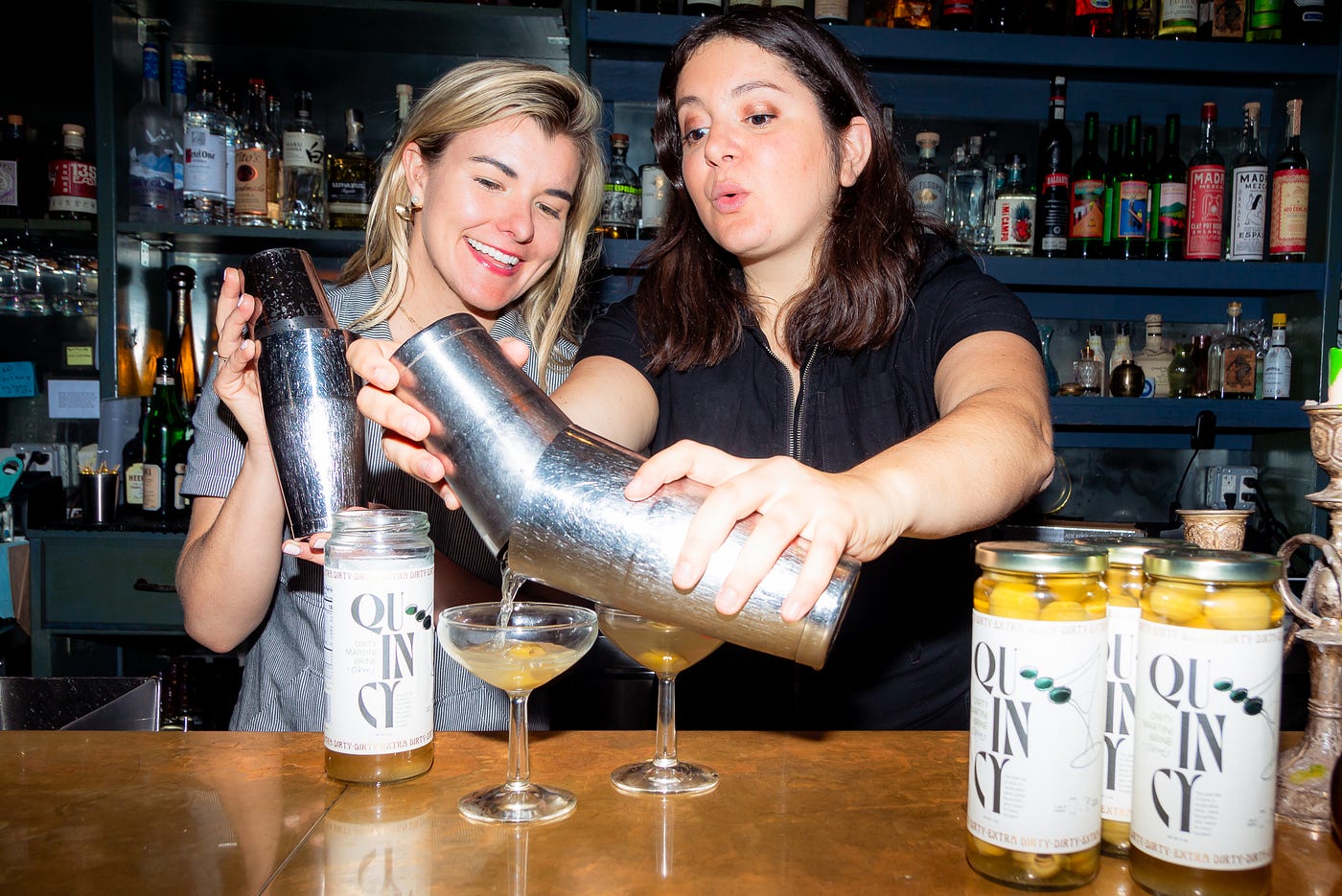
Halli Sigel and Shelby Sears are the co-founders of Quincy, a female-founded cocktail mixer and garnish brand redefining the way people enjoy dirty martinis at home. With more than two decades of combined experience across operations, sales, and marketing, the duo joined forces over a shared love of entertaining and a belief that the ingredients behind a great cocktail deserve just as much attention as the spirits themselves. Together, they’re shaking up an overlooked category with premium, thoughtfully crafted products, beginning with Quincy’s signature two-in-one olive brine and garnish. As Quincy continues to expand its retail presence nationwide, the founders are on a mission to elevate the at-home cocktail experience and bring a fresh perspective to the beverage industry.
Thank you so much for joining us in this interview series! Before we dig in, our readers would like to get to know you a bit more. Can you tell us a bit about your “backstory”? What led you to this particular career path?
Halli: We were actually introduced because of our shared love of a dirty martini, which feels fitting given where we ended up. We’re both happiest with a full table at home, and somewhere along the way each of us became the resident bartender in our friend group. Professionally, we come from complementary worlds. I spent the first ten years of her career at the intersection of operations and experience at fast-growing, venture-backed companies like Casper and Chief, where I was employee number seven, while Shelby spent twelve years in sales and marketing at category-defining CPG brands like Red Bull and Fiji. Combining those backgrounds with a shared obsession for making guests feel taken care of, Quincy was a natural next step: a company devoted to a great drink.
Can you tell our readers what it is about the work you’re doing that’s disruptive?
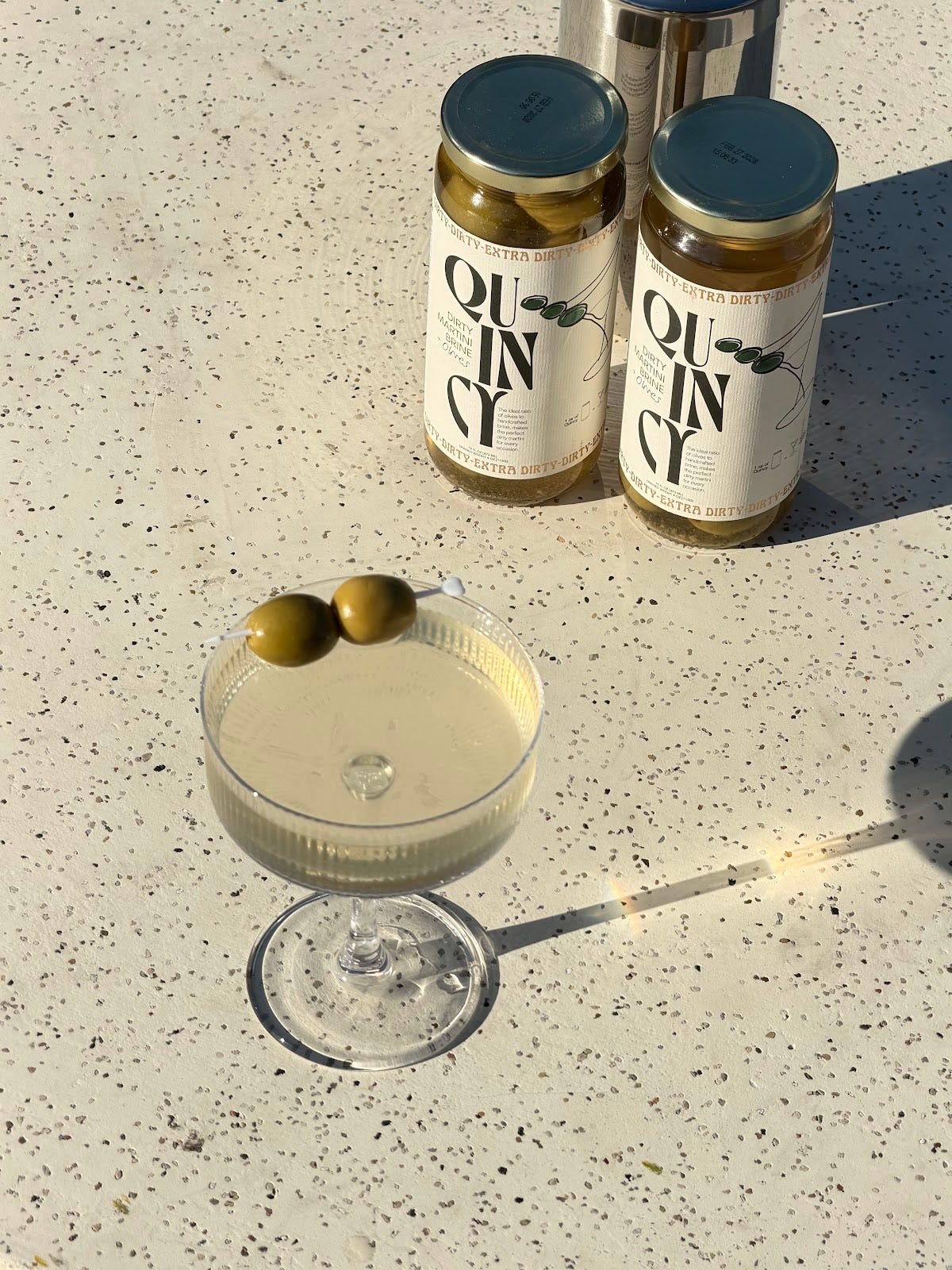
Shelby: Mixers and garnishes are essential to two massive, fast-evolving categories (alcoholic and non-alcoholic beverages). Yet the category that underpins both of these industries has seen little to no innovation. That’s why we created Quincy to redefine an overlooked but foundational part of beverage — the other half of the glass. Quincy treats mixers and garnishes as a consumer brand, not a commodity: clean, premium, easy-to-use products designed around the drinks people actually consume. Our first product is the first mixer to combine the right ratio of premium brine and garnish in one container. One jar makes about 14 dirty martinis and works beautifully in zero-proof drinks too. The dirty martini is our entry point, not our endpoint: we’re raising the standard for a category that’s been left behind, so people can make the drinks they love at their favorite bars at home.
Can you share a story about the funniest mistake you made when you were first starting? Can you tell us what lesson you learned from that?
Shelby: Well in getting started, we first thought we could make the brine ourselves. Two city girls (one in NYC, one in SF) spent a very optimistic weekend with cheesecloth and mason jars, “developing recipes” in kitchens with barely any counter space. Then it hit us: we’re not a homemade cookie brand. “Made in my kitchen” isn’t a charming origin story for a premium cocktail product. It’s a liability. What people want is exceptional olives from the right region, sourced and brined by people who’ve been doing it for generations. And a brine developed alongside the bartenders pouring the best martinis. The lesson: Know what kind of brand you’re building before you start building it. Craft is a beautiful thing, but sometimes the craft is in the sourcing and the standards, not in doing everything yourself. Our job was never to be the makers. It was to be the curators who bring the best version of a category to people’s home bars and favorite places to eat/drink out.
We all need a little help along the journey. Who have been some of your mentors? Can you share a story about how they made an impact?
Halli: I’ve spent my entire career inside startups, and while leadership will always be part of that answer (my CEO at Chief in particular shaped how I think about building a company), the people who influenced me most were often the ones working right beside me. When people talk about mentorship, they tend to picture someone further along the same path. What I’ve found is that the greatest growth comes from people whose experience is simply different from mine. Coworkers in engineering, finance, sales, and customer support each showed me a different way to see the same business, and the managers I worked under taught me as much through their contrasting styles as through any advice they gave. Today, when I’m leading at Quincy, I’m drawing on all of those perspectives at once.
In today’s parlance, being disruptive is usually a positive adjective. But is disrupting always good? When do we say the converse, that a system or structure has ‘withstood the test of time’?
Shelby: No, disrupting isn’t always good. From my perspective, disruption for its own sake, or built on a passing trend, creates noise, not necessarily lasting value. What’s exciting about what we’re disrupting is that it’s a space that has withstood the test of time. Food and beverage is defined by constant trends: what to eat, what to drink, what’s having a moment. But the dirty martini is timeless, and mixers and garnishes have always been, and will always be, part of what makes a cocktail or mocktail. We’re not inventing demand or chasing a trend or launching something net-new and hoping it sticks. Instead, we see disrupting something timeless as a kind of disruption that can be built to last.
Can you articulate to our readers when disrupting an industry is positive, and when disrupting an industry is ‘not so positive’? Can you share some examples of what you mean?
Halli: Positive disruption improves the experience; negative disruption only changes the business model. The question to ask is whether the customer’s life actually got better or whether someone just found a new way to capture margin. For us, disruption is positive when it makes something people already love even better. The martini is one of the most storied drinks in the world, and we have no interest in reinventing it. What we noticed was that the other half of the glass, the brine and the olive, had been overlooked for decades while spirits became more premium every year. Disruption becomes less positive when it ignores why a tradition exists in the first place, or when it replaces quality with novelty. The craft cocktail movement is a great example of the former: it raised standards across the entire bar. The flood of hard seltzer copycats a few years ago shows the latter, where a genuine innovation was diluted by brands chasing a trend rather than serving a drinker.
Can you share 3 of the best words of advice you’ve gotten along your journey? Please give a story or example for each.
1. Comparison is the thief of joy
It’s tempting in consumer to keep score against everyone else, because so much of the industry happens in public. We’ve learned that the moment we start comparing our timeline to someone else’s highlight reel, we stop doing the work that actually builds Quincy. Now, when we notice that pull, we treat it as a cue to turn back to our own priorities and the people who already love what we make.
2. Don’t forget you have a personal life
Someone once reminded us that a company built entirely on its founders’ exhaustion isn’t really built to last. We work hard, but we’re intentional about protecting our time outside of Quincy, because a team learns what’s expected by watching its leaders. If we want to build a culture where people do their best work and stay for the long run, it has to start with us modeling balance rather than burnout.
3. Fail fast and fail hard
This advice gave us permission to be wrong. Early-stage companies are full of unknowns, and waiting for certainty usually means waiting too long. We’d rather run a small experiment this week, learn from it, and adjust than spend a quarter debating it. Some of our most useful lessons have come from ideas that didn’t pan out, because they clarified exactly where our energy should go next.
We are sure you aren’t done. How are you going to shake things up next?
Halli: Not even close. Martinis are where we started, but there’s so much more we want to do with the other half of the glass. We’re exploring new formats that make it easier to bring Quincy into more moments, along with new mixes that give hosts and bartenders even more ways to play. Our goal has always been to make the ingredients beside the spirit feel just as considered as the spirit itself, and we have plenty of ideas left for how to do that.
In your opinion, what are the biggest challenges faced by ‘women disruptors’ that aren’t typically faced by their male counterparts?
Halli: This is specific to our industry but spirits and bar culture have long been shaped by men, and as two women building a martini brand, we sometimes notice assumptions about who the expert in the room is supposed to be. We’ve found that knowing our product and our category inside and out is the quickest way to shift that dynamic. The encouraging part is that the people actually drinking martinis look very different from the industry’s old image, and brands that reflect who those drinkers really are will have an advantage.
Do you have a book/podcast/talk that’s had a deep impact on your thinking? Can you share a story with us?
Shelby: I’d have to say the classic book The Alchemist. Because every entrepreneur wants the same ending: the exit, the acquisition, the scrappy-brand-to-massive-success story with a bow tied around it. However, one of the book’s main messages is that the journey itself is the point. Something I’ve heard over and over from other founders, once all is said and done, is that the building part is what they end up missing most. It’s what’s most nostalgic. And honestly, with all the stress and pressure in the day-to-day grind, it’s a good reminder to enjoy the journey. After all, we serve the people who love hosting, pouring, and gathering; a world that’s meant to be fun.
You are a person of great influence. If you could inspire a movement that would bring the most amount of good to the most amount of people, what would that be? You never know what your idea can trigger. :-)
Shelby: With blue cheese owning the stuffed-olive spotlight, I’d inspire the world to give brie a shot at martini stardom. A brie-stuffed olive, popped in the freezer for a quick chill and dropped into a dirty martini, melts into the brine in the softest, most delicious way. Stuffed olives aside, on a more sentimental front -I’d want to start a movement around holding close the truth that time is fleeting. It’s something we’re always forgetting, and that’s how we end up sweating the gossip, the stress, the fights that don’t matter. If we could actually keep this top of mind? Imagine: enjoying the morning commute (even when you’re late), being ballsy enough to ask them out (even if you get rejected), starting a company (even if you fail). I think it would make us all a little more present, a little more daring, and honestly, a lot more fulfilled. I think the world could use more of that.
Can you please give us your favorite “Life Lesson Quote”? Can you share how that was relevant to you in your life?
Halli: “Hospitality is present when something happens for you. It is absent when something happens to you.” We came across this line from Danny Meyer’s Setting the Table, and it captures how we think about everything at Quincy. Long before we started a company, we were the friends who loved hosting, and the best part was always the small details that made a guest feel looked after. That philosophy carries into how we treat our customers, our retail partners, and our team. Whether someone is pouring our martini mix at home or stocking it on a shelf, we want the experience to feel like something done for them.
How can our readers follow you online?
Halli: The best place to start is drinkquincy.com, and for daily inspiration, follow us on Instagram at @drinkquincy. We love seeing how people make Quincy part of their own gatherings, so tag us the next time you shake up a dirty martini. We’d also be glad to connect with readers on LinkedIn, where we share more about the founder side of the journey.
This was very inspiring. Thank you so much for joining us!