
It turns out that jazz musicians do all sorts of special stuff in their brains when they improvise – they tamp down their executive judge and the areas of the brain related to listening, connection, and collaboration LIGHT UP.
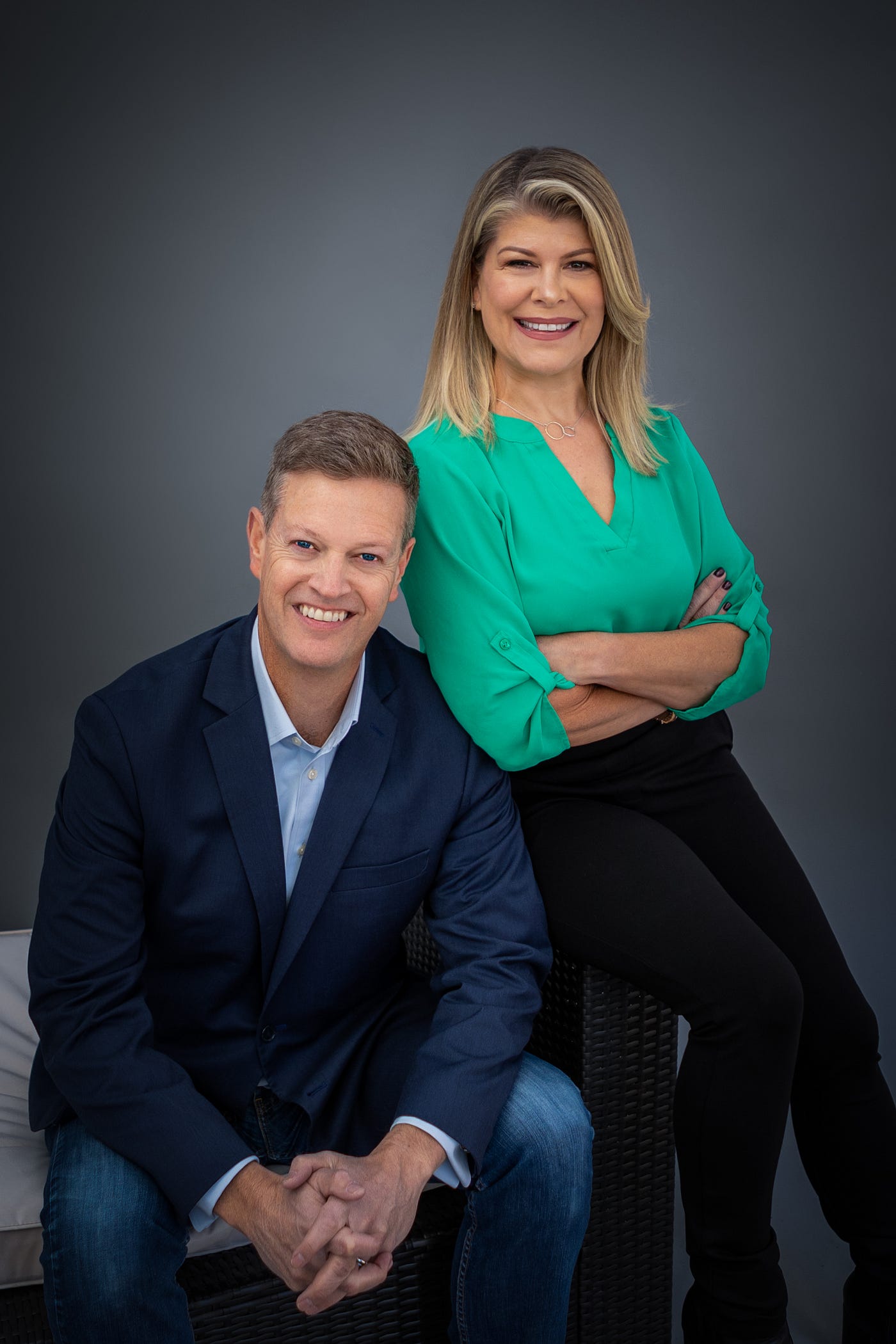
As a part of our series about lessons from Thriving Power Couples, I had the pleasure of interviewing Gail and Bruce Montgomery, Co-Founders of ExperienceYes.
Gail and Bruce of ExperienceYes, have developed and trademarked BRiQ™ (Business Relationship IQ), a training program developing team and leader “power” skills in the areas of the improv mindset, emotional intelligence, empathy, and influence.
They are like the Batman and Robin of the business world, except instead of fighting crime, they're fighting for more sales, retaining clients, and creating high-performing teams. Their superpower is using data-driven analytics to navigate the wild world of business with proven results and a sense of humor.
As CEO, Gail’s background includes HR and SaaS tech start-ups, and she is certified as an Emotional Intelligence Practitioner.
As President, Bruce has extensive experience in IT and Management consulting and is certified in Design Thinking.
After Bruce received his EMBA from the University of Denver, he and Gail joined as faculty partners. They have co-authored two books: “The Improv Mindset” and “CHANGE! A Leaders Guide to Fixing Sh*t.”
You can follow their work at www.experienceyes.com.
Thank you so much for doing this with us! Can you tell us a story about what brought you two to your respective career paths?
Gail:
Sure! My career started in New York City after I graduated from college. I went to pursue an acting career in New York City as a music theater actress. And, while that was awesome, it also really didn't pay the bills for a long time. So, I ended up temping at various companies in New York City, one of which that I continued to temp at quite a bit was AIG. And at one point AIG finally decided to offer me a job and I took it and ended up working in the corporate human resources office as a recruiter, hiring lawyers and actuaries and all sorts of folks for the corporate headquarters for AIG. It was fast paced and crazy. And I never thought I would do that.
That led to me having our first child together in New York City and, with no family around, we moved to Colorado to be nearer to Bruce's parents. Such a gift! And over the next several years, I was part of different arts organization boards. I became the executive director of a nonprofit theater company in Evergreen, CO and did that for a while.
Eventually I worked at a startup technology company, a SaaS company, and I had the pleasure and the opportunity to develop a change management and development arm of the business. I got a lot of great experience over the next four and a half years of doing that as I got my feet back into the corporate world. It was during that time that we started ExperienceYes. Wow. That was a lot. Your turn Bruce.
Bruce:
OK! Let’s see, I, much like Gail, started out as a professional actor in New York City, having studied it in college and made our way from New Mexico to New York to pursue an acting dream. I did that for a while – the better of seven and a half or eight years, until we had our first child, Jack. It was at that point I realized that we needed to move out of New York, which meant I needed to get a different job. So, I ended up really cutting my professional teeth in the management consulting space, working for an IT management consulting firm, traveling the country and doing IT implementations of various sizes and complexities.
I stayed in Information Technology for the next 10 or 15 years, and in the latter part of my experience I enrolled in the Executive MBA program at the University of Denver 2011. In that program they kept asking us a question of what do you love to do? Can you turn that into a business? What do you love to do? Can you turn that into a business?
At this time in my career, Gail and I had been doing comedic improv for the better part of seven or eight years. We didn't do it when we were in New York City when we were actors, but we found it when we came to our little mountain town, Evergreen, and just fell in love with it. I became really interested in how improv works and why things are funny and why listening intently and intensely matters.
So, during my EMBA, I kept coming back to the fact that, “I really love improv.” I mean, I REALLY love improv. And then I started wondering if I could turn that into a business somehow. And, you know, what’s interesting is that I never liked fluffy communications classes. Those were the classes I liked least. And so, I Googled “neuroscience and improv” and came up with a study where they put jazz musicians in an MRI machine and took a look at their brains.
It turns out that jazz musicians do all sorts of special stuff in their brains when they improvise – they tamp down their executive judge and the areas of the brain related to listening, connection, and collaboration LIGHT UP. And I went, “This absolutely happens in a comedic improviser’s brain.”
And I started to think, “Wouldn’t leaders and teams want to know how to do this? Wouldn’t they want to perform and listen BETTER?” And then it hit me – here was my entrepreneurial business – using the neuroscience of improv to improve team and leader performance. And ExperienceYes, our business, was born.
Can you share the most interesting story that occurred since you two got married?
Gail:
Well, honestly, Bruce and I have had a pretty interesting life. The first significant thing that comes to mind that many people find interesting was a bicycle trip that we took across the United States many years ago. I came to Bruce and asked him; I was just feeling stuck in New York and disenchanted with the vibe and how negative folks were. And I know it’s just that New York is fast paced. I just longed for connection - and connection specifically, I think, with Bruce. And some friends of ours had done something similar to this, so it seemed like it was at least possible.
When I brought it up to Bruce, he was a little hesitant at first and then I think he kind of got on board. And so, we sublet our apartment and went and did over 3000 miles cross country, from Oregon to Michigan, completely untrained. I think we had one training ride of 18 miles or something like that in Central Park. And then we just flew our bikes and ourselves out to Oregon and started our journey.
And what can I say about the trip? It was 11 weeks. And it was a really fascinating thing to see the world at an average of about 15 miles an hour. The United States is absolutely beautiful.
It totally restored my faith in humanity and the goodness and the kindness in people. There were a lot of adventures that we had during that time, not limited to meeting a foreman of a 75,000-acre wheat ranch who helped us after we had a little bit of a bike crash and had to kind of figure things out on our own.
And it also really connected me more to you, Bruce, and to just my best friend. It reminded me of the things that I loved about him and about us. It was just an interesting experience and an exceptional way to kind of draw closer to one another.
Bruce:
It's funny, I recall it to you, Gail, that it was my first experience with long form improv, although I didn't know that's what I was doing with the creation of Leonard. I would get very bored. And I created this character that just kept us company for monologue after monologue. He was an Englishman who had been hit on the head by his mother and lost part of his tongue. And that's where it started. So, I improv-ed, much like the experience of the entire trip was “an improv”…every day.
What inspired you to work together?
Bruce:
It's funny, we started our careers working together. Gail and I went to the College of Santa Fe in Santa Fe, New Mexico and studied theater. And in my freshman year and Gail's sophomore year, we were cast in a show together.
Now, to be fully transparent, I couldn't stand her, and she would very candidly tell you that she couldn't stand me either. That said, we were still cast in the show together. Gail was a lead, and I was a chorus boy, just to be clear. And as we were going through rehearsal, I suddenly got very interested in Gail and we kind of found ourselves getting together during that show. And then we did several more shows together in college.
When we moved to New York City together, we ended up on tour doing a show together. We toured for five or six months across the United States doing Young Abe Lincoln. And I played Abe Lincoln and Gail played my mother and my girlfriend. Yes, Freud or Jung would have a field day with that. It was a very strange thing. As time went on, in New York we did additional shows together. We ended up at AIG temping together. We moved to Colorado and immediately started doing shows together. It seems that we’ve always been working together on some level. And we've been very fortunate to do that.
Believe it or not, we actually like working with each other. So, it wasn't that anything inspired us. It's just what we've always done.
Have there been any disasters caused by miscommunication? Can you tell us what lesson you learned from that?
Gail:
You know, this is an interesting question because after reading it, I don't think either of us could really think of a thing that happened that we could both put our finger on and say, “This was a disaster.”
I think because we're married and because we've been together so long, when things happen, and there are things that happen all the time, I don't know if I'd categorize them as disasters – you know, forgetting to attach a document to an email or forgetting to invite somebody to a meeting, a Zoom meeting we were supposed to have, sending it to ourselves, just not inviting the actual client. Those kinds of little things happen. And I think because we're married and because Bruce is my best friend, we handle it differently.
We may be irritated by the other person's mistake. And our personalities are such that I don't think we dwell on any of that. So, if there is something to be learned, we help each other and remind each other - “Did you attach something?” “Did you remember to include that person in that email?” And I think we just move past it.
Bruce:
Yeah, I think that's the secret for us is the lack of dwelling that we can just kind of look forward and go, "Ok, that happened, let's keep going.” And even though it could have been a disaster, we're able to frame it in a way that goes, “Eh, it's not that bad, let's keep going.”
How do you divide the responsibilities in your company? Can you give examples?
Gail:
Well, when we started Experience Yes, I was coming off working at this SaaS company and I still lacked a lot of confidence about the language needed for consulting. I felt like I wasn't quite "there.” So, I definitely struggled at the beginning. I think we both did whatever needed doing, and there was a lot of stepping on toes.
And then I felt like – I don't know if you agree with me, Bruce – things just kind of shook out and I fell into one lane and you fell into the other, me doing more marketing and sales and some content creation and you doing kind of technology, content creation, finding clients. Do you agree with that?
Bruce:
Yeah, I would. I think how it shook out is something very natural. You're a much more visual person who's geared more toward communicating and I'm geared more toward data. I think that where we ended up has really given us the balance between how you operate and how I operate.
Gail:
Yeah, I agree.
What are the "5 Things You Do To Thrive As A Couple”? Please share a story or example for each.
1. Laugh. A lot.
Bruce:
My number one is “Laugh.” Look, we come from a place of laughter. That's something that's been a part of our marriage from our first date to today. And we've been married 29 years, which is…which is crazy. Together for 34 years, which is even crazier. And laughter has been at the center of a lot of things that we do.
We were on a trip to Destin, Florida, with my sister and my brother-in-law. We were all walking down the beach to go to a restaurant, and there was a...there was a hen party going on. Gail and my sister stood back to chat with the ladies that were part of that party. And my brother-in-law and I went up and grabbed a couple of drinks for us.
We came back down, the group of women, including our wives were having a big laugh. As we walked up, they said, “Shh, shh, be quiet, be quiet, be quiet.” And then the bride asked, “OK, I want to ask you guys a question. What's the secret to a long marriage? And you can't look at your partner, they can't tell you what they said before. We just wanna know what your one word is.”
And so, they looked at my brother-in-law and he said, “Respect,” which is very accurate to the way that they live their marriage. And when it was my turn I said, “Laughter.” Gail smiled at me and immediately laughed because that is precisely the word that she used as well.
Laughter matters. It does all sorts of things for the brain. It's really important for communicating.
We're a species that uses it to bond with each other. And life is just so much better when you're laughing.
Gail:
I love that story so much. I definitely think the secret is laughter for sure.
2. Work hard, play hard.
Gail:
I would say Number 2 would be something like work hard, play hard. We work hard and we're committed. We organize our day. We sit down, we tick off tasks and we push to get things done. And then, you know, when it's time to play we want to be able to do that and put our whole selves in that as well.
I mean, a great example of that would be the work we did for a client recently when we went out to Orlando, Florida and kicked off their sales conference with a Keynote. We knew we were going to be in Florida, and it was like, “Well, we're in Florida and we're specifically in Orlando.” So, we tacked on an extra couple of days, and we went and played in Disneyland and then Universal Studios and really just threw ourselves into kind of even celebrating what we had experienced with the client.
3. Don’t go to bed mad.
Bruce:
It seems like a simple one. And I will tell you honestly that maybe we haven't always been as perfect as we'd like to be on this. My Uncle Bob used to tell me that his secret to a long marriage to my Aunt Ginny was to, “Never go to bed mad.”
And so, we work really hard, even if we're going to be tired and we know we have to get up early the next day, we try to get to some sort of a resolution. It may not be perfect. It may not be completely resolved. But we get to a point where we can…put it to rest for the night and pick it back up the next day. And most of the time, you know, by the next day I'm like, “Yeah, you know, you're right. I was an idiot and let's…let's move on from that.”
Gail:
Yeah, I do love that. And you're right. We maybe have had a couple of nights where we haven't done that. And on the whole, we've been pretty successful.
Bruce:
It's mostly white wine’s fault. (mean look from Gail) No, no. I will edit that out.
4. Nurture your creative self.
Gail:
I would say Number 4 is that we nurture our creative selves. I’m not saying that our work – our business, the work we do with clients, contact creation – is not creative. It absolutely is. It's just that we both have arts degrees and we're both passionate about improv and performing improv and we're passionate about performing in general. And it was nice to come to Colorado after living in Manhattan and trying to be a professional actor as a living, that we were able to kind of shift that from something we were doing to make a living to, “Yeah, that's right. I love this. It feeds my soul.” And we were able to find that again when we came to Colorado.
I would say feeding our creative side is really important and feeds the artistic side of our soul.
5. Go out with friends.
Bruce:
The final thing that we'd say that’s a part of thriving as a couple is focusing on going out with friends on our own. We have friends that we like to go spend time with. We don’t need to do everything as a couple together. Trust me, we spend a lot of time together. We're at home together. We have dinner together. We have breakfast together. We're working together. We do a lot.
And it's just as important for us to get some of the decompression time with people who are outside the very small family unit of Bruce and Gail. I like to go out with a couple of really close friends and Gail does as well – and we’ll go out and watch a game, you know, go play, go do axe throwing, go play darts or something like that.
It really helps to kind of let go of what's going on around us. It makes us stronger together as a couple.
Are you working on any exciting new projects now? How do you share the responsibilities?
Gail:
Yes, we are. We are revamping our website and we're looking at our products and refining those. And we share the responsibilities by trying to make it clear, every morning, what each of us is working on. It’s our “Daily Stand-Up” time (though, admittedly, it’s not done standing up – it’s sitting on our deck with a cup of coffee in our hands). And we’ve both gotten better at taking responsibility for things that weren’t always our “cup of tea.” For example, I’m now doing quite a bit of website work. It's taken a lot of time to build trust in our roles. Bruce just put together a very pretty Case Study marketing slick, as a matter of fact.
Bruce:
Thank you. Thank you very much.
Gail:
And Bruce, do you want to share the really big news we're working on?
Bruce:
Yes. Sure. Yeah. We've started our third book, with a working title of Power-Up Your Teams, which is focused on the dynamic nature of how teams are formed, how they thrive, and how they PERFORM…and most importantly, how we can make them better – whether it’s a leadership team or a project team.
What advice would you give to other couples who work together?
Gail:
You know, here's what I would say, communicate, communicate, communicate. If something's bothering you, you're confused about something, you’re having a gut feeling about something or you're upset...talk about it.
And, you know, part of talking about it and not letting it fester is also understanding when it’s the right time for that, which can be difficult, especially depending on the kind of personality you are. You need to be sensitive that you may be wanting to share it at that moment, and your partner might not be ready to hear it, or in a good place to receive it. So that would be, I think, my best piece of advice.
Bruce:
Hmm…Well mine would probably be, and it goes back to our five things you do to thrive as a couple, is laugh. If you can put yourself into situations where both of you are laughing with and not AT each other, you're more likely to be able to stay working and respect each other than not.
And so even though we might be having something stressful going on, we improv. We'll end up doing a little improv game before stressful situations like Keynotes or workshops or anything where we have to go in and lead something. We'll use that as a method to connect and laugh, which just makes it easier for us before we start.
None of us are able to achieve success without some help along the way. Is there a particular person or couple who you are grateful towards who helped get you to where you are? Can you share a story about that?
Bruce:
I'll go with this one if you don't mind.
Gail:
Yes, of course.
Bruce:
The person that I would probably put at the top of this list is Dr. Charles Limb. Now, when I was back getting my Executive MBA and I Googled neuroscience and improv, it was Charles’ study on jazz musicians that came up. He has this great TEDTalk called “Your Brain on Improv.” He also happens to be the Chief of the Division of Otology, Neurotology and Skull Base Surgery at University of California, San Francisco.
And I watched his TEDTalk literally while I was in class. I mean, seriously, I was sitting in class, and I put in my earbuds and listened to what happens in a jazz musician’s brain when they improvise. And what was amazing to me was all the science behind what happens in the brain when you're improvising and how you tamp down a part of your brain to allow other parts to engage and interact.
And I got super excited about this, so much so that I decided, as Gail and I were founding ExperienceYes, that we needed our own study to do this. So, we worked on getting funding, and then we worked on trying to find a researcher. And eventually, I decided to reach out to Charles.
I sent Charles an email at 7 o'clock at night, way before we knew him, and I told him I had been trying to find money for this idea about looking at comedic improvisers in MRI machines and seeing what happens in their brains. And within 20 minutes, he sent me a response. Which just tells you that people who are interested in this kind of research don't get a lot of emails. And he immediately connected with us. We got on the phone. We had a great conversation. And by the end of the conversation, he just said, “Look, I'm doing a study that already has this baked in. Do you want to be a part of it?” And we said, “Yes!!!”
We flew out and I had my brain studied. I am a part of research history that proved comedic improvisors brains do something very similar to jazz musicians which allows them to connect faster and listen more. And it's just really, really cool stuff. So, I’d put Charles in that category as someone who not only really helped us, he’s also just super inspiring.
Gail:
I love that you brought him up because if we didn't have that relationship with him and we didn't have the research that was out there that he did, I don't know that we would have our business. His research and the work he's done has brought so much credibility to the work we do, as well as the partnership of being part of that study that was published in the Journal of Creativity.
Is there any particular book or concept that helped you overcome a turning point in your marriage?
Gail:
So, you know, very early when we were creating ExperienceYes, we wanted to write a book that encompassed the improv mindset – which to us, you know, really is the language behind improv teams. And both Bruce and I think an improv team is the highest performing team out there. They listen to one another, they quicky connect and trust, they rapidly adapt, they are flexible, and they stay open and curious and creative together through a very kind of famous mantra.
That phrase that really sticks out there as a turning point in our marriage is, “Yes and…,” which a lot of people have heard and not many people really understand. Saying “Yes, and…,” is about saying “Yes” to what someone else has said or is bringing you, and it’s also really about acknowledging and validating what you've heard. And the “and…” is what you bring next, how you respond, how you create together or collaborate together.
I would say the concept of “Yes, and…” is something that it wasn't just something we were teaching, it was something we were living by. And because of that, it helped inspire us to write our first book together, The Improv Mindset, During the writing process we ended up having to say “Yes, AND...” to each other because we both had such different writing styles (note: if you want to test your marriage, try writing a book together. It can be rough.)
In my opinion, more of us should move through life with a “Yes, and…” mentality. Like, “What's possible? OK, this happened. You know, how can we fix it?” That would help the whole world.
Can you please give us your favorite "Life Lesson Quotes"? Can you share how that was relevant to you in your lives?
Bruce:
So, our quote comes from Charles Darwin.
“It is not the strongest of the species that survives, not the most intelligent that survives. It is the one that is the most adaptable to change.”
Knowing that we come out of a life of improv and knowing that we've been a part of research to take a look at what happens in the brain when you're improvising and then subsequently writing a book about it – all those things are really a part of being able to be adaptable, living and thriving through uncertainty, through ambiguity.
And that really is the bottom of the pyramid that we used to build our business – It’s a question of: How quickly can you adapt to change? How can you move through it as fast as possible? And how can you get through the other side so that you're comfortable faster?
Comedic improvisers have a very unique way of being able to do that because they practice being in situations that are changing all the time, whether it's somebody comes in with an idea for a scene or an audience member throws out something that they found in their kitchen drawer, you've got to be able to be in that space and practice the rules of improv (including, “Yes, and...”) to be better and more adaptable to change.
How have you used your success to bring goodness to the world?
Gail:
Yes! We do a lot of work with various non-profits. We've volunteered time with them by facilitating innovation sessions and team building. We've worked with and discounted our pricing for organizations like WellPower, Rocky Mountain Human Services, Mount Evans Hospice, and many other organizations that really matter to us.
Most recently, I've gotten involved with the American Heart Association and will be on the local regional board in Colorado and we’ve offered to help them in a few different ways.
I think it's important that all organizations find those places to contribute their expertise and their talents. Money is great – and if you've got it and you want to write a bunch of checks, that's awesome. I also think that spending time to offer up expertise is a wonderful way to support within your own community.
And I'm glad that's something that we prioritize.
You are people of great influence. If you could inspire a movement that would bring the most amount of good to the most amount of people, what would that be? You never know what your idea can trigger. :-)
Gail:
Yeah, I love this question so much. Bruce and I are intensely passionate about helping people be better humans through the way they communicate, the way they listen, the way they relate, emotional intelligence, empathy, all of those things. And those particular skills have historically been called “soft skills.”
And they’re NOT “soft”. We're on a campaign to rename them “Power Skills” because that is absolutely what they are. It’s one thing to take a class in how to develop a pivot table in Excel. It's totally another to recognize that, regardless of your personality or your upbringing or anything, you can increase your ability to be more flexible, to be more empathic – and that will serve you so much more than a pivot table.
They're “Power Skills” because of the impact they can have when you focus on developing them and you make it a priority in terms of how you show up and what you give to others. And they matter. And that would be the movement, quite frankly, that I would support.
So, it's not “soft skills.” It's “Power Skills,” peeps.
We are very blessed that some of the biggest names in Business, VC funding, Sports, and Entertainment read this column. Is there a person in the world, or in the US with whom you would love to have a private breakfast or lunch with, and why? He or she might just see this if we tag them :-)
Bruce:
Yes! We are huge Denver Broncos fans. So, I'll put Sean Payton, the head coach of the Denver Broncos (although, really, just any head coach of a professional or D1 sports team would be awesome).
We have developed a product called SportsProvTM which is a program for building creativity skills within teams. Based on recent data, the higher the creativity of a team, the more likely they are going to win. Creativity, then, is the next big “performance enhancement.”
What we've done is taken our creativity program using improv and applied that directly to sports teams. We would love the opportunity to talk to Sean Payton and sit down and talk about how improv and creativity can directly improve the performance of the Denver Broncos (or any other professional sport).
Gail:
I love this, too, because I think oftentimes people don't realize the many external forces that teams tap into to be successful, like yoga or ballet or meditation or manifestation or visualization.
SportsProvTM is the next big thing.
How can our readers follow your work online?
Website: www.ExperienceYes.com
Vodcast: “Trailblazing for Success – Inspiring Leaders”
YouTube: ExperienceYes Official Channel of Fun and Stuff
Spotify
Apple
Instagram: @experienceyes
TikTok: @experienceyes
Facebook: ExperienceYes
Books
Change! A Leader’s Guide to Fixing Sh*t
Thank you so much for joining us. This was very inspirational.
About the Interviewer: Nancy Landrum, MA, Relationship Coach, has authored eight books, including “How to Stay Married and Love it” and “Stepping Twogether: Building a Strong Stepfamily”. Nancy has been coaching couples and stepfamilies with transformative communication skills for over thirty years. Nancy is an engaging interviewer and powerful speaker. Nancy has contributed to The Washington Post, Huffington Post, Authority, Medium, Yahoo, MSN, Psych Central, Thrive, Woman’s Day magazine, and more. Nancy is the Founder of the only one of its kind online relationship solution, www.MillionaireMarriageClub.com. Nancy coaches couples across the globe in person and via Zoom. Nancy’s passion is to guide couples and families to happy lasting marriages where children thrive and lovers love for life.