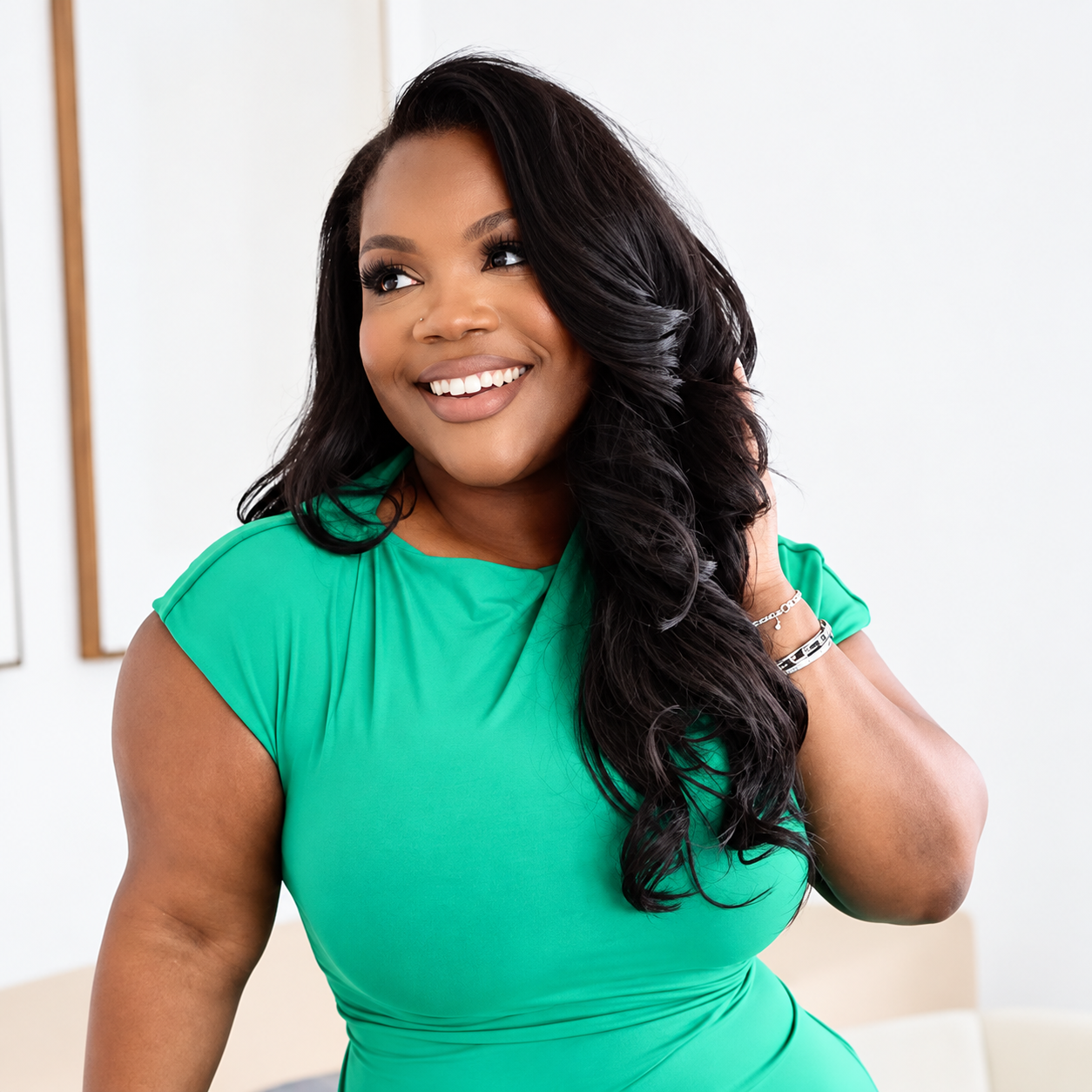
I come from a family that serves in ministry; my dad actually serves a very large church community of Haitian Americans and Haitians here in South Florida. I was always in a sphere of some sort of public scene or influence, in a sense, because our church community was a stronghold for our area.
The first real test of Emmy Petit’s career as a creator came with a paycheck large enough to make walking away hurt. She had secured what would have been her first five-figure brand deal, a milestone at a moment when every partnership still felt consequential. There was only one problem: when the gummy supplement arrived, she hated it. “It was so bad I couldn’t even keep it down,” she recalls. Petit was managing herself at the time, which meant there was no agent or intermediary to absorb the awkward conversation. She went back to the company and backed out.
The decision captures a tension that has followed Petit through a career built almost entirely in public. Social media rewards visibility, volume, and monetization, but Petit has learned that influence depends just as much on what she refuses to sell. The creator economy may run on sponsorships, algorithms, and attention, yet her most durable currency is trust.
That instinct was shaped long before she knew what an influencer was. Petit grew up in South Florida in a Haitian family, describing herself as American-born but raised as a “true Haitian girl.” Her father served a large Haitian church community, placing the family within a public-facing world of ministry and community life. At home, though, childhood changed abruptly when Petit was three. Her mother suffered a major accident and remained disabled throughout Petit’s upbringing. Petit spent much of her childhood at home with her, sometimes taking on caregiving responsibilities at an unusually young age.
Books became one of her escapes. Her father paid Petit and her two older brothers to read until he realized that, in her case, the incentive system was becoming financially unsustainable. She liked reading too much. Writing and imagination followed, although she did not initially think of herself as especially creative. An early art teacher had been harsh about her work, and Petit carried the conclusion that creativity belonged to people who were conventionally artistic. Part of adulthood, she says, has been learning to recognize creativity in forms she did not know to claim as a child.
For years, medicine seemed like the logical destination. Watching her mother navigate hospitals convinced Petit that she wanted to become a doctor and improve the experience for other families. She entered college on a pre-med track, only to discover after shadowing a physician that she did not want the life she had imagined. She moved toward public health, then political science, eventually circling back to the interests that had been there all along: writing, communication, and storytelling.
At the University of Miami, where she pursued a master’s degree focused on communications, multimedia journalism, and broadcast journalism, Petit arrived convinced she belonged in front of the camera. When the program required students to learn production and editing, her reaction was immediate: “I am not here for all of this; I’m here to be an on-air talent.” For the first several months, she struggled. By graduation, she had become an executive producer on major documentary projects and traveled internationally for Special Olympics-related work in Uganda, Dubai, Serbia, Abu Dhabi, and Mongolia.
The technical skills she once resisted ended up changing her career. Petit documented her travels online and grew her social following past 10,000. She started making promotional videos for small businesses to earn extra money. Then an art gallery owner whose content she was producing discovered her Instagram account. “This is your Instagram?” he asked. “How did you grow your platform to 10,000 followers? Why didn’t you tell me? I need your help.”
That question pulled Petit away from the journalism career she had expected and into social media marketing. She began helping businesses build their digital presence while developing her own fashion, lifestyle, and brand-partnership content. Eventually, the two sides of her work merged. She became both creator and strategist, building a personal platform while studying the commercial machinery behind it. House of Influence, the company she founded, grew out of that overlap and has since shifted toward educating creators, influencers, and personal brands on building audiences and revenue.
Her work now sits inside one of the creator economy’s central contradictions: a personal brand is expected to feel human while operating like a business. Petit knows the friction intimately. She describes the hardest part of her career not as one campaign or one difficult client, but as learning “to turn a creative personal brand into a scalable business.” Growth requires systems, employees, negotiations, and repeatable processes. Influence, meanwhile, still depends on a person showing up as herself.
Petit’s career has offered her reminders of both sides. Years before creator partnerships became part of her livelihood, she worked retail at Nordstrom, spending long stretches organizing a massive shoe wall while listening to marketing podcasts and audiobooks. One demanding manager stopped one day, heard what she was listening to, and told her, “Emmy, you’re going to be really successful one day.” Years later, Nordstrom became one of her brand partners.
The full-circle moment is tidy. Petit’s career is not. It continues to depend on knowing when to say yes, when to walk away, when to hire, and when an opportunity threatens the credibility that made the opportunity possible in the first place. For someone whose business is influence, the more revealing question may be what she chooses not to let influence her. That is where the conversation with Emmy Petit begins.
Yitzi: Emmy, it’s so nice to meet you. Before we dive in and talk about your great work, our readers would love to learn about your personal origin story. Can you share with us the story of your childhood, how you grew up, and particularly the seeds of all the amazing creativity that has come since then?
Emmy: Absolutely. I grew up right here in South Florida. I was born and raised here, but my family is from Haiti. I always joke with people and say that I was born in the US, in South Florida, but raised as a true Haitian girl. I come from a family that serves in ministry; my dad actually serves a very large church community of Haitian Americans and Haitians here in South Florida. I was always in a sphere of some sort of public scene or influence, in a sense, because our church community was a stronghold for our area.
At the age of three, my mom had a major accident that caused our whole lives to change. She has been disabled since I was three years old. I spent a majority of my young years with my mom bedridden, playing a young caregiver at times. I spent a lot of my childhood at home caring for her, and it significantly changed my upbringing. I remember a lot from before I was three and afterward because there was such a significant change at that point in time.
Throughout my childhood, I loved to read and write; that was probably one of my favorite pastimes. I have two older brothers, and my dad used to pay us to read books. When he realized I actually really enjoyed reading them and it was starting to get a little too costly for him to pay me, he said, “Okay, you no longer can get paid to read books because I see that you really enjoy it.” I spent a lot of my childhood reading books and just being an imaginative kid, which is where that creativity stemmed from.
At the same time, I struggled with thinking of myself as creative because I wasn’t an artsy or artistic kid in a conventional sense. Maybe I just didn’t explore it because my first art teacher was really mean and ragged on my art often. It created this voice in my head that my art wasn’t good enough. Over time, I’ve had to learn that I’m creative in my own right and in my own way, and grow more confident in that. That’s a bit about my childhood.
Yitzi: Amazing. Please tell us the next chapter. How did your career develop, and how did you get started?
Emmy: Absolutely. Circling back to my mom’s accident when I was three, watching her go through so much in hospitals during my childhood made me think I wanted to be a doctor. That was mainly because my mom experienced several instances of malpractice, though we never pursued that as a legal matter. I always said, “I want to work in a hospital. I want to change other people’s lives so that they don’t have to deal with what my mom dealt with.” I went to college for pre-med and thought I was going to be a physician.
Around my junior year, I shadowed a doctor and realized I didn’t actually want to do this. I started getting into the management side of things and leaning more into public health. Eventually, I realized my love for writing and reading pointed toward a desire to work in journalism and speak on politics. I changed my major to political science with the thought that I’d revisit a journalism career later by attending a master’s program for communications and journalism.
I worked in the healthcare field for a year and quickly realized it was time to get my master’s degree. I earned my master’s in communications, multimedia journalism, and broadcast journalism at the University of Miami. Through that journey, I really thought I was just going to be an on-air talent. Luckily, our program director wanted to make sure we knew how to use cameras and edit content. At first, I thought, “I am not here for all of this; I’m here to be an on-air talent.” I struggled so much and was probably the worst student for the first six months of the program.
By the time I graduated, I had become the executive producer of our major documentaries and traveled around the world for the Special Olympics to create documentaries for them in Uganda, Dubai, Serbia, Abu Dhabi, and Mongolia. During that time of traveling, I opened up my social platforms to document the journey, which is how I started growing on social media. I reached a little past 10,000 followers by the time I graduated from my master’s program.
Throughout that journey, I fell in love with learning about algorithms and social media. To make extra money on the side, since I had learned how to use a camera, I started creating promotional videos for small business owners. One of the business owners I was creating content for owned an art gallery. One day he found my social media and said, “This is your Instagram? How did you grow your platform to 10,000 followers? Why didn’t you tell me? I need your help.”
I dove into helping businesses with social media marketing, and that’s how I started my career. I left journalism school and went right into marketing. While working in social media marketing, I developed a career in social content and influencer marketing.
Throughout that journey, I also started creating content for myself that was tailored to fashion and brand partnerships because I was no longer held to journalistic standards regarding conflicts of interest. As I was developing my career in marketing, I was also building my own career as a content creator and influencer. The two went hand in hand, and I was able to transition into doing it full-time.
I also created my own company called House of Influence. It started with social media marketing, branding, and content for small business owners who needed professional expertise but couldn’t hire a large agency. That has since transitioned into an educational hub and resource for creators, influencers, and personal brands looking to build their impact online and grow their income.
Yitzi: There’s a saying that sometimes our mistakes can be our greatest teachers. Do you have a story about a funny mistake you made when you were first starting and the lesson you took away from it?
Emmy: I have so many, but there’s one that immediately comes to mind. As I was kicking off my career as a content creator, every brand deal that came through was exciting. A partnership came up that was the largest deal I had ever secured. It wasn’t a brand I previously knew, but it was a gummy supplement. I already loved gummy supplements and took most of my vitamins in gummy form.
We secured the deal and signed the contract, but the brand hadn’t sent the product for me to try beforehand. When the product finally arrived and I tried it, the supplement tasted disgusting. It was so bad I couldn’t even keep it down. I realized there was no way I could promote it in good faith, even though it was the largest deal I had ever secured.
At the time, I was my own manager, so I realized I was going to have to turn down my first five-figure deal because the product wasn’t good. It taught me a hard lesson: never secure any partnerships until I have tried the product or unless it’s something I can already personally stand behind. I had to go back to the brand and let them know that I didn’t love the product and had to renege on the contract for the campaign. It is a testament to the fact that your brand and the trust you build with your community are far more valuable than any paycheck.
Yitzi: There’s a related idea that “no” is not rejection, but redirection. Do you have a story where you received a “no” for an opportunity, but it led to an even better one?
Emmy: Absolutely. I was cast for an opportunity that was really cool and aligned with my brand, but the brand and I weren’t able to agree on the rate. Something told me, “I need to walk away from this because it’s a lot of deliverables and work, and I truly deserve the compensation I’m requesting.” I walked away from the opportunity, which was difficult because it was early in my full-time career.
Two weeks later, they circled back and said, “We actually found additional budget and are able to meet your rate.” That initial impasse redirected me to have a stronger perspective on acknowledging my value and being willing to walk away. It also led to the brand recognizing that value and returning to meet it.
More recently, I had a dream opportunity come my way that I was very excited about. At the last minute, the brand reneged on the opportunity, which was devastating because I had rescheduled my vacation for it. Just a couple of weeks later, I ended up receiving a similar opportunity that paid essentially the same rate. It was a clear reminder that what is meant for you will arrive at your door at the right time.
Yitzi: What has been the most challenging project or role you’ve taken on so far, and why?
Emmy: That’s a difficult question. I don’t necessarily see any individual project as more challenging than another.
The biggest challenge has simply been developing myself and learning to turn a creative personal brand into a scalable business. I love what I do, but when you look at building a business that truly scales, turning creativity into a sustainable enterprise is challenging. It’s fun, but it is certainly demanding.
Yitzi: Emmy, you’ve been blessed with a lot of success, and you must have learned a lot from your experiences. Looking back to when you first started your business, can you share five things you’ve learned over the years that someone starting out today can benefit from?
Emmy: For sure. The first is to develop a personal mission statement as well as a brand mission and vision statement. When you work in social media, it’s easy to get lost quickly. Having that strong foundation is vital.
Second, ensure the purpose behind building your platform allows you to showcase a unique perspective. If you are only adding to the noise and creating the exact same content as everyone else, you won’t find a distinct community that views you as an authority. A unique value proposition allows you to build stronger relationships with your audience by sharing insights others aren’t providing.
Third, hire before you think you need it. This business requires a significant amount of your visible presence. To scale well, hire people alongside you who can handle general operational tasks so you can focus exclusively on the things only you can do.
Fourth, build strong relationships. Relationships combined with high-quality work will take you much further than talent alone. Running around searching for the next brand to pay you is exhausting and not a sustainable strategy. Instead, build deep relationships with brands you genuinely love and connect with the real people behind them year over year.
Fifth, learn to be a great partner. Many creators want sponsorships and brand deals, but brand deals are collaborative partnerships. Long-term success comes from understanding both your own goals and what the brand needs to achieve with the campaign, ensuring you are fully invested in delivering strong performance together.
Yitzi: I’m sure this is difficult to single out, but can you share two stories that stand out in your mind from your career?
Emmy: The first goes back to when I worked retail at Nordstrom. I loved working there and spent several years with the company, often returning for seasonal work during my schooling. After finishing my graduate program, I went back for a season during a transitional period. My previous managers were no longer there, so the new manager hired me based on my past reputation and a recommendation from my former boss.
He was a tough boss, and because I was the last seasonal hire, I was given the hardest stock assignment: a massive shoe wall that had to be organized daily alongside new shipments. Nordstrom operates on commission-based sales, and while most people spent thirty minutes on stock assignments, mine took an hour and a half to two and a half hours every day, taking me away from the sales floor. I’m 4'11" and 3/4, so I spent hours climbing ladders every day. Coworkers would tell me they couldn’t believe I was assigned that wall alone, but I was simply grateful to have the job.
While working on that wall, I spent the time listening to marketing podcasts and audiobooks by educators like Amy Porterfield and Jenna Kutcher. A few months in, that strict manager walked past, heard what I was listening to, stopped, and said, “Emmy, you’re going to be really successful one day.” Coming from someone so tough, it made a lasting impression. A few years later, I landed my first official creator partnership with Nordstrom, bringing that experience full circle.
The second story illustrates how sharing your work online compounds over time. Last year, I was featured in Cosmopolitan because of an engagement story I had posted years prior. The editor writing a feature on engagement rings reached out, and at first, I thought it was spam. When I arrived for the feature, the editor explained that she had followed my journey, engagement, and wedding for years. It proved that nothing you share is in vain; even content that seems to get low engagement at the time can compound and yield returns later in your career.
Yitzi: Can you share with our readers the self-care routines you use to help your body, mind, and heart thrive?
Emmy: One essential practice is starting my mornings with devotion and prayer. Faith is central to my life, and when I don’t prioritize that morning time with God, I notice a difference in my mindset.
I also prioritize daily walks. I need sunlight on my back at least once a day, and long walks give me the space to clear my mind, reflect, and enjoy nature. Social media involves constant noise, so getting outside is one of the few times everything slows down.
Lastly, I prioritize massages. I don’t treat spa visits as a luxury; they are a necessary part of maintaining my health, especially since I put a lot of demand on myself physically and mentally.
Yitzi: Emmy, because of your work and platform, you are a person of great influence. If you could spread an idea or inspire a movement that would bring the greatest amount of good to the most people, what would that be?
Emmy: I love the idea of a daily give-back movement. Everyone is more fortunate than someone else in some way. If everyone consistently looked for ways to support or lift up someone behind them each day, society would improve significantly. Global issues often feel overwhelming, but if we each focused on a small daily contribution, those problems wouldn’t feel nearly as insurmountable.
Yitzi: How can our readers continue to follow your work, engage your services, or support what you do?
Emmy: For fashion — especially curvy and mid-size style — as well as beauty, lifestyle, and social media tips, you can find me across all major social platforms (Instagram, TikTok, YouTube, Pinterest, and Threads) @emmypetit (spelled E-M-M-Y-Y-P-E-T-I-T).
For guidance on building your influence and growing your revenue, you can follow @thehouseofinfluence, where we share resources on building a career as a creator, influencer, or personal brand.
Yitzi: Emmy, it’s been a joy to meet you. I wish you continued success, good health, and blessings, and I’d love to do this again next year.
Emmy: Thank you so much. It was great meeting you as well.
Yitzi: My pleasure, Emmy. Have a great day.
Emmy: You too. Goodbye.