I love exploring new visual technology and minimizing effort so I can put more energy into the art and creative work.
As a part of our series about “5 Things I Wish Someone Told Me When I First Became An Artist” I had the pleasure of interviewing Elke Reva Sudin. Elke is a Brooklyn-based multidisciplinary artist and the founder of Drawing Booth, the world’s first digital live sketch events company with teams across the US and UK. She has gained widespread recognition for her fine art connecting cultures through themes of identity. Her latest project involves a limited edition of unique scarf designs that celebrate the divine feminine and her own spiritual journey.
Thank you so much for doing this with us Elke! Can you tell us the story of how you grew up?
Igrew up in a small historic town in Western New England with woods filled with deer and soothing streams. The town started becoming heavily populated in the mid-20th Century. Irish, Italians and Jewish families were already establishing a presence, but we were still considered the newcomers. My parents had both my older brother and I later in life so despite a lot of 90’s television we grew up a little more sheltered and protected. I come from a traditional Jewish home, a bit secular while retaining tradition, and my family became more Orthodox as I got older. Based entirely on my own intuition, I started becoming vegetarian at age 8. All of these experiences made me feel a bit like an outsider growing up, not necessarily in a negative way, but just making me feel disconnected from what was then considered contemporary, mainstream, or even normal for where I grew up.
It wasn’t until I reached high school that I received any real art training. At 16 I begged my parents to allow me to attend the Rhode island School of Design (RISD) pre-college program. After a lifetime of private, conservative Jewish schooling, my parents allowed me to enroll in the local public school in my senior year and participate in its extensive art program. They knew that one of my grandmothers was a trained commercial artist in the 1930’s, so it was clear that I shared that gene. I went on to attend Pratt Institute and received a Bachelor in Fine Arts in Illustration. It was there I met my husband, a film-maker, and we got married between my sophomore and junior years. After that, the rest is history.
Can you share a story with us about what brought you to this specific career path?
Immediately upon graduation, I sketched paint-marker portraits as $20 party favors at late-night downtown art parties and friends’ rock concerts during Millennial hipster Brooklyn. One particular planner hired me to draw at several exclusive, private events. At one of these, I showed up expecting a bar mitzvah but instead found myself sketching the cast of my mother’s favorite television show, “The Good Wife,” during their holiday party. My momentum was halted with one of the cast’s requests to draw at their wedding, but because it fell on Shabbat I couldn’t work the event. It didn’t even occur to me how to keep up the flow and parlay those gigs into a career.
I spent those years mostly exhibiting my fine art paintings of portraits and urban landscapes like my debut Hipsters and Hassids series without fully focusing on the creative process as I would have liked. I also did freelance illustration and founded and ran an organization called Jewish Art Now, hosting events and putting out online content to foster community and bring more attention to artists like myself whose content didn’t really fit one venue or another. Additionally, I had a grant-funded program offered by the Hillel at Brooklyn College where I brought together students of different backgrounds, Jewish, Muslim, etc, through art. The program was called CreaCo, short for Creative Coexistence. During that time I also did a Jewish entrepreneur incubator (PresenTense) and the speaker asked me, “what do you really want to do”? My response was “to draw and create every day.”
At that moment I looked back at how I did those drawings at events years earlier and remembered how I loved it, the guests loved it, and the pay was great. I founded Drawing Booth in 2014 in New York City, which went on to be based in Chicago, London, and Los Angeles. My dad owned his own sales business so it felt really natural for me to start out on my own as he did and I’d already done for years, just bringing a sustainable financial model into the picture.
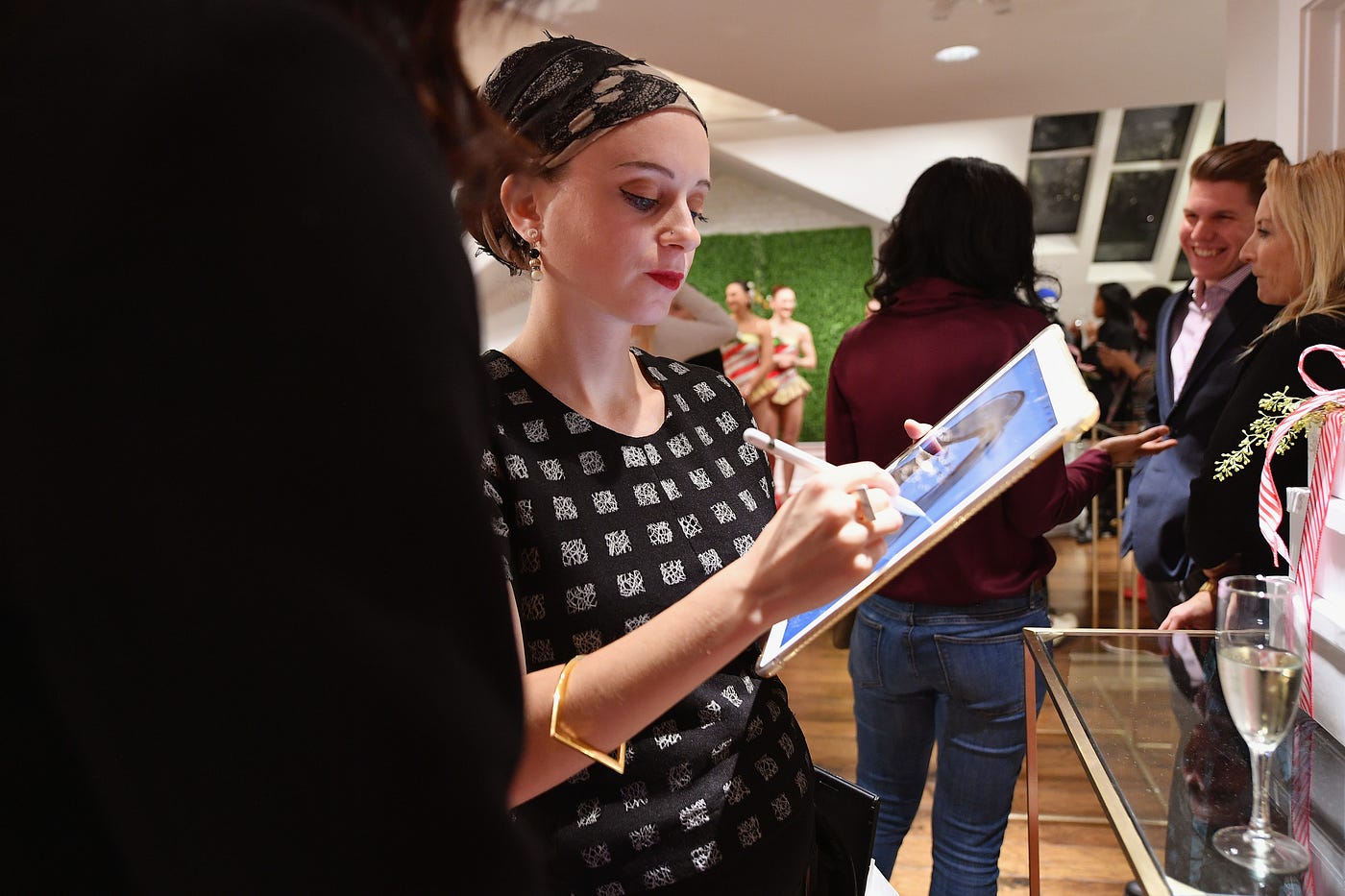
I bought a domain, an iPad Air and a pressure-sensitive stylus, printed up some business cards and Drawing Booth was born. I love exploring new visual technology and minimizing effort so I can put more energy into the art and creative work. Using digital portraits meant no more schlepping paper and paints on the subway to each event, and that seemed like such an easy and elegant solution.
My first event and testing ground for the Drawing Booth was at the Webutante Ball as part of Internet Week NY. The use of digital devices (pre-iPad Pro, mind you) was a natural position for me. Back in the early 2000’s I was obsessed with Palm Pilots which were little gadgets that looked really similar to our modern-day smartphones. I loved the ability to be creative using the low-fi apps available at the time. I used to sketch on it and “beam” the drawings to people with compatible devices.
It only occurred to me later that, of course, I would start a company in my adult life dedicated to sketching solely on digital tablets like iPads. Now manage over 40 visual artists and my business works with Fortune 500 companies in New York, Los Angeles, Chicago and the UK.
Can you tell us the most interesting story that happened to you since you began your career?
I landed this amazing job for Drawing Booth sketching for Interior Design Magazine’s “Giants of Design” event in 2017.
I was sketching an event at a sprawling luxury resort, formerly a private Mexican presidential retreat, in Cancun, Mexico.
While waiting for a shuttle bus I started chatting with another gal waiting there and it turned out to be the artist Shantell Martin, one of the conference presenters and show-cased artist, best known for her large scale black and white line drawing doodles. You can see her work in large-scale installations and in the gift shop at the Whitney. I showed her the project I was hired to do onsite, freehand sketches of scenes of the conference taking place, rather than my usual event portraits. When we arrived at the function, guests greeted her with accolades, applauding her drawing ability. She replied, “Oh I can’t draw, she, she can draw,” pointing at me, referring to my portrait illustration sketches meant to replace a photographer onsite versus her abstract atemporal sketches.
While we are both artists who draw, we are defined by different uses of the term. Shantell is a mega-famous artist specifically known for her drawing style, defined by its distinctive continuous line, doodles of eyes, and affirmations she writes in text. The use of line follows a Keith Haring approach, using a simplified visual language when depicting a subject. We were able to talk about the places we’ve crossed paths before. The different trajectories showed how art can take us in so many directions during the course of our lives.
What are some of the most interesting or exciting projects you are working on now?
Currently, I am working on a limited series of small-batch scarves with original illustrative designs, called the Crown Collection. In a time of widespread hate and discrimination, I felt compelled to create wearable works that celebrate the divine feminine and my own spiritual journey. The Crown Collection is defined by its intricate, mystical prints for an elevated and timeless personal style. Each scarf is designed to activate the subconscious, enlightening, illuminating, and fostering connection and growth. The Crown Collection is launching at an upcoming Havurah fashion show this May and will be available for purchase via my website. In a way, it’s a full-circle nod back to the diversity work I did via Hillel, in Creative Coexistence.
Who are some of the most interesting people you have interacted with? What was that like? Do you have any stories?
In the early 2000’s when I was just 18 years old, the famous sculptor Louise Bourgeois hosted weekly salons in her Chelsea home, interviewing a variety of artists, presenting their work, and privately recording the sessions for their own archives. I was still an art student at the time and met her son, an architect, at a loft party the night before one of these sessions. He encouraged me to go to her home which I did, taking what artwork I was working on in my classes to present at the session. During the interview right before mine, the artist was excitedly presenting their work to the camera filming, and Ms. Bourgeois interrupted her talk, pointed to me in my wild hairstyle and signature black bulky scarf around my neck, and requested to hear from me. I presented my work but then immediately rushed out the door, as my father was visiting NYC and I had little time to meet up with him. (Is it so ridiculous to remember that we were meeting at one of the last standing kosher delis?) I never reconnected with the studio of this famous artist and my interview sits somewhere in an archive to this day. However, I had the opportunity of a lifetime to sit with a legend in her own home and I am grateful for it.
I’ve had several short encounters with fascinating people, whether at Drawing Booth events or by happenstance, like meeting Amanda Palmer at a thrift shop and chatting with her without having a clue who she was or sketching a very famous child-actor singer who I can’t name to respect their privacy. The World Champion Boxer Yuri Foreman was a big influence on me like that. He and I met when he was studying to become a rabbi while rising in the boxing ranks. Yuri was very open about balancing his craft with his spiritual path and that one needed to exist to balance the other. I love the realness behind the celebrity facade. It gives hope to all of us here on the ground floor who aspire to greatness.
Where do you draw inspiration from? Can you share a story about that?
There’s nothing like the magic of New York City. The same street contains a mixture of people from paths from all walks of life. The people you encounter serendipitously can be someone from your neighborhood, or an old friend, or a famous actor. Someone you know may bump into you in the subway car, or cross paths in the park.
In a very practical sense, witnessing synchronicities and laws of attraction are the biggest sign of support. When you run into the same person twice in the same day in a city filled with millions of people the Universe is shouting “You’re doing great! Keep Doing it!”
I’ve personally found great inspiration from the people I surround myself with so maybe that’s why I try to surround myself with a lot of people and why I’m drawn to sketching people at these events. These people are my muses. Here’s where it gets a little woo woo, because by surrounding yourself with successful people their journeys rub off on you. What I love about being a spiritual person is that I can say I don’t need to know how everything works, I can flip on a light switch and there is light, no explanation needed. I try to look for the signs, do my part, do the work needed to fill the gap, and when something new manifests and if the signs look good, I keep going.
How have you used your success to bring goodness to the world?
Ever since my career as an exhibiting, working artist took off with my first exhibition, I have used my personal success to share with other artists early in their career. First, it was curating shows for artists who were underrepresented. Then through my company, I’m able to use the business to provide jobs and competitive wages to struggling artists, including those who would otherwise have difficulty finding work, or experience difficult barriers of entry enabling them to grow as artists. Besides the economic impact, I’ve offered my services as a grounding tether for artists who tend to get lost in a discouraging world, whether that be New York, Los Angeles, Chicago, or the UK. There’s no point in success if I can’t try to also lift those around me financially, spiritually and artistically.
Recently, one of the artists involved with Drawing Booth was inspired by my entrepreneurship to create her own ethical art business called Novel School of Art providing creative career mentorships for artists with disabilities, not only helping artists find a path but solving the economic gap where the artists can profit from the online sales through her site. “It takes a lot of self-analyzing to start an ethical business, and watching Elke work through obstacles with us as a team really helped me understand what’s possible when you chase your dreams with selflessness.” Says founder Gabriella Guzman. Paying the societal contribution forward gives me the satisfaction of leaving a positive legacy.
What are your “5 things I wish someone told me when I first started” and why. Please share a story or example for each.
- Find someone who is doing something that you can model your art business after. People didn’t understand what portrait event sketch artists looked like, but they knew about photo booths. While caricature drawings had existed, the format that modern photo booths presented captured a sense of ease, excitement, and customization. This was the experience I aimed to model, and so Drawing Booth was born. When I was able to place the role of the artist as a role and not tied to my personal artistic practice particularly I could envision the company model. That degree of seeing art as a service was huge for transforming my mindset as an artist to a business owner. Photo booths and similar concepts had been around for a long time but the digital version was finally trending. This is literally how the name Drawing Booth came about. It was much clearer to translate into what I was providing with a roaming artist offering extemporaneous digital portraits. This was a process that functioned completely by sketching on digital tablets before the drawing technology was as popular as it is currently.
- You must know yourself emotionally, do all the inner work, and know what aspect of the art process is most incredible for you. It may take some time. When I was reflecting on what I really wanted to do with my art career, I was in the middle of an incubator program for my community art initiatives with Jewish Art Now, as I already stated. That question of “What do you really want to be doing?” really changed the trajectory of my career. I wanted to draw or create something every day and now I do. Even though I wasn’t fitting into the box of the caricature artist, I knew I wanted to translate that experience into something sustainable that I could really work into my life. When it comes down to it, it’s about focusing on that one thing and having enough support to iron out the hiccups from the beginning and then keeping at it until it can operate sustainably and become totally fulfilling.
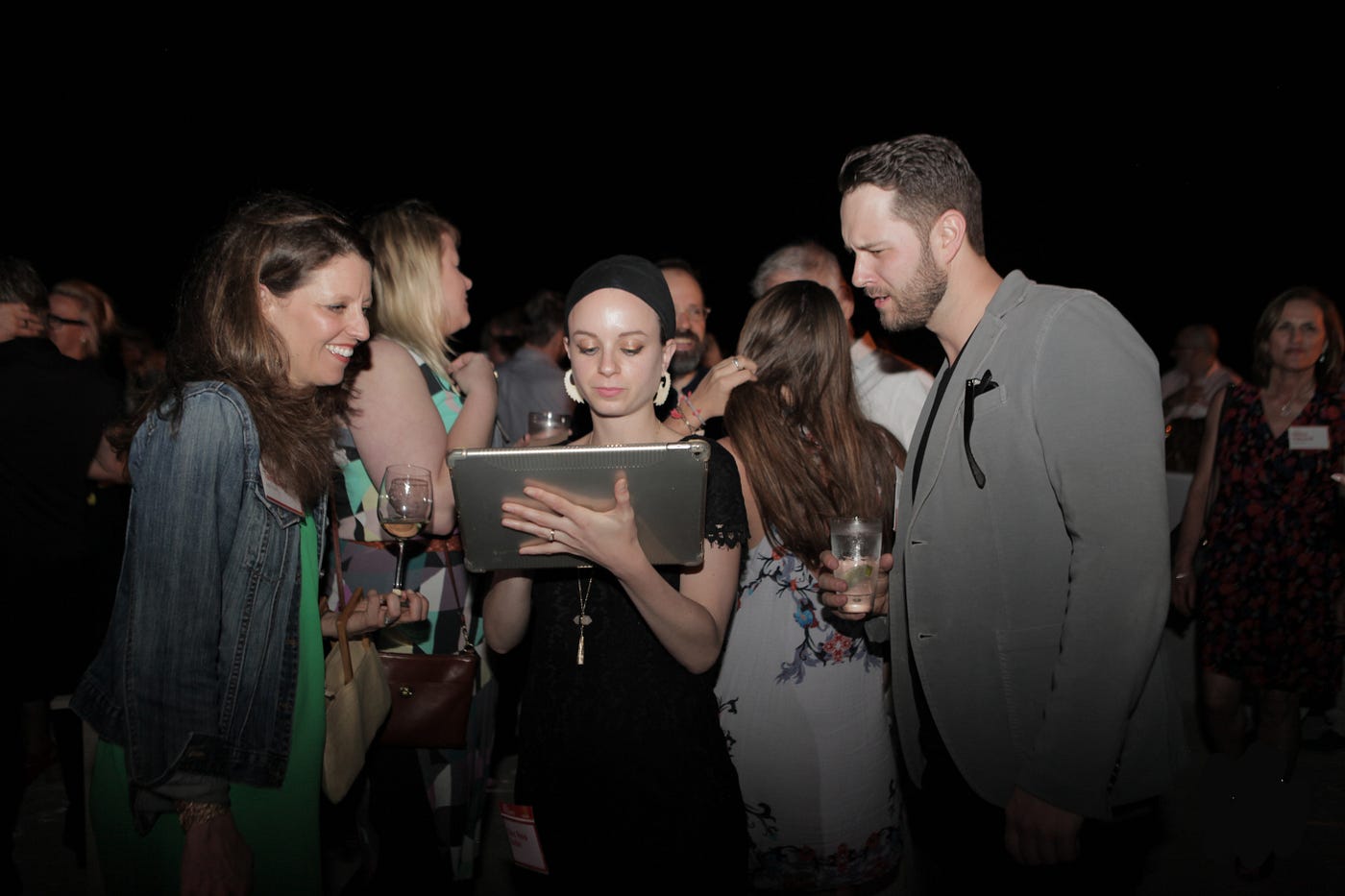
- Know that others may be doing the same thing you are doing, but never let yourself think for one moment that you have to limit yourself to how they define themselves or their practices. You can always bring something to the table that someone else cannot. I’ve witnessed multiple companies trying to replicate the services that I provide, literally copying the language we use or modeling their services after our specific practices, but there’s always going to be a flavor we provide that sets us apart. This applies to every field, don’t worry about your imitators. Each person has and presents ideas of what we can do to make things better and we bring our whole selves to the practice. Some of our practices are really a lot of work, like the way we mingle and even wear a printer in a holster on our hip so that guests could have that instant print takeaway without having to go over to a printing station or for the artists to be stationary while we sketch. It can be tiring but we work hard to make it seem effortless and it brings so much joy to the guests in their experience. This type of work is not for everyone but it does make us stand apart and we know how much value that aspect of our services brings to the event planner in fulfilling their needs.
- In your goal setting, aim for a 45-degree angle forward. Too high and you won’t go far. Too low and you will fall short. A consistent progression up and out will keep you in balance. When I was in art school my professor, the Time Magazine cover illustrator Tim O’Brien, witnessed the drawing approach of me and my classmates and made a graph to illustrate to us how we were timing our process with labor over time to our finished illustration. His ideal was this consistent 45 degree angle and I see the same thing when it comes to goal setting. In order to move ahead at a sufficient pace you need to have an idea of where you are headed. For example, is the goal national expansion or fewer contracts at a higher rate? You must also have a step by step process to get there. Sometimes we don’t know where our lives will take us and that’s okay. A vague idea like “I want to be able to draw every day” may lead to a job sketching construction plans, or graphic recording at meetings for a company. Just don’t aim too low, because you might just meet it, so why not shoot for more?
- Beta test (like crazy) what you are trying to achieve with minimal financial investment. When I started Drawing Booth I knew I wanted to offer drawings on iPads even though it was a really niche practice before the iPad Pro. I couldn’t manage to borrow an iPad so I invested $400 in an iPad Air. This was a big investment for me at the time and someone in my family told me that it was a waste of money. Flash forward all these years later and I’m drowning in iPads! The lesson here is I didn’t need to create a huge company and hire a bunch of people from the start. I just needed to get my hands on the equipment I needed and then offered my services for free in order to test things out. I was drawing at no cost-sponsoring my services in-kind at the early morning sober dance party known as Daybreaker in those early days, and it was a way for me to express myself creatively while also building and discovering what my business model and service offering was going to look like.
- Bonus tip: When hitting a wall, try the opposite of what you would logically do. Workshop that scenario, try it on a micro scale.
You are a person of great influence. If you could inspire a movement that would bring the most amount of good to the most amount of people, what would that be? You never know what your idea can trigger. :-)
What I would want to see more than anything in this entire world are training resources for adults (and for becoming an adult, this is really what I think teenagers need to be learning in school). There is a lack of education on how to operate as a human being from start to finish the same way you would learn how to run a business in a trade you are pursuing. Remarkably there seem to be more resources for learning how to operate a business than to operate ourselves. I’ve met people from small town USA to tourist hubs in India, where I was deepening my own faith and studying Reiki or in my community now. I see folks struggling in life because they are fed a lot of information but it doesn’t help them take care of themselves and when they look around for help they see everyone else is in the same emotional or financial position. The day to day guidance to navigate life is the ability to face and overcome your own challenges. This would give people more flexibility to do other things and make better decisions. Making decisions based on feelings of pain and desperation lead to negative outcomes. I was lucky enough to always be surrounded by successful people, whether they be community leaders, professionals, teachers or spiritual leaders. Without them I would not be where I am now and I am very grateful to my spiritual community for consistent and daily guidance.
We have been blessed that some of the biggest names in Business, VC funding, Sports, and Entertainment read this column. Is there a person in the world, or in the US whom you would love to have a private breakfast or lunch with, and why? He or she just might see this.
I would love to have lunch with Natasha Lyonne. She just keeps overcoming her obstacles and we share similar heritage from our Jewish background. I think I was even a speaker at one of the Jewish schools she attended in South Florida. There are institutionalized expectations in the Orthodox Jewish world caused by the persecution of Jews in Europe to live on a high echelon professionally, while upholding a very labor-intensive (religious) lifestyle, as a form of survival. What I think Natasha would understand is how striking out in a creative field is a form of survival too.
What is the best way our readers can follow you on social media?
Follow and interact with me @elkerevasudin on Instagram.
This was very inspiring. Thank you so much for joining us!
Thank you!