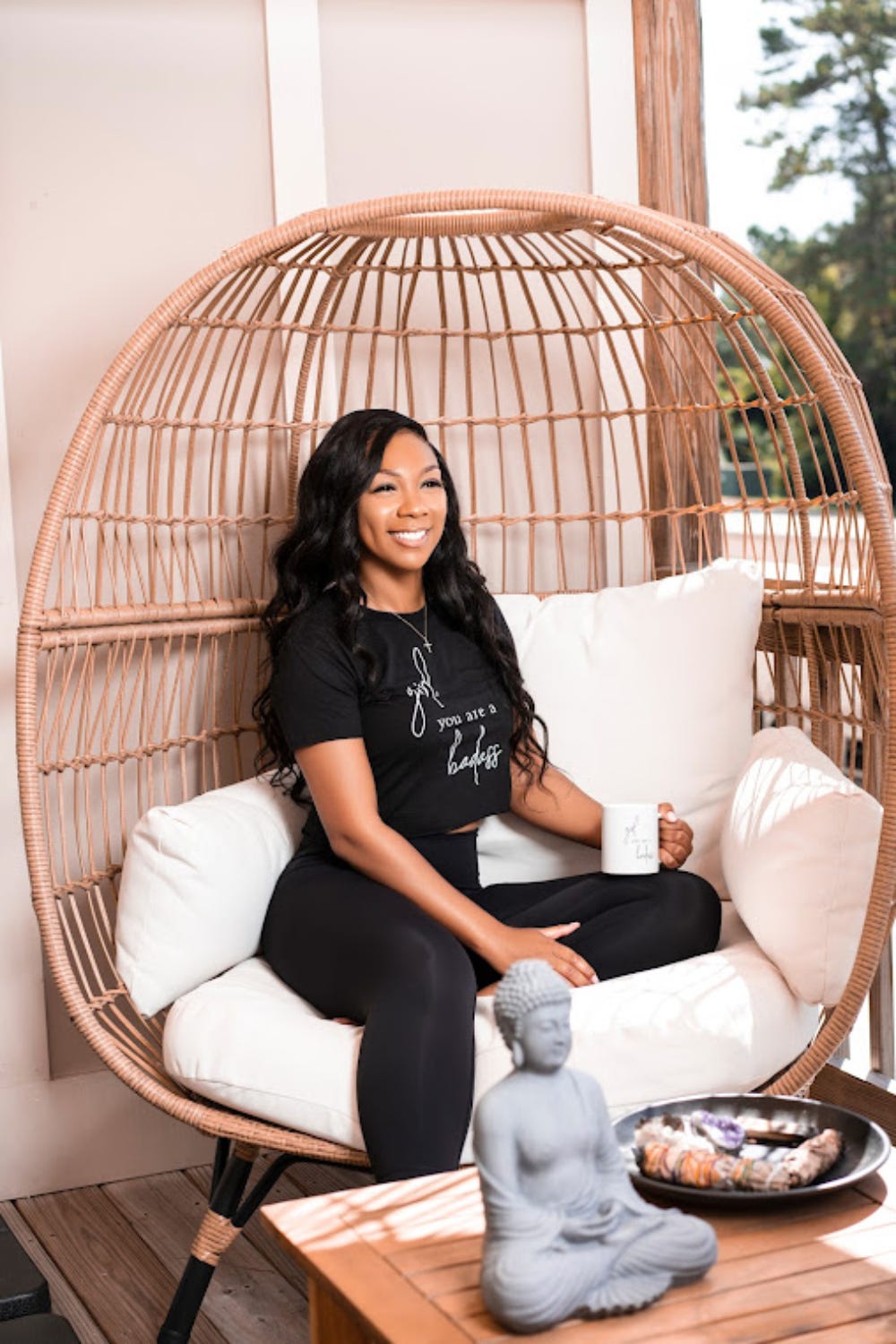
The most interesting thing that happened to me since I began this company was when my PR agency, ChicExecs, reached out and wanted to work with me.
As a part of our series about “Why We Need More Women Founders”, I had the pleasure of interviewing Classye James.
As a Black woman in tech and former Division 1 athlete, Classye is no stranger to hard work and is determined to push through any obstacle until her goals are reached. Upon suddenly experiencing a career-ending injury, Classye saw her life’s path change dramatically. Her drive, passion, and give-it-your-all mindset that pushed her to be a highly successful athlete began serving her as she ventured into tech and would eventually develop a highly successful health and wellness brand.
Thank you so much for doing this with us! Before we dig in, our readers would like to get to know you a bit more. Can you tell us a bit about your “backstory”? What led you to this particular career path?
Sip N’ Slay Tea was born during the height of quarantine as an answer to my need for elevated self-care. I have always loved tea and was drawn to the calmness I felt when savoring a cup. This led me to seriously study the various health and wellness benefits tea has to offer. I was inspired to start my own tea company as a way to encourage others to prioritize themselves and their mental care.
Can you share the most interesting story that happened to you since you began leading your company?
The most interesting thing that happened to me since I began this company was when my PR agency, ChicExecs, reached out and wanted to work with me. I had just stopped running ads because I was spending a lot more money than I was making, I was in a financial deficit, and I wasn’t sure if I should take a break from the company.
My end goal for the company was clear, I wanted Sip N’ Slay to be the leading loose leaf tea and wellness company founded by a Black Woman, but I was not clear on how I was going to make that happen. After speaking with ChicExecs and discussing our long term strategy, which was getting Sip N’ Slay in retail locations, I knew I was one step closer to my dream! I knew that hiring them would be a potential risk, but it was a risk I was willing to take.
Can you share a story about the funniest mistake you made when you were first starting? Can you tell us what lesson you learned from that?
When I first started the company I was trying to do EVERYTHING myself. As a techie, I was able to put together a decent website, but my product photos were absolutely tragic! I was just looking at those photos on my phone and all I could do was laugh and show gratitude for how far I have come.
The lesson I learned from that part of my journey is that we have to embrace each phase of entrepreneurship. In the early stages of Sip N’ Slay, I did not have the budget to hire a photographer to take product shots. I had to use what was readily available, which at the time was my iPhone, ring light, and props I got from the store.
None of us are able to achieve success without some help along the way. Is there a particular person who you are grateful towards who helped get you to where you are? Can you share a story about that?
I can’t name one person in particular who I am grateful for because it was a group of people who pushed me to keep going and dream big! My family and friends who tested my tea flavors, volunteered to help me run certain parts of the company when I needed assistance, listened to all of my crazy dreams for Sip N’ Slay, and always showed me love and support are a significant part of my success today.
When I first started the company, I hired my cousin as my assistant and although we had no idea what we were even doing half of the time it brought us closer together.
When I decided I wanted to incorporate candles in my tea kits, I had another cousin who would come to my home and have candle making parties with me so we could pick out the best scents that paired beautifully with my tea flavors.
When I had to travel for my full time job and needed orders to be fulfilled, my mom would go to my house to package and ship orders to ensure they were sent out in a timely fashion.
These are just a few stories highlighting the amazing people I have in my life.
Ok, thank you for that. Let’s now jump to the primary focus of our interview. According to this EY report, only about 20 percent of funded companies have women founders. This reflects great historical progress, but it also shows that more work still has to be done to empower women to create companies. In your opinion and experience what is currently holding back women from founding companies?
According to this Forbes article, Black female entrepreneurs are launching businesses at higher rates than white men. This is an exciting statistic for me to see as a Black female entrepreneur, however there is one major roadblock holding back Black women from founding companies. This roadblock is access to capital. Many non-Black entrepreneurs have been afforded the luxury of inheriting money from their families, but we don’t see that happen as often in the Black community. However, with the increase in Black business owners, I am hoping to see a massive change in generations to come.
Furthermore, it is hard for Black women to get buy-in from investors. We could have an amazing business plan and proof of concept, but we will still face extreme resistance.
Can you help articulate a few things that can be done as individuals, as a society, or by the government, to help overcome those obstacles?
One of the main reasons women receive less funding than men is because the majority of the investment world is run by men. These men are more likely to invest in businesses that solve problems that they understand. As more and more women enter into the investment industry, we will see an increase in women founders receiving the capital they need for their companies.
There has been an increase in the number of grants and loans afforded to Black-owned and Woman-owned businesses, but it's not enough. If Diversity, Equity, and Inclusion are important, we need to see more investments being made in this arena.
This might be intuitive to you as a woman founder but I think it will be helpful to spell this out. Can you share a few reasons why more women should become founders?
Female founders bring a different perspective to business problems that is needed for the world to progress in a positive direction. Women see the world differently because of our life experiences. As a woman, if you see a problem in the world please follow your intuition and create a business to solve that problem. I guarantee you weren’t the first person to identify this problem and you won’t be the last.
Female founders have support groups and resources that didn't exist before. I’m a millennial, and my experience as a female founder is far different than the experience of previous generations. In today’s society with access to social media, there is an abundance of resources for women looking to start their own business. All of this has created a massive amount of momentum, passion, and support for female founders. Simply put, many women want to help other women succeed.
What are the “myths” that you would like to dispel about being a founder? Can you explain what you mean?
Two myths that I want to dispel about being a founder is that entrepreneurs don’t have a personal life and entrepreneurs are rich.
Work-life balance is the reason I became an entrepreneur. I value my “me” time which reduces the risk of burn-out, increases my productivity and is good for my overall health. You may have been told that founders have to make sacrifices to follow their entrepreneurial dream. Often, this has been interpreted as a suggestion that entrepreneurs have zero personal life, which is not the case for many of us. The most successful entrepreneurs know how to take breaks and master their prioritizing, delegating, and scheduling skills.
There is this stigma that entrepreneurs are rich and that is why people should pursue entrepreneurship. Some entrepreneurs have achieved economic wealth, but others have not reached this privileged status (yet). Some of the people who are now millionaires literally started from the bottom with no money and just an idea. There are thousands of entrepreneurs who have started from nothing -or almost nothing- and have then achieved a favorable outcome, but trust me when I say entrepreneurship is not for everyone.
Is everyone cut out to be a founder? In your opinion, which specific traits increase the likelihood that a person will be a successful founder and what type of person should perhaps seek a “regular job” as an employee? Can you explain what you mean?
Entrepreneurship isn’t for everyone. If you possess any of these qualities you may want to reconsider entrepreneurship:
You like to stay in your comfort zone
You are a procrastinator
You complain about problems, but don’t know how to come up with solutions
You make plans but don’t take action
You want to be liked by everyone
You think it’s a fast track way to making money
The stress, frustration, and hard work that goes into starting and growing your own business are enough to scare most people away. You have to learn how to adapt to failure, learn how/when to pivot, and make friends with stepping out of your comfort zone.
Ok super. Here is the main question of our interview. Based on your opinion and experience, What are the “Five Things You Need To Thrive and Succeed as a Woman Founder?” (Please share a story or example for each.)
Self-care is essential. If you are not okay, how can you show up for your businesses? Self-care is important to maintaining a healthy relationship with yourself. It means doing things to take care of our minds, bodies, and souls by engaging in activities that promote well-being and reduce stress. Doing so enhances our ability to live fully, vibrantly, and effectively.
Ask for Help. Entrepreneurship can be extremely stressful and sometimes very lonely. It is okay to ask for help and broaden your network to get it. Seeking counsel -- from mentors, peers, even your suppliers and vendors -- is simply another way of taking charge of your business. Rather than being thought of as a weakness, reaching out can increase your chances of success.
Healthy boundaries are non-negotiable. This is something that I am still working on and will probably always have to work on. Boundaries look different for everyone but I am getting more comfortable minimizing my urge to be a people pleaser and saying no. I also reduce my time on social media because I realized social media is a trigger for me at times. When I am at home I have my phone on DND, I know that may annoy some of my friends and family who want to get in touch with me, but there are times when I have to be inaccessible.
Tracking your inflow and outflow of money and having a bookkeeper or accountant.
Don’t be afraid to pivot.
How have you used your success to make the world a better place?
Every business that I have created thus far has a social impact component – that is a requirement for me. I want to ensure I leave a positive impact in this world. Sip N’ Slay Tea, was born during the height of quarantine to encourage everyone to prioritize their needs by introducing self-love through herbal remedies. The brand encourages customers to practice self-love and enjoy holistic experiences so you can give the world the best of you, instead of what’s left of you.
You are a person of great influence. If you could inspire a movement that would bring the most amount of good for the greatest number of people, what would that be? You never know what your idea can trigger.
Health and Wellness should be a priority for everyone. I want to inspire a movement where women of color feel empowered to get into this space by fostering a healthy relationship inward, so they can love every bit of themselves as they show up in the world. I turned something as simple as loose leaf tea into a wellness brand founded on the belief that every woman needs more love, positive vibes, and self-care. I believe that doing so enhances our ability to live fully, vibrantly, and effectively while encouraging us to stay grounded and balanced.
We are very blessed that some very prominent names in Business, VC funding, Sports, and Entertainment read this column. Is there a person in the world, or in the US with whom you would love to have a private breakfast or lunch with, and why? He or she might just see this if we tag them.
Rihanna: I hear she loves ginger tea with Jameson. Since she is pregnant we can hold the Jameson and I would love to send her our Ginger tea (ImmuniTea). My ImmuniTea is also very safe for pregnant women to consume ;).
Laila Ali: I recently saw a presentation where Laila talked about her spice line and how her focus is centered around keeping the joy of food alive, while still making health-conscious decisions. This all starts with substituting harmful ingredients with foods and products good for the body, mind, and earth. As a former athlete myself who has transitioned into the wellness industry, I see a lot of similarities between Laila and myself.
Kate Hudson is incredibly passionate when it comes to inspiring others to lead happy and healthy lifestyles. I would love to do a collaboration with Fabletics and Sip N’ Slay Tea. What you consume is a reflection of how you feel and when you consume healthy items and wear cute/comfy clothing, you feel unstoppable!
BEATRICE DIXON, THE HONEY POT COMPANY: The Honey Pot offers women plant-based feminine care products that are natural (free of chemicals, parabens, carcinogens and sulfates). I am so impressed how Dixon was able to transform her business into a multi-million dollar company that sells over 30 plant-based feminine care products, giving women options that were hard to come by not too long ago.
I would love to pick her brain and learn some tips and tricks as to how I can scale Sip N’ Slay to that level!
TIA MOWRY, ANSER: I remember Tia Mowry from the iconic series Sister, Sister, the movie series Twitches, and Seventeen Again on Disney Channel. It is so amazing to see Tia running Anser, a company that provides women with supplements packed with clean ingredients, essential vitamins and high-quality nutrients that fuel the body. Like Mowry, I saw a void in the wellness space for diverse women, which is why I created Sip N’ Slay Tea, similar to what led to the development of Anser. I see a lot of synergies between our companies and would love the opportunity to collaborate or have lunch with her!
Thank you for these fantastic insights. We greatly appreciate the time you spent on this.