Thank you so much for joining us in this interview series! Before we dive in, our readers would love to “get to know you” a bit better. Can you tell us a bit about your ‘backstory’ and how you got started in robotics?
Sure thing, and thanks for having me! For as long as I can remember, I have been obsessed with electromechanics and computers. I quite vividly remember being 11 years old and deciding that I would do humanoid robotics when I grew up, and I was going to leave Norway and go to Japan because that was the big thing at that time. As a kid, I was a tinkerer filling my room with disassembled devices and Frankenstein prototypes. Though I never ended up going to Japan — I did still pursue my robotics dream in the end, and hopefully, the journey has just started.
Can you share the most interesting story that happened to you since you began your career?
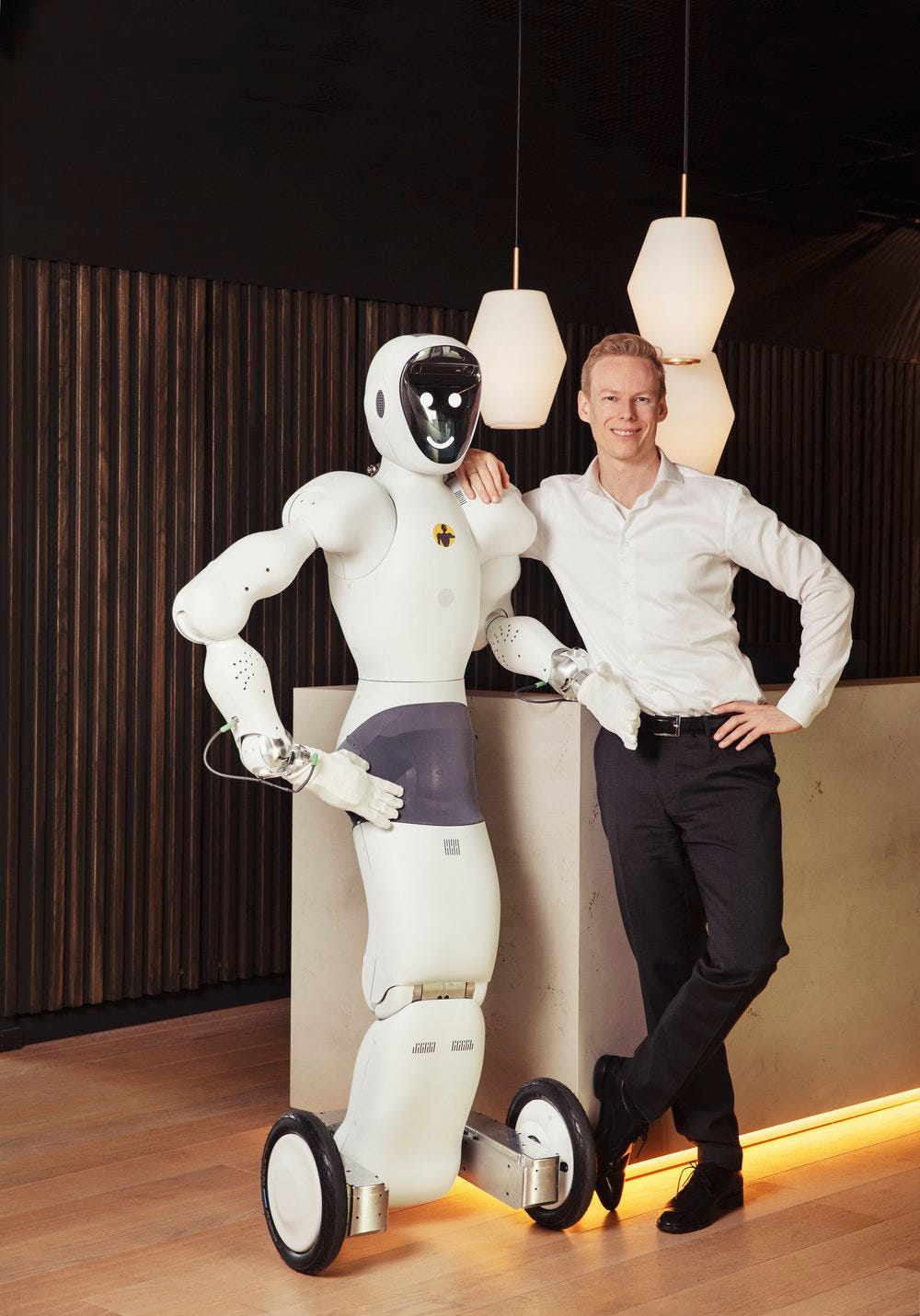
We build humanoid robots, but humans don’t have gears. Although that seems obvious, a big epiphany started with the realization that getting rid of the gears used in today’s rigid robots would enable us to make huge leaps in safety, capability, and cost. But as we went deeper and deeper down that rabbit hole, we saw more and more parallels to humans and biological systems for our best robotic designs. I became obsessed with the way nature uses passive dynamics designed into the “machine” to simplify the intelligence and conserve energy needed to do tasks. A dead salmon actually resonates with the water and swims upstream without using energy. A bird stalls in flight and uses individual feathers to stabilize the turbulence of the vortexes created to land with millimeter precision. Those kinds of examples changed our perspective, so our robot throws its arms forward and goes down into a crouch to recover its balance, or muscles through a heavy door with its elbow and shoulder. We started noticing these emergent bio-inspired robotic behaviors just due to the nature of design, and exploring the AI that makes it possible, and learning more about how “bodies” work. All that stems from removing gears from the equation — it was a magic moment to me.
Can you please give us your favorite “Life Lesson Quote”? Can you share how that was relevant to you in your life?
Pippi Longstocking (Astrid Lindgren): “I have never tried that before, so I think I should definitely be able to do that.”
I grew up with Pippi and her ‘anything is possible’ attitude. In our work at Halodi, when we realized we needed a motor about 3x the world record for the math to pan out without gears, this perspective came in handy. The first time we tested our Revo1 motor design, it worked. We were all looking at it and thinking, “What’s wrong? Nothing works the first time,” but it just worked. The next two prototypes had major issues, but we knew the design was good given the success of the first. Let’s call it a lucky start, but such luck stems from a can-do spirit.
Ok wonderful. Let’s now shift to the main focus of our interview. Can you tell our readers about the most interesting projects you are working on now?
We have two projects going on right now that I’m incredibly hyped about: (1) the commercial rollout of hundreds of EVEs, enabling us to test our data flywheel strategy for training our AI models at scale; and (2) our next-generation platform, which is still deep in R&D but showing some groundbreaking results for walking, running, and general operation in human environments. Look out for some exciting Halodi announcements towards the end of the year!
How do you think this might change the world?
Despite the immense wave of automation in our society over the last 15 years, most technology innovation is limited to a strictly digital space because there are no platforms capable of carrying out tasks in the physical space. We bridge the gap between intelligent software and the real world. You can make software as intelligent as you want, but in the end, you can’t automate things that are in the real world with software without a physical link. Having a platform that is affordable, capable, and safe — that is going to drive the next wave of automation. In a new era of bio-inspired robotics, our society could start looking a lot different — and it could happen faster than you’d expect. Today, our society is based on human labor being the ultimate capital; but physical scarcity and scaling limitations impact us more and more every day, in everything from low-skill but physically demanding task performance to caring for our aging population. Enabling us all to live more independent and fulfilling lives, that’s our vision.
Keeping “Black Mirror” in mind, can you see any potential drawbacks about this technology that people should think more deeply about?
Making a stand against the weaponization of robots and AI is one of humanity’s essential decisions for our age. I see this as just as important as previous generations’ taking a stand on de-weaponizing space and de-escalating nuclear weapons.
What are the 5 things that most excite you about the robotics industry? Why?
Right now, it’s incredibly fun and exciting to be in this early robotics genesis outside of factories — and to take part in shaping this field — doing key innovations with a relatively small team. We are arriving at the point where disruptive start-ups like Halodi Robotics are transitioning into scale-ups, but it is still really early — which means it is still a very creative and thrilling field for us to work in.
What are the 5 things that concern you about the robotics industry? Why?
They all revolve around the same single focus: making sure robots are used for good and in a responsible manner. As we all get used to having robots with close-to-human capabilities around us in everyday life, security, safety, and privacy become paramount. This comes down to designing robots that are intrinsically safe. Through gearless bio-inspired designs, we are able to be as capable as a human and still physically safe. You are generally not afraid of accidentally hitting your friend, and neither should you be of robots that share our space. From a data point of view, we have a big responsibility to use data for training with as small an impact on privacy as possible.
As you know, there is an ongoing debate between prominent scientists (personified as a debate between Elon Musk and Mark Zuckerberg) about whether advanced AI has the potential to pose a danger to humanity in the future. What is your position about this?
Although advances in AI have proven almost always to take longer than expected, their impacts are always far more prominent than we expect. I have no doubt that we, in the next 20 years, will solve robotics to the level where robots can do most tasks a human can do, as well or better. When this is coupled with 20 more years of advancements in language models and behavioral AI, it is very hard to predict the effects on society. Of a hundred use-cases I can come up with, ten will probably materialize and be way more important than anyone can predict. Although I believe that these machines will not be sentient in the manner science fiction teaches us to fear, they will be incredibly powerful tools that humanity needs to apply in a responsible manner — and I think the debate about responsible behavior needs to happen now to ensure we are ready.
My expertise is in product security, so I’m particularly interested in this question. In today’s environment, hackers break into the software running the robotics, for ransomware, to damage brands or for other malicious purposes. Based on your experience, what should manufacturing companies do to uncover vulnerabilities in the development process to safeguard their robotics?
Product security is challenging, but it’s not a new problem. Traditionally, we have seen a lack of concern for security in the beginning, as new products race to hit the market. But as long as it is taken care of from the start, and baked- or designed-in as an integral part of the system, we have good security certifications and best practices to follow. In physical robotics, for example, this means making sure that we have a good separation of concern with separate compute units for network-facing functionality and safety-critical base functionality. We also make sure we follow standards that not only look at the robot itself, but also personnel and connected equipment and all interaction points as the entire solution is what needs to be secure and safe.
Given the cost and resources that it takes to develop robotics, how do you safeguard your intellectual property during development and also once the robot is deployed in industry?
We follow the standard approach of patents, trademarks, copyrights, and trade secrets. But for us, the cost and resources required are also part of the defense. There is a lot of novel tooling and know-how in manufacturing, and we have more patents going in production processes than the product itself. In addition, large cap-ex investments in production make what we do a lot more expensive to copy than an app or pure software solution. On top of this comes our AI data flywheel strategies that make for a very powerful first-mover advantage.
Fantastic. Here is the main question of our interview. What are your “5 Things You Need To Create A Highly Successful Career In The Robotics Industry?
Bio-inspired robotics is a sum of all the major engineering disciplines and, as a field, is still very much in its infancy. An understanding of all the disciplines — both on a practical and theoretical level — is what differentiates superstars in the field.
- Build something: Bio-inspired robots are arguably the most complicated machines created by humans. The real world is messy, and we need practical solutions to complex theoretical problems. They say a picture is worth 1,000 words; I say a working solution is worth 1,000 simulations. Find a local maker space and start hacking it together!
- Strong background in math and physics: It’s not the sexiest answer, but it is the foundation of all we do. Make sure you understand the fundamental principles that govern! If you’re about to start your degree, make sure you get the concepts down really well. If you’re a bit further on in your career and want to transition to robotics, with all the resources available online today, there’s no excuse not to level up. Jump into it and make sure you have your Newtonian physics, calculus, and linear algebra down.
- Good software skills: Invaluable as an engineering tool. Even as a mechanical engineer, you will benefit from developing tools to make yourself more efficient and apply data-driven approaches to finding optimal solutions. Find an open-source project and start contributing.
- Engage: Participate in the community, join a robotics club, hang out in robotics-related Discords, start networking.
- Apply specialist knowledge: Examples might include acuity with tools from the gaming industry, such as physics-based animation or rendering pipelines for simulating cameras. Being a black-belted ninja wizard of anything generally might let you in through a backdoor :).
As you know, there are not that many women in this industry. Can you advise what is needed to engage more women in the robotics industry?
Increasing diversity and supporting equality require active awareness and outreach — you have to both create and demand a culture that is inviting and inclusive. We lose out on important contributions and expertise when a field doesn’t reflect the full range of human perspective and talent. There’s nothing inherently male or female about engineering or science or math or creativity or a love of technological innovation. So deficiencies in industry representation must stem from deficiencies in the culture we’ve developed. It’s up to us to fix it.
If you could inspire a movement that would bring the most amount of good to the most amount of people, what would that be? You never know what your idea can trigger. :-)
Robotics for good! I think there is a lot of looking the other way today as we see more and more weaponization of robotics and AI, even conceptually. Every robot should help, not harm. Let’s all take a clear stance on this!
How can our readers further follow your work online?
We try to keep our website fairly up to date. And now that some pandemic travel restrictions are easing internationally, we plan to reinvigorate our participation in industry events and conferences. And of course, we always contact important industry outlets like Authority when we have interesting news to share, so you can help spread the word :>
Thank you so much for the time you spent doing this interview!