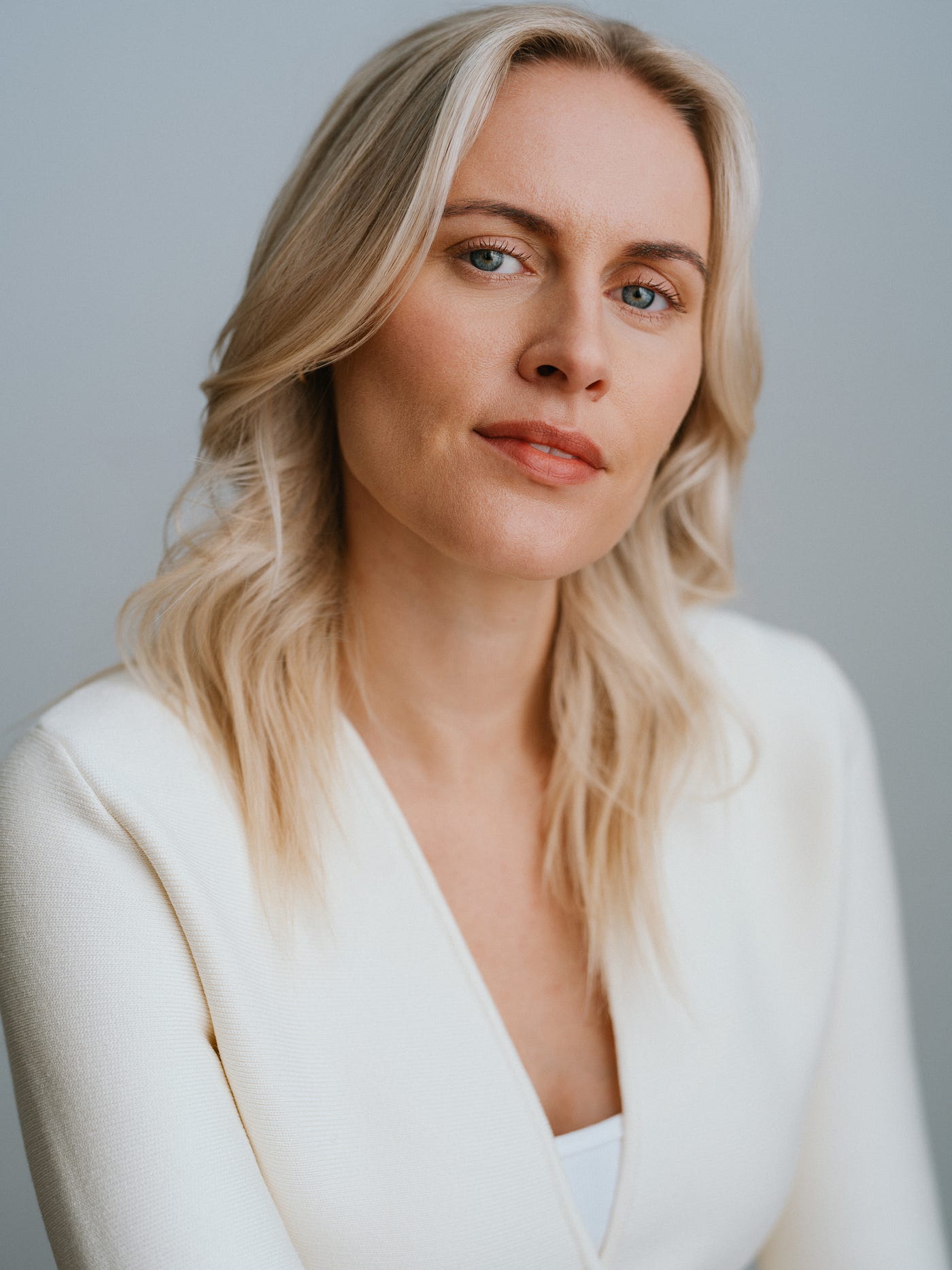
At a certain point, I need perspective. I need to be a person, too.
I had the pleasure of talking with Anne Windsland, who once walked out of an audition wondering whether she should quit acting. The part was a “nice, bubbly Norwegian airline stewardess” on HBO’s High Maintenance. Windsland was Norwegian and had every reason to think she could manage bubbly. But the reading went badly enough that she left asking herself, “If I can’t even book the Norwegian girl, what am I doing here?” Days later, she learned she hadn’t gotten the stewardess role. Instead, the director wanted her for another character, originally written as a man, now reimagined as “a bitter Betty with a Tinder addiction.”
The reversal is funny, but it captures something fundamental about the profession Windsland has chosen. An audition that feels disastrous can produce an opportunity, while one that feels perfect can disappear into silence. After years of unpredictable work, Windsland now has a recurring role as FBI Agent Hawthorne in Apple TV’s crime thriller Nocturne, alongside Liev Schreiber, Zazie Beetz, and Stephen Graham. It represents a major step in her career, but her story raises a question that a new television credit cannot resolve: How do you build an identity around a profession that so rarely lets you control the outcome?
Windsland grew up in a small town in southern Norway, trying everything from soccer and marching band to choir and theater. Her older brother was the artistic one, while her parents hoped their academically inclined daughter might pursue medicine or law. She considered becoming a veterinarian. Then, around age 15, she attended a production of One Flew Over the Cuckoo’s Nest at a performing arts high school. The all-female production incorporated Gnarls Barkley’s “Crazy,” and something about the experience settled the question for her. “Oh my gosh, this is what I have to do. This is where I belong,” she remembers thinking.
At 19, she moved to New York to study acting at the American Musical and Dramatic Academy. After graduation, she moved into an apartment in Harlem with friends and discovered how different professional life was from the structured intensity of conservatory training. She attended nonunion open calls at six in the morning, often knowing she might never get through the door. She worked on student films and performed in obscure Off-Off-Broadway theaters. During a particularly slow period, she wrote a short screenplay, gathered the courage to show it to a friend, and raised money through Indiegogo to produce it herself. The film reached festivals, and the relationships she developed through such projects continued long after the productions ended.
Her recurring role in Nocturne, filmed over several months in Pittsburgh, offered a striking contrast to those early days. Working with established performers and directors, Windsland entered a large ensemble in which her responsibility was to make Agent Hawthorne convincing without disrupting the larger story. Having frequently played victims or people questioned by investigators in crime dramas, she was now portraying an FBI agent. Yet what impressed her about the production was how much it resembled the smallest independent films she had made. Everyone depended on everyone else. An actor, however visible on screen, remained one part of an enormous collaborative effort.
Even a substantial television role does not eliminate the peculiar vulnerabilities of acting. Windsland describes contemporary self-tape auditions as performances sent into a void, often without acknowledgment or feedback. Her response has been to treat the audition itself as the job, giving it her full attention and then moving on. She also understands that a performance can be substantially altered or eliminated in editing. The distance between doing good work and receiving public recognition is sometimes beyond an actor’s control.
Perhaps that explains why Windsland is increasingly interested in the parts of herself that have nothing to do with being cast. “At a certain point, I need perspective. I need to be a person, too,” she says. She knits, sews, cooks traditional Norwegian meals, and rides horses whenever she can. Her mother and grandmother taught her to knit, a skill she rediscovered during the pandemic. She cheerfully describes herself as a grandmother at heart. During a difficult period, she also returned to Julia Cameron’s The Artist’s Way, using Morning Pages and other exercises to restore a sense of direction.
There is another revealing detail in Windsland’s story: the portrait of her great-uncle hanging behind her during the interview. He had immigrated to New York from Norway, lived there for decades, and eventually returned home. As a child, she remembered his denim jacket, gold jewelry, American candy, and impatient driving. Her parents sometimes found him difficult. Years later, having become a New Yorker herself, she began to understand him differently. The country she left remains central to her identity, through language, family visits, and the customs she preserves at home. Yet Brooklyn has become home as well.
Windsland knows the importance of landing a major role after years of work, but she is reluctant to let a résumé become the complete definition of a person. When strangers discover she is an actress, they tend to ask whether they have seen her in anything or what project comes next. She wishes they would ask something different: “What else are you about? What else do you love to do?”
For Anne Windsland, the answer includes a growing television career, certainly. It also includes Norwegian Christmas traditions, handmade crafts, family memories, and a life in New York that her great-uncle would have understood. Her experience suggests that the ability to keep pursuing an uncertain profession may depend, in part, on having a life that remains meaningful even when the next role has not arrived.
Anne Windsland, it’s so nice to meet you. Before we dive in and talk about your amazing work, our readers would love to learn about Anne Windsland’s personal origin. Can you share with us a story of your childhood and how you grew up, and particularly the seeds of all the amazing creativity that has come since then?
Anne Windsland: Oh wow. Well, I grew up in Norway. I was born and raised in a small southern town in Norway and spent my whole childhood there exploring anything from sports to theater to choir. I played in a marching band and played soccer. I did it all. Still, the one constant thing in my life was theater. My brother and I did community theater since we were very little. I think I was about three or four years old when I started dipping my toes into that.
Although my interests changed over the years, as they do when you grow up, theater was always the one that stuck with me, even though I wasn’t always going to become an actor. My brother was the artistic child in our family, and he was lost to the arts at an early age. I was good at school, so I think my parents hoped that I would be the one who decided to become a lawyer or a doctor. There was a moment where I wanted to become a veterinarian because I was very into horses, and I still am.
Then I remember one time, my brother had decided to go to a performing arts high school, and we went to see a performance there by the graduating class of that year. They were doing an all-female version of One Flew Over the Cuckoo’s Nest. I was probably about 15 around this time. I remember this black box theater that they were using, and the performance opened with a song: Gnarls Barkley’s “Crazy.” “Does that make me crazy?” That was the theme song throughout the whole theater piece.
I remember watching it and just having the epiphany: “Oh my gosh, this is what I have to do. This is where I belong.” It was almost a weird calling. So I put all of my academic plans aside and decided to apply for the performing arts high school. After that, I came to America when I was 19 as a student. I studied acting in New York at AMDA, the American Musical and Dramatic Academy, and I have been here ever since pursuing this crazy profession and this crazy dream. Here we are.
It’s amazing. Please tell us the next chapter. Tell us about your first breaks and some of the first opportunities that you had when you started acting.
Anne Windsland: Who knows what’s next, right? You think you know how life is going to unfold, and then it does the exact opposite.
Acting school is such a great time. You’re so plugged in. You know what you’re doing from morning till night: rehearsals, performances, practicing. Your instrument gets so sharp, and it’s such a bubble. Then when acting school is over, you’re still so young. I think I was 21 when I finished at AMDA, and I got an apartment with some friends up in Harlem, our first apartment in the city. Suddenly, you realize that now you’re on your own. You have to create your own schedule, create your own practice as an artist, and figure out how to navigate this monolith of an industry and wedge your way in.
You’re such a small fish in a very big pond, and you do whatever you can. I went to open calls at 6:00 a.m. as a non-union actor, knowing there was almost no way they were going to see me because the line was out the door. I did student films, and I did theater in the most bizarre Off-Off-Off-Broadway places. You just do whatever you can, hoping that somewhere, somehow, it will lead you down a path.
It takes a lot of skill and practice over time to sustain yourself in this industry and as an artist in general, yet there is also quite a bit of luck, serendipity, and divine timing in a sense. I truly believe the seeds that I planted early will bear fruit at some point. Some of the NYU students I did short films with have now gone on to become great directors in the industry. I still stay in touch with them and have worked with them later on other projects. It’s so cool to see who you came up with, where we all came from, and how everybody is starting to really establish themselves.
You probably have some amazing stories from your career, and I’m sure this is difficult to single out, but can you share with our readers two stories that stand out in your mind from your career?
Anne Windsland: Well, obviously this current one is a big one for me: Nocturne, I booked this last year and got to be on set and work on this amazing project over the course of six months in Pittsburgh. Every actor’s dream is to have a steady job for six months on a project. It’s such a privilege, especially in this day and age, and that was a huge deal for me. It was an affirmation that all the work I put in over all these years, and all the auditions that seemed to fall on deaf ears, were worth it. Finally, something was the right place at the right time.
Getting to go out there and work with that team was a dream come true. There were incredible directors like Tim Van Patten, Allen Coulter, and the list goes on, plus playing alongside Stephen Graham, Liev Schreiber, Poorna Jagannathan. It was such a good time. It really reminds you of how much teamwork it takes to make something of that scale happen. There were probably 50 or 60 people in the crew on and off, and probably even more, just to make the wheels go around. You realize you’re a very small piece in a big puzzle to make the show happen. Everybody has an important role. From doing student films all the way up to this big Apple TV+ production, it’s really quite similar in the way that you need to depend on everybody to do their job and be a team player. That was an amazing experience for me.
A second story is producing my own work. Years ago, when times were really rough and nothing was happening for me, I wrote a little script. I was too scared to put it out there, so I had a friend read it. He was really taken by it and told me, “You have to do this.” I had never produced a short film before and didn’t even know where to start, so I just launched a little Indiegogo campaign, raised some money, and got the film produced. I brought some amazing people along with me, and we got it into some awesome film festivals. I’m still in touch with those people today, and they’re on to doing great, big things for themselves. Those are the moments where it’s all worth it.
Amazing. There’s a saying that sometimes our mistakes can be our greatest teachers. Can you tell a story about a humorous or funny mistake that you made when you were first starting, and the lesson that you took away from it?
Anne Windsland: Well, I guess it wasn’t strictly a mistake, though I remember my first audition for a real TV show. It was for High Maintenance on HBO. I actually self-submitted for this one on Actors Access because they were specifically looking for Norwegian or Scandinavian actors to play a Norwegian airline stewardess. I thought, “Okay, amazing. I’m Norwegian! How many Norwegians can there be in New York who are also actors?” The character description was “a nice, bubbly Norwegian airline stewardess,” so I thought, “I’ve got this.”
I went into the audition as the first person of the day, and I think the casting director was a little flustered and unsure about who I was reading for. It was already a bit of a confusion, and I was super nervous. We started the audition, and it did not go great. I could tell that the casting director wasn’t loving whatever I was doing. I got in my head as he gave me notes. I was doing my best to be bubbly, smiley, and my Norwegian self, yet I could tell I wasn’t giving him what he wanted. I left thinking, “Oh my gosh, I need to quit acting. If I can’t even book the Norwegian girl, what am I doing here?” I was devastated.
A couple of days later, I got an email from my manager, whom I had just signed with. She wrote, “Hey, I got an email from High Maintenance saying that they cast the role and went with someone else. However, the director really liked your read, so they want to change one of the male characters into a female character and offer it to you.” I said, “What?!” And the description of the new character was “a bitter Betty with a Tinder addiction.”
So what I learned is that my nice and bubbly Norwegian reads as bitter! More importantly, I learned that what feels like a failure in the moment can sometimes lead you somewhere unexpected. Even though I thought my career was over and that I was terrible, it just meant that I was meant for something else. I thought it was hilarious that the part I read for was supposed to be bubbly, and I ended up with a bitter part instead. I thought, “Okay, I guess I found my niche.”
I noticed that a lot of your parts are in law enforcement, the FBI, or Law & Order worlds. Have you been attracted in that direction, toward Law & Order-type shows?
Anne Windsland: What’s interesting is that yes, those worlds are all very similar: a little darker, more intense drama with layered storytelling. Up until now, I’ve been in those worlds, though usually as a victim of a crime or someone being questioned about a crime rather than law enforcement itself. Still, I’m definitely orbiting in that space.
I really love prestige drama. Plus, I’m Scandinavian, and Scandinavians know dark crime; there are so many great Scandinavian crime novelists, and Nocturne itself is based on a crime novel. I feel I know how to navigate that world, and it shows up when I do my auditions and work in those circumstances. I feel I have a strong imagination and empathy for those situations, so it has just worked out that way. I’m glad about it because it’s very interesting to work in spaces that feel so raw and truthful. This time around, I finally got to play the law enforcement side of it. I had never played an FBI agent before, so exploring the other side of that world was fascinating.
There’s a related idea, which you may have touched on, that a “no” can serve as redirection rather than rejection. Do you have a story where you got a “no” to an opportunity, and it led to something even better?
Anne Windsland: Beyond that High Maintenance audition where they said “no” for one role and offered me another, I think rejection is simply a natural part of this industry. Right now, we don’t even get “nos” anymore; we just get silence. In a sense, a “no” was almost better because at least you knew it didn’t work out. Today, we send our self-tape auditions out into nothingness and don’t hear back. I have no idea if I was even close, or if they saw my tape, loved it, and it came down to me and two other people. Without getting any feedback, we’ve lost a little bit of that clear sense of direction.
I understand that casting directors don’t have time to give all of us a verbal “no,” a thank-you, or feedback. It’s a fast world. You just have to keep going. I try to give as much as I can to each audition and then forget about it the moment I send it in. I don’t want to think about it again unless something comes back around. I treat doing the audition right here and now as the job itself; when that’s over, it’s over, and I don’t expect anything else from it. Hoping and checking your emails constantly only leads to heartbreak, and that isn’t good for anybody.
Still, I truly believe that what’s meant for you will find you. There are plenty of roles I got “nos” for that I really wanted and thought would be perfect for me. Then, down the line, something else came along that was so much better and more fitting for me, and looking back, I can see why.
What has been the most challenging project or role you’ve taken on so far, and why?
Anne Windsland: They’re all challenging in different ways, though I think this current project, Nocturne, has been the biggest challenge. I’m coming into this world as a recurring character over an extended period of time. Because I’m part of a larger ensemble rather than a lead character, the challenge was figuring out how to blend seamlessly into that universe and match the tone set by the creators and directors. You have to understand what function your character serves in the overall story and find ways to bring your own specificity to the role while remaining true to the world the filmmakers have created.
Playing Hawthorne, I really enjoyed finding those small moments where I got to give a little glimpse of her personality beneath her professional exterior. Another part of the challenge was being ready to jump right into logistically and emotionally demanding scenes alongside extraordinary, veteran actors who have been doing brilliant work for a long time. You just have to step in, be prepared, and do the job you came to do. There were so many different layers to this role, and I feel I’ve grown tremendously working on it.
What is a part of your story that people rarely ask about, that you wish they would ask?
Anne Windsland: Oh my gosh, you ask very good questions! They’re making me think about things I haven’t necessarily stopped to articulate before.
As an actor, there are so many stretches where you aren’t working constantly on a project and have a lot of downtime. How do you define yourself as an actor during those times? When you meet people outside the industry, they usually ask, “Oh, you’re an actor? Have I seen you in anything?” Honestly, if you have to ask me that question on the spot, then obviously not! You tell me! Or people ask, “How can you live off of being an actor?” There’s this notion that to be allowed to call yourself an artist or an actor, you have to act all the time and have no other means of income. The reality is that we live in a very expensive world.
So the real question is: how do you keep yourself sane in between jobs, and how do you nurture your identity as a person and an artist? I’m still working on finding that balance, yet I’ve come to really cherish the things I love that have nothing to do with acting. Within the acting community, the career can become all-consuming. Sometimes that’s all anybody talks about: audition setups, or which agents, managers, and casting directors they’re reaching out to. At a certain point, I need perspective. I need to be a person, too.
I make sure to stay interested in hobbies outside the industry. I love to knit; my grandma and my mom taught me how, and I rediscovered my love for knitting during COVID. I also love cooking and keeping Norwegian cooking traditions alive in my own home, sewing, horseback riding, and learning new skills. Doing creative, nurturing things unrelated to acting gives you multiple legs to stand on. That way, when one part of your life isn’t blooming in the moment, it doesn’t destroy your sense of self.
In America especially, there’s so much focus on money and work. Instead of asking, “Have I seen you in anything?” or “What’s your next TV gig?”, I wish people would simply ask, “What else are you about? What else do you love to do?”
So, what else are you about? (Laughs)
Anne Windsland: Well, as I said, I am a little bit of a grandma! I love to cook old-fashioned Norwegian meals. I enjoy going to see theater and live music, and I love hiking and horseback riding, though I wish it were easier to go horseback riding around New York City without traveling so far. Most of all, I love working with my hands and making crafts. I’m even thinking about hosting a little Christmas craft party with my friends because I love doing things like that. That’s really who I am: a little bit of a grandma at heart.
That’s a beautiful thing. If it makes you feel any better, I think when people ask, “Have I seen you in anything?”, what they really mean is that you have a classic movie-star face. They feel they’ve seen you somewhere, and they’re trying to place which show in particular. Plus, people watch so many shows today that even with super-famous actors, it’s impossible to keep track.
Anne Windsland: I’ll give them the benefit of the doubt just because of you! Still, actors are such sensitive people. Oh my gosh, we’re the worst. Rory Culkin and I were actually talking about this on set: at the end of the day, all actors really need is for someone to tell us, “Good job. You did great.”
We’re sensitive because we put ourselves out there constantly, and we are the product. Even though there are so many talented people behind the scenes making a show what it is, actors are on the front lines. Ours are the faces viewers remember, whether they think, “She was in that show and it was amazing,” or “She was in that show and it was terrible.” Putting yourself out there is deeply vulnerable. Actors are very simple creatures: just tell us we did a good job, and we’ll happily do whatever you ask!
As you’re speaking, you made me realize just how vulnerable acting really is. Because so many people are involved, you could give an Oscar-winning performance in an Oscar-winning script, yet if someone else gives a weak performance, or the marketing misses, or it opens against a huge blockbuster, people might dismiss the project for reasons that have nothing to do with you.
Anne Windsland: Exactly. On top of that, when you put your performance out there, you don’t even know how it’s going to end up in the editing room. They might cut 90% of your scenes, or cut you out entirely, after you’ve told all your friends and family, “Hey, I’m in this!” Then they watch it and ask, “Where were you?”
That’s just the name of the game. It forces you to realize that you’re part of something bigger than yourself. Every role is a building block and a learning experience, and new projects will come. Still, you never know whether audiences are going to love or hate something until it’s out there, and watching a project take on a life of its own is exciting too.
I want to respect your time, though I could talk to you for so much longer. This is our signature question. Looking back to when you first started, can you share five things you’ve learned over the years that someone starting out today could really benefit from?
Anne Windsland: That’s such a good question, especially since I have this conversation a lot with my partner, who is also an actor. First and foremost, I don’t regret anything, because I did the best I could with what I knew back then. Looking back, though, here are five things I’d share:
1. Get right into an ongoing acting class after graduation. When you finish conservatory or acting school, it’s easy to think, “Now I’m done with training.” If you’re stepping out on your own in a city like New York, the very first thing I recommend is finding a great acting class so you keep training and stay sharp. It took me a few years to realize I needed to get back into class, and I’ve been studying with different coaches on and off ever since.
2. Remember that not every part is meant for you. If a role doesn’t quite fit you, you don’t connect with the script, or an audition feels awkward and difficult, that’s completely okay. That’s the whole reason casting exists: different people are right for different roles.
3. Discover what makes you unique. Pay attention to what lights you up and what kind of material you naturally gravitate toward. Look for the common denominator, because that tells you where your strengths lie. Leaning into your natural lane also helps casting directors, agents, managers, and the industry at large know where to place you.
4. Treat your career as a business and invest in your marketing. Invest in strong headshots and polished materials if you can. If you want to make a living as a working actor, you have to market yourself well so that people can actually see what you offer.
5. Make sure you truly love the craft itself. There are much faster and easier ways to get rich or famous. If you want to be a performer, you have to genuinely love acting. Honestly, it can be a love-hate relationship; I’ve had periods where I hated auditioning and hated the grind because you want it so badly and hit so much friction. Being an artist is a marathon with good seasons and tough seasons. If you know deep down that you love doing the work, you’ll stick with it.
Amazing. Can you share some of the self-care routines that you practice to help your body, mind, and heart thrive?
Anne Windsland: Last year, I was in a really tough spot mentally and felt as if I were floating around without direction. I found my old copy of The Artist’s Way, which I hadn’t read in years, and decided to commit religiously to everything Julia Cameron recommends: the Morning Pages, the weekly Artist Date, and all the exercises that come with it.
Doing that gave me profound peace and gratitude for having chosen this path. It taught me how to stay present during moments when I feel out of touch or start being too hard on myself. I go in and out of sticking to it perfectly, yet having grounding rituals makes all the difference. Morning Pages, Artist Dates, eating healthy, and getting enough sleep matter so much. When you’re in your twenties, you might want to stay out and party, and that gets old fast. As an actor, your mind and your mindset are the most important instruments you have to protect, and The Artist’s Way is a wonderful place to start.
Can you tell us a bit about the portrait behind you?
Anne Windsland: This is actually my great-uncle from Norway! He immigrated to America when he was pretty young, lived in New York for many years, and eventually moved back to Norway to retire when he was older.
Growing up, whenever he visited us in Norway, he would bring American treats like Coca-Cola in cans and American candy. We were completely in awe of him. He wore a cool denim jacket, gold rings, and chains, smoked Lucky Strikes, and lived in New York. My parents loved him, though they sometimes found him a bit brash and impatient, which was quite a contrast to the typically reserved and nonconfrontational Norwegian way. For example, my parents would sometimes come up with excuses not to let us ride in the car with him because of his rather erratic New York driving style!
He was thrilled when I decided to move to New York. He passed away a couple of years after I moved here, and before he did, he couldn’t wait for me to visit home and tell him all about my life in the city because he loved it so dearly. What’s funny is that now I understand him. Imagine living in New York for decades and then trying to readjust to the pace of small town life in Norway! Whenever I visit my family in Norway now, I have to consciously tell myself to slow down. Ordering a coffee in Norway isn’t going to take 30 seconds; it’s probably going to take five minutes, and I can’t get snappy or annoyed about it. Nor can I honk the horn in and drive the way people do in New York! So it hit me: “Oh, I get it now. He wasn’t so difficult; he was just a New Yorker.” He feels like my little guardian angel, and I’m proud to carry on the little family legacy of living in Brooklyn.
That’s beautiful. Do you miss home? Do you miss Norway?
Anne Windsland: In some ways, yes. I always go home for Christmas because Christmas in Norway is dark, snowy, and magical. I also visit in the summer, when the sun never sets and the weather is gorgeous. Having my family closer would be wonderful, though a six-or-seven-hour flight really isn’t bad; it’s almost like flying to LA.
At my core, I will always be Norwegian first. Norwegian is my first language, I grew up there, and I make a point of keeping my language and traditions close to my heart. At the same time, New York has become my new home.
This is our final aspirational question. Anne Windsland, because of your amazing work and the platform that you’ve built, you are a person of great influence. If you could spread an idea or inspire a movement that would bring the most amount of good to the most amount of people, what would that be? You never know what your idea can spark.
Anne Windsland: Oh wow, casually change the world, right? Honestly, I believe traveling is deeply important. I was fortunate to travel at an early age because my parents valued showing us the world. Beyond being fun and exciting, seeing people where they live and where they come from builds genuine empathy. You realize that people everywhere have hopes and dreams, laugh and cry, love their families, and work hard to build a better life.
Traveling opens people’s hearts to cultures they aren’t familiar with or might even feel afraid of. And you don’t have to go far! You can visit the next state over, drive to the next town, or even go have dinner at the house of the neighbors you think are a little odd. Once you see how they live, you realize they’re human beings just like you, usually coming from a place of love.
Amazing, Anne. It has been a joy to meet you. I wish you continued success and blessings!
Anne Windsland: Thank you so much! And thank you for asking questions that made me reflect on life in a bigger way. This has been wonderful.