I had no idea that we were struggling financially. It brought me a lot of shame, and I carried that burden just like my mom did.
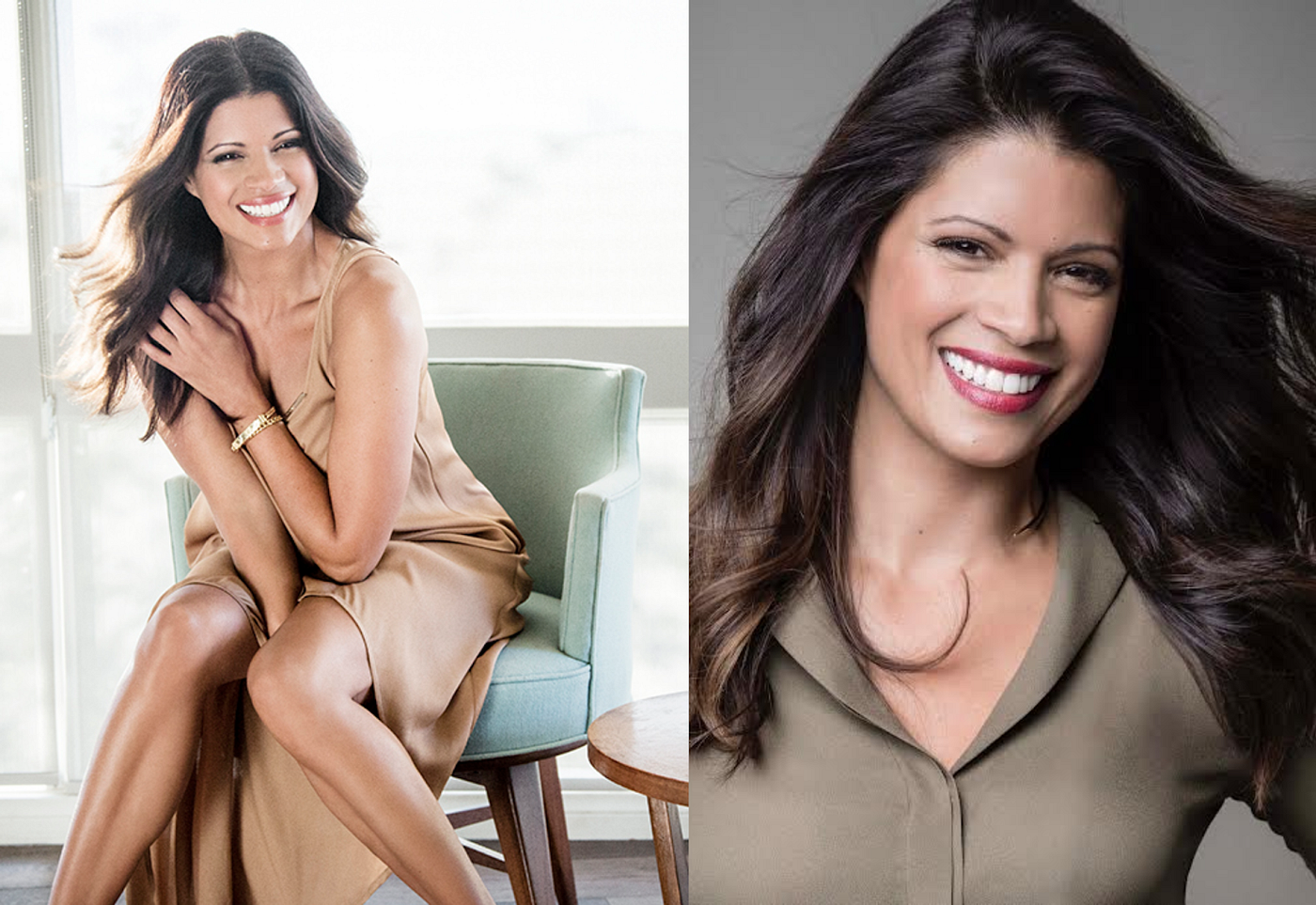
I had the distinct pleasure of talking to Andrea Navedo. Andrea is an acclaimed actress and author, born and raised in the Bronx, New York, to Puerto Rican parents. She has been celebrated for her honest portrayals of Latinas in the media, with her most recognized role as Xiomara, a multifaceted Latina character on The CW series, “Jane the Virgin”. This performance has earned her critical acclaim and the 2015 Imagen Award for Best Supporting Actress — Television.
In addition to her successful acting career, which includes roles in soap operas such as “One Life to Live” and “Guiding Light”, as well as primetime television series like “Law & Order”, Navedo has turned her attention to writing. Her book, “Our Otherness is Our Strength” (releases July 18), chronicles her experiences of growing up in the South Bronx and the challenges she faced in her personal life and career. Navedo shares insights and lessons from surviving abusive relationships, facing repeated rejection, and ultimately achieving success in the entertainment industry.
In her work, Navedo advocates for compassionate self-dialogue, and cautions against seeking validation through fame. She emphasizes the importance of not playing the victim, instead using personal trials and tribulations as catalysts for growth and self-actualization. Her book aims to inspire those who grew up in similar circumstances and were determined to succeed despite adversity.
Beyond her acting and writing, Navedo dedicates her time to various charities, including A Place Called Home in South Central Los Angeles and the Fresh Air Fund in New York City. These commitments underscore her passion for self-improvement, growth, healing, and assisting those who see themselves on the outside looking in.
Navedo currently splits her time between homes in Toronto and Connecticut with her family. Overall, Andrea Navedo’s career, both on-screen and off, reflects her commitment to authenticity, self-empowerment, and providing a positive representation of her community and culture.
Yitzi: Thank you for participating in this interview, Andrea. Our readers would love to learn more about you. Can you share your “Origin Story” and tell us about your upbringing?
Andrea: Well, I was born and raised in the Bronx to Puerto Rican parents. I lived in various areas within the Bronx, but it was a challenging time while growing up. The economy was in a really tough spot. When I was five years old my mom became a single parent after my parents split. Then after a series of unfortunate events we ended up on welfare.
Seeing my mom go through that experience was really difficult for me, and it made me realize the reality of our situation. I had no idea that we were struggling financially. It brought me a lot of shame, and I carried that burden just like my mom did. I realized that I was what I call “the other,” someone who didn’t quite fit into mainstream society. I didn’t see myself represented on television or in movies. It made me acutely aware that we were several steps behind in terms of economic power, education, and various other aspects.
Eventually, we moved to the Fort Apache area of the South Bronx, which gained notoriety through the movie “Fort Apache” starring Paul Newman. There was also the famous novel “Bonfire of the Vanities,” which was adapted into a film. These portrayals depicted the Bronx as a very troubled place. However, what they failed to consider were the actual human beings living there, including me, my mom, and my sister. We were just ordinary people trying to make ends meet and do our best. So, that’s where I grew up.
I attended DeWitt Clinton High School, which was a renowned school. I’m not sure if you’re familiar with it, but many famous individuals, like Colin Powell, Stan Lee, Judd Hirsch, and Ralph Lauren, have graduated from there. I was among the first group of girls to attend Clinton.
Yitzi: So, let’s hear the next part of this story. What led you to your fabulous career in entertainment? How did you get involved in acting?
Andrea: Sure. When I was growing up, watching television, I wanted to be an actress. Brooke Shields was the “it” girl at that time. Designer jeans were becoming popular, and Brooke Shields became very famous for promoting the famous Calvin Klein jeans line. “No one comes between me and my Calvin’s.” I wanted to be like her, to be an actress, to be beautiful, and do all the things she was doing. It was so magical to watch television and film, and I wanted to be a part of it. But it didn’t seem like a reality or a realistic option for me. I didn’t know anyone else who did it, and I had no idea how to break into it. So, I kept that dream to myself. It wasn’t until I finally made it to college after taking five years to graduate high school. I got mixed up with a boy who was going nowhere, and it took me a good two years to snap out of it and figure out what the hell I was doing. I finally got into college.
In college, I made a promise to myself. I said, “You know, I don’t know what my major is going to be, but I’m going to stay open-minded.” It had taken a lot for me to get there, so I was willing to try different things. One day, during my freshman year, as I was walking down the hallway, I saw an audition sign for a play. Instantly, it was like love at first sight. My eyes landed on that sign from across the room, and I thought, “Oh my yes! I want to audition. I want to be in a play.” But then I immediately talked myself out of it. However, a week later, I talked myself back into it. I auditioned, and to my surprise, I actually got a role.
The next thing I knew, I finished the play, and the theater teachers asked me if I had a major in mind and would I consider majoring in Theatre.” And just like that, during my second semester as a freshman, I declared theater as my major. Four years later, I graduated with a BA in the Arts. That’s how my career started.
After that, it took me a while to gain some traction in my career. I pounded the pavement for a few years to get an agent and my first acting gig. It was a gradual process, little by little, building up over the years.
Yitzi: You must have had fascinating experiences throughout your long, illustrious career. I’m sure readers would love to hear some interesting anecdotes or stories from your life as an actress.
Andrea: Well, let’s see. I actually touch upon this in the book. One of the most significant moments for me was when I landed a role on the soap opera, One Life to Live. It felt like a breakthrough.
Growing up in the city, everyone watched the soaps. It was like hitting the big time. I was thrilled about the audition and even got a callback. I was on cloud nine. Eventually, they offered me the role.
The scenes I read initially were about a girl next door, someone nice who goes to school and does normal things. But then things took a surprising turn. During the wardrobe fitting, they started asking me to try on different outfits like combat boots, mini skirts, and even gold bamboo hoop earrings.
I was confused and thought, “Wait a minute, this doesn’t seem like the girl next door in the script.” So I asked the wardrobe women, and she explained that those scenes were for a different character. The scenes for my character hadn’t been written yet, so they just needed something for me to read.
As it turned out, I was playing the girlfriend of a gang leader. I was taken aback. It was such a departure from what I had expected. I discuss this struggle in detail in my book. But in the end, I took on the role.
Working on One Life to Live was like attending a TV boot camp. I learned so much during those two and a half years. It helped me pay the rent and provided health insurance. Overall, it was a positive experience.
Oh, and here’s another story. I used to dance on Club MTV. I’m not sure if you remember that show, I might be showing my age here. It was hosted by Downtown Julie Brown.
I recall one particular episode when Mark Wahlberg, formally Marky Mark and the Funky Bunch, performed on the show. I ended up hanging out with him and Donnie Walberg, even visited Boston, where I had the chance to meet Mark’s mom. There was a possibility of becoming a background dancer for them, but it didn’t work out. Still, it was a cool experience.
Yitzi: Is there someone who has had a profound impact on your life? If so, could you share a story about that person?
Andrea: I’d say, my father. He had a tremendously positive influence on my life, even though my parents separated when I was five. He always made a point to be a part of my life. It was important to him. He was going to school full-time and working full-time, but he still made time to spend with me. He could only afford to rent a room in a house, but he made the most of it.
One thing he used to do during our time together was introduce me to the arts. We would visit museums like the Guggenheim or the Metropolitan Museum. He was also an art student on the side. Itt was something he was passionate about. He would give me a sketch pad and say, “Here, sketch that statue.” Even though I had no idea what I was doing, it was pretty cool. He exposed me to the world of art.
He also took me to see plays. I remember watching Raul Julia in an off-Broadway production of Dracula, which was really amazing. At the time, I didn’t even know who Raul Julia was.
Years later, after I had just finished shooting my first film, Double Take, a Touchstone Picture, I attended the premiere. And there, I had the chance to meet Raul Julia’s son, Raul Julia Jr. Sadly, Raul Julia had already passed away. But I had to share this story with his son.
I told Raul Julia Jr. that when I was eight years old, my dad took me to see an off broadway play called Dracula starring his father Raul Julia. There was a scene where Dracula sweeps up the heroine in his arms, and one of his hands reaches around and touches her “boob.” I was used to going to the theater, so I blurted out, “Oh, daddy, he’s touching her boob!” Some people in the audience turned around and smiled.
So, I had the opportunity to share this story with Raul Julia Jr. about his late father, who I had always hoped to meet and tell this story to when I became an actress. Maybe I even thought I could play his daughter in a film or something. Although that didn’t happen, being able to share it with his son was the next best thing.
Yitzi: Let’s pretend that you are the Queen or King of Hollywood. What changes are you happy about seeing in the industry over the past few years? What changes would you like to see in the industry going forward?
Andrea: Oh my goodness. Well, I’m happy to see the diversity that we see in television and media. I believe that people have been pointing out the inequities in representation for many years, and I’ve been part of that. It’s pretty cool because when I first started in the business, I knew I didn’t fit the popular mold at the time. But now I’m fitting in more and more, and I’m getting more opportunities that wouldn’t have come 20 years ago. I’m super happy about that.
Yitzi: That’s great to hear. And what changes would you like to implement?
Andrea: Well, I would definitely push for more diversity. Many people are already doing this, but I think a proactive search for developing more diverse voices and talent is crucial. We need to help people and bring them up into the business. Often, it’s all about who you know, and not necessarily what you know. The nepotism in entertainment is strong. It’s just so hard to break in.
So I think I would actively go into areas that have fewer opportunities and develop more talent for screenwriting, directing, acting, and so on. There are some small nonprofit pockets that exist, but it would be cool if studios, and I know some already do, had an arm that reaches out and actively supports talent from underrepresented communities. For example, Geena Davis and Madeline Dinnono, of The Institute on Gender in Media, are champions of women and diversity and I’m grateful to be around women like that to shed light on many important things. I am extremely grateful
to them for the support and opportunities they’ve given me.
Yitzi: Okay, you have so much impressive work. Can you share with the readers the exciting projects that you’re working on now? Tell us about your book. What’s coming up next?
Andrea: Jane ended, Covid happened and I went through a divorce, which was the hardest thing I’ve ever done in my life. We were together for 23 years, and it was just heart-wrenching. So, I’ve been through a lot of things over the last few years. During that time, I was forced to reflect and think, “What am I doing with myself? What am I doing with my life?” I turned 50 in 2019. That was also another wake-up call in a weird way. It was just like, “Oh my gosh, I’m looking at less than half of my life, assuming that I don’t live to be 100.” Most people live into their 70s and 80s, you know? So, I thought, “Well, I have no idea how much time I have left. And there are things that I’ve been wanting to do.” One of them was writing a book which I eventually did do, however, I had to get past all of my insecurities about whether I was smart enough, whether I was tenacious enough, whether I would see it through. So I had to hack the system. And the system was this: I needed a writing coach. Just like when I work out, I don’t always have the will power to get myself to the gym, therefore, I have a personal trainer. Because if I know that I’m putting money down, I’m going to show up. And then secondly, if I know somebody’s waiting for me, I’m going to show up. Not everyone has the money. I certainly didn’t have that money when I was younger, but now I have some money that I can invest in myself and take care of myself. So, I have a personal trainer, and I thought, “Now, you need a personal trainer for writing.” Because I knew that I would be all gung-ho for the first two weeks, motivated. But after the second week, I was going to lose some steam, lose motivation, life would happen, my kids would need something, something would happen. And I’d drop the ball and not pick it back up again.
So, I started reaching out to people to see if I could find a writing coach, and I ended up getting introduced to Adrienne Ingram, who is an editor at Broadleaf Books. I had no idea that they developed writers. So I told her about my book idea over Zoom, and she also saw a speech that I gave for my high school, and she said, “Andrea, I think you have more than one book. May I pitch you to my company?” I agreed, not expecting anything. And after three rounds of pitches, they offered me a two-book publishing deal. So, they paid me an advance. I didn’t pay them. I ended up being a writer. I had a coach, so we met for over a year and a half every week on Zoom, and I would have to work on homework in between the two meetings. The next thing you know, there’s a book, and I couldn’t believe it. It was great.
So, the book is called “Our Otherness is Our Strength: Wisdom from the Boogie Down Bronx.” It was inspired by the speech that I gave at my high school Dewitt Clinton, because here I was, coming 30 years later, being invited to give this commencement speech. I was going to talk to these black and brown kids who were sitting in the very same seats that I had been sitting in. Would they be able to relate to me? Could they see a path for themselves from those seats to the podium? What I wanted to do was share stories that I thought they might be able to relate to, challenging things that I had been through that I figured either they’ve seen or they’ve heard of something similar. I wanted to show that, “Hey, I’m not different. I was just like you, and somehow I got to this place, and you can too.”
And so that’s really what the book is about: for anyone who feels like they’re on the outside looking in and they’re looking for some motivation and inspiration. I hope that this book provides that. I do think that people will be surprised to hear some of these stories. Knowing me, I’m most known for playing the role of Xiomara in “Jane the Virgin”. If they look at Xiomara in “Jane the Virgin” and they read some of these stories, they’ll go, “Wow, that’s the same person.” So anyway, that’s what the book is about.
Yitzi: You mentioned Jane the Virgin. It would be remiss if you don’t bring it up. So, as you know, Jane the Virgin has a cult following. In your opinion, what was it that captured people’s hearts and attention?
Andrea: Well, there was so much. One thing, I think it was refreshing in the sense that it was the first show featuring a Latino family, but it wasn’t just a Latino show. That’s what was really great. The show delved into important political and societal topics and handled them in really interesting and funny ways.
I also think it had many viewers from diverse cultures who could relate to the intergenerational situations, the immigration issues, and all those challenges, even the dynamics between the ladies. There was just so much. It goes on and on.
Also, I know that Jane the Virgin was probably like the big sledgehammer swing into the Hollywood wall in terms of breaking down diversity barriers. Because after Jane the Virgin, there were so many more shows that came out like Fresh Off the Boat and many others, featuring cultures other than the typical Anglo-Saxon culture seen on American television.
Yitzi: Amazing. So what lessons do you think our society can take from the themes and motifs of Jane the Virgin?
Andrea: Well, I believe that we can learn a lot about family, culture, and struggles. We’re all the same, and it’s important to recognize and appreciate the humanity in each other, regardless of our backgrounds. I think Jane does a great job of capturing the humanity in its characters.
Yitzi: How would you compare your personal character, Andrea, with the character you play, Xiomara, in the series? How are you similar and different?
Andrea: Well, I’m quite different from Xiomara. I lean more towards being conservative, whereas Xiomara is incredibly outgoing. I’m more of an introvert. I would describe Xiomara as an extrovert who is very comfortable with her sexuality and has no reservations about expressing it to the world. On the other hand, I’m much more private. Additionally, I believe I’m stricter than she is when it comes to raising her daughter, Jane. I think I play the role of the mother figure in the relationship.
In real life, I have no problem drawing boundaries with my children, reinforcing rules, and being tough with them. So, I’m different in that way. But in how I’m similar, I have a lot of insecurities like she does. She can be very vulnerable and very emotional. I can be that way too. And she’s tough, and I think I’m tough too.
Yitzi: That’s a great answer. This is our signature question. You’ve been blessed with a lot of success. Looking back to the very beginning, do you have five things you wish someone told you when you first started?
Andrea:
Well, when I first started, I wish someone had told me to really learn my craft. I did, but I wasn’t as disciplined. So I needed to be more disciplined in my acting and put more effort into my studying because it really does go a long way.
I also wish I had known that I was going to become a theater major and an actor. If I had known, I would have done better in high school so that I could have gotten into an even better acting school. It goes back to the training. I had great training and I did what I could with what I had, and somehow I still put myself on the map.
Looking back, there were things that held me back — fear and insecurity. Now, I wish I had tried to do more theater. I was a theater major in college, but I focused more on TV and film because I saw that was where the money was. But if I’m being honest, there was an insecurity I had where I didn’t feel good enough to be on stage, but that’s bullshit. I don’t believe that anymore. I wish I could have overcome my fears and pushed myself more toward theater.
Another thing would be to learn how to write, direct, or explore other aspects of the industry. The people who are successful today need to have those skills. It’s no longer just surviving on acting. You need to be able to do other things as well.
Yitzi: This is our last question, Andrea. Because of the great work you’ve done and the platform you’ve built, you are a person of enormous influence. If you could inspire a movement that would bring the most good to the most people, what would that be?
Andrea: Well, this is something I actively do, and I don’t know if it will resonate with anyone, but I truly believe in revisiting and exploring your childhood. I do this through therapy, which has been tremendously beneficial in my life. I think mental health is extremely important, especially these days with the ubiquity of social media.
I see myself as a work in progress. I’ve been in therapy on and off for years, and I’m currently in therapy now, and I love it. I don’t think I could navigate through my life without it. My life is significantly better because of it. While I may not be in therapy forever, I experienced some serious things as a child that need addressing. I truly believe it’s important to go back, focus on these issues, sort them out, and get yourself to a place of healing. If you don’t explore those dark recesses of your mind, they will control your life. They’ll lurk in your subconscious, influencing your choices and actions, leading you down paths and leaving you wondering, “How did I get here, and why am I so unhappy?” This is the result of subconscious programming, and I think it’s really important to explore this and strive to reach a place of self-love while increasing awareness of who you are, what you do, and why.
Furthermore, I believe it’s important to talk about these issues openly because I want to help destigmatize them. That’s one of the things I didn’t delve too deeply into in my book, but I discuss my own experiences. There are a few incidents that occurred, and sharing these can help demystify the process for others, enabling them to see themselves in my story. “Oh, that happened to me too. She’s doing okay, maybe I can too.” This realization comes through the work I’ve done on myself, and I firmly believe in taking 100% responsibility for yourself and your life, no matter who did what to you. What’s done is done. Now, it’s about figuring out what to do moving forward.
Yitzi: How can our readers buy your book? Can they continue to follow your work?
Andrea: They can follow me on Instagram and Facebook at AndreaNavedo, and my website is AndreaNavedo.com. They can go ahead and order the book on Amazon, Barnes and Noble, or wherever books are sold.
So go out and buy one, buy one for someone you think could use it, especially people who are graduating high school or college or starting a new career, no matter what age they are. If they’re a fan of Jane the Virgin, they’ll really love it because there’s stuff I talk about in Jane the Virgin that I think they’ll like to read. They can also buy it as a gift for somebody.
Yitzi: Thank you for this amazing interview Andrea